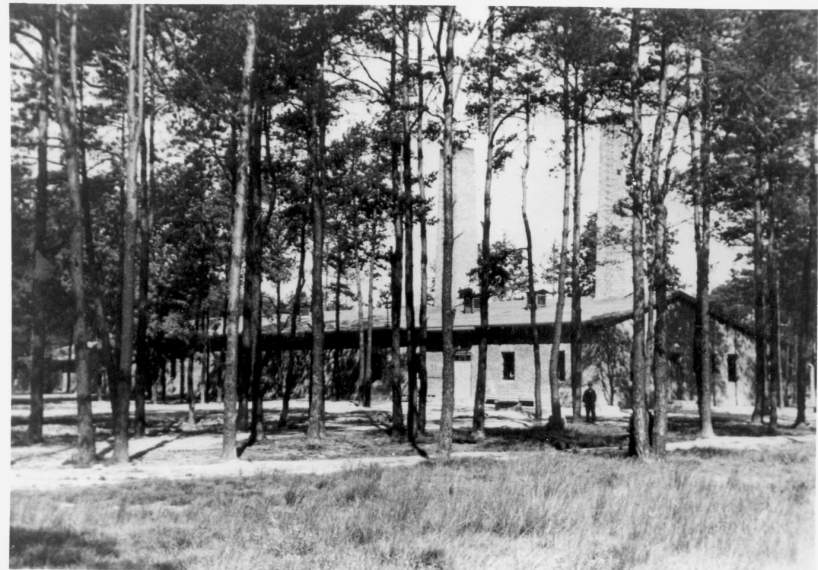
AUSCHWITZ --

Picture Taken of Barracks after liberation 1945 Auschwitz camp.

Wall of execution in Yard of housing blocks (in back ground)
Court Yard between block 10 and 11, Auschwitz I
Prologue:Court Yard between block 10 and 11, Auschwitz I
I have never been or seen the concentration camp at Auschwitz, the only contact I ever had were a hand full of Polish Engineers that had been transferred as prisoners (they apparently had the freedom of movement) to Dachau who maintained the infrastructure of the entire camp facilities there as late as the 1950s holding senior management positions and could never been drawn into any discussions as to their own activities in the past. I assume they were privileged inmates who's skills were needed or they knew very little about it.
I did see however about 500-600 women inmates at the end of the war about March 1945 near the Czechoslovakian border in the vicinity of the township of Asch, after we had an encounter with American troops. We retreated and regrouped having lunch at at a road side when this group of human misery slowly marched by controlled by SS women in tandem. I approached some stragglers including a young girl,(she had no shoe laces in her foot wear and had difficulties walking) pretty, despite her tear streaked face with a slice of dry bread who was slapped rather viciously by an SS women, my protest did not help she pulled her PKK at me and told me: "You do your job I do mine,Geh weg!" (Go away) I will never forget the incident , it was the only time someone had pointed a weapon at me at close range.
Material I am using in the following narrative is written by a number of researchers and not by any individual author, sponsored and published under the auspices of the Cultural Foundation of the German Federal Republic as well as by Alfried Krupp von Bohlen und Halbach and its Foundation.
As a Blog the entire history would be too long and I will mainly write about the worst atrocities, the Extermination of people, which I call "Völkermord" rather than Holocaust, which has more meaning and a greater impact in German than a Greek derivative. The translations are my own, for any grammatical errors I do apologize. Again I dedicate my writings to my young Indian School Pupils that still have to sleep on the footpaths of Delhi.
H K W Stolpmann, Auckland NZ, October 2011
BACKGROUND
The town of Oswiecim(Auschwitz) in the Wojewodschaft (County) of Cracow at the confluence of the Vistula and Sola lay already on the 1st of September 1939 with the German attack on Poland and the start of the second world war under the bombardment of the German air force. On the 4th September in 1939 the armed forces took the city. Auschwitz was annexed by the decision of the Boundary Commission of the Interior Ministry of Upper Silesia on the 26th of October 1939, as it was formerly a German linguistic territory prior to the Treaty of Versailles when Poland first became an independent state in October 1921, thus it was again integrated as part of Upper Silesia (Oberschlesien) and into the the Third Reich. The largest Nazi concentration and extermination camp was technically within Germany. Administratively it belonged to the district of Bielsko-Biala (Bielsko) in the newly formed Silesian Region of Katowice. However, Upper Silesia, Katowice, including that of East Upper Silesia during May1941 was divided by a police border (Polizei-Grenze). In this special zone the application of German Law was abrogated.
Imperial Germany 1871 - 1918
Arrow Points to Approximate location of Auschwitz


THE BEGINNING
The Germans set up at the beginning a brutal occupation regime to "Germanize" and ruthlessly exploit the region economically. (Although initially they allocated 600 Million Reichsmark for industrial developments around the town. To establish this type of Industrial Complex was one of the largest investments made during Germany's war time period, then again Labor Costs were low and was there for the taking.) The higher police authorities promised to remedy short-comings and in December 1939 the construction of a camp in the district of Katowice was planned. Against the background of the expected attacks in Western Europe and in the wake of further anticipated arrests, Himmler ordered the Inspector of Concentration Camps Richard Glücks to look for suitable sites and objects of "interest" to the SS. Finally, in general terms only two places were available: The transit camp for Jews in Sosnowiec and the former Saxony-goers camp in Oswiecim. The decision was later decided by the Security Police and SD in Breslau by Arpad Wigand who decided for the construction of a concentration camp at Auschwitz. The 22 brick houses and 90 wooden barracks were previously built under the Austrian-Hapsburg Rule for Saxony-goers (Sachsengänger) is a colloquial Polish expression for: "go to work in Prussia " and was capable to accommodate 12 000 workers. Two years after the end of World War I, the work flow dried up and the re-established Polish state had taken over the grounds.
 |
| SS Sphere of influence and control |


Up to summer 1941, Zyklon-B gas experiments conducted in the main camp so far have had been for delousing purposes and not for the killing of people. The poison pellets were delivered by the Hamburg-based company "Tesch and Stabenow" on a regular basis only as a pesticide to Auschwitz. [To what I understand the safety level is at 25 degree Celsius sic]. The first homicidal experiments took place in the basement of Block 11 (formerly Block 13) were Soviet prisoners of war were used as human guinea pigs. Probably the most extensive killings carried out with poison gas in this test phase, and the hitherto initially the largest perpetrated mass murder in Auschwitz took place in early September 1941. (131) 250 inmates including selected ill prisoners, about 600 Soviet prisoners of war, and some prisoners from the penal company were put into the basement whose cell windows had been previously filled in with earth were put to death with Zyklon-B (132) A large number of prisoners were employed at the crematorium for the removal and evacuation of victims from the basements, which led to a rapid announcement of the events of what had taken place, within the prison community. The basement of Block 11 did not function long enough as an extermination facility using gas, soon it became clear and the first gas chamber was installed in a room at Crematorium I - Auschwitz.

Sign that was allegedly over the entrance to a gas chamber at Auschwitz. [Source: Scrapbookpages Blog dtd. 21.12.2015]
Note: The sign ‘Desinfizierte Wäsche” is written in the Past Tense and to any German speaking individual would indicate a store room for clean laundry, which would include Undergarments and Bedlinen.There is no inference to any Gas Chamber. (HKS)
Equipped initially with a combustion furnace with two combustion gas chambers by Topf and Sons, Crematory I in the main camp could cremate more than 100 corpses on a daily basis until 1942. The crematorium received two additional ovens so the capacity increased to 340 corpses (133), which commenced operation on 15 August 1940 as a cremation site. Prior to this the municipal crematorium in Gliwice (Gleiwitz) had been used. In autumn 1941 the mortuary was converted to function as a gas chamber with a capacity of 700 to 1,000 people. (134). In addition to this mass execution of up to 200 took place of those that had been sentenced to death by the police-state court (Standgericht).[literally meaning "Standing Court"the verdict is read out, accused has no defence, German Army deserters were treated like this and shot immediately sic] . The Gas chamber was only one year in operation, it served upon the establishment of a gas chamber at Birkenau only as a backup system. (135). The use as an incineration plant ended in July 1943 with the the larger cremation facilities in Birkenau. From early 1942 the killings by poison gas took place successively in the new camp there, initially in two provisional gas chambers (bunkers) in converted farm buildings (inmates referred frequently to the façade colour "Red" and "White" called cynically "Home"), which were shielded by trees from view. The distance from Oswiecim freight station was about 2,5 km to the extermination facilities and victims were taken either on foot or by truck to the bunkers where they were forced to undress in the gas chamber into the (Bunker I) which had a capacity of 800 prisoners or (Bunker 2) which could hold up to 1200 people (136).
DECISION OVER LIVE AND DEATH
From spring 1942, the deported Jews were singled out as such, from July of that year they were selected systematically by their ability to work. They had to line up separately by gender, children stayed until about the age of 14 years with their mothers. Within a short time it was decided the selection shall proceed on the basis of external characteristics on the decision of an SS camp doctor, Mengele among others, and Schumann who would decide which prisoner would be sent into the camp or not. Old, the sick, the weak and children were sent to the left side, from where they reached directly by foot or by truck the gas chambers. Inmate functionaries of the "ramp commandos" that were responsible for the unloading of freight trains tried often to convey their behaviour towards guards to the new-comers the importance of this decision to make it clear but gave them false hope. "When we arrived in Auschwitz, we were immediately sorted at the ramp". They were whispering to the new-comers constantly "You are young and healthy, you are young and healthy!" They did not know what this meant but soon found out. Anyone who was old and sick walked away from the ramp towards the gas chambers. All children and mothers with children, all pregnant women went in the same direction. [there have been some who gave birth and kept their babies sic (a)] Many did not want to part from their loved ones and preferred death in the gas chambers rather than live without them.(137)(a) If the pregnancy was noticed after arrival the SS would kill the infants as a rule immediately or it died soon after birth due to inhumane living conditions. One of the few cases where a baby was able to be protected until the liberation is described by Anna G.: "On April 18, 1943 shortly after assembly was finished I brought my son Joseph into this world right in the open,[meaning the delivery was performed on open ground sic] with the help of fellow prisoners I succeeded to hide my baby in my bed in the dormitory ..... about four months later, however, he was found ..... by a big dog and and run with the bundle of my child into the courtyard where we were gathered. Although my mates wanted to hold me back I've made it known that I myself am the mother."The SS tried to kill mother and child but by pure coincidence it was found during the subsequent counting in the gas chamber that one person was registered too many. Thus, both narrowly escaped death. The boy was tattooed on his right thigh."From that time my son was officially recognized. I always kept him with me even at work. The child even delighted SS women and often had fun [sie hatten viel Spass mit ihm]..... Some times I was warned that my child should be killed, but with the help of a Jewish nurse ..... I was able during all these years to keep my child alive."(75)
[There are many stories about babies born at Auschwitz-Birkenau. Olga Lengyel, a prisoner at the Birkenau camp, wrote a book entitled “Five Chimneys.” In her book, Lengyel described how Dr. Mengele would take all the correct medical precautions while delivering a baby at Auschwitz, yet only a half hour later, he would send the mother and baby to be gassed and burned in the crematorium. Lengyel herself was selected for the gas chamber, but managed to break away from the group of women who had been selected, before the truck arrived to take the prisoners to the crematorium.
Ruth Elias, a survivor of Theresienstadt and Auschwitz, wrote a book entitled “Triumph of Hope.” Ruth was one of the women who gave birth to a child at Auschwitz. In her book, Ruth described Dr. Mengele as follows:
“Mengele was an attractive man. A perennial little smile showed the gap between his front teeth. Immaculately dressed in jodhpurs, he wore a cap bearing the SS insignia and carried the obligatory riding crop, constantly slapping it against his gleaming black boots. Whenever he spoke to me, he was very polite, giving the impression that he was interested in me. It was hard to believe that his little smile and courteous behavior were just a facade behind which he devised the most horrific murderous schemes.”
Ruth Elias and her husband had conceived a child while she was a prisoner in the Theresienstadt camp, although the men and women were kept in separate barracks. When Ruth arrived at Birkenau on a transport of Czech prisoners in December 1943, she was three months pregnant. In spite of this, Ruth passed several selections for the gas chamber even though she was obviously pregnant. She and her husband were assigned to the Czech “family camp.” On July 11, 1944, after a selection made by Dr. Mengele, 3,000 prisoners in the Czech family camp, who were not considered fit to work, were sent to the gas chamber, but Ruth passed the selection even though she was in her eighth month of pregnancy. On July 14, 1944, Ruth was sent to Hamburg, Germany to work in clearing rubble from Allied bombing raids, even though she was pregnant.
After only four days of working in Hamburg, Ruth Elias was escorted by an SS man, in a private compartment on a passenger train, to the infirmary at Ravensbrück, the women’s concentration camp near Berlin. From there, Ruth and Berta Reich, another prisoner who was nine months pregnant, were sent back to Auschwitz on another passenger train. Ruth wrote in her book that she gave birth to a baby girl at Auschwitz, but Dr. Mengele cruelly ordered her to bind her breasts and not to nurse her child because he wanted to see how long it would take for a baby to die without its mother’s milk. Mercifully, a woman dentist named Maca Steinberg, who was a prisoner at Auschwitz, obtained some morphine and gave it to Ruth so that she could inject her baby and end its life, after Ruth told her that Dr. Mengele was due to arrive the next morning to take Ruth and her child to the gas chamber.
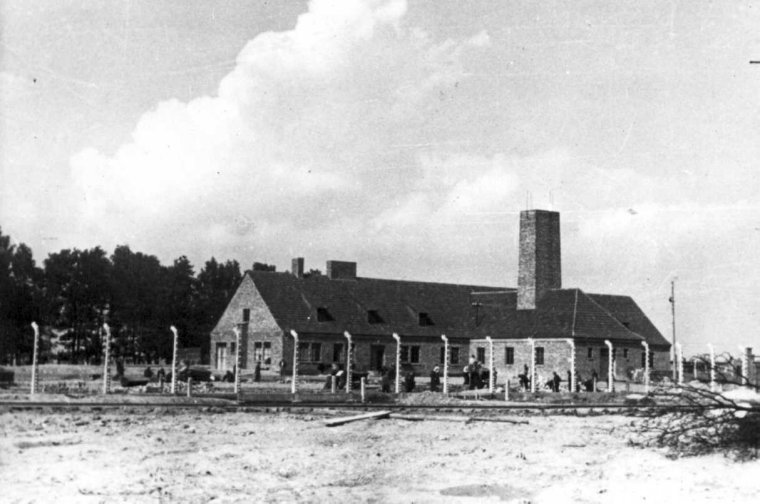
Auschwitz II-Birkenau concentration camp. Gas chamber and crematorium III. SS photograph, 1943
Berta Reich gave birth a few days later and immediately injected her baby with morphine, then told Dr. Mengele that her child had been stillborn. After saving themselves from certain death in the gas chamber at Auschwitz, both Ruth and Berta were sent to Taucha, a labour camp near Leipzig, which was a sub-camp of Buchenwald.
Gerda Schrage was 24 years old when she was sent to Auschwitz-Birkenau in 1944. She had been in hiding in Berlin during the war, until someone betrayed her to the Gestapo and she was arrested. According to Gerda’s story, as told in the documentary film “Gerda’s Silence,” when she arrived at Auschwitz, she was pregnant by a married man with whom she had had an affair while she was in hiding. Her baby died in her arms at Birkenau because Dr. Mengele was conducting yet another cruel experiment and would not allow her to nurse the baby.] Source:Scrapbook Pages furtherglory 26.9.2011
WORK ELIGIBLE
Anyone who was registered as a prisoner went first into what was called a "sauna" an unheated building for the recording procedure where he or she undressed and accompanied by glances and laughter of the SS-men usually had a shower with cold or overheated hot water. Here the prisoners were given clothing, Holzpantinen [wooden clog-like slip on shoe popular in North Germany sic]or ill-fitting footwear. It was followed by virtually the "shearing" of hair usually with blunted utensils which left a number of injuries. That was followed by the painful tattoo on your left forearm with your number which replaced your name, and in future you would be called or addressed and responded by it and kept in all your records. [Gypsies had the letter "Z" tattooed on their number as a prefix for the German word "Ziegeuner" sic]
BIRKENAU CREMATORIUM
In July 1942 the construction of crematorium II was produced by the company Huta. In August 1942 the decision was made for three additional furnaces by the firm Topf and Sons for the installation and necessary auxiliary equipment. Due to delays in deliveries the completion of four new furnaces was not carried out until between March and June 1943 (139). The capacity of the availability for cremations now ready for use at a running time around the clock at crematoria I (which however had been shut down in July 1943) was 340 corpses, in the crematoria II and III, each of 1440 corpses, in the crematoria IV and V respectively 768 corpses(140) . At its peak, as in the extermination of Hungarian Jews or Ghetto-liquidation up to 8000 people were burned per day (141). The crematoriums were built outside the prison camp at Birkenau and partitioned off and protected by a "Green Belt" with high fences made of branches from the view of prisoners (142).
Crematorium 2
Crematorium lV
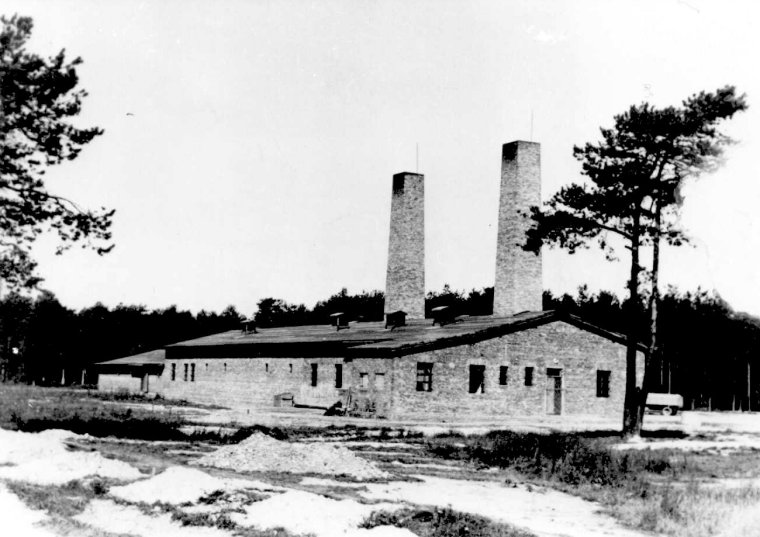
Crematorium 5
Auschwitz II-Birkenau concentration camp. Gas
chamber and crematorium III. SS photograph, 1943
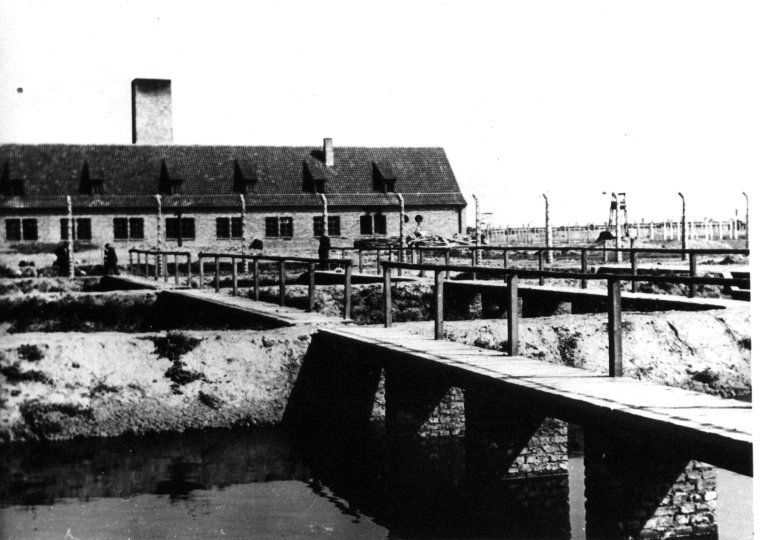
Auschwitz II-Birkenau concentration camp. Gas chamber and crematorium II. SS photograph, 1943
Crematoria II and III were almost built to identical plans and possessed a combustion chamber with five furnaces and underground changing room and an about 210 square meter large gas chambers with mechanical ventilation and three or four specially made in the machine shop of the concentration camp throw-in chutes for the Zyklon B pellets, there were two rooms for the storage of hair, glasses and other objects of the murdered victims. In addition crematorium III had a plant for the smelting of gold teeth. Also both crematoria possessed a small stove as a waste incinerator for the elimination of worthless objects removed from the dead, in which during the end phase of the Auschwitz camp the SS would burn documents of the mass killings that taken place.(143)
Crematoria IV and V, the low capacity differed significantly structurally from II and III. The gas chambers and undressing facilities were not underground but on the ground floor.
The method and procedure of extermination was very similar in all four crematoria. Those that were selected at the unloading ramps to be gassed walked out towards the crematoria or driven in by trucks .... After the gas chambers were filled first with women and children, the men were pushed in when the SS members left the room and locked the doors. So-called Disinfectors [prisoners sic] then poured under the supervision of the attending SS-physicians, (Kieselgur) diatomaceous-linked Zyklon B into the insertion devices. The deaths occurred within a maximum of twenty minutes, dependent on factors such as temperature and humidity and the number of victims in the gas chamber . After the death had occurred, the ventilation system was switched on and prisoners of the Sonderkommando (Special Work Team) entered the chambers with gas masks and began with the removal of corpses .... [The dead were removed with a type of tongs clamped around their neck and pulled by two men who wore rubberised protected clothing and dragged the cadaver for cremation sic] The evacuation of a gas chamber took about four hours, the burning of three corpses in an oven for about 20 minutes . The ash was collected in pits and later poured into surrounding waters or for the production of fertilizer used in the agricultural areas of concentration camp.[the sequence and comment by the researcher in the method of disposal of ashes is not quite correct, bone fractions had to be removed, crushed and pulverized sic]
 |
| Posed photo shows body being dragged from the morgue |
 |
| Bodies were picked up with large tongs and loaded onto a stretcher |
Method of deposing of bodies. Pictures taken posed at Dachau KZ - note corpse is a Plastic (WAX) dummy
MEDICAL EXPERIMENTS
In late 1942 Dr Clauberg began in barrack 30 within the women's camp at Birkenau B Ia to test his method of operation without sterilization. From April 1943 Clauberg was assisted by Johannes Goebel and continued his activities in Block 10 of Auschwitz. Between 150-400 Jewesses of various nationalities have been subjected to this method of intra-uterine injection of a caustic substance which caused the inflammation of the fallopian tubes and became impermeable. Side effects of the painful procedure such as peritonitis or general sepsis often lead to death. Clauberg's test station was placed in May 1944 into Block I of the new women's camp in the protective custody camp extension, from January1945, he continued his activities in the camp
In another method who worked from November 1942, was Dr. Horst Schumann, who had been in the Euthanasia facilities in Grafeneck and Pirna-Sunstone and murdered "incurably ill" patients and then participated in the Action 14f13. In Auschwitz, he tried a method by using X-rays on men and women to make them infertile. Schumann worked in the barrack 30 of the women's camp Birkenau B Ia were under his supervision male and female prisoners were surgically castrated (147) [I doubt that women can be surgically castrated it is more likely it was Oophorectomy(Hysterectomy) when both ovaries are removed sic] . Few survived the estimated 1,000 victims of the experiments of Clauberg and Schumann.
The person with two doctorals (medicine and philosophy), SS Major Josef Mengele was a practicing leading researcher in the physiology of dwarfism in Auschwitz. Mengele was from May 1943 in Auschwitz and did service until November 1943 as Lagerarzt (Camp Doctor) at Birkenau. He was interested in an experimental station in the gypsy camp where he also studied the Noma Disease caused by malnutrition and poor hygiene of which many prisoners were suffering from, and had another facility in barracks 15 of the men's Krankenbaulagers (Hospital Building Camp) B II f and an additional one in the women barracks, camp B Ia.During the selection at the ramp Mengele made certain the ones he wanted to use for his experiments, children that were twins, people that had certain anomalies. Many children were killed after tormenting studies by phenol injections so that they could be dissected. Mengele was assisted by detained inmate doctors (148).Anatomical specimens were sent to Berlin-Dahlem for evaluation. Mengele continued to serve at the camp until January 17th 1945 at Auschwitz.
ROBBERY
The exploitation of the prisoners did not end with their murder.Since September 1940 the tooth gold was added to the inventory of the SS from inmates that died in a concentration camp on Himmler's orders and not to members of their families. In October 1942 the Medical Inspection of the Waffen SS a local service and inspection team of precious metal in Auschwitz got sufficient gold for all the dental care of SS members to last them for the next five years. Therefore, the excess of gold should be delivered to the Reichsbank. At the height of the mass murder of Hungarian Jews in the summer of 1944 at least 40 inmates were involved in breaking out of the gold teeth of the victims (153).Members of the illegal opposition group alleged that in early 1944, the SS collected every month, ten to twelve kilograms of tooth gold.
[This statement of breaking out gold teeth from the dead is somewhat simplistic and in parts utterly false. Rigor Mortis sets in within 1-8 hours and start to putrefy after that, did they ask the dead: "open your mouth wide I want to extract your gold teeth?" Not very likely! SS men I have spoken to in Dachau where the same procedure was conducted, told me:"Wenn Du solche Scheißerei glaubst, glaubst Du noch an den Weihnachtsmann"! (If you believe such shit you still believe in father X-mas too). The "extraction" of gold was done after cremation when the ashes were scraped into a vessel and put through a sieve, fragments of bones removed and the gold fillings picked out for further processing. The SS did not trust the inmates at all as they attempted to conceal gold on their bodies and even tried to swallow the pieces. The Germans were meticulous when it came to hygiene and took precautions to stop the spread of diseases from congealed blood of a cadaver which could effect their own contingent which exceeded 7000 men and women plus their families. In the early days the SS returned the gold (if any) together with the ashes to the next of kin, but made them pay for the cremation. I do not know if bone crushing machines were used in Auschwitz or Dachau, they were in use by the SS Einsatzgruppen in Minsk, Mogilev and Smolensk i.e.- Russia sic].

Members of a SonderKommando 1005 unit pose next to a bone crushing machine in the Janowska concentration camp. (Jun 1943 - Oct 1943)
THE NUMBERS OF DEATHS AT AUSCHWITZ FROM1940-1945
THAT DIED OR WERE KILLED Not Registered Registered
1.1 million (1.082 million) Total All* 900 000 200 000
1 000 000 (960 000) Jews 865 000 100 000
70 000-75 000 (74 000) Poles 10 000 60 000
21 000 Gypsies 2000 19 000
15 000 Soviet POW's 3000 12 000
10 000-15 000 Others: N/A 10 000
Czechs,
Russians,Belorussians
Ukrainians,Yugoslavs
French,German
Austrians and others
[*The above figures should be treated as estimates at this stage as computerized results are not available at the time of writing and are based on research by Franciszek Piper's publication "Research 1945-1990, Oswiecim 1993" page 202 which uses the factor of total Deportations to Auschwitz. One must assume that the unregistered victims went from the Ramp upon arrival straight to the Gas Chambers.sic]

Standard Personal Details kept in Auschwitz for Registered Inmates, in this case for Sigismund Gajda, a Pole, married with two children. I can not make out the handwriting for the reason of his arrest dated 18.4.43, but it states in part: "Has helped the Jews fleeing.. He apparently had no previous convictions. He committed an offence within the Camp (left lower stamp) and was sent to Mauthausen on the 4th December 1944. His inmate number was also changed to 112047.
Additional Post, October 2014
THE EXPANSION AND STRUCTURE OF THE COMPLEX OF AUSCHWITZ.
(Researcher Angelika Königseder)
In May 1941, the construction of eight additional blocks had begun, but their completion lasted until 1942. The numbering of the blocks was changed in August 1941. The expansion of the camp took much longer than planned and did not hold with the needs of the growing number of incoming prisoners. The Master Plan (Generalbebauungsplan) by the end of 1942 saw finally the setting up of a total of 78 two-storey buildings, a parade ground, a new headquarters, an SS-settlement and an SS barracks. The change (partly) in building to single-storey blocks and the construction of eight new buildings and the "receiving building"on the the former military site accelerated the rate of available facilities, thus 20 buildings were finally realized on the grounds of "protective custody camp extension" which were completed in the spring of 1944 and served as an SS barracks, lodgings for prisoner, as Magazines and Workshops. On October 1, a women's camp (Frauenlager) was set up here as well.
 |
| Sleeping shelves or bunks in the women's barracks. The prisoners slept in 60 spaces, with three bunks in each space. They slept on straw filled mattresses spread over the wooden bunks. |
On 25 November 1944 the Auschwitz complex was again reorganized,
Auschwitz II-Birkenau was in turn subordinate to the main camp and
Auschwitz III was renamed Monowitz. The latter now controlled all
sub-camps. Josef Kramer was transferred as commander to the
concentration camp Bergen-Belsen. Richard Baer was since May 11,
1944 the last commander of the main camp and since 29 June 1944 and
SS garrison also Elder (Standortältester) of the entire site at
Auschwitz. Camp commandant of Auschwitz III-Monowitz was since the
re-structuring in November 1943 for the eventual evacuation,
SS-Hauptsturmführer Heinrich Schwarz. [Following the evacuation
of Auschwitz complex on 18 January 1945, Schwarz was initially
slated to take over command of the Mittelbau-Dora concentration
camp and the associated V-weapons production facility of
Mittelwerk, but was passed over for this post in favour of Richard
Baer. He was instead appointed commandant of Natzweiler-Struthof
in Alsace-Lorraine, where he oversaw the evacuation of the camp's
inmates to Dachau during April and May 1945. Following the German
defeat, Schwarz was convicted of war crimes by the French
occupation authorities in Rastatt. He was sentenced to death and
subsequently shot by a firing squad near Baden-Baden on 20 March 1947.]
First Commandant of the Auschwitz concentration camp from May 4th
1940 until 11th November 1943 was SS-Obersturmbannführer Rudolf
Hoess (Höß), who was then named Head of the SS-WVHA D-I Central
Office. Due to the rising prison populations and the expansion of
the Auschwitz complex, the concentration camp was restructured on
November 22, 1943 in three formally independent main camps with
their own administration: (a) Auschwitz I main camp, (b) Auschwitz
II-Birkenau and (c) Auschwitz Satellite Camp (Außenlager). Birkenau
and Auschwitz III received successively their own commandants and
protective leaders, because of the size of the camp each section had
now its own protective custody camp leader. The satellite camps were
previously assigned to the main camp, they now became subordinate to
the concentration camp Auschwitz III, only the farms Rajsko, the
Administration Estates (Wirrtschaftshöfe) Budy and Birkenau,
Harmense, Babitz and Plawy belonged from now on administratively to
the concentration camp Auschwitz II-Birkenau.On 25 November 1944 the Auschwitz complex was again reorganized, Auschwitz II-Birkenau was in turn subordinate to the main camp and Auschwitz III was renamed Monowitz. The latter now controlled all sub-camps. Josef Kramer was transferred as commander to the concentration camp Bergen-Belsen. Richard Baer was since May 11, 1944 the last commander of the main camp and since 29 June 1944 and SS garrison also Elder (Standortältester) of the entire site at Auschwitz. Camp commandant of Auschwitz III-Monowitz was since the re-structuring in November 1943 for the eventual evacuation, SS-Hauptsturmführer Heinrich Schwarz. [Following the evacuation of Auschwitz complex on 18 January 1945, Schwarz was initially slated to take over command of the Mittelbau-Dora concentration camp and the associated V-weapons production facility of Mittelwerk, but was passed over for this post in favour of Richard Baer. He was instead appointed commandant of Natzweiler-Struthof in Alsace-Lorraine, where he oversaw the evacuation of the camp's inmates to Dachau during April and May 1945. Following the German defeat, Schwarz was convicted of war crimes by the French occupation authorities in Rastatt. He was sentenced to death and subsequently shot by a firing squad near Baden-Baden on 20 March 1947.]
 |
| Each wooden barrack had two stoves with a brick heating flu running between them. Hoever, fuel was not provided. In winter the temperature at Auschwitz-Birkenau could reach as low as minus 20 degree Celsius, as a result many prisoners froze to death. |
The camp commander was responsible for the supervision of the SS guard units. In March 1941, about 700 SS guards were used in Auschwitz, In June 1942, 2,000, in April 1944 2,950, in August 1944 3,342 and on January 15, 1945 finally 4,481 SS men and 71 women guards (Aufseherinnen). The SS guards were subject to constant fluctuation. A total of approximately 7,000 SS men were used in Auschwitz. Some were housed on the site of the main camp, others in seized (beschlagnahmte) apartment buildings in the city and in the newly-built SS-settlement whose good infrastructural facilities prompted many family members to leave Reichs-Deutschland and lived preferably in Auschwitz.
&nb
sp;
LOVE ESCAPE and DEATH
 |
| Mala and Edek |
The guard at the gate, who did not even glance at the pass, opened the gate and allowed the escort to leave. Several hours later, the sound of a siren announcing an escape filled the Camp.
Edek Galinski, prisoner number 531 was missing from the Men's Camp, while from the Women's Camp the same was true of Mala Zimetbaum, prisoner number 19880. This escape became legendary within the Camp...
 |
| A telegram informing the escape of a female prisoner Mala Zimetbaum |
"The love of Edek Galinski and Mala Zimetbaum became camp legend in Auschwitz; a symbol of the victory of good over evil, of what is human over what is bestial. They gave us hope". (Statement: Camp Survivor Rene Raindorf of Brussels)
MALA
Mala Zimetbaum was a Jewish woman born in the Polish city of Brzesko on 26 January 1918. In 1928, her father Pinkus, a merchant, emigrated to Antwerp with her whole family. Mala attended elementary school in Belgium, where she became fluent in Flemish, French, German, English, as well as Polish and some Russian. Because of the difficult financial situation due to her father's blindness, she was not able to attend high school and began working as a seamstress. Mala was arrested on 11 September 1942, during a round-up of Jews at the main railway station in Antwerp and was in a convoy of 1,048 Jews sent to Auschwitz. On 17 September 1942, the convoy reached the camp; 717 people were sent to the gas chambers from the ramp. Mala was among those judged fit for work and was given number 19880.
 |
| 'Fragment of a list of transports sent to Auschwitz with prisoner numbers September 19, 1942 a transport from Malines. The female prisoners were given the numbers 19821-19921 (underlined in red)'. |
Edward Galinski was born in Jaroslaw on October 5th, 1923 and was a student at the maritime school in Pinsk when war broke out. In the spring of 1940, he was arrested and several weeks later, on 14 June 1940, he was brought in the first transport of political prisoners from Tarnów to the Auschwitz concentration camp. He became prisoner 531 out of the 728 transported. He survived the next four years of camp life, until, thanks to help from fellow prisoners and chance, he got into a "better" commando and began to work in the camp locksmith workshop. He served under chief Kommandoführer (Corporal) Edward Lubusch. Lubusch was an SS-man, who rather than tormenting the prisoners, helped them.
 |
| Photo was taken in the camp metal workshop. In the foregrround SS-man Edward Lubusch who provided Galinski with SS uniform before the planned escape and next to him is Edward Galinski'. |
 |
| Portrait of Mala Zimetbaum. It was made in the camp by fellow prisoner Zofia Stepien-Bator |
 |
| A document from the file of prisoners working in the camp metal workshop. Galinski Edward, prisoner 531, trained profession: high school student, employed in the camp as metalwork apprentice'. |
PREPARING TO ESCAPE
At the end of 1943, Edek began to make efforts to be transferred from the camp locksmith workshop in Auschwitz to the fitters` commando in Birkenau, because he hoped that from there it would be easier to arrange an escape with his good friend and colleague from Jaroslaw, Wieslaw Kielar. Edek and Wieslaw Kielar had persuaded Antoni Szymlak, a tiler by trade, who had entry to the camp zone as a civilian worker, to provide shelter for them once they had escaped before they went further to Zakopane, to Wieslaw Kielar's sister. When everything was ready, Edek became abstracted and reticent. Kielar suspected that Mala Zimetbaum was the reason. They met when Edek went with the fitters commando to the women's camp to make repairs. Since their first meeting at the turn of 1943/1944, a deep affection had grown between them.
"I love and am loved", Mala told one of her fellow prisoners. Edek also confessed his feelings to his friend.
 |
| Phograph of Wieslaw Kielar taken 1978' |
They crossed the line of camp guard post by showing a forged SS pass, for which Mala had stolen the form. They successfully reached the village of Kozy and received help from Antoni Szymlak.
Wieslaw Kielar's testimony on the events of 24th June 1944'.

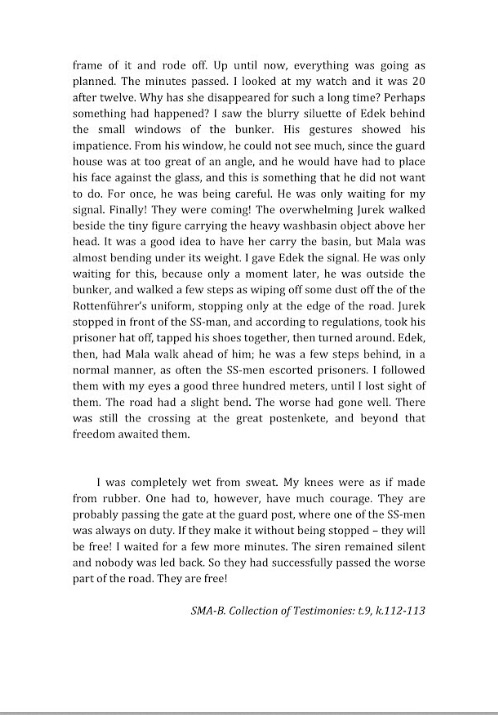


Wieslaw Kielar's testimony on the events of 24th June 1944'.
 |
| Map showing sited related to the escape'. |
At
Mala's insistence, they changed the next stage of escape route. Instead
of Zakopane, they went towards Slovakia, where Mala's relatives lived
and where they wanted to take refuge until the liberation.
However, luck had abandoned them. On 6 July 1944, they met a German border patrol. Mala, who was in front, was stopped.Edek, not noticed by the Germans, could easily have withdrawn to safety, but he refused to do so. They were recognised as fugitives and sent back to the camp. In a telegram dated 27 July 1944, Auschwitz headquarters informed the superior authorities of their arrest.
 |
| elegram announcing the recapture of Edek and Mala'. |


Testimony of Boleslaw Staron'.
 |
| Interrogation and imprisoment sites' |
 |
| The basement of the Death Block where Mala and Edek were detained after their failed escape from the camp'. |
 |
| Fragment of the wall from cell 20 in the basement of Block 11 of the former Auschwitz I camp |
In secret messages sent to Wieslaw Kielar they reassured Lubusch and the prisoners who knew about the escape that they had nothing to fear. In the camp they were talked about as heroes.
"... Now, everyone made their way towards the kitchen and stood at the edge of a square, where a gallows had been placed in the centre. After some time, the cell doors were opened and Edek appeared in the doorway. There was a sudden silence. Only the gravel beneath their shoes could be heard as they walked towards the gallows, Edek (the condemned) and Jupp (the executioner)... [ One could contemplate, that the tiger would pity the fawn, the wolf would weep over its lamb, before a hangman would cringe at the corpse of a dangling prisoner, sic] Then I saw his upright back and his hands twisted behind him and tied with wire. This was the work of Jupp, who, was walking after him with a truncheon in the direction of the gallows. Here, Edek stepped onto the podium without hesitation and then immediately onto the stool that was placed beneath the gallows... An SS-man came forward from the group of SS standing at the side of the guardhouse and started to read the sentence in German from a piece of paper that he was holding in his hand.
 |
| The current appearance of the "Death Bloc" in the Main Camp |
Quote: "He suddenly yelled with an astonishing voice 'Long live Pol...', but he could not finish"
Execution by hanging was also planned for Mala. However, a young Slovak woman and fellow prisoner described to Wieslaw Kieler what really happened:
"When she (Mala) was already on the platform, as the sentence was being read she cut her veins with a razor that she had prepared beforehand, but as with Edek she was not allowed to die that way.


Testimony of Wieslaw Kielar, "Execution".
Rapportführer Taube ran over to her and she slapped his face with her bloody hands. At the same time, the SS-men practically trampled her to death before the eyes of the whole women's camp. She died on the way to the crematorium."
"I donate two locks of human hair to the Museum. They are wrapped in paper with German printed on it. On the edge of the paper is a pencil inscription: Mally Zimetbaum 19880, Edward Galinski 531. It is an inscription made by Galinski and his hair and that of Mala Zimetbaum. The camp Lager kapo, Jupp Windeck, who hanged Edek, gave me the hair and the note an hour after his death in the presence of Rapportschreiber Kazimierz Gosek, stating that it had been the last request of the condemned that I take them and give them to his father. That tragic memento went with me through all the camps and I kept it to this day". (Statement from Wieslaw Kieslar dated January 29th, 1968)
 |
| Tragic momentous left of Mala and Edek. Locks of their hair |
Curator- Dr. Maria Martyniak and Alicja Bialecka.
Acknowledgements:
The exhibition featured many, in some cases have been created by an independent third party and may not always represent the views of the institutions. Listed who have supplied the content: Auschwitz-Birkenau State Museum.
OTHER ESCAPES
Kazimierz Piechowski, born October 3, 1919 Rajkowy, Poland) is a retired engineer, a Boy Scout during the Second Polish Republic, a political prisoner at Auschwitz concentration camp, a soldier in the Polish Home Army (Armia Krajowa) then a prisoner for seven years of the communist government of Poland. He is known for his famous escape from Auschwitz I along with three other prisoners dressed as members of the SS-Totenkopfverbände, fully armed in a stolen SS staff car, in which they drove out the main gate—"a universally acclaimed...feat of exceptional courage and gallantry", in the words of Kazimierz Smolen.
After the collapse of Polish resistance to the German invasion, Piechowski along with fellow boy scout Alfons "Alki" Kiprowski were captured by the German occupiers in their hometown of Tczew and impressed into a work gang clearing the destroyed sections of the railway bridge over the Vistula, which had previously been blown up by the Polish military to impede Nazi transports.
 |
| Railway bridge over the Vistula River; Piechowski was in a forced work gang clearing the rubble' |
Piechowski was sent to Auschwitz as a political prisoner, the so-called Legionsgänger, one wishing to join Polish military formations—or "legions"—abroad. Moreover, the Polish Boy Scouts were labeled a criminal organization in Occupied Poland. Piechowski was among a transport of 313 Polish deportees to Auschwitz on 20 June 1940: it was only the second transport after the initial one from Tarnów. Among this Tarnów group was another Pole who would escape in an SS uniform: Edward (Edik) Galinski. Galinski's escape was short-lived.
Piechowski received inmate number 918. He credits Kapo Otto Küsel (inmate number 2)—one of the original 30 German deportees from Sachsenhausen—with his survival by assigning him lighter work. Piechowski was in the Leichenkommando, assigned to bringing corpses to the crematorium, including those shot at the "Black Wall" by SS-Rapportfuhrer Gerhard Arno Palitzsch. Piechowski was present when Polish priest and fellow Auschwitz prisoner Maximilian Kolbe offered to exchange places with a fellow Pole who was among a group of ten sentenced to be starved to death. The sentence was in retribution for a perceived escape attempt of a prisoner.
On the Saturday morning of 20 June 1942, exactly two years after his arrival, Piechowski escaped from Auschwitz I along with two other Poles, Stanislaw Gustaw Jaster, inmate number 6438), veteran of Invasion of Poland in rank of first lieutenant from Warsaw; Józef inmate number 3419), a priest from Wadowice; and Ukrainian Eugeniusz Bendera, inmate number 8502), an auto mechanic from Czortków, Ukraine. Piechowski had the best knowledge of the German language within the group, and held the command of the party.
They left through the main Auschwitz camp through the Arbeit Macht Frei gate. They had taken a cart and passed themselves off as a Rollwagenkommando—"haulage detail"—a work group which consisted of between four and twelve inmates pulling a freight cart instead of horses.
Bendera went to the motorpool, Piechowski, Lempart and Jaster went to the warehouse in which the uniforms and weapons were stored. They entered via a coal bunker which Piechowski had helped fill. He had removed a bolt from the lid so it wouldn't self latch when closed.
Once in the building they broke into the room containing the uniforms and weapons, arming themselves with four machine-guns and eight grenades. Bendera arrived in a Steyr 220 sedan (saloon) car belonging to SS-Hauptsturmführer Paul Kreuzmann, license number SS-20868. As a mechanic he was often allowed to test drive cars around the camp.
 |
| Steyr 220, similar to car used in escape' |
He entered the building and changed into SS uniform like the others. They then all entered the car, Bendera driving Piechowski in the front passenger seat, Lempart and Jaster in the back, and drove toward the main gate. Jaster carried a report that Witold Pilecki had written for Armia Krajowa headquarters. When they approached the gate they became nervous as it had not opened. Lempart hit Piechowski in the back and said to do something. With the car stopped he opened the door and leaned out enough for the guard to see his rank insignia and yelled at him to open the gate. They then drove off.
After the escape the fugitives abandoned the stolen escape vehicle in the vicinity of Maków Podhalanski, at a distance of some 60 kilometres from the camp. Kazimierz Piechowski eventually made his way to the Ukraine, but was unable to find refuge there due to anti-Polish sentiment. Forging documents and a false name, he returned to Poland to live in Tczew, where he had been captured. He soon found work doing manual labor on a nearby farm, where he made contact with the Home Army and took up arms against the Nazis within the units of 2nd Lt. Adam Kusz nom de guerre Garbaty (one of the so-called "Cursed soldiers"). His parents were arrested by the Nazis in reprisal for his escape, and died in Auschwitz; the policy of tattooing prisoners was also allegedly introduced in response to his escape. Piechowski learned after the War from his boy-scout friend Alfons Kiprowski, who remained a prisoner at Auschwitz for some three more months after his escape, that a special investigative commission arrived at Auschwitz from Berlin to answer—independently of the camp's administration—the question as to how the escape so audacious as Piechowski's and his companions' was at all possible.
After the war he attended the Gdansk University of Technology and became an engineer, and then found work in Pomerania. He was denounced to the communist authorities for being a member of the Home Army and sentenced to 10 years, he served 7. At the end of his sentence, he was 33; he reports thinking, "They have taken away my whole youth—all my young years." Thereafter he worked as an engineer for the communist government for some decades.
After the democratic transition, he declined the Order of the White Eagle when Maciej Plazynski tried to award it to him, politely (but also enigmatically) replying, "I do not feel that this honour is owed me". In 1989 he sold land he owned near Gdansk and travelled with his wife to various parts of the world, visiting over 60 countries. In 2006 Piechowski was named an honorary citizen of the city of Tczew with which he has had a longstanding association (as his pre-War hometown). Likewise in 2006 Kazimierz Piechowski was the subject of the 56-minute-long documentary film Uciekinier ("Man on the Run") produced by Marek Tomasz Pawlowski and Malgorzata Walczak, which won several international awards. In 2009 the British singer Katy Carr released a song about Piechowski under the title "Kommander's Car"; while 2010 saw another documentary on the subject from the filmmaker Hannah Lovell, the 26-minute Kazik and the Kommander's Car He currently lives in Gdansk.
Piechowski's associates
The kapo Kurt Pachala, a native of Neusatz (inmate number 24), in charge of the motor pool (Fahrbereitschaft; or alternatively, of the food stores or supply depot, the so-called Truppen Wirtschaftslager) at Auschwitz, was implicated in Piechowski's escape by the circumstantial evidence uncovered during the ensuing investigation, and as a result was tortured and then sent to the standing cell in Block 11 where he died of thirst and hunger on 14 January 1943. He is said to have been reduced at the end to eating his own shoes. His treatment and death were recounted at the Frankfurt Auschwitz Trials in 1965 which formed the basis for the 1965 play Die Ermittlung (The Investigation) by Peter Weiss. Pachala is the only known victim of reprisals for the escape within the Auschwitz concentration camp itself (apart, that is, from the family members of the escapees): it was the ruse of the fake work commando that saved other prisoners from reprisals.
Eugeniusz (Gienek) Bendera from Tschortkau, Podolia, then in the Austro-Hungarian Empire): According to Kazimierz Piechowski, Bendera was the originator of the idea of the escape, and the one who conceptualized the whole plan. After the War he returned to Przedbórz to live with his wife (married in 1930; one son), until a divorce in 1959 when he moved to Warsaw. He died after 1970.
Józef Lempart, after the escape he was dropped off by the escapees at a monastery in Stary Sacz, a locality some 155 kilometres from the camp, in a state of total exhaustion. His mother was deported to Auschwitz in reprisal for his escape and killed. He left the priesthood, married and had a daughter. He died in 1971 after being run over by a bus while crossing a street in Wadowice.
Stanislaw (Staszek) Gustaw Jaster, nom de guerre Hel, was the youngest of the escapees. In Auschwitz he was a member of the secret underground military organization ZOW. In Warsaw he reported to the Home Army High Command about the resistance in Auschwitz and became a personal emissary of Witold Pilecki. His parents were deported to Auschwitz in reprisal for his escape, where both died (his father, Stanislaw Jaster, b. 1892, having perished at Auschwitz on 3 December 1942; his mother, Eugenia Jaster, b. 1894, first deported to the Majdanek concentration camp, eventually perished at Auschwitz on 26 July 1943). He continued to fight against the German occupiers in the ranks of the Home Army as a member of one of its most important special-operations units, the Organizacja Specjalnych Akcji Bojowych (Osa–Kosa 30), but also at his own initiative taking part in engagements staged by other Home Army units, most notably participating in the successful action at the Celestynów railway junction on the night of 19 May 1943, carried out under the command of Captain Mieczyslaw Kurkowski nom de guerre Mietek, whose object was to free the prisoners being transported by the Nazis from the Lublin Castle prison to the Auschwitz concentration camp by train, when he gained special distinction through an act of bravery whereby he virtually single-handedly assured a victorious outcome for the operation in which 49 prisoners were freed. His comrades-in-arms have described him as a man "of enormous stature invested with extraordinary physical power".
According to the account first promulgated in a 1968 book by Aleksander Kunicki, Cichy front, Jaster was accused of collaboration with the Gestapo and executed in 1943 by members of the Home Army. This account has since been discredited as lacking foundation in documentary evidence. What now appears to be reasonably certain is that Jaster was rearrested by the Gestapo in Warsaw on 12 July 1943, and that he perished sometime between July and September of that year. The exact circumstances of his death remain however a bone of contention. Both Eugeniusz Bendera and Kazimierz Piechowski himself as well as many others who knew him personally made their voices heard in an effort to exonerate the memory of Jaster in the wake of the controversy engendered by the publication of Cichy front. It has been pointed out that the author of the accusing book, Aleksander Kunicki (1898–1986), an intelligence officer of the Home Army during the War (see Operation Kutschera), had himself been subsequently accused of having collaborated with the Gestapo and sentenced to death, only to have his conviction set aside by the authorities of the Communist Poland (who instead awarded him a state pension for "meritorious service to the nation" — an extraordinary outcome for an operative of the Home Army, a military arm of the Polish government in London, whose members were persecuted after the War by the Communists either with lengthy imprisonments (as in the case of Kazimierz Piechowski himself) or by being killed, as in the case of Witold Pilecki, a figure directly connected with the events dealt with in the present article, Gen. Fieldorf, and others). Kunicki's book was submitted to a closely reasoned and devastating critique by Tomasz Strzembosz in 1971, which uncovered (among its other weaknesses) deliberate selective concealments and falsifications of published sources which Kunicki invokes in support of his thesis.
In the slowly emerging consensus of opinion in the matter — while the uncorroborated allegations of Aleksander Kunicki presented as "facts" in Cichy front remain what they are, namely allegations, unsubstantiated, in parts fanciful, and (in the light of emerging facts about Kunicki himself) perhaps self-serving — the book is thought nevertheless to contain an element of truth concerning Jaster's ultimate fate. It would appear that after his second arrest by the Gestapo in Warsaw on 12 July 1943 Jaster may have managed to escape yet again (this time by jumping out of a speeding Gestapo car moments after having been seized in a street together with a high-ranking Home Army commander, Mieczyslaw Kudelski nom de guerre Wiktor) — a feat so unprecedented (both in the degree of bravura displayed and in the fact that it would have been the second time that Jaster managed to extricate himself from Nazi clutches) that it would have aroused suspicions among the Home Army just then plagued by a series of devastating setbacks which could only have been caused by a well-placed mole, leading to a hasty and unjust execution of Jaster. If this hypothesis as to the fate of Jaster were to be accepted as a fact, it would remain to be explained why no documents relating to the case have come to light, however.
The authors of the aforementioned award-winning 2006 documentary film about Kazimierz Piechowski, Uciekinier ("Man on the Run"), Marek Tomasz Pawlowski and Malgorzata Walczak, are currently working on a sequel centred on the person of Stanislaw Gustaw Jaster.
Alfons "Alki" Kiprowski, Piechowski's fellow boy scout, was separately deported to Auschwitz (inmate number 801). He would escape from Auschwitz independently from Piechowski, just 94 days later, on 22 September 1942, together with two other prisoners, Piotr Jaglicz and Adam Szumlak inmate number E-1957
Links:

The 2006 documentary film Uciekinier ("Man on the Run") about
Kazimierz Piechowski
Kazimierz Piechowski video on YouTube
Singer-songwriter Katy Carr visits Piechowski
Blown-up bridge at Tczew
THE CRIMES OF AUSCHWITZ BEFORE THE COURTS
After the liberation of Auschwitz the total of 7000 men and women who were members of the SS who had been involved and done service in the camp complex were under investigation as suspects in the crimes against humanity. The hour of reckoning and their punishment, so the victims and their relatives believed had finally arrived ... The Nuremberg Tribunal, the four allied powers who signaled a new era of law against war criminals which would enshrine human rights in future within international law failed partly on political grounds due to the cold war and was the cause that it was only considered as an opener. Thus the punishment of Nazi crimes was now in the national interest, primarily by the re-created Polish State. About 1000 individuals who had worked in Auschwitz were extradited to Poland, around 700 were tried during the the postwar prosecutions. (265)The Supreme Peoples-Court in Warsaw prosecuted the former camp commandant Rudolf Höß and sentenced him to death April 2nd1947. The sentence was carried out 14 days later in the grounds of the Auschwitz Stammlager. Also before the Supreme People's Court were former officials, among them Höß's successor Arthur Liebehenschel who was also sentenced to death and was executed in 1948 in Krakow, the court accused further 23 SS-members and in these particular proceeding 21 death sentences were carried out, (two accused were pardoned). Six others were sent to life in prison the rest sentenced to fixed-term imprisonment, the doctor Hans Münch was acquitted. This process took place in Krakow.Between 1946 and 1953 further court proceedings took place in the cities of Krakow,Wodowice, Raciborz, Gliwice, Katowice, Lublin and Torun the accusation was against a total of 673 former members of the Auschwitz camp complex (administrative staff, guards, maintenance personal etc.). While the sentence was on the average three to four years imprisonment, the acts of the accused guards were treated more severely, of 17 female defendants four were sentenced to death, the others received mostly heavy prison terms.
Between 25th April and 31st May 1946 before the Special Law Court at Danzig, a trial was held against fifteen guards of the Stutthof Concentration Camp. Six men and five women were sentenced to hanging in public. [The SS-women sat on chairs and had their hands tied in the back. For the execution they were lifted up on chairs, this was very difficult as they had their their legs already tied at the ankles sic.]
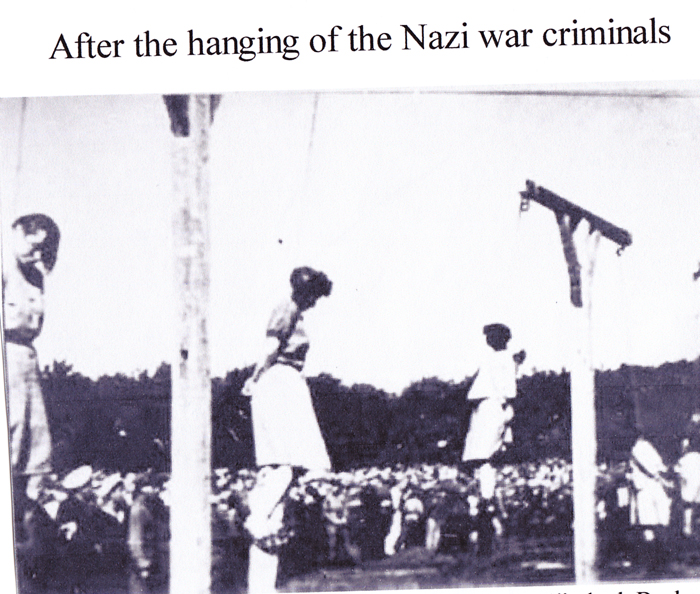 |
| From left to right: Jenny Barkmann, Ewa Paradies, Elisabeth Becker, Wanda Klaff, Gerda Steinhoff |
 |
| The prisoners were noosed and then pushed from the ramp of the trucks Jenny Barkmann has just been hanged and struggles and the end of the rope while Ewa Paradies is being noosed by her executioner. In the background (white dress): Wanda Klaff. Already hanging with the back to the camera (dark blouse, white skirt): Gerdia Steinhoff |
The American, British and French military tribunals in the early post-processes in the Western occupation zones of Germany took actions against people that had carried out functions in Auschwitz, but had then been transferred to other concentration camps. During the 1945/46 Dachau trials, a U.S. military court sentenced the Camp Leader of Monowitz, Vinzenz Schöttl and the head of the crematorium at Birkenau, Otto Moll to death. During the Mauthausen-Process the camp doctors Helmut Vetter and Friedrich Entress were convicted, in the Buchenwald Trial the Chief of Dog-Handlers Merbach, in the process of the Ravensbrück camp leader of the men's camp of Birkenau Schwarzhuber all received the death sentences. Also during 1946/47 under US Jurisdiction at the Nuremberg Doctors Trial the medical experiments at Auschwitz were subject of discussion and provided the basis for subsequent trials.[No women were executed under American jurisdiction sic.]SS doctor Josef Mengele did not have to answer for his crimes: he had gone into hiding after his release from an American prisoner of war camp in his home town of Günzburg, he worked then as a laborer on a farm and went in 1949 with a Red Cross passport to South America. Mengele died in Brazil in 1979 ....[During his funeral while the casket was lowered into the grave two of his friends gave the Hitler salute. Note all members of the SS had their blood-group tattooed under their left upper arm, except doctors, as he was released from an POW Camp, he must have passed inspection, POW's were all checked by the Allies for any give-away scars under the arm or the blood group sic.]
Doctor Carl Clauberg was arrested in 1955 was put on trial but died of a heart attack in his cell before the trial could start.[Deaths in cells during a trial are always suspicious, it is quite possible that he committed suicide sic.]
Doctor Horst Schumann opened his own consulting practice with a refugee credit [he was entitled to that, sic.] and was recognized as a war criminal in 1951, he did flee and worked as a ship-doctor,settling in Sudan in 1955, four years later he fled again to Ghana. In 1966 Schumann was extradited to Germany where the trial was opened September 1970 which was interrupted as the defendant suffered from high blood pressure[so do I and many others sic]. Without any public interest he was released from prison and spent the rest of his life in Frankfurt and died May 1983. A British tribunal prosecuted in 1945 at Bergen-Belsen, among others, Josef Kramer who was the adjutant of the camp commander and from summer1944 chief of Auschwitz- Birkenau acting camp commander and sentenced him to death. In the British Neuengamme process the camp doctors Trzebinski and Kitt were tried. A French court in 1946 during the Natzweiler process sentenced Sturmbannführer Friedrich Hatjenstein (Commandant of Birkenau until summer 1944) and SS Captain Heinrich Schwarz (Commandant of Auschwitz- III-Monowitz) to death. Schwarz was executed, Hartjenstein died in 1954 in French custody.
EPILOGUE:
Hoes(Höß) under the Gallows


Pictures of Hoes excution The British had arrested Höß, who was one of the most sought-after war criminals. He appeared on the witness stand several times during at the International Military Tribunal in Nuremberg. While never denying that he had committed crimes, he contended that he had only been following orders.
Höß was turned over to Poland in 1946. He was calm and controlled during his trial. He had no illusions about the fate that awaited him. To the end, he contended that, at the most, a million and a half people had died at Auschwitz, not 5 or 6 million. At the end of the trial, he requested the court’s permission to send his wedding ring to his wife. The court announced its verdict, sentencing Höß to death by hanging, on April 2, 1947.The day after the verdict, former prisoners petitioned the court for the execution to take place on the grounds of the camp. It was scheduled for April 14, but postponed because of fears that Oświęcim residents would attempt to lynch Höß when he was being transferred to the site.
While Hoess had been appearing as a witness at Nürnberg as a witness, the Polish government sent word that they were now prepared to try him themselves for crimes he had committed in their country. So it was that on 25 May 1946, almost exactly a year since the end of the war and eleven weeks since the capture by Alexander, Hoess was driven to the Nurenberg airport, where he was forced to pose for the Pathe news cameras, looking dishevelled and unkept in his rough woollen prison clothes.[The picture shown was probably retouched]. He was then flown in an American plane, along with two other German war criminals, to Warschau, where he was handed over to the Polish authorities. At the city's main prison, he was processed, checked once again for cyanide pills, and placed in his own cell.
There is little record of his time in the Warschau prison. The only source is Hoess himself. He wrote that time passed slowly and that he endured the beatings, including the vicious assaults of a twenty-year-old guard, but that he never complained as the other guards treated him well.
On 30 July 1946, it was then that he was taken to the old jail at 7 Montellupich Street, on the outskirts if Krakow where, after being processed again, he was escorted to a tiny basement cell. Somehow Montelupich prison had avoided the worst of aerial bombardments and, by the end of 1946, it housed many of Poland's most notorious criminals. Hoess's cell was six feet by ten, walled in grey concrete with a small grilled window set seven feet off the ground. He had a metal cot with a thin worn mattress, a bucket in the corner, a single light bulb hanging from the ceiling, a small stove in one corner and, in the other, a small jug from which to drink and wash. The prisoners were allowed to shower once every two weeks, although soap and towels were rarely available. They wore their own clothes and, by rule, underwear had to be changed every six weeks. Food was provided by the prison - coffee, potato soup, a small chunk of bread - and a lucky few received extra provisions from family members. The Poles had been kind enough to give Hoess warm woollen socks.
He had nothing to occupy him. The other prisoners either ignored him or treated him with hostility. He wrote letters to his wife, and to his family, but received nothing in reply. Hid sense of isolation and dejection increased with each passing day. He was becoming unhinged.
Two weeks after the trial's start, on 27 March, Hoes stood as the jury's verdict was read out: Guilty. He showed no surprise. He had told reporters from TIMES that he had been expecting this outcome. On 2 April, Hoess returned to court to hear his sentence. He looked healthier than he had at the Nuremberg Trial, his face no longer gaunt, his hair neatly combed, his grey woollen jacket clean and pressed. Again he stood, black headphones once again in place, two armed guards standing behind him, their white-gloved hands holding rifles. The president of the tribunal, Alfred Eimer, read out the sentence: 'Death by hanging in a non-public manner within the territory of the Auschwitz camp'.
This upset Hoess greatly, who believed that it was dishonourable to die on the gallows, an execution method which he believed to be more suited to a common murderer than a man of his military standing. Eight days later the highest court in the land upheld the decision and shortly after that a letter arrived from the president of the Polish republic saying that he had 'decided not to use his power to reduce the sentence'.
On 11 April, five days before he was due to be executed, Hoess wrote a last letter to his wife. It was a final goodbye, and a confession. In it he declared that his priciples had been founded on incorrect assumptions, that it was inevitable that they would one day break down. He said that he now realised that he had been 'cogwheel in the monstrous German machinery of destruction', an 'automaton who blindly obeyed every order', one who had followed a very wrong path, and thereby brought destruction on myself'. He acknowledged that for these crimes he must die: 'With calm and composure, I see my last moments approaching'.
Enclosing the wedding ring, he reminisced about their wedding, and the 'spring od life' on the farm in 1929. He urged Hedwig to move to a new location and take back her maiden name, arguing that 'it will be best for my name to die with me'.
He then completed the letter with these words: 'With a heavy heart, my dearest Mutz, my unfortunate wife, so very, very dear to me, I send all my love to you. Remember me with love. I am with you, with my last breath'. Within the envelope he also included a last letter to his children.
German POWs erected the gallows, with a trap door, at dawn. It cannot be ruled out that they were also the hangmen. No one was admitted to the grounds without a special pass. Armed, uniformed guards stood everywhere. Höß arrived at 8 a.m. and was taken to the building that had once housed the commandant’s office. There, he asked for a cup of coffee. Once he had drunk it, he was led to a cell in the “bunker,” the camp jail in Block no. 11, also known as the “Death Block.”
Höß was led out punctually at 10 a.m. He was calm. With energetic steps, almost strutting, he walked along the main camp street. Since his hands were handcuffed behind his back, the executioners had to help him climb onto the stool placed above the trapdoor. A priest, whose presence had been requested by the condemned man, approached the gallows. This was Father Tadeusz Zaremba, a Salesian from Oświęcim.
A prosecutor read out the sentence. The hangman placed the noose on Höß’s neck, and Höß adjusted it with a movement of his head. When the hangman pulled the stool from under the former commandant, his body struck the trapdoor, which opened, leaving Höß hanging.[As can be seen they didn't even hang him properly, just strangled him with a rope instead of using a drop.]
The priest began to recite the prayer for the dying. It was 10:08 a.m. A physician pronounced Höß dead at 10:21. His remains were probably cremated.
The Polish press noted the execution only briefly. Newspapers were apparently forbidden to print eyewitness accounts. Documents found among the records of the Höß case indicate that the state authorities decided in early 1947 to stop holding public executions of German war criminals. This occurred after the execution in the summer of 1946 of Arthur Greiser, Gauleiter of “Warthe-Land.” Crowds of people watched his hanging on the slopes of the Citadel in Poznań. A picnic atmosphere prevailed, there were children among the observers, and vendors sold ice cream, soft drinks, and sweets. After the execution, people fought over pieces of the hangman’s rope. Intellectuals and Church officials protested to the authorities. The ministry of justice decided that the execution of the Auschwitz commandant should be a less public affair. More than 100 people former prisoners and high officials from the ministry of justice, the state prosecutor’s office, and the Security Bureau witnessed the hanging. This was the last public execution in Poland.
Born in 1900, the son of a small shop keeper in Baden-Baden, Höß was pressured by his pious father to become a priest. Instead he joined the Nazi Party in 1922. The next year he was implicated and convicted of murder, together with Martin Bormann of school teacher Walter Kadow, a communist, who allegedly had betrayed Albert Leo Schlageter, a German saboteur in the Ruhr who was executed (rather cruelly) by the French Occupation Forces and became a Nazi martyr. Höß received a ten year jail sentence. He was released in a general amnesty in 1928, joined the SS, whose principal job was guarding of the concentration camps. His first job in this Unit was at Dachau. Thus he spent almost of his entire adult life first as a prisoner and then as a jailer. This is how the events developed: On 31 May 1923, six months after hearing Hitler's Munich speech, Hoess met friend Martin Bormann, a farm supervisor, for dinner at a restaurant in Parchim, a small town in Mecklenburg, 150 miles north of Berlin. It was a warm spring evening. Bormann and Hoess and two other friends stayed late at the restaurant, drinking beers and becoming increasingly rowdy. They then spotted a former brother-soldier, Walter Kadow, eating at a table nearby. Kadow had left the Freikorps with a black cloud hanging over his name: He was believed to have have betrayed another member, Albert Leo Schlageter, to the French, who in turn accused Schlageter of blowing up bridges in the French-occupied Ruhr. (This was a fact) Five days before the meeting at the Parchim restaurant, the French had taken Schlageter onto the Golzheimer Heath, near Duesseldorf, read out his sentence and shot him.
Hoess, Bormann and the others joined Kadow at his table, pretending to be eager to catch up with their Freikorps colleague. After they were all fairly drunk, they suggested that they go for a drive, not telling Kadow where they were headed. A short while later they were outside town and entered some dark woods. There they beat Kadow with clubs until he could not stand. When he was half dead and covered with blood, one of the men cut his throat and another then shot him twice in the head with a revolver at close range. They buried the body in the woods and drove back to town. Later, Hoess described this killing in clinical tones: "I was firmly convinced then, and still am, that as a traitor he deserved to die."
A few days after the killing, one of the participants called 'Vorwaerts' the Berlin-based newspaper of the Social Democratic Party, and told a journalist what had happened. Soon afterwards, Hoess and Bormann were arrested. It was quickly agreed that Hoess would protect Martin Bormann, it is unclear if he offered or was asked, but either way it was an act of loyalty, to take full responsibility for the crime.
Hoess had been unworried about the arrest. He was convinced that the case would be dismissed, and the government had an unspoken agreement to release any arrested member of the right-wing paramilitary group in their support on the streets. However, this deal was soon broken.
Hoess was found guilty of manslaughter, in the end he was not found guilty of murder, as even the prosecutor had Kadow's badly damaged skull, he had been unable to prove whether the victim had died from a cut to the throat, blows to the head or bullet wounds. Hoess was sentenced on 15 March 1924 to ten years of hard labour. For his part Bormann was sentenced to one year in prison.
Only 22 years old, Hoess was totally unprepared to face the prospect of a decade of incarceration.
 |
| Believed to be Martin Boermann (left) and Rudolf Hoess (right) |
Following the inconclusive general election of 1928, an unstable "Grand Coalition" cobbled together from an array of right-wing and left-wing parties seized power. With a sense that politics had achieved a modicum of security, the new government announced an amnesty for all political prisoners. This was the good news that Hoess had been waiting for. Only four years into his ten-year sentence, at the age of 26, Hoess was released back into society, on the morning of 14 July 1928. A guard at the main entrance to the Brandenburg Prison handed him a small bag of possessions, opened the front gate and pointed him in the direction of the railway station.
----Additional post---- 29th of July 2012
BRITISH METHOD OF INTERROGATION
There was a burning thirst for revenge on those who had executed Hitler's notorious eastern policy. But it could not be slaked immediately. In the case of Rudolph Hoess,[the correct spelling should be Höß, but it is sometimes spelled as Höss or Hoess, sic] also Commandant of Auschwitz, it was to take over a year from the war's end. [...] At 5 pm on 11 march 1946, Frau Hoess opened her front door to six intelligence specialists in British uniform, most of the tall and menacing all of then practised in the more sophisticated techniques of sustained and merciless investigation. [...] Then all at once his manner [Clarke's} had changed and he was shouting: 'If you don't tell us we'll turn you over to the Russians and they'll put you before a firing-squad. Your son will go to Siberia.' It proved enough. Eventually, a broken Frau Hoess betrayed the whereabouts of the former Auschwitz Kommandant, the man who now called himself Franz Lang. Suitable intimidation of the son and daughter produced precisely identical information. [...] Clarke recalls vividly: "He was lying on top of a three-tier bunker wearing a new pair of silk pyjamas. We discovered later that he had lost the cyanide pill most of them carried. [In fact, Höss stated: My phial of poison had been broken two days before,sic] Not that he would have had much chance to use it because we had rammed a torch into his mouth". Hoess screamed in terror at the mere sight of British uniforms. Clarke yelled: What is your name? With each answer of ‚Franz Lang‘, Clarke's fist crashed into the face of the prisoner. The fourth time that happened, Hoess broke and admitted who he was. The admission suddenly unleashed the loathing of the Jewish sergeants in the arresting party whose parents had died in Auschwitz following an order signed by Hoess. The prisoner was torn from the top bunk, the pyjamas ripped from his body. He was then dragged naked to one of the slaughter tables, where it seemed to Clarke the blows and screams were endless. Eventually, the Medical Officer urged the Captain: "Call them off, unless you want to take back a corpse."A blanket was thrown over Hoess and he was dragged to Clarke's car, where the sergeant poured a substantial slug of whisky down his throat. Then Hoess tried to sleep. Clarke thrust his service stick under the man's eyelids and ordered in German: "Keep your pig eyes open, you swine". The party arrived back at Heide around three in the morning. The snow was swirling still, but the blanket was torn from Hoess and he was made to walk completely nude through the prison yard to his cell. It took three days to get a coherent statement out of him. But once he started talking, there was no holding him.
 |
| ...„verhaftet“... in custody |
 |
| ...und „verhört Interrogated |
At the end of his trial at Cracow; Höss greeted his death sentence with apparent indifference, Rupert Butler comments as follows:
Höss reasoned that the Allies had their orders and, that there could be absolutely no question of these not being carried out. (ibid.) One could not say it any better. It seems that Rudolf Höss, like thousands of accused Germans turned over to the mercy of conquerors who were totally convinced of their own goodness, had quickly grasped that he had no other choice but to suffer the will of his judges, whether they came from the West or from the East.
Of his activities as far back as 1942, Hoess comments:
' I had to see everything that was being done. Day or night, I had to watch bodies being collected up and burnt, I had to see teeth being broken out, hair cut off, I ha to witness all these horrors for hour after hour. I had to stand there myself in the dreadful, sinister stench that arose when mass graves were dug, and the bodies burnt. I also, at the request of the doctors, had to look through the peep-hole into the gas-chamber and watch the inmates dying. I had to do all this because everyone looked to me, and it was for me to show them that I not only gave the orders, I was also prepared to be present myself, just as I had to require the men I commanded to be present'.
And so under Hoess's watchful eye, the mechanism for mass murder was created.
Here are the words Höss uses to describe, in succession, his arrest by the British; his signing of the document that would that would become NO-1210; his transfer to Minden-on-the-Weser, where the treatment that he underwent was worse yet; his stay at the Nuremberg tribunal's prison; and, finally, his extradition to Poland.:
"I was arrested on 11 March 1946 (at 11 pm). My phial of poison had been broken two days before.
When I was aroused from sleep, I thought at first I was being attacked by robbers, for many robberies were taking place at that time. That was how they managed to arrest me. I was maltreated by the Field Security Police.I was taken to Heide where I was put in those very barracks from which I had been released by the Bntish eight months earlier. At my first interrogation, evidence was obtained by beating me. I do not know what is in the record, although I signed it. Alcohol and the whip were too much for me. The whip was my own, which by chance had got into my wife's luggage. It had hardly ever touched my horse, far less the prisoners. Nevertheless, one of my interrogators was convinced that I had perpetually used it for flogging the prisoners. After some days I was taken to Minden-on-the-Weser, the main interrogation centre in the British Zone. There I received further rough treatment at the hands of the English public prosecutor, a major.The conditions in the prison accorded with this behaviour.
After three weeks, to my surprise, I was shaved and had my hair cut and I was allowed to wash. My handcuffs had not previously been removed since my arrest.
On the next day I was taken by lorry to Nuremberg, together with a prisoner of war who had been brought over from London as a witness in Fritzsche's defence. My impnsonment by the Intemational Military Tribunal was a rest-cure compared to what I had been through before. I was accommodated in the same building as the principal accused, and was able to see them daily as they were taken to the court. Almost every day we were visited by representatives for all the Allied nations. I was always pointed out as an especially interesting animal.
I was in Nuremberg because Kaltenbrunner's counsel had demanded me as a witness for his defence. I have never been able to grasp, and it is still not clear to me, how I of all people could have helped to exonerate Kaltenbrunner. Although the conditions in prison were, in every respect, good -- I read whenever I had the time, and there was a well stocked library available -- the interrogations were extremely unpleasant, not so much physically, but far more because of their strong psychological effect. I cannot really blame the interrogators -- they were all Jews.
Psychologically I was almost cut in pieces. They wanted to know all about everything, and this was also done by Jews. They left me in no doubt whatever as to the fate that was in store for me.
On 25 May, my wedding anniversary as it happened, I was driven with von Burgsdorff and Bühler to the aerodrome and there handed over to Polish officers. We flew in an American plane via Berlin to Warsaw. Although we were treated very politely during our journey, I feared the worst when I remembered my experiences in the British Zone and the tales I had heard about the way people were being treated in the East".
"CONFESSEN' OF 15 MARCH 1946
"We had rammed a torch in his mouth [this was to check according to Clarke, to see if Höss had a poison pill in his mouth, as he alleges they all had them, [which in most cases were glass capsules, sic] The blows and the screams were endless". Statement by Bernard Clarke
After the abduction, Bernard Clarke took three days until Höss finally started talking and said what he wanted to hear. In the allegedly sustained Polish-Soviet captivity autobiography, Rudolf Höss says: "Under the circumstances of this "first hearing", the overwhelming evidence came during my first interrogation. What stands in the records, I do not know, although I signed it. Alcohol and the whip were too much for me.
And even before his interrogation as a "defence witness" before the Nuremberg Tribunal in the trial of Hans Fritsche another defence witness Moritz von Schirmeister, Hoess said: 'Gewiss, ich habe unterschrieben, dass ich 2 Millionen Juden umgebracht habe. Aber ich hätte genausogut untershrieben, dass es 5 Millionen Juden gewesen sind. Es gibt eben Methoden, mit denen man jedes Geständnis erreichen kann -- ob es nun wahr ist oder nicht'.
"Certainly, I signed that I have killed 2 1/2 million Jews. But I might as well sign that there have been 5 million Jews. There are just ways that you can reach any admission - whether it's true or not".
On 15 March 1946 Rudolf Höss signed at two thirty in the morning an eight-sided typed "document" in German ( NO-1210 ) which contains numerous spelling and grammatical errors as well as deleted sentences and apparently is a derivative of a "translation" marked as the English text.
Another Confession Signed by Rudolf Höss:
The British torturers of Rudolf Höss had no reason to exercise any restraint. After making him sign document NO-1210 at 2:30 in the morning of the l4th or l5th of March 1946, they obtained a new signature from him on March 16, this time at the bottom of a text in English, written in an English handwriting style, with a blank in the space where the name of the place ought to have been given. His guards made him sign a simple note written in English:

Statement made voluntarily at ______ Gaol by Rudolf Höss, former Commandant of Auschwitz Concentration Camp on 16th day of March 1946. "I personally arranged on orders received from Himmler in May 1941 the gassing of two million persons between June/July 1941 and the end of 1943 during which time I was commandant of Auschwitz". signed.
Rudolf Höss,
SS-Stubhr.
Eh. (?) Kdt. v. Auschwitz-Birkenau(even the word "signed" was written in an English hand).
Bernard Clarke is "today a successful businessman working in the south of England" (Legions of Death, 1983, p. 235). One can in fact say that it is his voice that was heard at Nuremberg on 15 April 1946, when Assistant Prosecutor Amen read, piece by piece, to an astonished and overwhelmed audience, the supposed confession of Rudolf Höss.
THE DIFFERING FACTS - THE ARREST OF RUDOLF HÖSS
Journalism is said to be the first draft of history, but it is often disappointing to find that the second or third drafts, by the historians, move little further in establishing the truth about what happened. Errors are made by reporters in the heat of the moment, instead of being eliminated, have become part of the authorised version. (Like the book by Rupert Butler, published by Hamlyn Paperbacks) Factors that are crucial in creating the context within which events occurred go unmentioned. This also applies to events that took place to apprehend Rudolf Höß: (alternative spelling: Hoess ,or Höss) Bernard Clark was a Sergeant, and was most likely part of the team that led the torture of Hoess, but he never traced or apprehended him as usually stated.
The person who actually tracked down the Kommandant of Auschwitz was Hanns H. Alexander, a German Jew, born in Berlin, who fled Germany at the age of 19 to England in 1936. Alexander enlisted together with his twin brother Paul, 1940 with the British Army, the Pioneers, digging trenches [as Aliens they could not carry a weapon] and was at the latter stage a commissioned officer with the rank of Captain. But despite his assurance to his parents, being assigned to a refugee army unit irritated Alexander.[On the first day of World War II, when he was only 22, he tried to join the British Army, but was sent away on account of his German background]. As the conflict dragged on, the rules were relaxed, and he eventually enlisted, although he wasn’t allowed to carry a gun until becoming an officer a few years later. By this time he had worked and lived in London for four years and felt he owed his adopted country his loyalty, even if he had mixed feelings about his new home. In another letter to Elsie, his sister, who was missing their old live in Germany, he agreed that England did not yet feel like home: 'Do not think that London is a place of heaven. I don't think it is either'. Yet he felt tied to his new country: 'We are lucky and very fortunate that we are at least living in one and the same country, amongst people that respect us and perhaps even feel a bit with us, in these also for them uneasy times'. Equal to his new allegiance, however, was his anger against his mother country: 'Although we are told not to hate, I think we are allowed to have some grudge against the people who only want to live, but would not 'let live'. He had reason to hate the Germans as much, if not more, than any native Briton, so why could he not be trusted to fight in the regular army? Yet, now that he had enlisted, he would have to do as he was told. [He did change change his name from Hanns, which sounded very German, to Howard Harvey Alexander, [but initially he could not spell 'Harvey' correctly] Another matter troubling Alexander was his long term future. Still officially stateless, he was eager to find out if Britain would offer him and his brother citizenship. In a letter to is parents, he reported a conversation with the officer responsible for the welfare of Pioneer Corps soldiers, Alexander had asked a few questions which every one of our men want answered: 'Would they be offered naturalisation when they returned from active duty? What arrangement were being made for Pioneer Corps members after the war? Could their families remain in Britain? Alexander was not reassured when he was told that no arrangement had been made and 'there is nothing to worry about'. Alexander wrote, 'It is no use to say there is no Jewish problem in England. There damned well is'.
[Later on, returning to Britain he took a ferry across the channel, and from there, a train to Guildford. Here he was given his demobilisation papers and a brand-new dark suit. It was 20 April 1946 [Hitler's birthday] Hanns's war had finally ended. A few days later, he received an envelope in the mail. Inside were his Naturalisation Papers. After six and a half years in the British Army, Hanns Hermann Alexander had finally become a British citizen.]
 |
| 'Official announcement showing that the Alexanders had been stripped of German nationality' |
 |
| 'Hanns H. Alexander', 3.6.1936, entering Britain. His Alien ID' |
 |
| 'Letter from Rudolf Höß to his wife Hedwig' |
 |
'Hanns Alexander,1946. Age about 29 at that time'
|
As soon as they arrived in Lunden, Captain Alexander pulled the boy from the truck and escorted him into the prison, where his mother was being held. She was shocked to see her son. Yet, despite any fears that she might have had over his safety, her answer remained the same as it had been for days: "I do not know where my husband is living". But having seen her anguish when the boy was brought in, all Alexander needed was to find the best way to convince her that Klaus's life was in danger.
 |
| The barn in Gottrupel where Rudolf Höß was hiding (photo taken circa 1909) |
Seeing her son being interrogated, Hedwig decided to retaliate by announcing that she and Klaus were now on hunger strike. In response Alexander asked the prison warden to move Hedwig to a separate cell. But each time Alexander entered Hedwig's cell and asked one question "Where is your husband"? - she replied, 'He is dead'.
 |
| Rudolf Höß under British arrest, March 1946 |
Alexander flashed a photograph and told Hoess that he believed him to be the Kommandant of Auschwitz. Again Hoess denied the claim, pointing once mored at his identity papers. Perhaps he would be able to wriggle out of this: after all, the British had let him slip through their fingers in the past.
However Alexander remeined convinced. He rolled back the man's shirtsleeves to see if there was a blood group tattooed on his arm, but there was nothing. The conversation went around in circles. Yet Alexander wasn't going to give up. His eyes roved about the barn entrance searching for a way to prove the man's identity. At last Alexander looked down and noticed his wedding ring.
'Give to me', he said.
'I can't, it has been stuck for years', Hoess answered.
'No problem', Alexander said, 'I will just cut off your finger'.
Alexander asked one of the members of Field Security Section 92 to fetch a kitchen knife from inside the barn. When this man returned, he handed the knife to Alexander, who stepped forward, clearly intent on carrying out his threat. Realising he would lose the ring either way, Hoess reluctantly removed the wedding band from his finger. Then, staring furiously at Alexander, he handed it over. Alexander held the ring up to the light and looked inside the band, where he saw the names 'Rudolf and Hedwig' inscribed. Alexander thanked him and put the ring in his pocket.
Having identified his man, Alexander was ready to make the arrest. But he sensed that his colleagues wanted to vent their hatred. Indeed, he wanted to join in. He had to make a quick decision:: should he allow them free rein, or should he protect Hoess? Turning to his men, Alexander said, 'In ten minutes I want to have Hoess in my car - undamged and walked off. He knew that this made him responsible what was about to happen, but he was prepared to face the consequences. [The previously mentioned event I described prior is mainly a repeat that took place]
Hoess was immediately surrounded by the remaining soldiers, who dragged him to one of the barns slaughter tables, tore the pyjamas from his body and beat him with ax handles. Hoess screamed, but the blows were kept coming. After a short period, the doctor spoke to Alexander: "Call them off', he said, unless you want to take back a corpse.
There is a grey area to what extent Captain Alexander took part in the torture of Höss, which made him into a rag-doll, but he certainly was not simply a by-stander, or above suspicion. Throughout his life in Britain, Alexander never spoke of his involvement in the hunt for Auschwitz commander Rudolf Höss, and the facts were not revealed until after his death.
LUXENBURG - GAULEITER GUSTAV SIMON
Following his death on Dec. 18, 1945, several contradictory rumours persisted about the place and the circumstances of Simon's end. The stories, however, can be grouped into two fundamental versions. The official version has it that Simon died in Paderborn, as the registry office there put on the death certificate. Simon is said to have hanged himself shortly before he was to have been handed over to Luxembourg. It does stand out, though, that the registration number 66/1946 was only written in February 1946, some two months after the date of Simon's death.
The second – and to this day unofficial – version has it that Simon died in Luxembourg. After the British Occupation Administration agreed to hand him over, he was to have been taken by car by two Luxembourgers from Paderborn to the Luxembourgish capital (also called Luxembourg) so that he could be brought to book before a court there. Shortly before reaching Luxembourg, at Waldhaff, there was an incident provoked by Simon in which he was killed. Simon's body was nonetheless taken to the prison in Grund, a neighbourhood in the capital, where it was photographed by the press, and then in the end buried. His premature death thwarted any trial. To suppress the whole business, the media, among them the agency DANA (Deutsch-Amerikanische Nachrichtenagentur) and the Tageblatt, were furnished with information by the British Captain Hanns Alexander, about the 'suicide' in Paderborn".
 |
| Gustav Simon, Luxenbourg, August 1942 |
Thomas Harding revealed that his great-uncle was believed by his family to have been involved in the murder: "Gustav Simon had been alive when Hanns picked him up from Paderborn prison, and that he did not hang himself, as Hanns had written in his field report. Instead, Alexander had then been joined by seven Luxembourg partisans, Captain Leone Muller among them, taken Simon to a forest outside of Paderborn and executed him. [Simon was most likely garotted or strangled to death by a piece of tarpaulin strip.sic] Having sworn an oath never to reveal what took place, Hanns Alexander was alleged to have covered up the murder, presenting the 'official version' at the press conference the next day in Luxembourg. This alternative account is bolstered by various inconsistencies with the official version: why, for instance, if Simon had committed suicide in prison on 18 December 1945, was a death certificate not issued until 8 February 1946, a full two months after his death? Equally, how could a man who was 1.6m high possibly hang himself from a bedpost that was 1.4m high? Even if such a feat was technically possible, how could the guard posted outside his door on suicide watch, for twenty-four hours a day, not have noticed what was taking place inside the cell? Finally, if the suicide had taken place, why had so many people come forward saying that the official version was untrue? According to this 'unofficial account', the murder was motivated either by Luxembourg collaborators, who did not want Simon to reveal their identities in court, or by partisans, angry at Simon's treatment of the Luxembourg nation. Yet Captain Alexander was the leading officer and participated in the murder. (Source Wikipedia) Now with a corpse instead of a prisoner, Alexander decided that he should still deliver the body 'dead or alive'. He wrapped a blanket around the corpse, tied it up with string and then strapped it onto the luggage rack fixed to the back of the car. They then drove with the 'stiff', as Alexander called it, flopping up and down, all the way across Germany. They arrived on the border at two in the morning of 20 December, where they handed the dead Gustav Simon, and the living Hengst, to Victor Bodson, the Luxenburg Justice Minister and Judge Hammes. After brief retelling of the tumultuous day's events, Hengst was dropped off at the city's jail and Alexander was taken to a local hotel. The former Gauleiter spent the night in prison as a corpse.
 |
| Captain Alexander in talks with: ' Victor Bodson, the Luxenburg Justice Minister and J. Thorn' |
CAPTAIN H.H. ALEXANDER'S FIELD REPORT:
SECRET
Report of the Disposal of Gustav Simon and Richard Hengst
Capt H.H Alexander
NO I War Crimes Investigation Team
2 Jan 1946
HOHNE (BELSEN) CAMP
On 19 Dec 45, on instructions received from Judge Advocate General's Branch Army of the Rhine, accompanied by Richard HENGST, the former Mayor of Luxenburd-City. I was met at Headquarters by Captain (Miss) Mulller of the Luxenburg War Crimes Bureau. We proceeded to Paderborn with the intention of collecting Gustav SIMON, but on arrival were informed by the Commanding Officer of Paderborn that SIMON had hung himself on the 18 Dec 45, whilst in Paderborn Police Prison. This was the second attempt he had made to commit suicide. I was informed that the first attempt took place on 11 December when he attempted to cut one of his veins; however this attempt was discovered before it was successful. Before endeavouring to take his life on the 11 December, SIMON made a voluntary statement to the police officer guarding him admitting that he was in fact Gustav SIMON, Gauleiter of Luxenburg, and that the reason for making such statement was to save his family from further trouble. This statement together with the police officer's report is attached marked 'A'. The original was handed over to the Luxenburg authorities and Exhibit A, attached, is a certified true copy of the original.
I was informed that SIMON hung himself between 1145 hours and 1215 hours on 18 December 1945. A piece of rope made out of canvas covering on his bed was used and SIMON hung himself on the bedpost of his double bunk bed. The piece of rope was handed to Miss Muller and taken back to Luxenburg. It was ascertained that the prison had taken all necessary precaution against any such attempt and his braces boots, etc, had been removed. In addition, after the first attempt the guard was doubled. (Source: Hanns and Rudolf Page 216)
[Would a German Jew, stateless as he was in the British Army, ever lie? YOU JUDGE!]
When sixty years later an alternative account of Gustav Simon's death was sketched out during a meeting of H. Alexander's nephews, nieces and their spouses, not one person raised an objection. They believed that it was entirely possible that Alexander could have disobeyed a direct order, overseen the extra-judicial killing of a senior Nazi, led the cover-up of the story, and kept the secret hidden ever since. Alexander's nephew Peter Süssmann went further, having spent three years in Luxenburg in the 1970s and having discussed the Gauleiter's arrest with Alexander when he had visited him in Luxenburg: 'He left me with the impression that Gustav Simon was not dead when he picked him up at the prison,' Peter recalled: 'Do I think that uncle Hanns killed Simon himself? No. He was not the kind of man to do that. He was not stupid, he would have been put behind bars. But do I think that he could have allowed it to happen? Absolutely yes. He hated those bastards. And if asked which way, I would cast my vote, of the two versions. I would go with the partisan story, that Simon was killed in the woods and that Alexander then issued the other story to make it all kosher'.
As he aged, Alexander never forgot the debt that he owed the British Nation for taking him and his family in. So it was that in 1986, at the the age of sixty-nine, and fifty years after his arrival in London, he and his wife threw a 'Thank You Britain Party' at Croydon Aerodrome, the spot at which he had first stepped onto British soil. At the end of the meal, Alexander stood up with a glass in hand, and said: 'Some of you were yourself refugees from Nazi oppression. We are most grateful and we are here by the grace of God. I would like you be upstanding and to join me in the toast to Her Majesty the Queen.
Although Alexander remained grateful and appreciative of his adopted hone, his feelings about Germany never changed. When he and his siblings went through their father's possessions after his death, they found his Iron Cross First Class. Knowing how much it had meant to him as a boy, his sister offered the medal to Alexander. But he told her he wanted nothing to do with it, or with Germany. The anger that he felt in 1945 remained: 'The number of murderess I had to dismiss made me sick. They made fools out of us. You know, the Russians were more efficient. When they heard such stories they found the accused and shot them. We could not do it. We did not do it.'. The war, for him, was never a topic for discussion. 'I would not talk to children about it because they should not be brought up to hate. I. however, am full of hatred'. Der ewige Jude, full of hate and a guilty conscience Alexander died in London at age 89.
After the memorial function, Alexanders' ashes were taken to the Jewish Cemetery in Willesden, north London, and sprinkled at the Alexander family plot. This is where his father, Alfred, had been buried years before, later to be joined by the ashes of his mother, Henny, and brother Paul.
At the head of this family plot, rarely visited and covered with ivy, stands an impressive headstone, upon reads the legend: 'SERVICE BEFORE SELF'.
--Additional Post Sept 10th 2012--

THE FATE OF WITOLD PILECKI A POLISH RESISTANCE FIGHTER
Witold Pilecki (13 May 1901 – 25 May 1948; Polish pronunciation: ['vit?lt pi'l?t?sk?i]; codenames Roman Jezierski, Tomasz Serafinski, Druh, Witold) was a soldier of the Second Polish Republic, the founder of the Secret Polish Army (Tajna Armia Polska) resistance group and a member of the Home Army (Armia Krajowa). As the author of Witold's Report, the first intelligence report on Auschwitz concentration camp, Pilecki enabled the Polish government-in-exile to convince the Allies that the Holocaust was taking place.
During World War II, he volunteered for a Polish resistance operation to get imprisoned at Auschwitz in order to gather intelligence and escape. While in the camp, Pilecki organized a resistance movement and as early as 1941, informed the Western Allies of Nazi Germany's Auschwitz atrocities. He escaped from the camp in 1943 and took part in the Warsaw Uprising. He remained loyal to the London-based Polish government-in-exile and was executed in 1948 by the Stalinist secret police Urzad Bezpieczenstwa on charges of working for "foreign imperialism", thought to be a euphemism for MI6. Until 1989, information on his exploits and fate was suppressed by the Polish communists
Shortly before the outbreak of World War II, on 26 August 1939, Pilecki was mobilized as a cavalry-platoon commander. He was assigned to the 19th Infantry Division under Józef Kwaciszewski, part of the Polish Army Prusy. His unit took part in heavy fighting against the advancing Germans during the invasion of Poland and was partially destroyed. Pilecki's platoon withdrew to the southeast, toward Lwów (now L'viv, in Ukraine) and the Romanian bridgehead, and was incorporated into the recently formed 41st Infantry Division, in which he served as divisional second-in-command under Major Jan Wlodarkiewicz. During that conflict (known in Poland as the September Campaign), Pilecki and his men destroyed seven German tanks, shot down one aircraft, and destroyed two more on the ground. On 17 September, the Soviet Union invaded eastern Poland pursuant to the Molotov-Ribbentrop Pact. Involved in more heavy fighting on two fronts, Pilecki's division was disbanded by 22 September, parts of it surrendering to their enemies. Pilecki returned to Warsaw with his commander, Major Wlodarkiewicz.
On 9 November 1939, the two men founded the Secret Polish Army (Tajna Armia Polska, TAP), one of the first underground organizations in Poland. TAP provided military expertise and leadership to the Armed Confederation (Konfederacja Zbrojna, KZ, the military arm of Konfederacja Narodu the Confederation of the Nation, KN). Both KZ and KN were clandestine incarnations of the pre-war National Radical Movement (Ruch Narodowo Radykalny, also known as ONR – "Falanga" – a large extreme-right splinter group of the National Radical Camp). The leader of both KN and KZ was Boleslaw Piasecki.
Pilecki became organizational commander of TAP as it expanded to cover not only Warsaw but Siedlce, Radom, Lublin, and other major cities of central Poland. By 1940, TAP had approximately 8,000 men (more than half of them armed), some 20 machine guns, and several anti-tank rifles. Later, the organization was incorporated into the Union for Armed Struggle (Zwiazek Walki Zbrojnej), later renamed and better known as the Home Army (Armia Krajowa, AK). Within AK, TAP elements became the core of the Wachlarz unit.
AUSCHWITZ
In 1940, Pilecki presented to his superiors a plan to enter Germany's Auschwitz concentration camp at Oswiecim (the Polish name of the locality), gather intelligence on the camp from the inside, and organize inmate resistance. Until then, little had been known about the Germans' running of the camp and it was thought to be an internment camp or large prison rather than a death camp. His superiors approved the plan and provided him with a false identity card in the name of "Tomasz Serafinski." On 19 September 1940, he deliberately went out during a Warsaw street roundup (lapanka) and was caught by the Germans, along with some 2,000 innocent civilians (among them, Wladyslaw Bartoszewski). After two days detention in the Light Horse Guards Barracks, where prisoners suffered beatings with rubber truncheons, Pilecki was sent to Auschwitz and was assigned inmate number 4859.
 |
concentration camp photos of Pilecki (1941) Auschwitz |
At Auschwitz, while working in various kommandos and surviving pneumonia, Pilecki organized an underground Union of Military Organizations (Zwiazek Organizacji Wojskowej, ZOW). Many smaller underground organizations at Auschwitz eventually merged with ZOW. ZOW's tasks were to improve inmate morale, provide news from outside, distribute extra food and clothing to members, set up intelligence networks, and train detachments to take over the camp in the event of a relief attack by the Home Army, arms airdrops, or an airborne landing by the Polish 1st Independent Parachute Brigade, based in Britain.
ZOW provided the Polish underground with invaluable information about the camp. From October 1940, ZOW sent reports to Warsaw, and beginning in March 1941, Pilecki's reports were being forwarded via the Polish resistance to the British government in London. In 1942 Pilecki's resistance movement were also broadcasting details on the number of arrivals (zugangs) and deaths in the camp, and the inmates’ state and their conditions using a radio transmitter that was built by camp inmates. The secret radio station, built over seven months using smuggled parts, was broadcasting from the camp until the autumn of 1942 when it was dismantled by Pilecki's men after concerns that the German's might discover its location because of "one of our fellow's big mouth"
These reports (Witold's Report) were a principal source of intelligence on Auschwitz for the Western Allies. Pilecki hoped that either the Allies would drop arms or troops into the camp or that the Home Army would organize an assault on it from outside. Such plans, however, were all judged impossible to carry out. Meanwhile, the Gestapo redoubled its efforts to ferret out ZOW members, succeeding in killing many of them. Pilecki decided to break out of the camp, with the hope of personally convincing Home Army leaders that a rescue attempt was a valid option. When he was assigned to a night shift at a camp bakery outside the fence, he and two comrades overpowered a guard, cut the phone line and escaped on the night of 26/27 April 1943, taking with them documents stolen from the Germans.
Outside the camp
After several days, he made contact with the Home Army units. On 25 August 1943, Pilecki reached Warsaw and joined the Home Army's intelligence department. The Home Army, after losing several operatives in reconnoitering the vicinity of the camp, including the Cichociemny Stefan Jasienski, decided that it lacked sufficient strength to capture the camp without Allied help. Pilecki's detailed report (Raport Witolda – Witold's Report) was sent to London, where the scale of Nazi atrocities at Auschwitz ("During the first 3 years, at Auschwitz there perished 2 million people; in the next 2 years—3 million") was thought to be grossly exaggerated. The British authorities refused the Home Army air support for an operation to help the inmates escape.
The Home Army in turn decided that it did not have enough force to storm the camp by itself. In 1944, the Russian army, despite being within attacking distance of the camp, showed no interest in a joint effort with the Home Army and the ZOW to free the camp. Until he became involved in the Warsaw Uprising, Pilecki remained in charge of coordinated ZOW and AK activities, and provided what limited support he was able to offer to ZOW.
On 23 February 1944, Pilecki was promoted to cavalry captain (rotmistrz) and joined a secret anti-communist organization, NIE (in Polish: "NO or NIEpodleglosc – independence"), formed as a secret organization within the Home Army with the goal of preparing resistance against a possible Soviet occupation.
Warsaw Uprising
When the Warsaw Uprising broke out on 1 August 1944, Pilecki volunteered for the Kedyw's Chrobry II group and fought in "Mazur" platoon, 1st company "Warszawianka" of National Armed Forces. At first, he fought in the northern city center as a simple private, without revealing his actual rank. Later, as many officers fell, he disclosed his true identity and accepted command. His forces held a fortified area called the "Great Bastion of Warsaw". It was one of the most outlying partisan redoubts and caused considerable difficulties for German supply lines. The bastion held for two weeks in the face of constant attacks by German infantry and armor. On the capitulation of the uprising, Pilecki hid some weapons in a private apartment and went into captivity. He spent the rest of the war in German prisoner-of-war camps at Lambinowice and Murnau.
Communist Poland
On 9 July 1945, Pilecki was liberated from the POW camp, and soon afterwards he joined the 2nd Polish Corps, which was stationed in Italy, where he wrote a monograph on Auschwitz. As the relations between the Polish government in exile and the Polish Committee of National Liberation worsened, in September 1945, Pilecki accepted orders from General Wladyslaw Anders, commander of the 2nd Polish Corps (main unit of the Polish Armed Forces in the West) to return to Poland under a false identity and gather intelligence to be sent to the government in exile.
Pilecki returned to Poland in October 1945, where he proceeded to organize his intelligence network. In early 1946, the Polish government-in-exile decided that the postwar political situation afforded no hope of Poland's liberation and ordered all partisans still in the forests (cursed soldiers) either to return to their normal civilian lives or to escape to the West. In July 1946, Pilecki was informed that his cover was blown and ordered to leave; he declined. In April 1947, he began collecting evidence on Soviet atrocities and on the prosecution of Poles (mostly members of the Home Army and the 2nd Polish Corps) and their executions or imprisonment in Soviet gulags.
Arrest and execution
On 8 May 1947, he was arrested by the Ministry of Public Security. Prior to trial, he was repeatedly tortured. The investigation on Pilecki’s activities was supervised by Colonel Roman Romkowski. He was interrogated by Col. Józef Rózanski, and lieutenants: S. Lyszkowski, W. Krawczynski, J. Kroszel, T. Slowianek, Eugeniusz Chimczak, and S. Alaborski – men who were especially famous for their savagery. But Pilecki sought to protect other prisoners and revealed no sensitive information.
 |
Photos of Pilecki from Mokotów prison (1947) |
On 3 March 1948, a show trial took place. Testimony against him was presented by a future Polish prime minister, Józef Cyrankiewicz, himself an Auschwitz survivor. Pilecki was accused of illegal crossing of the borders, use of forged documents, not enlisting with the military, carrying illegal arms, espionage for General Wladyslaw Anders (head of the military of the Polish Government-in-Exile), espionage for "foreign imperialism" (thought to be British intelligence) and preparing an assassination on several officials from the Ministry of Public Security of Poland. Pilecki denied the assassination charges, as well as espionage (although he admitted to passing information to the II Polish Corps of whom he considered himself an officer and thus claimed that he was not breaking any laws); he pleaded guilty to the other charges. On 15 May, with three of his comrades, he was sentenced to death. Ten days later, on 25 May 1948, Pilecki was executed at the Warsaw Mokotów Prison on ulica Rakowiecka street, by Staff Sergeant Piotr Smietanski. Smietanski was nicknamed by prisoners the "Butcher of the Mokotow Prison". Pilecki's place of burial has never been found but is thought to be somewhere within Powazki Cemetery. A symbolic gravestone was erected in his memory at Ostrowa Mazowiecka Cemetery after the fall of Communism in Poland. In 2012 the Powazki grave was opened to find Pilecki's remains.
Pilecki's conviction was part of a prosecution of Home Army members and others connected with the Polish Government-in-Exile in London. In 2003, the prosecutor, Czeslaw Lapinski, and several others involved in the trial were charged with complicity in Pilecki's murder. Cyrankiewicz escaped similar proceedings, having died; Lapinski died in 2004, before the trial was concluded.
Witold Pilecki and all others sentenced in the staged trial were rehabilitated on 1 October 1990. In 1995, he received posthumously the Order of Polonia Restituta and in 2006 he received the Order of the White Eagle, the highest Polish decoration.

THE FACE OF BOLSHEVISM
THE AUSCHWITZ BOMBING DEBATEThe issue of why Auschwitz concentration camp was not bombed by the Allies during World War II continues to be explored by historians and Holocaust survivors. Michael Berenbaum has argued that it is not only a historical question, but "a moral question emblematic of the Allied response to the plight of the Jews during the Holocaust ..." David Wyman has asked: "How could it be that the governments of the two great Western democracies knew that a place existed where 2,000 helpless human beings could be killed every 30 minutes, knew that such killings actually did occur over and over again, and yet did not feel driven to search for some way to wipe such a scourge from the earth?"[2] During his second visit to the Yad Vashem Holocaust memorial in Jerusalem in 2008, the U.S. President George W. Bush said "We should have bombed it." Other scholars, such as William D. Rubinstein, James H. Kitchens, Richard H. Levy, and others have noted that this argument has no basis and that the idea of bombing Auschwitz or the rail lines leading to it is to a very large extent a post-war invention. The issue was launched in the late 1970s when aerial reconnaissance films, which had never been developed or seen by anybody during the war, were found by Central Intelligence Agency (CIA) analysts to show that U.S. bombers had flown over Auschwitz-Birkenau on their way to and from bombing other targets. WHY THE BOMBING WAS NOT CONSIDERED Bombing Auschwitz (or the rail lines leading to it) was physically impossible until the beginning of 1944, and it would have required a very significant re-allocation of resources from other efforts, such as preparation for and support of the Normandy invasion. The idea of bombing Auschwitz was not conceived until May 1944, when Allied air forces were most heavily tied up by their round-the-clock raids on transportation infrastructure in the West of France, in advance of Normandy. The idea of bombing Auschwitz was proposed in the late spring and summer of 1944 by a tiny handful of individuals on the periphery, and it was not supported by any major organization. In fact, it was specifically rejected by the most important Jewish groups. When the idea of bombing Auschwitz was transmitted by the War Refugee Board to the War Department in the summer and early autumn of 1944, it was specifically done so without any endorsement by the WRB. The effectiveness of such a bombing raid was questioned. Contemporary experts who have examined the issue in recent years have questioned just how effective such a raid might have been.[who?] As it was just beginning to get organised, at the beginning of 1944, the War Refugee Board asked Jewish organisations and other groups helping refugees for suggestions on what it should do. Not one suggested bombing extermination camps or rail lines leading to them. There is no evidence that anybody came up with the idea before May 1944. Apparently the first such proposal was made by a Slovak rabbi, Michael Dov Ber Weissmandel, to the Jewish Agency on May 16. At about the same time, two officials of the Jewish Agency in Palestine separately made similar suggestions. Yitzhak Gruenbaum made his to the U.S. Consul-General in Jerusalem, Lowell C. Pinkerton, and Moshe Shertok made his to George Hall, the British under secretary of state for foreign affairs. However, the idea was promptly squashed by the Executive Board of the Jewish Agency. On June 11, 1944, the Executive, with David Ben-Gurion in the chair, overwhelmingly rejected a proposal to ask the Allies to bomb the railroad lines and the death camps, with Ben-Gurion summing up: "The view of the board is that we should not ask the Allies to bomb places where there are Jews." Shortly thereafter, Benjamin Akzin, a junior official on the War Refugee Board staff made a similar recommendation. It was put in writing in an inter-office memorandum dated June 29 to his superior, a senior staff member, Lawrence S. Lesser. These recommendations were totally rejected by leading Jewish organisations. On June 28, Lesser met with A. Leon Kubowitzki, the head of the Rescue Department of the World Jewish Congress, who flatly opposed the idea. On July 1, Kubowitzki followed up with a letter to War Refugee Board Director John W. Pehle, recalling his conversation with Lesser and stating: "The destruction of the death installations can not be done by bombing from the air, as the first victims would be the Jews who are gathered in these camps, and such a bombing would be a welcome pretext for the Germans to assert that their Jewish victims have been massacred not by their killers, but by the Allied bombers." On June 19, the head of the Jewish Agency's office in Geneva, Richard Lichtheim, wrote a five-page letter to Gruenbaum summarising detailed information about Auschwitz that had been provided by two recent escapees from the camp, Rudolf Vrba and Alfred Wetzler. Lichtheim explained that the information revealed that the Agency's previous belief about Auschwitz being a labour camp was wrong:"We now know exactly what has happened and where it has happened. There IS [emphasis in original] a labour camp in [the] Birkenau [section of Auschwitz] just as in many other places of Upper Silesia, and there ARE [emphasis in original] still many thousands of Jews working there and in the neighbouring places (Jawischowitz etc). But apart from the labour-camps proper [there are] specially constructed buildings with gas-chambers and crematoriums....The total number of Jews killed in or near Birkenau is estimated at over one and a half million....12,000 Jews are now deported from Hungary every day. They are also sent to Birkenau. It is estimated that of a total of one million 800,000 Jews or more so far sent to Upper-Silesia 90% of the men and 95% of the women have been killed immediately..." Although Ben-Gurion and his JAE colleagues had decided at their June 11 meeting against bombing, there was no subsequent meeting or vote at which the JAE went on record as reversing its earlier decision. On September 5, members of the World Zionist Organization’s Smaller Zionist Actions Committee, as it was known, convened in Jerusalem. The session included a discussion of the Allies’ failure to aid European Jewry. Yitzhak Gruenbaum of the Jewish Agency, who was a member of the committee, remarked that “bombing Oswiecim, destroying Oswiecim, bombing transportation lines” was the only way to save the Jews, "but it is impossible to say such things explicitly and openly in a resolution passed by the Actions Committee." Gruenbaum did not say why “such things” could not be included in a resolution; it was as if there was an understanding among the members that this was the case. When Pehle first discussed the idea with the War Department's John J. McCloy [who later became the first American High Commissioner to post war Germany, replacing General Lucius D. Clay,sic]that he specifically told McCloy that he was transmitting an idea proposed by others, that he had “several doubts about the matter,” and that he was not “at this point at least, requesting the War Department to take any action on this proposal other than to appropriately explore it.” Several times thereafter, in the summer and early autumn of 1944, the War Refugee Board relayed to the War Department suggestions by others that Auschwitz and/or the rail lines be bombed. It repeatedly noted that it was not endorsing any of them. WHAT THE ALLIES KNEW The Polish Army Captain Witold Pilecki was the only known person to volunteer to be imprisoned at Auschwitz concentration camp. He spent a total of 945 days at Auschwitz before his escape. From October 1940, he sent numerous reports about camp and genocide to Polish resistance headquarters in Warsaw through the resistance network he organised in Auschwitz (known as Związek Organizacji Wojskowej), and beginning with March 1941, Pilecki's reports were being forwarded via the Polish resistance to the British government in London. These reports known as Witold`s reports were a principal source of intelligence on Auschwitz for the Western Allies. Pilecki hoped that either the Allies would drop arms or the Polish 1st Independent Parachute Brigade troops into the camp, or the Armia Krajowa (AK) would organise an assault on it from outside. By 1943, however, Pilecki realised that no such plans existed. He escaped on the night of April 26–April 27, 1943. Pilecki's detailed report was sent to London, but the British authorities refused air support for an operation to help the inmates escape, as an air raid was considered too risky, and the AK reports on atrocities at Auschwitz were deemed to be gross exaggerations. The Polish resistance in turn decided that it didn't have enough force to storm the camp by itself. Before Pilecki escaped from Auschwitz the most spectacular escape took place on 20 June 1942, when Ukrainian Eugeniusz Bendera and three Poles, Kazimierz Piechowski, Stanisław Gustaw Jaster and Józef Lempart made a daring escape. The escapees were dressed as members of the SS-Totenkopfverbände, fully armed and in an SS staff car. They drove out the main gate in a stolen Steyr 220 with a smuggled first report from Witold Pilecki to Polish resistance about the Holocaust. The Germans never recaptured any of them. In 1942 Jan Karski reported to the Polish, British and U.S. governments on the situation in Poland, especially the destruction of the Warsaw Ghetto and the Holocaust of the Jews. He met with Polish politicians in exile including the prime minister, as well as members of political parties such as the Socialist Party, National Party, Labor Party, People's Party, Jewish Bund and Poalei Zion. He also spoke to Anthony Eden, the British foreign secretary, and included a detailed statement on what he had seen in Warsaw and Bełżec. In 1943 in London he met the then much known journalist Arthur Koestler. He then travelled to the United States and reported to President Franklin D. Roosevelt. His report was a major factor in informing the West. In July 1943, Karski again personally reported to Roosevelt about the situation in Poland. During their meeting Roosevelt suddenly interrupted his report and asked about the condition of horses in occupied Poland. He also met with many other government and civic leaders in the United States, including Felix Frankfurter, Cordell Hull, William Joseph Donovan, and Stephen Wise. Karski also presented his report to media, bishops of various denominations (including Cardinal Samuel Stritch), members of the Hollywood film industry and artists, but without success. Many of those he spoke to did not believe him, or supposed that his testimony was much exaggerated or was propaganda from the Polish government in exile. The former Foreign Minister of Poland Władysław Bartoszewski in his speech at the ceremony of the 60th anniversary of the liberation of the concentration camp at Auschwitz-Birkenau, 27 January 2005, said: "The Polish resistance movement kept informing and alerting the free world to the situation. In the last quarter of 1942, thanks to the Polish emissary Jan Karski and his mission, and also by other means, the Governments of the United Kingdom and of the United States were well informed about what was going on in Auschwitz-Birkenau." On April 7, 1944, two young Jewish inmates, Rudolf Vrba and Alfréd Wetzler, had escaped from the camp with detailed information about the camp's geography, the gas chambers, and the numbers being killed. The information, later called the Vrba-Wetzler report, is believed to have reached the Jewish community in Budapest by April 27. Roswell McClelland, the U.S. War Refugee Board representative in Switzerland, is known to have received a copy by mid-June, and sent it to the board's executive director on June 16, according to Raul Hilberg. Information based on the report was broadcast on June 15 by the BBC and on June 20 by The New York Times. The full report was first published on November 25, 1944, by the U.S. War Refugee Board, the same day that the last 13 prisoners, all women, were killed in Auschwitz (the women were "unmittelbar getötet"—killed immediately—leaving open whether they were gassed or otherwise killed).
ALLIED BOMBING AND RECONNAISSANCE MISSIONS


'(Auschwitz II) extermination camp taken by an American surveillance plane on August 25, 1944. Crematoria II and III and the holes used to throw cyanide into the gas chambers are visible.One of a series of aerial reconnaissance photographs of theAuschwitz concentration camp taken between April 4, 1944 and January 14, 1945, but not examined until the 1970s.'

From March 1944 onwards, the Allies were in control of the skies over Europe, according to David Wyman. He writes that the 15th U.S. Army Air Force, which was based in Italy, had the range and capability to strike Auschwitz from early May 1944. Auschwitz was first overflown by an Allied reconnaissance aircraft on April 4, 1944, in a mission to photograph the synthetic oil plant at Monowitz forced labor camp (Auschwitz III).
On July 7, shortly after the U.S. War Department refused requests from Jewish leaders to bomb the railway lines leading to the camps, a force of 452 Fifteenth Air Force bombers flew along and across the five deportation railway lines on their way to bomb oil refineries nearby. Several nearby military targets were also bombed, and one bomb fell into the camp grounds. Buna-Werke, the I.G. Farben industrial complex located adjacent to the Monowitz forced labour camp (Auschwitz III) located 5 kilometres (3.1 mi) from the Auschwitz I camp was bombed four times. On December 26, 1944, the U.S. 455th Bomb Group bombed Monowitz and targets near Birkenau (Auschwitz II); an SS military hospital was hit and five SS personnel were killed.
The Auschwitz complex was photographed accidentally several times during missions aimed at nearby military targets. However, the photo-analysts knew nothing of Auschwitz and the political and military hierarchy didn't know that photos of Auschwitz existed. For this reason, the photos played no part in the decision whether or not to bomb Auschwitz. Photo-interpretation expert Dino Brugioni believes that analysts could have easily identified the important buildings in the complex if they had been asked to look. On August 24, 1944, the U.S. Army Air Forces carried out a bombing operation against a factory adjacent to the Buchenwald concentration camp. Despite perfect conditions, 315 prisoners were killed, 525 seriously harmed, and 900 lightly wounded.
THE ALLIES CONSIDERATIONS
In June 1944, John Pehle of the War Refugee Board and Benjamin Akzin, a Zionist activist in America, urged the U.S. Assistant Secretary of War John McCloy to bomb the camps. McCloy is said to have told his assistant to "kill" the request, as the U.S. Army Air Forces had decided in February 1944 not to bomb anything "for the purposes of rescuing victims of enemy oppression", but to concentrate on military targets. However, Rubinstein says that Akzin was not involved in discussions between Pehle and McCloy, and that Pehle specifically told McCloy that he was transmitting an idea proposed by others, that he had “several doubts about the matter,” and that he was not “at this point at least, requesting the War Department to take any action on this proposal other than to appropriately explore it.”
The British Prime Minister, Winston Churchill, did not see bombing as a solution, given that bombers were inaccurate and would also kill prisoners on the ground. The land war would have to be won first. Bombers were used against German cities and to carpet-bomb the front lines. But according to Martin Gilbert  Winston Churchill pushed for bombing. Concerning the concentration camps, he wrote to his Foreign Secretary on July 11, 1944: "... all concerned in this crime who may fall into our hands, including the people who only obeyed orders by carrying out these butcheries, should be put to death...." The British Air Ministry was asked to examine the feasibility of bombing the camps and decided not to for "operational reasons", which were not specified in wartime. In August 1944, 60 tons of supplies were flown to assist the uprising in Warsaw and, considering the dropping accuracy at that time, were to be dropped "into the south-west quarter of Warsaw". For various reasons, only seven aircraft reached the city.
A 2004 documentary, Auschwitz; the forgotten evidence included interviews with historians William Rubinstein and Richard Overy. It mentioned the Jewish Agency's request to the Allies on 6 July to bomb Auschwitz and showed the aerial reconnaissance photographs. It then examined the operational and technical feasibility aspects, in two categories: precision bombing by Mosquito-type aircraft, and area bombing by larger aircraft. It considered that precision bombing of railway lines was so common by 1944 that the Germans had specialist teams that could repair damage within hours or days. The inmates' food supplies were assumed to come by rail, and so an unrepaired railway would cause them hardship. Area bombing risked killing too many prisoners. However, Rubinstein says that on 11 June 1944, the Executive of the Jewish Agency considered the proposal, with David Ben Gurion in the chair, and it specifically opposed the bombing of Auschwitz. Ben Gurion summed up the results of the discussion: "The view of the board is that we should not ask the Allies to bomb places where there are Jews."
AUSCHWITZ - LIVING CONDITIONS IN THE CAMPS - WORK AND EXTERMINATION (Researcher: Barbara Distel)
Auschwitz, since June 1940, the seventh main camp in the Nazi sphere of influence, was the first concentration camp, established by the SS for non-German-speaking prisoners. In the Nazi concentration camp universe, however, the survival of the individual prisoner often depended on whether he could understand the German commands the SS thugs gave him and react quickly. In addition to the hatred of the Nazi leadership of Poland and its citizens and the lack of the German language, made life of a Polish prisoner particular harsh.
In the years 1940/1941, there were some exceptions, such as German prisoner functionaries, apart from that only Polish prisoners were held in Auschwitz. During 1942 German and Slovak Jewesses were admitted into the newly created women's blocks within the main camp. From the second half of 1942, the Jewish prisoners comprised approximately 50% of the total numbers of all inmates in Auschwitz camps, starting in 1943, they formed the majority. The prisoner society and its satellite camps finally included citizens of almost all countries of Europe.
 |
| New arrivals. Jews from Hungary, in late May or Early June 1944, are sorted into male and female lines. |
 |
| Hungarian Jewish women stripped of their identity walk towards the blocks and a life of slave labour |
However, for the majority of the prisoners shock began immediately after their arrival, that was the unbearable everyday camp life. Completely inadequate accommodation - the prisoners had initially sleeping in crowded conditions on dirty straw on the floor, and there were no sanitary facilities of any type - which led to permanent lack of sleep, and accelerated physical exhaustion. Even after the building was increased and three-story bed frames were installed, the accommodations were still crowded with the result that several prisoners had to share one bed. Wake up was at 4.00 clock in the morning, making beds and trying in frantic haste a little to wash despite the lack of sanitation. Get coffee, roll-calls, formation of work details, departure, accompanied by the playing of the camp orchestra. Musical life in the concentration and death camps was of a distinctly two-faced nature. On the one hand, music acted as a means of survival for the inmates; on the other hand, it served as an instrument of terror for the SS. Prison personnel abused inmate musicians for their own purposes. With forced daily musical performances they furthered the process of breaking the prisoners’ willpower and of human degradation. Thus, music in Nazi camps served as a necessary distraction and method of cultural survival for the victims, and simultaneously as a means of domination for the perpetrators. The working time was eleven hours, often they had to work at a run. With "faster, faster," (schnell, schnell) the prisoners were driven non-stop. The SS rushed dogs on the defenceless and shot and killed arbitrarily prisoners. On the evening return to the camp the dead or seriously injured had to be dragged along. Prior to the issue of food which was often protracted by many hours at evening roll calls, which came to an end only when the number of registered prisoners was equal to those present. If a prisoner had escaped, a criminal appeal was organized that, as after the flight of Polish prisoners Tadeusz Wiejowski, could last 19 hours on July 6, 1940. "It was a terrible night", the survivor Hendyk Krol remembers, "in the morning all were trembling with cold. The rays of the rising sun brought relief for a short time. Soon it was scorching hot and created growing pains. One by one they fell over. The powerless were doused with water".
 |
| The remains of toilets in the quarantine section at Auschwitz-Birkenau. |
The prisoners - except for "Night and Fog" detainees, as well as Jewish and Soviet prisoners, were allowed to receive mail twice a month by their relatives, and twice write a letter. All letters had to be written in German language and were strictly censored . "I'm healthy and I'm fine," was the standard record for the family, which was at least a sign that the prisoner was still alive. This was the only contact that was allowed to the outside world. Through friendly connection with civilians, mainly Polish prisoners succeeded to carry also uncensored letters and messages to the outside.
Besides the food, the workplace was the most important factor on which depended the preservation of health and vitality of a prisoner. Inmates employed in the Department of "Labour" started a daily work plan for the work details, in which the exact number of skilled and unskilled (Hilfsarbeiter) workers was recorded for the individual site. In a four card file system were names listed with the prisoner number, occupation and work detail of detainees and revised daily to the new state of position. [This was necessary as some fell by the wayside due to injuries or outright death.]
 |
| Roll call at Auschwitz-Birkenau (This is probaly a work assignment - not a roll call.HKS) |
At the time of commissioning of Auschwitz, the prisoners worked In all section of the concentration camps mainly In SS-owned enterprises. In the main camp in early 1941 began the construction of a complex of assembly halls (Werkstättenkomlexes) of the DAW (Deutsche Austrüstungswerke), in August 1941, they started production. From about mid-March 600 prisoners worked for them In two shifts. By the end of 1944 the number rose to 4,000. However, the expansion was delayed again and again, it was not until 1943 that six workshops were completed. Among the enterprises included a joinery and a carpentry section and a locksmith shop. During 1940 prisoners from the main camp were put to work into agriculture. This originated in 1941 close In the vicinity outside of the camp that six farms of reasonable size farms were operating, where prisoners had the possibility to obtain additional food in one hand, on the other these activities were under strict control. In addition, work in the outdoor area were difficult and debilitating. About half of these inmates worked for the kitchen requirements for the camp, others of the outside commando cleaned latrines, worked in the infirmary, acted as pallbearers, or in the administration and In the offices of the SS. Basically a workplace under a roof was preferable to a commando in the open. The prisoners who were directly involved in the service of the SS, had better clothes and the opportunity to keep clean. The SS men were afraid of infectious diseases. At the same time prisoners became there a direct witness of the organization of crime and easily in danger to be liquidated themselves.
 |
| Prisoners on forced labour extending the barracks at Auschwitz I |
The introduction of the penal company was formed in August 1940 which meant certain death through hard labour, by torture that went from ice cold showers to forced suicide by hangings. Functionary prisoners who were preferably used in the penal company, who had already distinguished themselves by their brutality , who had killed inmates arbitrarily in the past. In an attempted escape by approximately 400 prisoners of the penal company in July 1942 only nine prisoners reached freedom, the others were shot. Members of the penal company had to perform auxiliary services for the SS in their killings. A former prisoner reported the shootings of women and children on the wall of block 11: "The children were crying softly. I will never forget this. The youngest girl in the camp, seven years old, was taken to be shot with her grandmother. The grandmother was shot first. The little girl turned to the killer and asked, 'Does it hurt?' (Tut das weh?) I was called to translate her words.(The SS-man) Placke's answer was: "You can have it otherwise". He smashed her head with his weapon. After all the women and children were killed, we brought them to the other site of the camp , and cleaned up the yard ". [Ref.: Auschwitz. The Light at the Border of the Wood. Report by Jan Balzejewski, Prisoner Number 1121 from Krotoszin, Poland, in:. APMAB, inventory ZO Vol 43 page. 231-237,this on page. 232]
 |
| Washbasins in a prisoner's sanitation block during 1941. You can see the German messages telling the prisoners that they must wash to keep clean and healthy. However, clean water was rarely supplied. |
[A penal company for women was created in June 1942. These prisoners were first housed near the Buda sub-camp before being moved to Birkenau in the spring of 1943. The women were mostly Polish and Jewish, but there were also some Germans. Their labour included dredging mud and clearing rushes from ponds, digging ditches, demolishing buildings, and building roads. At labour, they were subjected to continual beating. In early October 1942, German women functionary prisoners used clubs and hatchets to kill about 90 prisoners in the penal company—mostly Jewish women from France—under the pretext of suppressing a mutiny. In July 1944, the entire women’s penal company was transferred to Ravensbrück Concentration Camp. There, the prisoners were placed in blocks along with other prisoners, in effect freeing them from their punishment.sic]
Also, in most cases to a death sentence was the incarceration into the Kommandaturarrest that were the holding cells of Block 11 (bunker). Prisoners were primarily held only under suspicion because of their involvement in the clandestine resistance movement in the camp, if proven they were shot on the wall of death. That is to say if they had survived the torture in the interrogation department of the Political Department. Minor offences to a probably death such as an improperly closed knob during the camp roll call which had been noticed, as mentioned by Ryszard Kordekequel. This was equal to an end of a prisoner, after days or weeks in a standing arrest cell into a particularly infamous of only about one square meters large and poorly ventilated standing cells to be locked in. From suffocation, in dark and only about one square meters large and poorly ventilated standing cells to be locked in, it did not take longer than 10 days before death sat in. Women had to endure this agony as well and the fear of death was always there due to the significant vocal sounds of the shooting at the death wall.
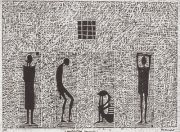 |
| Drawing "Standing cells" by the Slovenian surviver Bogdan Borcic. The standing cell, tiny cells where the prisoner wasn't able to sit down, were a punishment in the bunker. |
An estimated 20,000 prisoners, most of whom were sorted out in the prisoner sick bay were killed by an injection of phenol wich was thrust into the heart of them. Also thousands were killed by a shot through the neck at the Black Wall in the courtyard of Block 11. Others were hanged on the gallows, suffocated in the gas chamber, tortured in medical experiments to death, killed during the Roll Calls, or often drowned at work places. In the overall balance of the victims of Auschwitz, it seems almost ludicrous that in the context of action "14f13", they were selected from the sick of all other concentration camps to be eliminated, in July 1941, in Auschwitz 575 prisoners were chosen in the killing with poison gas at Sonnenstein in Saxony .
The dead had been brought in the early summer of 1940 to the city of Gliwice (Gleiwitz) crematorium for cremation before the crematorium of the main camp was put into operation in August 1940. As early as 1941, the dead of the camp were registered by the camps own own registry office. [This was done as a precaution not to show publicly the high rate of deaths. which occurred in he camp.sic]
In October 1941, a trial gassings commenced of Russian prisoners of war and often other detainees in the basement of Block 11, the first killings with Zyklon B took place in the morgue of the crematorium . Prior to commissioning of the killing venue in Birkenau in the spring of 1942, especially larger transports of Polish Jews from Upper Silesia were asphyxiated with Zyklon B which took place in the crematorium of the main camp.
An estimated 10 to 20 percent of the prisoners of Auschwitz were rescued. The question of how and often why they have survived despite their almost unavoidable death, this has in freedom occupied them for the rest of their remaining lives. Among many reasons, which owed the few to survive, were luck and chance and often above all, the help and moral support encouraged and highlighted by fellow prisoners.
 |
Helene Melanie Lebel, was a young Austrian woman who loved to swim and go to the opera. In her late teens she developed mental illness and later had a nervous breakdown. When she was just 29 years old she became a victim of the Nazi’s T4 euthanasia programme. Forerunner to the Final Solution: The euthanasia programme had begun with lethal injections by doctors .In order to speed up the process a new method was sought and gassings were implemented.
|
CAMP CONSTRUCTION AT BIRKENAU.
(Researcher Verenaa Walter
During his visit to Auschwitz on March 1, 1941 Himmler announced on the site of the village of Birkenau, about three kilometre away from Stammlager to build a camp of previously unknown proportion in the concentration camp system for the dimension of 100,000 prisoners of war. After a visit of Hans Kammler - Boss of the Main Office - Budget and Construction - in October 1941 this plan was already obsolete because at this time a camp for 200,000 people were targeted. This second plan was confirmed in August 1942, the head of the special construction and management, SS-Sturmbannführer Karl Bischoff. [The construction work at the Auschwitz complex continued until November 1944. At this point, Himmler gave the order to halt the extermination of the Jews there, and the Germans began to dismantle the extermination facilities in order to conceal all traces of their crimes. Later, the Germans dismantled further sections of Birkenau, but when the Red Army arrived on January 27th, 1945, most of the Birkenau camp and with it, the architectural plans were still intact.sic]
The inhabitants of Birkenau were 'resettled' in April 1941. The 'command structure' Birkenau' pulled in the last quarter of 1941 from existing buildings everything down, sorted the materials and used them for the construction of future prisoner barracks. The 'Central Construction Office of the Waffen-SS and Police' was responsible for the entire development of the camp complex of Auschwitz I and II. Prisoners worked in others spheres of the complex, in the reclamation of the land, they built a road right up to the camp gate at Birkenau or cleaned the stones of the demolished houses from their remaining mortar. Because the Birkenau site was a swampland, the prisoners were also used to gruelling levelling and drainage works. Auschwitz-Birkenau was renamed up to 31 March 1944 under the name "POW camps", without ever having found such use. Instead Birkenau
served since 1942 as an extermination camp for the mass killings of Jews from all over Europe.
According to the plans of the new camp at Birkenau which was originally intended for four building sections for 60,000 inmates (BI-IV) (except BI in only 20,000) accommodating people. On the individual camp plans it should be divided in camp portions. 1943 the camp sections in the field of BI plus II were successively completed. Auschwitz -Birkenau remained throughout the period of its existence constantly under construction plus it never reached the configured scope. The structure of B-III (Mexico) was cancelled in April 1944, they would no longer start building section B-IV . In Birkenau' initially there should have been 600 objects in receiving, housing, sanitation facilities created, of which about 300 barracks and economic buildings and latrines were built . There were also the 'ramp', four gas chambers plus crematorium plus 13 kilometre sewage pipes were laid laid werewolf. [The waste eventually was directed and finished up into the river Weichsel.] Overall the Birkenau comprised about an area of 140 hectare before tits dissolution.
THE MEN'S CAMP (B Ib and B II d) IN Birkenau (Researcher Angalika Köningseder)
The construction of Birkenau had begun with the design of the camp section B Ib. From March 1942 to July 1943 it was here that the men's camp was located. The SS, on March 1, 1942 moved, 945 Soviet prisoners of war and and some Polish prisoners into brick barracks which was first provisionally secured, they had the prisoner - (working commandos) by forced marches taken daily from the main camp to Birkenau. From the beginning at Birkenau it was a place of death and slow destruction. The former prisoner Karel Stransky described the relocation of 1,200 patients from the main camp to Birkenau. "We learned that on March 13 the relocation of the prisoners should be taken into the new camp [...] From the intended liquidation of the protection block (Schonungsblock) we had previously obtained from the office the knowledge and we succeeded so that at the last moment, to achieve the release of some prisoners from the protection block [...]. [...] On 13 March, it was still winter, the ground frozen and I would say that was a great experience for me the way from Auschwitz to Birkenau, not because of the physical effort, but due to the special strenuous experiences.
 |
| The main entrance of Birkenau (1945) |
On this day the prisoner (March 13) of sick-blocks (Nr. 20 and 21), as well as the Recuperation Block (Schonungsblock) were chased and cleared without preamble and on the double marched (getrieben) out of them with most of the prisoners and some hundreds of them on foot to Birkenau. I'll never forget the mass of these completely exhausted prisoners in wooden clogs (Holzschuhen) and only in underwear (excluding outerwear) partly running bare-foot and went to the place of their destination. The horror of these columns with the human shadow reinforced by the presence of trained dogs, which the SS-Escorts and Guards used for crowd control. The whole road was strewn with captives who had collapsed and who could no longer walk, they remained among with the dead. Both the ones as the others were thrown onto a cart ". [APMAB, Report, Vol. 84, page 49, according to Stzelecka, men's camp in Birkenau, page 253ff]. Most of the prisoner that went in this manner to Birkenau died in the following weeks of exhaustion or hunger, others froze to death or were tortured until they died. "The worst were the Sundays", describes the former prisoner Czeslaw Ostakowitz. "At the gate itself a bunch of young SS men gathered together who had received no pass for that day. From their conversation we had our fears and worries, everyone made some attempt to save his own life. They stared at the tight-standing prisoners as in a revue. Then they chose one of us. A blow was heard. Their game had started. I remember many such games. Kapo Rudi would hit a prisoner with a spade on the head. This was nothing new, but this time he hit the selected inmate comparatively lightly. However, he was hammering so long on the head, until the beaten prisoner was weak, disoriented and fell. Then the 'Swinging' was played. As the victim's neck was lying on the ground they put a shovel handle under him and rocked him, until the larynx broke and gave no further signs if life. Alois, the former chief of block 17a, gave lessons in swimming, this was his own invention. He ordered one prisoner chosen to lie face down on the ground and to move his arms like a swimmer. With one foot, he positioned himself on the back of the prisoner and with the other foot he pushed him into a puddle. If the victim would no longer twitch, Alois looked with feigned astonishment that he was dead. All a game for them of perverse entertainment on a boring Sunday. Although Alois was an Inmate Functionary himself. [Czeslaw Ostakowitz, in: APMAB, memories, Vol 33, page 104, after Stzelecka, page 253 ff]
Since the end of March 1942, the SS accepted transports directly into Birkenau , which was camp section B Ib . One of the first transports brought 1,112 Jews from Compiegne (France) to Auschwitz. The admission formalities were still taken place in the main camp . Jews, who were 'selected' by the SS on their arrival as fit for work were also admitted from July 1942 into this camp section. The prisoners were registered in the receiving block (No. 22) and then came as a work detail or into a quarantine-block, where SS guards and prisoner functionaries beat newcomers into rag-dolls, a foretaste of things expected on a future basis.(Some did not survive the beatings)
 |
| The sauna building shortly after completion in 1942. In this building those prisoners selected to work would be processed. They would be shaved of all body hair, disinfected, showered in either freezing cold or boiling hot water and then given their striped camp uniform. |
Most in the spring and summer of 1942 those prisoner craftsmen and the ones partly trained went to Birkenau and were distributed into numerous commandos as forced labourers in the establishment of camp section B Ib and the construction of B Ia, and complete B II with its crematoria. Approximately 1,200 prisoners were members of the levelling commando that had to pave the huge area with very simple equipment. Sewerage and drainage ditches meliorations (Improvement) commandos were active. The relocated prisoners from the main camp in the section B Ib in May 1942 which was the the Penal Company (Strafkompanie) which undertook the Main Sewage Ditch (Hauptwässerungsgraben) cynically called by prisoner Königsgraben, [an old meaning, it is a place where the King walks on his own to relieve himself] with which the water should be drained into the Vistula (river Weichsel). The murderous conditions were the cause of escape attempts. From the penal company on 10 June 1942, in which, however, only nine prisoners managed to escape. In retaliation, and show as an example, the SS executed 350 prisoners at random. Because of the severe working conditions and the road construction, the unloading and the trolley commandos were most feared. In March 1942, in the camp section B Ib 1,387 prisoners died , 1,381 in April, 2,028 in May, 2,675 in June and from 1 to 19 August 1942 a total of 2,529. 20 prisoners, however, managed between March 1942 and July 1943 to escape from the men's camp.
 |
| Crematorium III functioned from June 1943 through November 1944. |
In the camp section B Ib during the year 1942, 27 living quarters -15 brick barracks and twelve wooden barracks with latrines and wash-rooms, a kitchen, a bathroom and a clothes magazine had been built. SS-Obbersturmführer Johann Schwarzhuber led the men's camp at that time.
[SCHWARZHUBER, Johann SS-Obersturmführer Schutzhaftlagerführer (Deputy Commander) in Birkenau.
Like many other leading SS men who made important careers in the concentration camps, Schwarzhuber came from Bavaria. In March 1933, he joined the SS. He began his career in the KZ Dachau in 1933, where he first performed sentry duty and later worked as a Blockführer (head of a prisoners’ barrack). In 1938, he was transferred to the KZ Sachsenhausen, where he was Rapportführer.
In September 1941, he was assigned to Auschwitz and in March 1942 he was appointed Schutzhaftlagerführer (Deputy Commander) of the Men’s Camp in Birkenau. Schwarzhuber stayed in Birkenau until November 1944. He had probably hoped that the big changes in command that took place as part of the preparations for the "Hungarian Action" in spring 1944 would have promoted him to Commandant of Birkenau; however, this post was given to Josef Kramer.
Survivors described Schwarzhuber in very different ways. He could send thousands to their death without any show of emotion, yet at the same time do anything to save a few. So, for example, during the liquidation of the “Theresienstädter Familienlager” (the Family Camp for Jews from Terezin /Theresienstadt) when it is said of him that he saved about 78 children from a certain death by simply placing them in the Men’s Camp. Witnesses often saw Schwarzhuber drunk at selections and they also mention his love of music. The camp orchestra once arranged a small concert for him on his birthday. His wife and their two children attended the concert. In November 1944, he was again sent to the KZ Dachau and made responsible for certain sub-camps. On 12 January 1945, he was transferred to the KZ Ravensbrück as Schutzhaftlagerführer. Here he was directly responsible for the gassings that took place during the last months of this camp. Immediately after the liberation of the camp on 29 April 1945, Schwarzhuber was arrested. In the Ravensbrück-process he was sentenced to death and hanged on 3 May 1947.sic]
The barracks 7 and 8 were described by the SS since the summer of 1942 as a prisoner infirmary, although the detainees initially stayed there but no medical care was available. Number 7 barracks served as a collection centre for the debilitated and sick that, if they had not died already at the place, were dragged for killing in the gas chambers. In the barrack 8 the SS doctors 'selected' prisoners for the gas chamber or killed them by phenol injections. However, some functionary prisoners tried to set up a medical supply in Hut 8. By the end of 1942 the prison infirmary was extended to the wooden barrack number 12.
 |
| Auschwitz-Birkenau prisoners disinfecting clothes from new arrivals to the camp. Many of these items of clothing would be sent to Germany and given to German citizens' |
The camp section B Ib served until July 1943 as men's camp at that time, yet some female prisoners were housed there as well. The new men's camp at that time was established in the camp section B IId, on which 40 wooden barracks (including 38 horse stables) were finally completed, in which the prisoners were sent as from July 10, 1943. The prisoners were moved into the Krankenhaus (Hospital), camp section B IIIf. Camp leader was Obersturmführer Schwarzhuber. At this time lived in the men's camp about 11,000 mostly Polish, Jewish and non-Jewish prisoners. 1943/44 there were further Polish political, but especially Jews as 'fit for work' selected prisoners from all over Europe in the camp section B IId. On 20 April 1944, in the men's camp there were 7,985 inmates, on 28 August 10,747, about 2,000 prisoners held, on October 3rd, and mid January 1945 about 9.387 were still listed on roll call records. The Jewish prisoners lived in constant fear of falling victim to a selections. During the first event in the men's camp at that time from B IId on 29 August 1943, the SS categorized approximately 4,000 Jews unfit for work and had them disposed off [the German text reads murdered] in the gas chambers. The prisoners were from early summer of 1944 used for demolition and clearing work in Birkenau. Others dismantled old aircrafts, detailed in different working groups, weld-cutting obsolete or damaged military equipment in plants at the German factories or used on assembly lines. Others were taken to the dreaded Sonderkommando at the crematoria. The men's camp at that time was evacuated on 18 January 1945...
THE WOMAN CAMP (B Ia) IN BIRKENAUi (Researcher Franziska Jahn)
Until the transfer of the women's camp at Birkenau on 6 August 1942 within one month further 8,000 women were admitted, including about 4,300 Jewesses from French camps and 1,939 Jewesses from the Dutch transit camp of Westerbork. All incoming since 2 July 1942 RSHA transports were subject to selections. Pregnant women and mothers with children were destined for the gas chamber.
If the pregnancy but was only noticed after admission, the SS killed the babies usually immediately after birth or they died quickly because of the inhumane living conditions. One of the few cases where it was possible to protect a baby until the liberation, happened only in individual and rare cases, such as that of Anna G. [as I have previously described]
The relocation of the women's camp from the main camp (Stammlager) to Birkenau to the front of camp section B Ia, to the left of the entrance gate took several days. On August 10, 1942, the resolution of the women's division began from the main camp. First, the work details were relocated. The remaining blocks to of the main camp, not the work scheduled women and the sick and convalescents in the area and to of the (Schonungs) barracks, the SS underwent of the hitherto largest selection of this section. Approximately 13,000 women were taken by foot to the Birkenau camp. By the end of the year another 10,000 female prisoners, among others displaced (i.e forced resettlement) women and girls from the region of Zamosc, victims of the Germanization were registered. On December 1, 1942 from the 26,286 known women were still alive, only 8,232 of them were listed as survived. Especially Jewesses were frequently victims of selections at Birkenau . Others died of typhus, to abuse or exhaustion, hunger and thirst.
The camp section B Ia in Birkenau and particular the open extension through the adjacent, previously cleared men's camp B Ib in July 1943, served until November 1943 as a women's section within the concentration camp complex of Auschwitz. In the camp section B Ia there were initially 15 stone and 15 wooden barracks to house the women . A little later five latrine ditches and particular washing barracks were installed, which replaced the open latrine ditches. {Thesis were originally open pits]. After the merger with B Ib, most of the wooden barracks section B Ia were converted into hospital barracks . Women incapable of working and particular Jewish women already selected in the barracks surrounded by a wall of building 25, the so-called death block, pushed tightly together together to capacity then killed in the gas chambers. Reference: (Strzeleck / Setkiewitcz, expansion and development, page 103.)
 |
Map of Auschwitz-Birkenau
Birkenau was one of the sub-camp of Auschwitz. The "main camp" was located directly in Auschwitz. There were also 39 additional external commands, et al the camp "Monowitz" in the vicinity of BUNA-work.
Note the white horizontal line in the lower third of this was the open so-called "ramp" near the railway. It was here that the open "selections" were held. The able-bodied prisoners went north into the camp, not the open able-bodied prisoners, (the sick, the elderly, children) went west to the two gas chambers connected with crematoriums the remains of which are still recognizable as debris in the grove.
See more KZ: www.burgen-web.de/auschwitz.htm
|
 |
| A pre-war photograph of ALA GARTNER who was hanged for her part in the smuggling of gunpowder into Auschwitz-Birkenau during the Autumn of 1944. The Sonderkommando used the the gun powder to destroy Gas Chamber and Crematorium IV at Auschwitz-Birkenau. |
On 10 June 1942 a group of Polish prisoners in a work detail attempted to escape whilst constructing a drainage ditch at Auschwitz-Birkenau. Very few got away. The SS shot twenty prisoners. To prevent future acts of resistance and in revenge, more than 300 Poles were eliminated {text reads 'murdered'] in the gas chambers.
The most ambitious uprising at Auschwitz-Birkenau involved the actions of 250 Jewish Sonderkommando on 7 October 1944. They set fire to one of the crematoria. They managed to cut through the fence and reach the outside of the camp. The SS surrounded them. In the fight that followed, they managed to kill three SS guards and wound 10 of them. All 250 Jews were killed.. One of the work camps made arms for the German army. The SS discovered that four Jewish women had stolen explosive material from this factory and given it to the Sonderkommando. The women were captured and hanged in front of other prisoners – again as an act of revenge, but also to stop others resisting. HKS
THE THERESIENSTADT FAMILY CAMP AT BIRKENAU (Researcher Franziska Jahn)
PROLOGUE
Theresienstadt served an important propaganda function for the Germans. The publicly stated purpose for the deportation of the Jews from Germany was their "resettlement to the east," where they would be compelled to perform forced labour. Since it seemed implausible that elderly Jews could be used for forced labour, the Nazis used the Theresienstadt ghetto to hide the nature of the deportations. In Nazi propaganda, Theresienstadt was cynically described as a "spa town" where elderly German Jews could "retire" in safety. The deportations to Theresienstadt were, however, part of their strategy of deception. The ghetto was in reality a collection centre for deportations to ghettos and killing centres in German-occupied eastern Europe. Succumbing to pressure following the deportation of Danish Jews to Theresienstadt, the Germans permitted the International Red Cross to visit in June 1944. It was all an elaborate hoax. |
| Wash Room constructed at the Little Fortress of Terezin for the Red Cross visit. It was never used' |
 |
| Theresienstadt concentration camp archway with the phrase "Arbeit macht frei" (work makes (you) free), placed over the entrance in a number of Nazi concentration camps'. |
Theresienstadt was located in North Bohemia and served initially since 24 November 1941 as a collection and transit camp for Jews from the Protectorate of Bohemia and Moravia. Since July 1942, the 'old-age ghetto' Theresienstadt was the deportation target of 42,921 elderly, prominent and many decorated with war medals of the First World War, Jews, so called by 'date of application' Jews and Jewish spouses of dissolved of 'mixed marriages' from Germany and Austria. In fact, Theresienstadt was for this group only one stop on the way to extermination.
The first transports from Theresienstadt to Auschwitz took place between January 20 and February 1, 1943. More than 5,600 of the 7,001 deported Jews died in the gas chambers of Birkenau . This was followed by an order from Himmler of the 6 September 1943 to temporary stop the scheduled transports of elderly Jews. On this day, just two transports with 2,479 and 2,528 prisoners respectively left Theresienstadt for Auschwitz. The aim of the September order was a mere precaution to remove especially young Czech Jews who had the potential to organize resistance cells within the camp and thus prevent an uprising by having them removed..
After their arrival at Auschwitz-Birkenau they were not, as with Jewish transports from July 1942 to Birkenau as usual, selected, rather all - men, women and children - were directed to the camp section B IIb, which was called: the "Theresienstadt family camp" . The section was about 600 meter long and 130 meter wide, surrounded by barbed wire and a drainage ditch, the section consisted of 28 prisoner barracks, a school and kindergarten barrack (block 31), two infirmaries (barracks 30, 32) and a weaving mill. As Rapportführer acted Unterscharführer Wilhelm Fritz Buntrock, who was feared among the prisoners. After the war, he was sentenced to death and executed.[Fritz Buntrock (died January 28, 1948) was a SS-Unterscharführer at Auschwitz. He was prosecuted at the Auschwitz Trial. Buntrock was tried by the Supreme National Tribunal in Krakow and sentenced to death. He was hanged in Montelupich Prison on January 28, 1948.sic]
With the arrival of the September transports some barracks were not yet finished. It lacked especially of beds. Prisoners of the September arrival portrayed the arrival and transport conditions in the camp. They had to leave their hand-luggage behind. Their own clothing remained in the sauna, before they were taken into the barracks, although some were given wooden shoes, others went barefoot back to the camp section. The male prisoners and young people were taken into barrack-blocks with even numbers, women and girls taken into barracks blocks with uneven ones, so quotes Alfred Milek, of his first impressions. Jiri Steiner, a former prisoner, reported: 'At the railway station we were immediately chased out of the wagons, dragged out under howling and screaming [...] and taken into barracks'. At night the registration and tattooing of people by members of the SS-political Department took place. In the early morning hours, other prisoners had a cleaning of some sort in the sauna, where their hand luggage, as before, was retained. Here, all their hair was cut. After undressing and washing the prisoners received, not the striped prison uniforms [...], but civilian clothing.Â
 |
| Jews to Theresienstadt under the supervision of German policemen from the city of Pilsen'. |
 |
| Distribution of wooden clogs to deportees during the deportations from the Lodz Ghetto' |
 |
| A photograph of Jewish children in the Theresienstadt ghetto taken during an inspection by the International Red Cross. Prior to this visit the ghetto was "beautified" in order to deceive the visitors. Czechoslovakia, June 23, 1944' |
--------------------------
THE GYPSY CAMP (B IIe) IN BIRKENAU (Researcher Miriam Bistrovic)
PROLOGUE:
CONDITIONS
On February 26th 1943, the first transport arrived with Gypsies from the Reich into the still unfinished gypsy camp in section B IIe of Auschwitz-Birkenau . After the new arrivals were registered with a separate number series starting with "Z",[meaning 'Z'igeuner, the German word for Gypsies] they had to build the camp facilities. They erected 32 wooden huts of the type 260/9 so called 'pre-fabs and re-placeable horse stables, usually without windows', which had to accommodate 1,000 people in the coming months. Along the camp road there were 16 barracks erected on each side, on the left side they had been marked with even numbers, on the right side with uneven block-numbers. In addition to this two kitchen barracks were completed, and a storage shack. The Block Leader's room was already outside this section and from the first July 1943 separated by an electric fence, which limited excess to this this part. At the other end of the rows of barracks arose some wash-rooms, a latrine, and in late summer of 1943 an operational 'sauna' with showers and a room for the disinfection of clothing had been completed . However, improvements of sanitary conditions in the camp did not stand through synthesis buildings. The latrines were emptied only irregularly, and water-pipes through which would flow, yellow germ-contaminated water was postponed until months later to the wash-rooms. The blocks 1,2,3 and 8 held the warehouse offices, which included the Political Department, a clothing store, a food storage hut and a canteen. There, inmates could purchase against Reichsmarks, cigarettes, additional food and soap. For most prisoners, these desirable goods were prohibitive, so they were dependent on allocated food rations only. Five prisoners had to share daily one Kommisbrot [Expression for a standard German Army bread loaf]. In addition, each adult received a spoonful of jam, half a kilo, either boiled or raw turnips and the occasional bit of sausage and margarine.
Of the remaining barracks, all windowless apartment blocks were initially used . Their roofs were often leaky, and the floors were usually made of clay, which was later covered with cement or bricks. Each family had a platform (Pritsche) with two blankets regardless of the number of persons within a family. As a result of overcrowded barracks, inadequate sanitation and poor nutrition, diseases of epidemic proportion broke out . The most common findings were scabies, measles, tuberculosis, and abdominal typhus, smallpox and what affected mainly the children was primarily Noma (water cancer). In order at least to separate the healthy from the sick, two barracks were used as hospitals, which were overcrowded in a short time. In autumn 1943, the infirmary complex included the former residential blocks, 24, 26, 28, 30, and 32, whose structure hardly changed despite the new use. 400 to 600 patients were housed per block. In the back of the rooms, a lavatory, a shower room, a provisionally kitchen and a makeshift morgue which had to absorb an average of 30 deaths per day, had been provided.. Although 30 prison doctors in addition to 60 helpers took care of the sick, by April 1943, the mortality rate did not fall, there was a lack of clean water, medicines and dressings.
 |
| 'Gypsy children suffered from an illness called Noma' |
On March 23, 1943 1,700 Roma from Bialystok arrived in Birkenau. They were typhus carriers and without registration or in depth investigation, isolated and put into blocks 20 and 22 and suffocated with gas as a closed group Approximately 16,000 Sinti and Roma were deported up to the end of May 1943 into the overcrowded gypsy camp, until a decree of the Reich Criminal Police Office on May 15, 1943 came into force, that ongoing admissions into B IIe 'until further notice' to be avoided, due to the risk of speeding the disease.
Meanwhile, the camp administration tried to isolate the typhoid epidemic by more murders [i.e.gassings]. So on the 25th May 1943 there were 507 men and 528 women who been held as suspect typhoid-carriers, killed. At the end of 1943 70% of the inmates lived no longer. The remaining Sinti and Roma now had to move on the right side of the camp road into the blocks, while on the left about 1,000 Hungarian Jews were quartered until their elimination [murder] beginning in July 1944.
On 15 May 1944, the camp commandant decided the liquidation of the Gypsy camp. The next night, the SS surrounded this section and ordered the inmates to leave the blocks. Only a fraction of the Sinti and Roma obeyed the command sequence and were transported to the crematoria. The majority had heard of the intention of the SS and barricaded themselves with 'weapons', like', crowbars, spades, knives and stones . Since the SS had not expected resistance, they broke off the action. Eight days later, on May 23rd 1944 former members of the Wehrmacht were listed with their families in the camp-office and routed alongside with other 'fit for work' prisoners from the gypsy camp into the blocks 10 and 11 of the main camp, from where they would be deported to other concentration camps , Also a part of the Polish nursing staff was removed from the hospital and transferred to other compounds of the camp complex. (There is no indication given as to the reason of members of the Wehrmacht and their families had been held there, other than Kladivova's writing in: Sinti and Roma, page 314)
 |
| :LOCATION OF THE VARIOUS CAMP FACILITIES WITH REGARD TO THE TOWN OF AUSCHWITZ |
 |
| Registry book of the Gypsy camp" |
RESISTANCE AND ESCAPE (Researcher Claudia Curio)
In the years up to 1942, when the prisoners were still predominantly Polish, especially the Polish political prisoners, they built various underground organizations that eventually combined with the Home Army (AK,) . The name is identical to that of all Polish oriented and operating sections throughout the Polish government in exile under their greater Polish professional resistance organization, this clarified the Polish national policy of an important resistance group in Auschwitz. In addition to the Home Army, there existed communist and other left-wing Polish groupings, which later emerged into an organizations that were supported by the different nationalities represented in the camp and usually leaning towards the left. A group of Jews and non-Jews were represented from many European countries and was dominated by former Spanish fighters , created after 1941, by the Austrian Ernst Burger. In most groups, Jews were members, but it was beyond establishing an explicitly Jewish underground movement. In 1943 a change took place which combined most of the Polish and international groups into the 'Kampfgruppe Auschwitz' under the leadership of two Polish and two Austrian prisoners.
 |
| A concentration camp survivor, this Polish man is seen weeping near the charred corpse of a friend, burned to death, by flame-throwers while trying to escape |
[ERNST BURGER
[...] In November 1938, he was arrested once again - this time by the Gestapo. He was sentenced to two years and eight months penitentiary and transferred to Auschwitz concentration camp on December 6, 1941 with the prisoner's number 23 580. In Auschwitz, he was very active within the camp resistance and became the leader of the international "Kampfgruppe" (Battle Group Auschwitz). After a failed attempt to escape, he was hung on December 30, 1944 together with his two Austrian friends Rudolf Friemel and Ludwig Vesely on the roll-call ground in Auschwitz I. sic]
The actions of organized resistance, the supply for vulnerable prisoners from 'Canada' or the pilferage from SS food stocks, were taken at great risk, or the support of operating resistance groups outside the camp in smuggling food and medicines. The decisive factor was the occupation of inmates and the relevant information from the SS-Administration, writing rooms, food storage and infirmaries of the prisoner, who were actively employed there (and became the important sites of resistance) with members of the underground. Only in this way was it possible to divide the elderly, young or sick for lighter work details to prevent selection or to plan escapes. This is how Hermann Langbein, a central figure of the resistance and leading member of the 'Battle Group Auschwitz', in his capacity as secretary of SS-state physician Eduard Wirths actively worked in the interest of prisoners. Another important task was to identify and eliminate the spies and informers among the prisoners who collaborated with the Political Department, or side-lined particularly brutal block elders or Kapos. Sabotaging of German industrial companies, employing prisoners. In the German armament plants interruption of production had been been so effective that the productivity in a few months fell by 50 percent.
As of 1942, the Armia Krajowa (Polish Home Army) considered an armed uprising of all prisoners. However, such undertaking was only possible with the support from the outside, i.e. by the Polish resistance movement. During 1944 with the advance of Soviet troops and in connection with a plan to a Poland-wide uprising against the retreating German troops, the jointly appointed Military Council by the Home Army and the Battle Group Auschwitz, dealt with plans initially for a general revolt in Auschwitz, which, however, was never carried out. Yet there were minor revolts of groups of prisoners, usually in imminent danger of death while preparing to flee, such as on 10 June 1942, by Polish members of a penal company in Birkenau, which failed and as a consequence the SS shot 300 Poles from this company, another group group were Soviet prisoners of war on 6 November 1942 also in Birkenau, in the course of their attempt only a few managed to escape.
 |
| A report from a local police station in Oświęcim considering the revolt of prisoners from the Sonderkommando on October 7, 1944. It says about an escape of "a large number of prisoners" from the Sonderkommando at 2 p.m., a description of the prisoners and information that some prisoners were shot during the chase. At the end the report says that 4 prisoners were not captured at that time. |
ROSA ROBOTA
[One of those arrested, the female Polish Jewesses Roza Robota worked in the personal effects camp, which bordered on the compound of Crematorium IV. Roza Robota accepted from one of her fellow prisoners explosive materials stolen by Ella Gartner, in the Weichsel –Union Metallwerke plant (Deutsche Rüstungsindusrie) and passing it on to Wrobel, who was a member of the Sonderkommando.
On the 6 January 1945 in the evening four female prisoners Ella Gartner, Roza Robota, Regina Safir and Ester Wajsblum are hanged in the women’s camp of Auschwitz. The execution takes place in two stages, two female prisoners are hanged during the evening roll call, in the presence of the male and female prisoners who work the night shift at the Weichsel –Union munitions plant.
The other two female prisoners are hanged after the return of the squad that works the day shift. SS- Obersturmfuhrer Hossler reads out the sentence, and screamed that all traitors will be destroyed in this manner.sic]
.jpg) |
| Photograph A picture 'from the college years' |
Her name was Franceska Mann, the shots she fired should have been a signal for the other women to attack the SS men; one SS man had his nose torn off, and another was scalped. However, different accounts say different things; in some, the SS-men Schillinger (he died on the way to the camp hospital), and Emmerich are the only victims. (Emmerich survived, but was crippled for life) Reinforcements were summoned and the camp commander, Rudolf Höss, came with other SS men carrying machine guns and grenades. According to Fillip Mueller, all people not at that time inside the gas chamber where mowed down by machine guns.[ In most cases the SS would use and were individually issued with the MP's 38, which were more effective in close quarters than a machine gun]. Due to various conflicting accounts, it is unclear what truly happened next; the only things that are certain, on that day Schillinger died, Emmerich was wounded, and all the Jewish women were killed.
On the initiative of the 'Battle Group Auschwitz' prisoner data was transferred to the Polish underground in June 1943, with instructions to send them to free countries and ask for Food Parcels, possibly though the International Red Cross. The subsequent incoming packets strengthened the prisoners not only in practical, but also in moral terms.
One aspect of the resistance was to document the crimes in the camp by the underground organization and individual prisoners. In addition to the writing of reports and messages and the copying of drafts or the theft of SS documents also was part to the smuggling of this information out of the camp. With the aid of conspiratorial resistance contacts that operated outside, much of this information was being smuggled by partially encrypted secret messages, which provided information about the extent of the crimes reported, such as lists of names of victims, photographs of the gas chambers and a list of names of SS men in charge of these operations. This was passed in part to the Polish government in exile, to the Allies, and the Polish resistance movement at large. The BBC published in 1944 on strength of such Information a 'hangman's list' with the name of the official directly responsible for the destruction processes in the camp. As a consequence the so called 'Moll Plan' of the SS, which meant to be implement in the second half of 1944, and called for the bombing by the Luftwaffe of the remaining facilities including those prisoners that had been left behind after the liquidation of the camp, to cover up the traces of the crimes, in view of Soviet troops approaching rapidly. The governments of Britain and the United States tried to intervene together with the Polish government in exile and issued a statement in which they made the plans public and were threatening punishment. This statement was broadcast on 10 October 1944. Probably it was the reason why the 'Moll-Plan' was not implemented and thousands of people, mostly Jews, had been saved. [Although many Germans listened to the BBC at the beginning of the war, which Reuter accurately and correctly reported, unfortunately in later years it became a propaganda tool]
 |
One of the secret letters of the camp which went to the Archives of the PMA-B.
53 original camp secret messages went to the Archives of the Auschwitz-Birkenau State Museum. Among them are copies of the camp's morgue books, or lists of names of those who were murdered in gas chambers. A few secret letters are materials previously unknown to historians of the Museum.
|
The escapes from the camp was, if they succeeded, the only form of resistance that could actually save lives permanently, yet often short-lived. Attempted escapees had to break through a sophisticated security system of the camp, to penetrate the small and large safety ring, followed by an electric barbed wire which located behind the 'neutral zone', and shots were fired without warning (even at shadows during the night) and surrounded by small retaining fence. As these obstacles seem almost insurmountable, but sometimes breached, there was then for the escapee the outer security zone, there a the well defined 40 square kilometre large 'area of interest' around the area of Auschwitz. Once an escape was noted, motorized SS-Units with dogs began searching the surroundings, the overall security was amplified and watchtowers of the outermost codon occupied. This state of alert was maintained for three days if the fugitive was not taken before. Only a well-organized escape had a chance of success and was likely to succeed by lying in wait outside the camp jobs. Without cooperation from active underground groups near the camp which provided them a hiding place, clothes and papers, but longer survival of the rapidly recognizable cropped hair, tattooing and emaciated and gaunt appearance and often the lack of the knowledge of the Polish language, a flight of an inmate looked hardly possible, although the Polish population of the surrounding villages helped the escapee, at least when it came to a polish citizen, and had been very helpful. (A total of 144 managed a successful escape) [This did not apply to foreign Jews, they were often mistreated or even betrayed.]

On 20 June 1942 between 3 and 4 p.m., four Polish prisoners working in the garage of the troops' supply depot escaped from the Auschwitz camp. They were: Kazimierz Piechowski (no. 918), Stanisław Gustaw Jaster (no. 6438), Józef Lempart (no. 3419), and Eugeniusz Bendera (no. 8502). Three of them wore SS uniforms they stole from an SS storeroom, the fourth was chained like a prisoner. They left the camp from the garage in a Steyer Model 220 car with the license number SS-20868. 80 kilometres from the camp they left the car concealed in a pit. After the successful escape they sent the camp commandant a letter ironically asking forgiveness for stealing the car from him.
Other escape attempts ended less successful, such as the five members of the camp resistance, including Ernst Burger, on October 27, 1944. They should have been moved by corrupt SS passing out of the camp, but were betrayed, tortured and hanged in public at roll call. Relative momentous escape was that of the Slovak Jews Rudolf Veba (Walter Rosenberg) early April 1944 and some of Poles and Alfred Wetzler in the period November 1943 to May 1944. Vrba, Wetler, Jerzy Tabeau, Czeslaw, Mordowicz and Arnost Rosin wrote after fleeing based on smuggled documents a report about the camp that arrived in the West in November 1944 in the US and was published under the title 'German Extermination camps - Auschwitz and Birkenau'. This has become known in historiography as 'Verba-Wetzler report' or the 'Auschwitz protocols'.
In total, over 800 escape attempts by prisoners are known to have been attempted, mainly by Poles, Soviet prisoners and Jews. There were several hundred people who escaped during the evacuation, and the prisoner revolt. Auschwitz had thus a very high number of escape attempts, only surpassed by the Buchenwald concentration camp.
THE HUNGARIAN JEWS (Researcher, Brigitte Mihok)
For the largest extermination in Auschwitz numerous administrative, personnel and technological measures had to be taken. In addition to reinforcing the SS guards came from May 1944 some personnel changes came into effect and delegations of authority. The first commandant of Auschwitz, Rudolf Hoess, who had risen in the medium as head of the SS-WVHA to the Section D I-Central Office, and was appointed on May 8 until the 28 July 1944 as a temporary SS garrison elder to Auschwitz. After completion of his mission - the 'Höß Aktion'- he returned to Berlin on 29 Juli1944. Hauptsturmführer Josef Kramer replaced on 15 May Fritz Hartjenstein as commandant of Auschwitz-Birkenau. Hauptscharführer Otto Moll was transferred from the satellite camp Gliwice I (Gleiwitz) to Auschwitz and was appointed head of the crematoria.
 |
| Arrival in Auschwitz-Birkenau 1944-1945 |
Pictorial record Hungarian Jews arrive at Auschwitz May
When the foreseen camp capacity could not absorb the masses of newly arriving Hungarian Jews , those responsible reverted to improvisation. They used three camp sections and converted them into 'transit camps', into which those were taken who's fate had not yet been decided . Men and teens were in a part transferred into the family camp for 'Gypsy's' (camp section B IIe), later the entire camp section B IIe was determined as a transit camp for registered Jewish prisoners. The women and girls were housed in camp section B IIc and B III. Also in the camp section B IIg, where 30 Magazine Barracks had been located (Canada II), female prisoners were sometimes admitted into this part of the camp.
On May 2, 1944 arrived in Auschwitz I two irregular transports with 3,800 Jews from Hungary. Only 486 men and 616 women from this transport were registered and sent into the camp, the other 2,698 people were murdered in the gas chambers. [source: Czech, 'Kalendarium' page 764]. Between May 16 and June 8 arrived daily from three to four freight trains with about 12,000 Hungarian Jews in Auschwitz-Birkenau. Each freight train, comprised about 45 cattle wagons, in each were approximately 70 people crammed into them. From June 9 to July 11 transports arrived on a irregular basis, on some days only one or two trains were cleared, which created intermittent multi-day breaks in between. The German plenipotentiary and envoy in Hungary, Dr. Veesenmayer, announced on 11 July 1944 completion of 473,402 deportation of Hungarian Jews .
The Kastner train consisted of 35 cattle trucks that left Budapest on 30 June 1944, during the German occupation of Hungary, carrying over 1,600 Jews to safety in Switzerland. The train was named after Rudolf Kastner, a Jewish-Hungarian lawyer and journalist, who was a founding member of the Budapest Aid and Rescue Committee, a group that smuggled Jews out of occupied Europe during the Holocaust. Kastner negotiated with Adolf Eichmann, the German SS officer in charge of deporting Hungary's Jews to Auschwitz in Poland, to allow over 1,600 Jews to escape in exchange for gold, diamonds and cash.
Compared by Kastner to a Noah's ark, the train was organized during the deportations to Auschwitz in May–July 1944 of 437,000 Hungarian Jews, three-quarters of whom were sent to the gas chambers. Its passengers were chosen from a wide range of social classes and included around 273 children, many of them orphaned. The wealthiest 150 passengers paid $1,000 each to cover their own and the others' escape. After a journey of several weeks, including a diversion to the Bergen-Belsen concentration camp in Germany, 1,670 passengers reached Switzerland in August and December 1944.
Kastner emigrated to Israel in 1947. He was a spokesman for the Minister of Trade and Industry when his negotiations with Eichmann became the subject of controversy. Kastner had been told in April or May 1944 of the mass murder that was taking place inside Auschwitz. Allegations spread after the war that he had done nothing to warn the wider community, but had focused instead on trying to save a smaller number. The inclusion on the train of his family, as well as 388 people from the ghetto in his home town of Kolozsvár, reinforced the view of his critics that his actions had been self-serving.
The allegations culminated in Kastner being accused in a newsletter of having been a Nazi collaborator. The government sued for libel on his behalf, and the defendant's lawyer turned the trial into an indictment of the Mapai (Labour) leadership and its alleged failure to help Europe's Jews. The judge found against the government, ruling that Kastner had "sold his soul to the devil" by negotiating with Eichmann and selecting some Jews to be saved while failing to alert others. Kastner was assassinated in Tel Aviv in March 1957. Nine months later the Supreme Court of Israel overturned most of the lower court's ruling, stating in a 4–1 decision that the judge had "erred seriously."
 |
| Kastner train passengers on their way to Switzerland' |
The expressly authorized order by Hitler commanded that a labour-force of 100,000 Hungarian Jews who were already deported to Auschwitz, was directly related with the increasing lack of labour since the spring of 1944 in the German armaments industry. The purpose of this new regulation introduced the 'Use of Jews' as well as the expertise acquired by the Ministry of Munitions by the allocation of concentration camp prisoners demonstrates the pragmatism of war economic needs, which was only apparently on the surface in contradiction with the ideology of the 'Final Solution'. Approximately 100,000 of the selected fit to work Hungarian Jews were sent from the end of May 1944. as 'Forced Labour' into the German Reich.
adttional - 26-12-2014
SONDERKOMMANDOS- (Researcher Amgelika Königseder)
By the end of 1943, the Sonderkommando constantly comprised of 400 prisoners who had to be constantly replaced because the SS just killed the sick and the weakened. The end of February 1944 until the arrival of the transports from Hungary in May the strength decreased to about 200 prisoners. On 28 July 1944, the Sonderkommando had its peak with 873 prisoners. For confidentiality, the prisoners were transferred from the men's camp B IId mid-1944 on the site of the crematoria. After the murder of Hungarian Jews, the Sonderkommando was reduced again. Because they knew as witnesses to the crimes that the SS just would not let them live, the rest of the Sonderkommando decided to revolt, in which 451 prisoners died on 7 October 1944. Only the crematorium III and IV assigned Sonderkommando prisoners survived the attempted uprising. The last about 100 prisoners of them were deported to Mauthausen on January 18, 1945. [Source Ibid, pages 219-224]
FINAL STAGE AND LIBERATION (Researcher Verena Walter)
 |
| Gross-Rosen entrance gate with the phrase, 'Arbeit macht frei' |
 |
| Gas chamber in the main camp of Auschwitz immediately after liberation. Poland, January 1945 |
 |
| Polish partisans from Kielce area - unit "Jędrusie" 1945 |
[On 20 January 1945, SS-Obergruppenführer Schmauser issued instructions to liquidate the remaining inmates. An SS detachment shot 200 Jewish women and then blew up the buildings that housed crematoria I and II. Under order from Schmauser, 700 prisoners from Auschwitz-Birkenau and other sub-camps were killed by SS units. The 1st Ukrainian Front of the Red Army arrived on 27 January 1945 and liberated the Auschwitz concentration camp. Nearly 8,000 inmates escaped death because the remaining SS units had fled as the Red Army arrived. On 10 February 1945, Schmauser was driving to Breslau when he encountered some German troops near Altenrode. They pointed out that the Soviet armoured spearheads had already broken through. For unknown reasons, Schmauser did not heed their warnings and drove on. He has been missing since that date. It is believed that he fell into the hands of the Red Army and was either killed immediately or executed later in captivity.sic]
By the end of October 1944, the last incoming transport from Theresienstadt was selected on the ramp at Auschwitz. In November 1944, Himmler ordered to stop the killings in the gas chambers of Birkenau and destroy all extermination facilities. The killing of prisoners by no means had stopped. Until the evacuation of the camp, the SS shot prisoners. Parallel to this, the organizational merger of Auschwitz and Auschwitz II-Birkenau into 'KL Auschwitz' was initiated and completed. Auschwitz III served from now on as 'KL Monowitz'. Monowitz was systematically bombed by the Allies from August, September and December.
On September 13, 1944, an attack flown by 96 B-24 Liberator bombers heavily damaged the I.G. Auschwitz construction site. The main camp and the Auschwitz II camp (Birkenau) were hit. In this air-strike, an estimated total of 300 people, including SS men, were injured and killed. A further air raid on December 18, 1944, heavily damaged the pump and compressor stations of I.G. Auschwitz. As an Allied assessment report mentions, five barracks of the concentration camp also suffered damage in the strike. The fourth air-strike on I.G. Auschwitz, on December 26, 1944, was rated a success by Allied aerial reconnaissance because of the serious damage done to the plant. The last attack by the U.S. Air Force took place on January 19, 1945, one day after the start of the evacuation of the camp complex, when the SS forced the prisoners to begin a westward death march.
 |
| Monowitz Buna-Werke Concentration camp-IG Farben factory within the Auschwitz III camp complex |
 |
| IG Farben plant under construction approximately 10 kilometres (6.2 mi) from Auschwitz, 1942 |
As of mid-1944, the camp SS of Auschwitz planned to eliminate all traces of the crimes committed there. In November and December, the demolition of the gas chambers and the furnace halls in the crematoria II and III was destroyed. The remaining architectural remains were demolished on 20 January 1945. The crematorium V was still in use until the middle of January 1945 burning corpses and blown up on 26 January 1945. For the laying of dynamite charges and blowing up the crematorium building, specially trained demolition commandos were used. The removal of the demolished ruins was not completely carried out and ruins were still there during the liberation of Auschwitz on 27 January 1945. Not all traces of the mass killings could be eliminated. At the same time the files of the camp administration were burned as much as possible. The SS also tried to use the effects of the prisoners in large quantities from the camp. Building materials such as bricks, lime or cement, and the makeshift wooden barracks were intended to be taken West. It was planned to re-construct a-new, crematoria II and III from Auschwitz-Birkenau at Mauthausen.
In January 1945, circa 67,000 people were imprisoned in the Auschwitz complex of which 35,000 lived in satellite camps within Upper Silesia working as forced labour in Armament Factories. 31,000 stayed in mid-January 1945 in the main camp and in Birkenau. Overall, until the final clearance in January 1945 over 100,000 concentration camp prisoners were evacuated from Auschwitz, of which up to 50,000 went to Germany.
On January 18, 1945 units of the Red Army had reached Krakow , thereupon the SS leadership ordered the final evacuation of Auschwitz, the last roll call took place on the 17 January. Between the 17th and 21st of January, the SS forced about 58,000 concentration camp prisoners from Auschwitz and its satellite camps along the main routes towards the 63 km away of Loslau- and the 55 km away Gleiwitz camps.. The emaciated prisoners were herded here partly into open wagons and transported to the Mauthausen concentration camp, Ravensbrück, Sachsenhausen and Bergen-Belsen. The prisoners from the central camp of Jaworzno, 30 km from Kattowitz, had to march over 250 km on foot in the direction of the Gross-Rosen concentration camp. Endless columns with thousands of prisoners were moving west. In the middle of winter, the emaciated prisoners were herded through Upper and Lower Silesia, March-unfit individuals were shot or clubbed to death on the spot by the accompanying SS personnel. The Auschwitz death marches fell victim from 9.000 to 15.000 prisoners.
 |
| Evacuation of Auschwitz prisoners in open railway wagons' |
 |
| The photograph is a still photo from a Soviet propaganda film about the Auschwitz liberation. The clothing warehouses, known as “Canada II,” are burning. But who set them on fire? |
 |
| Auschwitz After Liberation: Burying the Dead |
Credit: Wikipedia
References:
 ^ Berenbaum, Michael. "Why wasn't Auschwitz bombed?" Encyclopædia Britannica.
 ^ Wyman, David S. "Why Auschwitz wasn't bombed," in Gutman, Yisrael & Berenbaum, Michael. Anatomy of the Auschwitz Death Camp. Indiana University Press, 1998, p. 583.
 ^ "Bush Pushes Peace in Kuwait, Says U.S.should Have Bombed WWII Death Camp".Fox News.January 11, 2008. Hanns and Rudolf, Thomas Harding, section only
 ^ Media Blog on National Review Online
 ^ wymaninstitute.org/special-reports/Wyman Auschwitz Report 2012.Section IV Minutes of the Jewis  Agency Executive, 11 June 1944, 4-7, Central Zionist Archives
 ^ Wyman Institute.Special-reports/Wyman AuschwitzReport 2012.pdf Lichtheim to Gruenbaum, 19 June 1944, A127/1856, Yitzhak Gruenbaum Papers CZA.
 Main Source:
Der Ort des Terrors, C.H.Beck-München 2007, Vol 5 'Auschwitz, page 75, Researchers:Wolfgand Benz, Miriam Bistrovic, Claudia Curio, Barbara Distel, Franziska Jahn, Anglika Königseder, Brigitte Mihok, Verena Walter
Herbert Stolpmann