

PRELUDE
Oskar Schindler.
It was the winter of 1947/48 in Munich, Ted Feder, a former GI, was now Deputy Director of the Munich Office of the American Jewish Distribution Committee (AJJDC). His boss, Samuel L.Haber, called Ted into his office and told him: 'Ted, there is a German out there, he wants to see me. See him, see what he wants, and get rid of him'. When Ted Feder walked into the outer office, he saw a German sitting there in traditional Bavarian clothing: Winter Lederhosen with knee socks and a felt cap with a feather in it. As Feder uncomfortable approached the German, a side door opened and one of the office's workers, a Holocaust survivor, saw the German and cried out in Yiddish, 'Uns grettet, uns grettet (He saved us. He saved us). The survivor then fell to his knees and began to kiss the German hands. The German was Oskar Schindler..
At that time, Oskar Schindler was an impoverished former Sudeten German factory owner desperately searching for ways to survive financially during postwar hardships in Germany. With the exception of the 1.098 Schindlerjuden (Schindler Jews) who survived the war in larger part because of Schindlers efforts, few people knew of his exploits. Yet to many Schindlerjuden, he was already a god-like figure. This adoration was the basis for Schindler's extremely close relationship with many of his survivors until his death in 1974. 'My Jews or my children', as he often called them overlooked Schindler's human failings and continually searched for ways to help their flawed hero maintain in some semblance of a normal life, first in Germany, later in Argentina, and again in Germany. They helped him financially and looked for ways to honour him and tell the world about his unique efforts to save them during the Holocaust. The Schindlerjuden were driven, for the most part, by the deep love and admiration they had for him. When faced with Schindler's shortcomings, particular after the war, many would explain that it was these very character flaws that made him so effective during the Holocaust. In reality, their love for Oskar Schindler was so deep and reverential that some would simply shrug off talk about his drinking and womanising and say, 'Oh that's just Oskar'.
Yet who was this Oskar Schindler? Was he truly the revered saviour portrayed in Steven Spielberg's film "Schindler's List"? Or was he a womanising alcoholic with questionable business skills? The only way to answer these questions is to look at the complete life of this controversial figure.
Germany invaded Poland September 1st 1939, they took Krakow on the sixth, then home to 60 000 Jews, 26 percent of the city's population. By years end, Jews lost the right to attend school, keep bank accounts, own business, or walk on the sidewalks. They were tagged by the yellow Star of David. By the following April, evacuation orders would reduce Krakow's Jewish population to 35 000.
All this transformed Poland into a land of economic opportunity for German entrepreneurs. They swarmed the cities, snapping up forfeited Jewish firms as their Treuhändlers, or trustees. [The American Occupation Forces did the same in Germany 1945 for any Nazi-owned business.sic] One of them was a young salesman named Oskar Schindler, born 1908 in the Sudetenland. He applied for NSDAP Party membership on February 10, 1939. By then he was an agent of the German Abwehr, the Intelligence Services. [He remained one of theirs to very end and probably played a double game when it suited his interests, it is amazing that he controlled a total of 25 Agents sic] In fact, he had been jailed in 1938 as a spy by the Czechs and was released when Germany annexed the Sudetenland. Oskar Schindler provided Polish Army Uniforms to the German Provocateurs who attacked the German border radio station at Gleiwitz the night before the invasion.
Heydrich’s plan, given the code name “Tannenberg” called for dressing SD operatives in Polish Uniforms, they would attack other SD men dressed in German Grenzpolizei (Border Police). The phony Polish troops would then seize the German radio station at Gleiwitz, about forty miles north of Mährisch-Ostrau. The phony Polish soldiers would also attack a nearby German forestry station and a boarder post. When the Germans in Polish uniforms had finished their attacks, they would bring in dead bodies from concentration camps to ensure that everything looked authentic. The SS gave the dead inmates the code name Konserven (canned goods).
On the 31st August a small SS-Unit under the command of Alfred Naujocks, dressed in Polish uniforms, attacked the Radio Station Gleiwitz, a customs house and a forestry lodge along the German-Polish border in order to stage, as Hitler called it the following day, 'Polish frontier violations of a nature no longer tolerable for a great power'.
The men proceeded to broadcast declarations in German and Polish through the Gleiwitz station. They left behind a number of dead concentration camp prisoners who had been murdered and stuck into Polish uniforms.
That same night Heydrich wrote his testament, drafted as a letter to his wife, but instructed his staff to keep it in the safe of his office and to hand it to his wife only 'when I am no longer alive'.
Did he have a foreboding?
What did all this have to do with Oskar Schindler? According to Emiliie Schindler, it was Oskar who had obtained and stored the Polish uniforms in their Mährisch Ostrau apartment before they were sent to Heydrich’s operatives for the attack on the radio station at Gleiwitz. Emilie adds that their first Polish uniform was obtained from a Polish soldier and then sent it to Berlin, were it was reproduced in large quantities. It is possible that a random Polish uniform was obtained this way, but most were obtained from Polish ethnic Germans who had deserted the Polish army and fled to Germany. They gladly turned over their uniforms to the Wehrmacht. This was Oskars only involvement in this aspect of the attack on Poland. According to historian Dr, Jaroslav Valente, even if Schindler had stored large quantities of Polish uniforms, weapons, and cigarettes in his department, it is doubtful he had much to do with the Gleiwitz attack because his operational area was around the Polish city Tesin near the Slovak border[…].
Whatever the motivation, Oskar Schindler (his code name: 'Otto Zeiler') was actively engaged in espionage for the Abwehr well before the German takeover of the remnant of Czechoslovakia in March 1939. Alios Polansky (he was a Sudeten-Grman and engaged by the Abwehr,sic) says that he drove his boss Leutnant Görgey, an Abwehr Officer, three times to meet with Schindler in Moravska Ostrava before the German move into Czechoslovakia. Their last meeting was probably on March 12, 1939, three days before Hitler absorbed Bohemia and Moravia. Though Moravska Ostrava was still part of Czechoslovakia, the Abwehr used it as its prime listening post for developments within the country. As Hitler planned his second move against Czechoslovakia, though, Canaris was determined not to be excluded from planning Hitler's next moves. The Abwehr looked constantly for collaborators within Czechoslovakia and carefully watched the activities of Czechoslovak intelligent agents. To strengthen his intelligence-gathering operation in Czechoslovakia, Canaris even approached General Frantisek Moravec, head of the Czech military intelligence, about collaboration between the two agencies, General Moravec never responded to Canaris offer.
 |
| Oskar Schindler living the high life, his wife Emilie recalls: Göth drank incessantly and Oskar began to follow the rhythm. Before knowing the Nazi society, he hardly drank (contrary to all the evidence), but now I was afraid he would become an alcoholic. |
 |
| Schindler's enamel factory in Kraków turned into museum in 2010 |
Then on March 13th 1943 Untersturmführer Amon Göth liquidated the Ghetto. Those who lived through it became inmates at the Plaszow Forced Labour Camp on the outskirts of the city, under Göth's bloodthirsty command. For a few months, Schindler's workers lived in the camp barracks and marched every day to the factory at 4 Lipowa Street. At the end of their shift, they would return to Amon Göth's hell, and very real possibility ending up dead on Chujowa Gorka, the camp's notorious execution hill.
Schindler made up Lists,[it probably was Goldberg who typed the List.sic] to save human lives but the composition of these Lists are as much of a puzzle as Oskar Schindler's motives. Was he an angel masquerading as an opportunist? An opportunist masquerading as an angel? Did he intend to save eleven hundred Jews, or was their survival simply one result of his self-serving game plan? Did he build the Emalia Subcamp to protect Jews or to keep Amon Göth from interfering in his lucrative black marketeering? Emilie Schindler recalled: “My husband built the barracks under SS supervision. Göth, of course, arranged the transfer of labor from Plaszow, but it was all based on my husband paying him. That was done with diamonds, presents, and other things, as money had no value”. He was a gambler and loved to outwit the SS, in the beginning it was a game. It was fun at first. He joined the NSDAP to make money, but he had no stomach for killing. He enjoyed the wheeling and dealing and doing outrageous things, living on the edge, but then he realised if he did not save the Jews, nobody would. Did he have a sudden change of heart or undergo a gradual metamorphosis? For most survivors the bottomline is: "If I hadn't been with Schindler, I'd be dead, and that's all that's matters". [It is thought that nearly 400 "Schindlerjuden" are still alive, about half of them living in Israel, his fellow countryman Julius Madritsch did perhaps just as much for the Jewish inmates as Oskar, in Krakow, but was not immortalised by Spielberg, sic]
Schindler's Emalia subcamp extracted his workers from hell, but in August of 1944 he was ordered to reduce his workforce by about 700. In September , the Emalia Subcamp shut down and its remaining workers were sent to Plaszow. In October, Schindler moved his operation to a new plant at Brünnitz, Czechoslovakia, near his hometown, Zwittau. A second list was drawn up, providing the nucleus of the one in circulation today. The October list consisted of 300 original Emalia workers and 700 replacements for those shipped out in August. It should be noted that the Davar newspaper was a very important and popular newspaper in Palestine. In the issue of August-September 1944, lists of names appeared of Jews who were saved by Oskar Schindler from going to the Plaszow camp. It is believed that these lists were given to the Jewish Rescue Committee in Istanbul by Schindler. If this is the case, then during the whole of the war years the lists in Davar and the Madritsch list are the only real original lists which were complied many months before the so-called Brünnlitz lists.
Clearly, Oskar Schindler was a sybarite, a sexually voracious, thrillseeking dandy. He wore so much cologne that you could smell him before you saw him. Apparently he considered his sexual magnatism negotiable in situations where gemstones or vodka might have had a less dramatic impact. One of the survivors felt, that it was his personality more than anything else that saved them, another, who came from his hometown, said: "As a Zwittau citizen, I would have never considered him capable of all these wonderful deeds. Before the war, you know, everybody here called him Gauner(Swindler)". He permitted the Jews to observe holidays (secretly) and, at Brünnlitz, to bury their dead traditionally. He got them extra food and rudimentary medical care. He accepted "frozen transports" when no one else would, and, with his wife, Emilie, lavished personal attention and resources on behalf on the half-dead survivors. The Schindlers never slept a single night in their comfortable villa at Brünnlitz, sleeping instead in a small room at the factory, because Oskar understood how deeply the Jews feared late-night visits by the SS.
 |
| Oskar Schindler with female companions, apparently twins 1940. |
On April 18th 1945, Oskar Schindler recognised that everything was over, so he told someone in Brünnlitz, "Make me a list of all the people that are here". That's when Oskar Schindler hatched his plan of escape. There can be no question in anyone's mind that he needed this list of who survived in HIS camp because he was going to Germany and take this list into some agency. It's commonly believed that Schindler had far less to do with compiling the list than Marcel Goldberg, the greedy Jewish policeman, or his faithful accountant Itzak Stern. It was Goldberg who controlled the list, who demanded payment directly from those who wanted to go on the list. What's definite that 700 Emalia workers were sent to death camps. Some survived, others didn't. There is no small amount of bitterness among the former group and among the surviving relatives of the latter. After the war, some confronted Schindler, demanding to know why they had been left behind. He said he couldn't stand over Goldberg's shoulder keeping track all the time.
When Schindler left Brünnlitz, he was accompanied by Emilie, a mistress, and eight Jewish inmates assigned to safeguard him. The group left the factory on May 8th 1945, in Oskar's Mercedes. A truck pulling two trailers followed. The interior of the Benz-the seats and door panels-had been stuffed with valuables. The Schindlers also carried letters, signed by some of his workers, explaining his role in saving their lives.
The entourage headed southeast, first getting stuck in a Wehrmacht convoy, then halted by Czech partisans. They stopped over for the night in a town called Havlickuv Brod. They spent a night at the town jail-not as prisoners, but for accommodations-then they awoke to find their vehicles stripped , inside and out. They proceeded by train and on foot.
In the spring of 1945 Kurt Klein, an intelligent officer in the US Army-a German born Jew-encountered Oskar's travelling party near the Czech village of Eleanorenhain, on it's way from Brünnlitz to the Swiss border. Klein got permits for the group to remain in the American Zone of Occupation until it could find transportation for the rest of the trip.
They were all dressed in prison uniform and presented themselves as refugees from a German Labour Camp. They didn't let on that Schindler, their Nazi Labour Camp Director, was in their midst, probably because they were afraid he would be arrested as POW. They were correct, Klein's function was to interrogate and segregate Germans caught fleeing from Russian and Czech guns, he then enlisted the aid of other Jewish American servicemen to ensure the group's safe passage to the Swiss border town of Konstanz.
Schindler later on helped American investigators gather evidence against Nazi war criminals by presenting them with detailed documentation on all his old drinking companions, on the vicious owners of other slave factories...on all the rotten group he had wined and flattered while inwardly loathing, in order to help the lives of helpless people.
But in 1949, Oskar Schindler was a lost soul. Everyday life became more difficult and unsettled. A Sudeten German, he had no future in Czechoslovakia and at that time could no longer stand Germany he had once loved. For a time, he tried to live in Regensburg. Later he moved to Munich depending heavily on CARE parcels sent to him from America by some of the Schindlerjuden, but too proud to plead for more help. He apparently suffered from alcohol withdrawing symptoms, it is well known to have had an infinite capacity for alcohol. When he came to New York in 1957, he stayed with Manci and Henry Rosner in Queens. Manci remembers how "every night, we got him a bottle of cognac, and in the morning, I found an empty bottle. But he was never drunk". [a typival indication of an alcoholic, sic] Polish Jewish welfare organisations traced him, discovered him in want, and tried to bring some assistance even in the midst of their own bitter post-war troubles. However, he was warned in summer of 1945, to stay out of Poland, "Because he'd meet the same fate as had Dr. Gross and Kerner, the OD men (Jews killed for their war crimes). He'd meet it at the hands of those who got knocked off the list".
The Jewish Joint Distribution Committee gave Oskar money and set up the Schindlers in Argentina on a nutria ranch, where they tried raising the mink-like animals. He failed. Survivors bought him an apartment in Buenos Aires, but he left Emilie in 1957 and went back to Germany. He tried running a cement plant but failed on that too. He just couldn't seem to adjust to the banality of life in peacetime.
He visited Israel in 1962. The Schindlerjuden there received him like a potentate. From then on, he never lacked support from his "children". Before he died in 1974, he asked that the Schindlerjuden take his remains to Israel and bury him there. Schindler died in Hildesheim in Germany October 9, 1974, penniless. He lies in the Catholic cemetery on Mount Zion.
In late 1999 a suitcase belonging to Schindler was discovered, containing over 7,000 photographs and documents, including the list of Schindler's Jewish workers. The document, on his enamelware factory's letterhead, had been provided to the SS stating that the named workers were "essential" employees. Friends of Schindler found the suitcase in the attic of a house in Hildesheim, where he had been staying at the time of his death. The friends took the suitcase to Stuttgart, where its discovery was reported by a newspaper, the Stuttgarter Zeitung. The contents of the suitcase, including the list of the names of those he had saved and the text of his farewell speech before leaving his Jewish workers in 1945, are now at the Holocaust museum of Yad Vashem in Israel.
 |
| Emilie Schindler Poland 1940. Emilie Schindler 1994 |
Although Emilie and Oskar never divorced, they never saw each other again. Thirty-seven years after he left her, she visited his grave: At last we meet again... I have received no answer, my dear, I do not know why you abandoned me... But what not even your death or my old age can change is, that we are still married, this is how we are before God. I have forgiven you everything...
Emilie Schindler lived for many years in her small house in San Vicente, 40 kilometres south-west of Buenos Aires in Argentina with her pets. She received a small pension from Israel and Germany. Uniformed Argentinean police were posted 24 hours a day to protect her from anti-Semitic and extremist groups.
In July 2001, during a visit to Berlin, Emilie Schindler told reporters that it was her "greatest and last wish" to spend her final years in Germany, adding that she had become increasingly homesick. She died from the effects of a stroke in Märkisch-Oderland Hospital, Berlin, on the night of 5 October 2001, at the age of 93 years. Her only relative is a niece in Bavaria. She is buried at the cemetery in Waldkraiburg, Germany, about an hour away from Munich. Her tombstone includes the words from the Mishnah, Sanhedrin 4:5, Wer einen Menschen rettet, rettet die ganze Welt ("Whoever saves one life, saves the entire World.").
PLASZOW KL-"SCHINDLERS LIST'-
The Plaszow camp was built in 1942 as a labour camp for Jews after the closure of the Krakow ghetto, which was 2.5 kilometres away. During the year 1943 it became a transit camp for other forced labour camp inmates from the ghettos in the district of Krakow which were gradually closed. The camp also served as a labour reservoir up to the end of 1943, for the remaining camps at Skarzysko-Kamienna, Starachowice in the Radom district, as well as Tschestochau, Mielec, Wieliczka and Zakopane. In addition to the Jewish part of it in July 1943, it was a detention centre for non-Jewish Poles, who accounted for between 10-20 percent of the inmates. Here, the "political" prisoners are to be distinguished from the rest. Poles were arrested for a limited time simply for non-observance of curfew restrictions. But the Political Prisoners were given usually indefinite prison terms and then transferred after a few months into the concentrate camps at Auschwitz or Gross-Rosen. Among them was a large group from the Gestapo prison in Pomorska and Montelpich, they were suspected of resistance activities by the Gestapo.
Finally, Plaszow was converted in January 1944 into a concentration camp. This happened at the time, when most surviving forced labour camps and ghettos in September 1943 within the General Government were finally liquidated.
 |
| forced labour at Plszow |
1. The Jewish prisoners worked at first, as before at the ghetto relocation and it's closure, in Krakow's factories which were accessible by daily marches under SS guard. Apart from the resulting contact with the outside world and better working conditions compared to the internal camp facilities , it strengthened the economic position of the prisoners, whose only "life insurance" to prolong and probably save their lives was the importance to work in a military run operations.
2. Access to the black market [this expression and it's method is often misunderstood, especially by Americans, it was simply based on a barter system: "I give you two packets of cigarettes for your half loaf of bread" , or what ever and was a necessity for survival. I did the same after 1945 and other things, besides Jews to the best of my knowledge did not receive any wages, what other method did they have?sic] of the city was essential for them, but also for the supply to the camp operations in working at the Enamelware Factory of Oskar Schindler or the Clothing Factory of Julius Madritsch. Both were German or rather Austrian Industrialist, who employed Plaszow prisoners.They became close friends, but this friendship soured at the end over Schindler's claim that only 60-65 of Maditsch's Jews were on the list for Brünnlitz
3. Most of the prisoners, men, women and children, often entire families came from Krakow, and knew each other through membership in the Jewish community. This resulted in the camp solidarity and was helpful in a tight knit community. In addition, many prisoners had friends and acquaintances on the "Aryan" side, which had it's limits, although support from that direction was there.
4. Organisations like the Jewish Support Unit (JUS), Rada Glowna Opiekuncza committee (RGO the Main Council for Support) and the Polish Aid Organisation had easy access to the camp to help the needy.
Plaszow had in contrast to other concentration camps very few satellite camps. The majority of the prisoners was quartered in the main camp and worked there for the German SS operating Equipment Works Deutsche Ausrüstungswerke) (DAW).
 |
| The handwritten entry in German reads: Oktober ???, Verzeichnis der von den ??? Schindler über unser Ersuchen übernommenen Leuten unseres Betribes R. Fitz?l |
 |
| Madritsch Factory |
 |
| Plaszow Mealtime |
THE LIST -THE FICTION - THE MYTH
By the time that Schindlerjude Sam Birenzweig (Zimich Birnzweig) became a prisoner in Plaszow in the early fall of 1944 it was almost empty, he said, it had a vibrant black market fuelled by a "Plaszow-area store that still stocked luxury items like vodka and salami". Sam says the store was for 'show' because the Germans still wanted 'to maintain he illusion that they were winning the war'. These luxury items 'were like diamonds. I did not eat good food like this for three or four years! I bought it inside Plaszow. People there had money. This was terrific '! It is also important to remember Hans Stauber's comments to Heinrich Himmler at about the same time. Stauber the Chief Treasurer of the Army Post Administration in Krakow , had complained to the Reichsführer SS in early September1944 about the active black market trading between guards and Jewish prisoners in Plaszow. So there were valuables in Plaszow to buy almost everything, even human life. It is doubtful, though, that more than a handful of the remaining inmates had anything significant to trade. If they did, it was usually used to buy brad or other foodstuff to supplement their meagre diet.
And although some people bribed Marccel Golberg to get onto 'Schindler's List', most were on it for other reasons. Many of the places, for example, were already predetermined. Mierek Pemper said during an interview, that although Oskar Schindler had little to do with the actual creation of the list, he gave Franz Müller several guidelines for who he wanted on the list. He first wanted 'my people', meaning the remaining Emalia Jews., Madritsch's list of workers, and specially trained metal workers. Beyond this, Goldberg had to add to the list the workers who had accompanied Brünnlitz's new commandant, Josef Leipold, from the aviation factory in Wieliczka. The Jews chosen by Madritsch, or, more precisely, his manager, Reimond Tisch, were the most prominent Jews from the factory. The same was true with the Jews chosen by Josef Leipold, the new SS-Commandant for Brünnlitz.
The scene, which was taken from Thomas Kennely's historical novel 'Schindler's List', is pure fiction. For one thing, Oskar Schindler had no role in preparing the famous list other than giving SS-Hauptsturmführer Franz Josef Müller, some guide lines for the type of workers he wanted on the list. Moreover Amon Göth was in prison in Breslau when the list was being prepared and played no role in its creation. In reality, the creation of the famous 'Schindler's List', like so much of the Schindler story, is more complex. Its author was not Oskar Schindler, Itzak Stern, Mierek Pemper, Abraham Bankier, or even Amon Göth. Instead, the person responsible for the preparation of 'Schindlers List' was a corrupt Jewish OD man, Marcel Goldberg, he was the assistant of SS-Hauptsturmführer Franz Müller, who was responsible for the transport lists. Spielberg's version of the creation of the famed 'Schindler'sList' certainly fits more comfortably with his efforts to underscore Oskar Schindler's decency and concern for his Jewish workers, but the reality is that Schindler had very little to do with it and he admitted as much after the war. In fact, only about a third of the Jews on the list had worked for Oskar Schindler in Krakow before he was given permission to transfer part of his factory operation to Brünnlitz. And more often than not, many of those who were put on Goldberg's list were prominent prewar Cracovian Jews or important Jewish officials in Plaszow. Some Jews were able to bribe their way onto the list, though this was more the exception than the rule. Others were on the list because they had worked for Julius Madritsch or had worked previously for Josef Leipold, Brünlitz's new SS-commandant. And some were on the list because they were lucky.

Schindler's factory at Brněnec (Brünnlitz) in 2004
The complexities surrounding the creation of the famous 'Schindler List' , underscores the tragic series of events that led to its creation. The list was, Itzhak Stern told Schindler as he completed typing it in the film, 'an absolute good, the list is life, all around its margins lies the gulf'. That gulf, of course, was the death and horror of the Shoah. And all the Jews who did not make it onto the list faced the possibility of death during the final months of World War II. Germany may have been losing the war, but this had little impact on the fate of inmates. The Nazi commitment to rid Europe of all the Jews continued until the very end of the conflict at Plaszow.
After the war, Oskar was bitter about what he saw as Julius Madritsch's failure to do more to put substantial number of his Jewish workers on the list. Oskar first alluded to this in his 1945 financial report. He mentioned as part of his discussion about the transfer of his armament operations from Emalia to Brünnlitz that Raimund Tisch had been able to rescue 'at least part of his Jews to my relocated factory in Brünnlitz. This was a task that in my opinion should have been Mr. Marditsch's obligation'. He added that Tisch visited Brünnlitz several times to make sure that his Jews were 'not living in danger and also to give them the support and mail of foreign friends'.
Oskar was more pointed in his criticism of Madritsch in several letters he wrote to Dr. K.J. Ball-Kaduri, who was investigating the Schindler story in the summer and fall of 1956. On August 21, 1956, Dr. Ball-Kaduri had written Itzhak Stern in Israel and asked him to talk about his experiences in Poland during the Holocaust. Stern let Oskar read the letter and suggested that he also share his experiences with Dr. Ball-Kaduri. Over the next few months, Oskar and Dr. Ball-Kaduri corresponded about Oskar's wartime experiences. In one of the letters, Dr. Ball-Kaduri asked Oskar whether he had a copy of Madritsh's wartime memoirs, 'Menschen in Not' (People in Distress). Oskar had already told Dr. Ball-Kaduri of his frustration with Madritsch, though he did not mention him by name. In his letter to the Yad Vashem researcher on September 9, 1956, Oskar talked of being urged during his last months in Emalia 'to emigrate to Switzerland in order to save myself and my financial possessions'. This would have meant, Oskar explained, 'to leave everything to its predetermined fate (extermination)' Oskar also admitted that 'it took quite a bit of moral strength to say 'no'. Yet he wondered 'who would have dared condemn me, if I had left for Switzerland and after being imprisoned by the dangerous Gestapo?'
For Oskar the real hero in this story was Tisch who, he thought deserved 'an Iron Cross for humaneness'. He said that Tisch alone was the motor and it was because of his selfless, undaunted actions when Jewish people were helped at the Madritsch factory'. Tisch felt the same way about Schindler. After the war, he said, 'I look upon Schindler as the greatest adventurer I have ever known, the bravest man I have ever known'.
According to Schindler, when he asked Madritsch about putting some of his Jews on the list, Madritsh seemed uninterested. Oskar continued to press him on the matter until Madritsch said: 'Dear Oskar, spare yourself your words, it is a lost cause. I am not spending another dime in it.' Tisch who was also at the party, spoke with Oskar later that evening and hastily put together a list with sixty-two names on it. Tisch later admitted that it was difficult to come up with so many names at a loud, drunken party. Oskar said that he was then able to persuade Büscher, who was in a good mood, to sign it. He explained that the Jews on the list would be factory tailors'. But the handwritten note that Tisch gave to Oskar that night was not the final Madritsch list.
Several interesting things can be learned from this list, particularly when it is tied to Oskar's discussion with Madritsch and Tisch in October 1944. Schindler's list was prepared just after he got permission from the Armaments Inspectorate and the SS to move his armaments operations to Brünnlitz. We know from Oskar's comments that this matter was uncertain until the last minute. And from the time Oskar received this order to shut down his armaments production at Emalia, Göth and his successor Büscher, were emptying Plaszow of its Jewish prisoners. With the transport of 4,000, there were still 20,000 prisoners in Plaszow of its Jewish prisoners. With the transport of 4,000 prisoners to Stutthof concentration camp in Germany in late July 1944, there were still about 20,000 prisoners left. On August 6th, Göth shipped 7,500 Jewish women to Auschwitz and four days later 4,589 Jewish men to Mauthausen, which reduced the camp's population by almost half. On August 10th, another 1446 Jewish women were sent from Plaszow to Auschwitz, and in September, the SS closed the Polish section of the camp. Only 7,000 Jews now remained in Plaszow. This was by no means the end of transports that left the camp.
The transport on October 15th and 22nd. included the 700 men and 300 women, who were to be sent ultimately to Brünnlitz. Schindler's seemingly last minute request to Madritsch for 300 names, principally women, is revealing because he appeared to be desperate to find names to fill the women's list. One would have presumed that when Schindler told Franz Müller that his first priority was 'my people', he meant the men and women who had worked for him at Emalia. We have no idea how many women worked for Oskar at Emalia, but given the 700:300 ratio of his 1944 list, one would presume that this was about how many women worked in his Krakow factory. But if Oskar was asking Madritsch to fill his female quota completely, then little must have been done to protect his former female workers. This probably had less to do with Oskar's concern over the fate of his Emalia workers than his inability to win approval for his move to Brünnlitz until the eve of the next to last liquidation stage for Plaszow. If that was so, there was probably little he could do to keep his individual workers off the ongoing transports out of Plaszow. A case in point, of course, was the Mauthausen transport of August 10th. All that Oskar could do in that situation was, help make the trip to Austria a little more comfortable for his former Jewish workers. Because Madritsch and Tisch were able to come up with only sixty names at the last minute, Marcel Goldberg had to fill the remaining places for women bound for Brünnlitz. Complicating the matter further, the three-hundred women on the female Plaszow-Auschwitz-Brünnlitz list were mainly women who had worked for Oskar Schindler in Emalia. Goldberg of course, was on the October 15th Transport to Groß-Rosen, so there is no way to tell whether changes were made on the female list during the last week.
After the war Madritsch explained what seemed to be his hesitancy to join Schindler in Brünnlitz. He had planned for some time to move his operation to Lower Austria and open his factory in Drosendorf. These plans fell through, he explained, because the fields where he wanted to build his barracks for his Jewish workers had not been harvested. Local officials then rejected his application for the move. One wonders whether the real reason for local Austrian disapproval was similar to the one Schindler encountered when he tried to move his armament factory to the Sudetenland. At this juncture, Madritsch wrote, he accepted Schindler's offer to move his sewing machine factory to Brünnlitz. He was given permission of the economic officials in the General Government and the HSSPF-Ost for the move, but failed to get approval from Maurer's D2 Office. Madritsch made several trips to Berlin to argue his case but was finally told that 'uniforms are not essential production items for the war effort. Fighting is possible in civilian clothes, too. Jewish work forces are to be used in the production of ammunition only'!
Madritsch said that by August 6th, 1944 he had given up hope of ever moving his factory. Gradually, many of Madritsch's 2,000 workers were sent to Auschwitz and Mauthausen. He was initially allowed to keep about 300 men and 200 women for clean-up work. They would be placed on the final October transport to Groß-Rosen and Auschwitz. He said he provided Oskar with one-hundred names for his list and also gave him 'several hundred meters of textiles from his Krakow stock piles'.
But Madritsh's story did not end there. In the early September, he visited his family in Vienna, where he and his wife 'were buried alive in my mother's house after an air raid on Vienna'. But his troubles were only beginning. On November 3rd, 1944, the SD arrested him in Krakow and put him in the city's infamous Montelupich prison. Three days later, he was transferred to a prison in Berlin. The SD explained that his name had been found on a list of the resistance movement in Poland: 'I was supposed to have spread gruesome stories about Plaszow. 'That's all'? The SD released him after twelve days.
Given all this, why did Oskar feel so betrayed by Madritsch? [They had been close friend right from the beginning,sic] There is no reason to doubt Madritsch's version of the story. The Jews who worked for him considered him Schindler's equal when it came to the treatment of his Jewish workers. Just after the war, Irwin [Izak] and Phylli/Feiga Wittenberg) Karp, both Schindler's Jews, went to Vienna to testify in support of Madritsch and Tisch's efforts during the Holocaust. Madritsch had taken over their business, Hugo and Irvin helped run the business for Madritsch. Celina Karp Biniaz, Irwin and Phyllis's daughter, described Madritsch as a 'more elegant and classy than Schindler'. He was she added, 'a good human being with a heart'. She was equally complimentary of Tisch, whom she considered 'a wonderful man who got caught in the wrong place at the wrong time. During the war. Jakub Feigenbaum gave Tisch some diamonds to keep for him. When the war ended, he went to Vienna to find Tisch, who returned the diamonds.
Julius Madritsch and Oskar Schindler were very different people.
Madritsch had a good working relationship with Amon Göth, yet he never
felt the need to cross the line when it came to sharing Göth's passion
for wild parties and drinking. Helen Sternlicht-Rosenzweig, one of Amon
Göth's two Jewish maids, said that, unlike Oskar, Madritsch was not a
womanizer. Madritsch's virtuous ways and kind treatment of his Jewish
workers made him, along with Tisch, a prime candidate for nomination as a
Righteous Among the Nations in Israel after the war. It is quite
possible that Oskar was jealous of Madritsch, who prospered after the
war ended. After their escape to Germany, Oskar and Emilie became very
close to some of the Jews they had cared for and protected during the
Shoah. In this unguarded environment, questions must have been asked
about why certain people made the list and others did not. Given
Madritsch's reputation as someone friendly and helpful to Jews, some
Schindlerjuden must have wondered why some of their friends and
relatives who worked for Madritsch were not on the list. Given the
inconsistencies, favouritism, luck, bribery, it would have been easier
to blame questions about the 'missing' on Madritsch rather than Oskar
Schindler, who was gradually emerging as a saint to many of his former
Jewish workers.
But there is no doubt that jealously was a factor once the issue of Madritsch and Schindler came to the attention of Yad Vashem in the mid-1950s. By this time, Oskar had failed in his business ventures in Argentina, and his efforts to save Jews during the war became an important part of his identity. To suddenly have to share it with Julius Madritsch, a successful man of seeming impeccable character, was probably a little more than Oskar could handle. From Schindler's prospective, Madritsch owed his postwar success to the money he made during the war, and this only added to Schindler's dislike of him. Raimond Tisch on the other hand, was a different matter. He was not a factory owner and therefore as threatening to Schindler as Madritsch. Oskar had read Madritsch's memoirs, 'Menschen in Not', but said little about it. He never questioned the accuracy of Madritsch's account, winch was filled with countless, daring tales of efforts to help Jews throughout the war. Perhaps Oskar, who's own account of his wartime efforts to save Jews was published in Germany in 1957, was uncomfortable about sharing the limelight with someone whom some Schindlerjuden considered Oskar Schindler's equal.
SIDE ISSUES ABOUT SCHINDLER'S LAT YEARS OF HIS LIFE
LOVE AND BITTERNESS - NOT A PERFECT MAN
It was a typical, hot, late July day in Tel Aviv in 1970. Ami ( Annemarie) Staehr had just arrived in Israel's beautiful coastal city with her husband Dr. Heinrich Staehr, who was working with the West German reparation (Wiedergutmachungen) program for Israeli's Holocaust survives. Dr Staehr was there medically to investigate and help to determine the amount each survivor was to receive, which was based on trauma he or she had suffered during the war. Ami Staehr wa sitting alone on the beach when she noticed someone standing near her.

Tel Aviv's coastline (seen from Jaffa) is highly urbanized
The soles of the man's feet were covered in blood. Standing before her was Oskar Schindler, so drunk that he did not know he had blistered his feet in the hot sand. A month earlier, Oskar had done the the same ting at the Dead Sea. Entranced by this tall, handsome German, Ami bandaged his feet. Several days later, she wrote her daughter in law Tina Staehr, that she had met a 'real hero a hero named Oskar Schindler.' Thus began the last, and perhaps most important romance in Oskar Schindler's life.
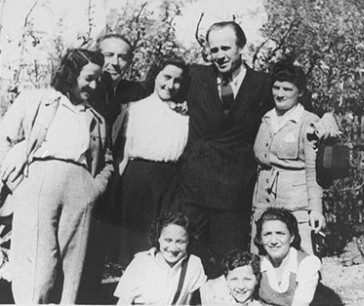
Schindler poses with Jews he rescued circa 1946
After Oskar died in Hildesheim in 1974, Ami gathered many of his private papers from his apartment in Frankfurt and took them back to her home in Hildesheim, which is about two hundred miles Northwest of Frankfurt. These famed Koffer (suitcases) files were later discovered by her son, Chris, after the death of his father Heinrich in 1997. In the midst of two pending lawsuits bu Emilie Schindler, who still lived in Argentina, Chris Staehr managed to spirit this vast collection of Oskar Schindler,s private papers out of Germany to Yad Vashem in Israel.
Oskar Schindler had many girlfriends throughout his life. But apart from his marriage to Emilie and his relationships with his wartime girls, except perhaps Ami Staehr, none of the other romances seemed very important, with only one, his staid affair with Herta Klage, who was Oskar's girlfriend and secretary in the 1960's,. As he grew older, Oskar, unlike many men his-age sought ties with attractive mature women. Oskar had a magnetic personality and remained handsome even as he aged. He never had trouble attracting women, his only problem was keeping them.
Dr. Dieter Trautwein said that the main reason Oskar had trouble keeping girlfriends was his drinking. Oskar knew he drank too much and that his heavy drinking was partly responsible for his poor health. In fact, his heavy drinking was one of the few criticisms that was ever mentioned about him from his Schindler Jews. Oskar tried time and again to stop drinking, but always slipped back. His close friend Lotte Schiffler wrote him an "SOS" letter in 1970 in which she, along with his physician in Frankfurt, Dr. Horst Metz, gave Oskar a blunt warning. 'You are completely ruining yourself with alcohol.' Lotte Schiffler told him he had many friends who wanted to spend a decade of friendship with him. But they wanted him this time to be rosy red and not blue [drunk]. Unfortunately, about the best Oskar could do about his drinking problem was try to limit the amount he drank each day. An autopsy report, two days after his death in Hildsheim on October 9th 1974, noted that Oskar drank from two to four cognacs a day and smoked twenty cigarettes (down from forty).
By the time Oskar met Ami Staehr on the beach in Tel Aviv, he had already suffered one heart attack and had serious kidney problems and diabetes. Ami fell madly in love with Oskar, though in a mature, distant way. She remained true to her marriage and husband, Heinrich, who had previously indulged in numerous affairs, and Oskar was drawn into their family circle as a friend.Oskar travelled with Ami and Heinrich and became close friends with their son and daughter in lae Tina who approved of Ami's relationship with Oskar, Chris and Tina ha always fretted over Heinrich's affair with other women and knew that they depressed Ami.They were overjoyed that her relationship with Oskar made Ami happy, Oskar's death devastated Ami but also led to the revitalization of her marriage to Heinrich. Dr. Staehr, who became one of Oskar's physicians, was well aware of their relationship and a bit jealous of Oskar. Fortunately, he and Ami became closer after Oskar's death in 1974 and had a happy marriage in the years before Ami's death in 1988.
What we know of Ami's relationship with Oskar comes from her modest diary, the comments from Dr. Trautwein and Dr Charlotte Schiffler. His chance meeting with Ami Staehr came at a particularly meaningful time for Oskar who had broken up with Herta Kluge the year before. Though Oskar never said much about it, his friends sensed his pain over the the breakup. For years, Herta had accompanied Oskar on his visits to Israel and the United states. Jakob Sternberg blamed the breakup on Herta's daughter, Lotte Schiffler who seemed infatuated with Oskar even though she was married,also sensed the loneness and told Oskar that he needed the sympathy of a women' one 'who is quite free of other baggage.who has no grandchildren on her lap', in other words, a women who could 'make herself beautiful' for him alone. Ami Staehr, though she had a grandchild, was able to give herself totally to Oskar within the the context of her married life in Hildesheim. She became his intimate friend, confidant and muse, and the time they spend together, particularly in Israel were some of the happiest in Oskar's life. Oskar called Ami 'a piece of gold' for all she did for him when he was sick in the summer of 1973,and Lotti Schiffler added that Ami was even better than gold for Oskar.. The day after Ami met Oskar on the beach, she sent an elegant, handmade get-well card to his room No. 74 at the hotel Narcissis. It is difficult to describe the care and love that went into making the card, but it let Oskar know that it was sent by someone who had more than just a passing interest in this 'real hero'. Later that year they vacation together in Dubrovnik , Yugoslavia, and the following spring spent some time together in Israel. Some of the memorable photographs taken by Oskar during the last years of his life, show him with Ami in Israel. They depict a happy content couple and surprisingly tanned, healthy-looking Oskar. It was no secret of course, that their relationship was more than platonic.
During his stay with Ami in Israel in 1973 there are no indication of Oskar's delicate health In their autopsy a year later doctors indicated that Schindler was always ' healthy until December 1973'., when he had a stroke. In reality he was a very sick man and in lot of pain well before this date. As early as 1972 Oskar very had high blood pressure, Problems included defect of the lower spine and was so painful that it kept him from sleeping. In addition Oskar talked about a'strophantinue'for his heart' and constant kidney basin 'suppperation'. He also had nerve pain in his feet and had an oscilloscope treatment for his legs He alo wrote to his friend Page that he had 'radioactive isotopes' for his kidneys as well as hundred injections. He became quite ill in Israel during a visit with the Staehrs in June 1973, and, though Oskar returned to Germany, Dr.Moshe Beiski told him that he needed 'constant medical supervision'.

Oskar Schindler and Anne Marie Staeh
'Oskar returned to Hildesheim on August 8th, and, except for a brief trip back to Frankfurt approved by his physician Dr. Kleinsong, he would spend the remaining weeks of his life in Hildesheim with the Staehrs. Oskar's health was deteriorating and Ami Staehr called Dieter Trautwein in late August to let him know that Oskar's continuing heart heart problems.. Dr. Trautwein then called Lotte Schiffler who wrote Ami Staehr and asked her about the prospect of a heart operation for Oskar.. Dr James Osborne made it clear that heart surgery was in its infancy at the time, so he was uncertain what Schiffler meant by this. Instead, the decision was made to give Schindler a pacemaker to help stabilise his heart rhythms .
It is possible to piece together what happened next from the autopsy resort prepared two days after Oskar died, a letter that Ami wrote to Dr. Beiski and Itzak Stern's wife for Oskar's Israeli friends just before he died on October 9th, and one she sent to Oskar's niece Traude Ferrari ,on December 1974. The autopsy report noted that a week before he was admitted to the hospital, Schindler was suffering from swollen feet as well as server breathing problems, lack of appetite, and sleep'. the decision was made to give him a pacemaker at the St.Bernhard Krankenhaus. a Roman Catholic hospital in Hildesheim. During the operation Oskar slipped into a coma and never regained consciousness. He was placed into the intensive care unit of the St Bernard's. Ami described what happened next in her letter to Dr. Beiski and Mrs.Stern. She wrote on October 7th, and described Oskar's condition afer he slipped into the coma. For the most part, she told them,'he was dozing along with constant unconsciousness though he was periodically responsive to those around him. When his name was mentioned, he would open hjs eyes and sometimes say:'Yes'. But for the most part, Ami explained, he had no idea where he was or what was happening to him. Because Oskar was in intensive care, Ami was not able to be with him all the time, although she called the hospital to find out how he was doing,, and she was told the same thing: 'No change, Mr. Schindler is still alive'. She reassured Beiski and Stern that everything was being done medically and personally to care for him. On the day she wrote the-letter, it was decided to put Oskar on 'liquids and astronaut food' to help flush his kidneys. Oskar was now nothing more than 'skin and bones'. She was glad that Dr. Beiski and Mrs. Stern did not have to see Oskar like this. She ended by writing that she felt it was ' a greeting from God' that Oskar was obliviousness what was happening to him 'Since the unconsciousness also spared him the pains, the tortures. Two days later, October 9th 1974, Oskar Schindler passed away. During this period. the pacemaker worked very well. His body damaged by his diabetes as well as his kidney, heart, and other problems simply gave out. From Ami Staehr's perspective, his slow death 'was more an extinguishing of his spirit, diminishing of all energies, a breakdown of all functions'. Oskar Schindler was sixty-five years old.

Memorial plaque to Oskar Schindler (1995), Regensburg
THE DEATH OF OSKAR SCHINDLER
For most part Oskar recovered from his stroke, though Lotte Schiffler told him when she saw him in April 1974 that he seemed 'fresh and rested'. Yet a month earlier Oskar could not permit her in his apartment to help him with small things such as 'cipping the nails and other things'. Oskar was was still having trouble with te paralysis on the right side of his body, and Lotte suggested that he receive a salt water treatment to help 'revive the right side again'. She also wondered whether the expensive injection he was receiving were helping his paralysis. Oskar was able to travel and went to Hildesheim for four days for Ami Staehr's birthday in early March. After the stroke, the Staehrs made a small room for Oskar in their apartment in Hildesheim which in a way became his second home. He returned for a visit to Hildesheim in late May ans styed with the Staehrs for about ten days.

Schindler's grave with stones, as can be seen in the film Schindler's List (1993)
Oskar's death devastated Ami Staehr, she wrote Dr. Beiski a month-after his death that, for her 'time now stood still.'
But there is no doubt that jealously was a factor once the issue of Madritsch and Schindler came to the attention of Yad Vashem in the mid-1950s. By this time, Oskar had failed in his business ventures in Argentina, and his efforts to save Jews during the war became an important part of his identity. To suddenly have to share it with Julius Madritsch, a successful man of seeming impeccable character, was probably a little more than Oskar could handle. From Schindler's prospective, Madritsch owed his postwar success to the money he made during the war, and this only added to Schindler's dislike of him. Raimond Tisch on the other hand, was a different matter. He was not a factory owner and therefore as threatening to Schindler as Madritsch. Oskar had read Madritsch's memoirs, 'Menschen in Not', but said little about it. He never questioned the accuracy of Madritsch's account, winch was filled with countless, daring tales of efforts to help Jews throughout the war. Perhaps Oskar, who's own account of his wartime efforts to save Jews was published in Germany in 1957, was uncomfortable about sharing the limelight with someone whom some Schindlerjuden considered Oskar Schindler's equal.
SIDE ISSUES ABOUT SCHINDLER'S LAT YEARS OF HIS LIFE
LOVE AND BITTERNESS - NOT A PERFECT MAN
It was a typical, hot, late July day in Tel Aviv in 1970. Ami ( Annemarie) Staehr had just arrived in Israel's beautiful coastal city with her husband Dr. Heinrich Staehr, who was working with the West German reparation (Wiedergutmachungen) program for Israeli's Holocaust survives. Dr Staehr was there medically to investigate and help to determine the amount each survivor was to receive, which was based on trauma he or she had suffered during the war. Ami Staehr wa sitting alone on the beach when she noticed someone standing near her.
Tel Aviv's coastline (seen from Jaffa) is highly urbanized
The soles of the man's feet were covered in blood. Standing before her was Oskar Schindler, so drunk that he did not know he had blistered his feet in the hot sand. A month earlier, Oskar had done the the same ting at the Dead Sea. Entranced by this tall, handsome German, Ami bandaged his feet. Several days later, she wrote her daughter in law Tina Staehr, that she had met a 'real hero a hero named Oskar Schindler.' Thus began the last, and perhaps most important romance in Oskar Schindler's life.
Schindler poses with Jews he rescued circa 1946
After Oskar died in Hildesheim in 1974, Ami gathered many of his private papers from his apartment in Frankfurt and took them back to her home in Hildesheim, which is about two hundred miles Northwest of Frankfurt. These famed Koffer (suitcases) files were later discovered by her son, Chris, after the death of his father Heinrich in 1997. In the midst of two pending lawsuits bu Emilie Schindler, who still lived in Argentina, Chris Staehr managed to spirit this vast collection of Oskar Schindler,s private papers out of Germany to Yad Vashem in Israel.
Oskar Schindler had many girlfriends throughout his life. But apart from his marriage to Emilie and his relationships with his wartime girls, except perhaps Ami Staehr, none of the other romances seemed very important, with only one, his staid affair with Herta Klage, who was Oskar's girlfriend and secretary in the 1960's,. As he grew older, Oskar, unlike many men his-age sought ties with attractive mature women. Oskar had a magnetic personality and remained handsome even as he aged. He never had trouble attracting women, his only problem was keeping them.
Dr. Dieter Trautwein said that the main reason Oskar had trouble keeping girlfriends was his drinking. Oskar knew he drank too much and that his heavy drinking was partly responsible for his poor health. In fact, his heavy drinking was one of the few criticisms that was ever mentioned about him from his Schindler Jews. Oskar tried time and again to stop drinking, but always slipped back. His close friend Lotte Schiffler wrote him an "SOS" letter in 1970 in which she, along with his physician in Frankfurt, Dr. Horst Metz, gave Oskar a blunt warning. 'You are completely ruining yourself with alcohol.' Lotte Schiffler told him he had many friends who wanted to spend a decade of friendship with him. But they wanted him this time to be rosy red and not blue [drunk]. Unfortunately, about the best Oskar could do about his drinking problem was try to limit the amount he drank each day. An autopsy report, two days after his death in Hildsheim on October 9th 1974, noted that Oskar drank from two to four cognacs a day and smoked twenty cigarettes (down from forty).
By the time Oskar met Ami Staehr on the beach in Tel Aviv, he had already suffered one heart attack and had serious kidney problems and diabetes. Ami fell madly in love with Oskar, though in a mature, distant way. She remained true to her marriage and husband, Heinrich, who had previously indulged in numerous affairs, and Oskar was drawn into their family circle as a friend.Oskar travelled with Ami and Heinrich and became close friends with their son and daughter in lae Tina who approved of Ami's relationship with Oskar, Chris and Tina ha always fretted over Heinrich's affair with other women and knew that they depressed Ami.They were overjoyed that her relationship with Oskar made Ami happy, Oskar's death devastated Ami but also led to the revitalization of her marriage to Heinrich. Dr. Staehr, who became one of Oskar's physicians, was well aware of their relationship and a bit jealous of Oskar. Fortunately, he and Ami became closer after Oskar's death in 1974 and had a happy marriage in the years before Ami's death in 1988.
What we know of Ami's relationship with Oskar comes from her modest diary, the comments from Dr. Trautwein and Dr Charlotte Schiffler. His chance meeting with Ami Staehr came at a particularly meaningful time for Oskar who had broken up with Herta Kluge the year before. Though Oskar never said much about it, his friends sensed his pain over the the breakup. For years, Herta had accompanied Oskar on his visits to Israel and the United states. Jakob Sternberg blamed the breakup on Herta's daughter, Lotte Schiffler who seemed infatuated with Oskar even though she was married,also sensed the loneness and told Oskar that he needed the sympathy of a women' one 'who is quite free of other baggage.who has no grandchildren on her lap', in other words, a women who could 'make herself beautiful' for him alone. Ami Staehr, though she had a grandchild, was able to give herself totally to Oskar within the the context of her married life in Hildesheim. She became his intimate friend, confidant and muse, and the time they spend together, particularly in Israel were some of the happiest in Oskar's life. Oskar called Ami 'a piece of gold' for all she did for him when he was sick in the summer of 1973,and Lotti Schiffler added that Ami was even better than gold for Oskar.. The day after Ami met Oskar on the beach, she sent an elegant, handmade get-well card to his room No. 74 at the hotel Narcissis. It is difficult to describe the care and love that went into making the card, but it let Oskar know that it was sent by someone who had more than just a passing interest in this 'real hero'. Later that year they vacation together in Dubrovnik , Yugoslavia, and the following spring spent some time together in Israel. Some of the memorable photographs taken by Oskar during the last years of his life, show him with Ami in Israel. They depict a happy content couple and surprisingly tanned, healthy-looking Oskar. It was no secret of course, that their relationship was more than platonic.
During his stay with Ami in Israel in 1973 there are no indication of Oskar's delicate health In their autopsy a year later doctors indicated that Schindler was always ' healthy until December 1973'., when he had a stroke. In reality he was a very sick man and in lot of pain well before this date. As early as 1972 Oskar very had high blood pressure, Problems included defect of the lower spine and was so painful that it kept him from sleeping. In addition Oskar talked about a'strophantinue'for his heart' and constant kidney basin 'suppperation'. He also had nerve pain in his feet and had an oscilloscope treatment for his legs He alo wrote to his friend Page that he had 'radioactive isotopes' for his kidneys as well as hundred injections. He became quite ill in Israel during a visit with the Staehrs in June 1973, and, though Oskar returned to Germany, Dr.Moshe Beiski told him that he needed 'constant medical supervision'.
Oskar Schindler and Anne Marie Staeh
'Oskar returned to Hildesheim on August 8th, and, except for a brief trip back to Frankfurt approved by his physician Dr. Kleinsong, he would spend the remaining weeks of his life in Hildesheim with the Staehrs. Oskar's health was deteriorating and Ami Staehr called Dieter Trautwein in late August to let him know that Oskar's continuing heart heart problems.. Dr. Trautwein then called Lotte Schiffler who wrote Ami Staehr and asked her about the prospect of a heart operation for Oskar.. Dr James Osborne made it clear that heart surgery was in its infancy at the time, so he was uncertain what Schiffler meant by this. Instead, the decision was made to give Schindler a pacemaker to help stabilise his heart rhythms .
It is possible to piece together what happened next from the autopsy resort prepared two days after Oskar died, a letter that Ami wrote to Dr. Beiski and Itzak Stern's wife for Oskar's Israeli friends just before he died on October 9th, and one she sent to Oskar's niece Traude Ferrari ,on December 1974. The autopsy report noted that a week before he was admitted to the hospital, Schindler was suffering from swollen feet as well as server breathing problems, lack of appetite, and sleep'. the decision was made to give him a pacemaker at the St.Bernhard Krankenhaus. a Roman Catholic hospital in Hildesheim. During the operation Oskar slipped into a coma and never regained consciousness. He was placed into the intensive care unit of the St Bernard's. Ami described what happened next in her letter to Dr. Beiski and Mrs.Stern. She wrote on October 7th, and described Oskar's condition afer he slipped into the coma. For the most part, she told them,'he was dozing along with constant unconsciousness though he was periodically responsive to those around him. When his name was mentioned, he would open hjs eyes and sometimes say:'Yes'. But for the most part, Ami explained, he had no idea where he was or what was happening to him. Because Oskar was in intensive care, Ami was not able to be with him all the time, although she called the hospital to find out how he was doing,, and she was told the same thing: 'No change, Mr. Schindler is still alive'. She reassured Beiski and Stern that everything was being done medically and personally to care for him. On the day she wrote the-letter, it was decided to put Oskar on 'liquids and astronaut food' to help flush his kidneys. Oskar was now nothing more than 'skin and bones'. She was glad that Dr. Beiski and Mrs. Stern did not have to see Oskar like this. She ended by writing that she felt it was ' a greeting from God' that Oskar was obliviousness what was happening to him 'Since the unconsciousness also spared him the pains, the tortures. Two days later, October 9th 1974, Oskar Schindler passed away. During this period. the pacemaker worked very well. His body damaged by his diabetes as well as his kidney, heart, and other problems simply gave out. From Ami Staehr's perspective, his slow death 'was more an extinguishing of his spirit, diminishing of all energies, a breakdown of all functions'. Oskar Schindler was sixty-five years old.
Memorial plaque to Oskar Schindler (1995), Regensburg
THE DEATH OF OSKAR SCHINDLER
For most part Oskar recovered from his stroke, though Lotte Schiffler told him when she saw him in April 1974 that he seemed 'fresh and rested'. Yet a month earlier Oskar could not permit her in his apartment to help him with small things such as 'cipping the nails and other things'. Oskar was was still having trouble with te paralysis on the right side of his body, and Lotte suggested that he receive a salt water treatment to help 'revive the right side again'. She also wondered whether the expensive injection he was receiving were helping his paralysis. Oskar was able to travel and went to Hildesheim for four days for Ami Staehr's birthday in early March. After the stroke, the Staehrs made a small room for Oskar in their apartment in Hildesheim which in a way became his second home. He returned for a visit to Hildesheim in late May ans styed with the Staehrs for about ten days.
Oskar's death devastated Ami Staehr, she wrote Dr. Beiski a month-after his death that, for her 'time now stood still.'
CLOSURE OF THE KRAKOW GHETTO
 |
| Gates to the Kraow Ghetto, around 1942 |
 |
| Krakow Liquidation Notification |
 |
| A column of Jews march through the streets of Krakow during the final liquidation of the ghetto |
The closure of the ghetto in Krakow and the establishment of the Plaszow forced labour camp began with Himmler's order of July 19, 1942, so that by the end of December 1942 no Jews were allowed to spend outside of the five transit camps Warsaw, Cracow, Radom, Lublin and Tschentochau in the General Governmet. All companies who employed Jews should stop these working arrangements and relocate their factories into the camps. On October 9, 1942, Himmler ordered, "to close step by step" , except to a few "Jewish workers in the armament factories and to limit Jewish KZ-Larger firms as far as possible only in the eastern part of the General Government".
In October 1942 followed the next Resettlement Action: SS deported 6,000 Jews from the Krakow ghetto and shot several hundred people on the spot. During the selections there were well qualified workers who fell victims to these killings and to the companies that employed them, this meant a huge loss. The owners of the factories while trying to save their workers, were rarely successful.
In accordance with Himmler's decree to the SSPF Distrkt Krakow, Julian Schemer, on 14 December 1942, that Jews who had lived in March 1941 in the Krakow Ghetto will have to be relocated into the Plaszow labor camp. This affected the Jewish workers who worked for the Army Defence Inspection, in places for the operations of the military district commander and in private companies, or active in important war efforts. The ghetto was thus converted in two areas the A and B ghettos. The able working Jews lived with barbed wire surrounded ghetto A until they were detained from 13 March 1943 in the newly established forced labour camp Plszow of the SSFP. The Reichsführer SS had set a dead line as of 31 December 1942, which with this measure at least maintained in part his orders, unlike, for example, in Warsaw, where the SS did not initiate any steps that Jews from the ghettos be accommodated in closed camps which made Himmler furious, and caused him to issue commands to commence the closure of all the ghettos.
 |
| A German officer checks the papers of Jews moving into the Krakow ghetto |
CONSTRUCTION OF THE PENALTY CAMP PLASZOW
At the same time, by the end of 1942 began the first construction work planned for the forced labour camp in the district of Krakow at the Plaszow Jerozolimska Sraße. It was to house 15 000 prisoners, all of them Jews in the Krakow District that were still alive. Preparatory work began on the grounds of the New Jewish Cemetery in Jerozolimska street. The terrain on which the camp should be built belonged in part to the Polish state and the city of Krakow, and some private owners. In addition, two Jewish cemeteries were on the premises. [The "old cemetery" belonged officially to the Podgrz community and after combining the two in 1936 the property was owned by the Krakow's Jewish community. The land adjacent to the "new cemetery" had also been acquired in the meantime by the Krakow Jewish community and used since 1932.sic] The land that had belonged before the war to the Polish government, and went to the General Government, any property rights were disregarded and not regulated. Owners and occupants of the houses on the land earmarked for the camp were quickly forced out and had not received a written verification of the administrative action. Even the Council of the Jewish community (Der Judenrat) was not notified of the start of the construction.
In late summer of 1942 the company that had been commissioned for the project under the direction of Ing. Lukas, was the "Deutsche Bau- und Siedlungsgesellschaft" (German Construction and Housing Association). Polish companies from Krakow were subcontractors. When informed of this project, the Jewish Community Leader Ing. Jakub Stendig was able to convince the German Engineer Lukas to work only on the Friedhofsreserve 'cemetery reserve' (unused area) and not to destroy or disturb the Jewish graves.[This is quite possible as up to that time only levelling earthwork took place. Also mentioned by A. Biberstein in: Zaglada zydow w Krakowie, in Krakow 2002,page 119. (Ing. is the German abbreviation for Engineer).sic]
Ing. Lukas was not a convinced National Socialist, and his working methods were not effective enough for those in power to complete the construction of a Forced Labour Camp. Additional problems occurred, bottlenecks appeared in the supply of materials, particularly timber was absent for the building of barracks. Although the camp was still under construction, in the autumn of 1942, SS Sergeant Horst Pilarzik had been appointed as first camp commander. Because of the slow progress of construction, he asked the Jewish community to provide some Engineers for this task. In this specialised field, the Engineers Zygmunt Grünberg, Jacob Berger, Stendig, Haber, and little later Wohlfeiler were chosen. The SS left the responsibility for the construction and overcome technical problems to the Jewish engineers.
Although the German authorities were spreading rumours to the contrary, for the Krakow Jews it became quickly clear that the majority of the new camp was intended for them. After the "resettlement action" on October 28, 1942 every day, workers were taken out of the ghetto to the Plaszow "Barrack commando". These prisoners were not provided with food during working hours, they had to bring their own meals with them out of the ghetto. Already in November 1942, the first members of the "barracks-commando" 'were detained (locked up) in Plaszow, they were the initial prisoners in the new labour camp, and had to live in the unfinished barracks without electricity or sanitation. The "barracks-commando" was one of only about 200 men at first, but grew very quickly. In December 1942 it comprised about 500 prisoners, covering all trades normally needed in building projects. The workers were divided into groups of 25-50 men, each group was monitored by a representative of the security service, the Jewish (OD) Police Unit, established by the German authorities.
 |
| plaszowmainentrance |
Despite the draconian methods the progress of the construction of the camp did not proceed smoothly because Müller and Pilarzik (who did remain in the camp service) did not on concentrate with the erection of barracks for inmates, but focused on the completion of administrative and workshop buildings and in particular on the the renovation of the villas in which would house in the main the SS-Leadership in future.
Three Jewish Physicians Dr. Edward Goldblatt, Dr. Leon Gross and Dr. Henryk Rubinstein reported on orders of the German administration for work in the camp and had to take over without any medical equipment and medicines in the dark and unheated barracks, the care of patients. Only shortly before the final closure of the ghetto in March 1943, the infirmary was equipped with instruments, medicines and bandages. The Jewish Support Unit (JUS) had deposited these goods in the ghetto.
From December 1942, step by step, workers previously employed outside the camp in factories, were transferred to Plaszow. "During that time, when single work details were moved into the camp, the contact with the ghetto was very much alive," recalled a survivor. Many of the barracks commandos "fled because of the severe conditions in the remaining ghetto. The OD-men Jakub Tobiasz Katz and Leopold (Poldek) Goldberg were authorised to issue passes to prisoners into the ghetto, which made "maintaining contact with the ghetto easier". When during a roll call on February 6th 1943 it was found that 15 prisoners were missing , Goldberg and Katz were held responsible and executed. [ See: AZH, Zespol 301, rel. 4738 and 188, Statement 05/06/1967 Lola K., in: BArch Ludwigsburg, AR-Z 1276/63, page 806.sic]
 |
| Göth on horseback |
The problems in the camp still under construction grew in proportion to the number of inmates, by mid-February 1943 there were about 2,000 people trying to cope.
continued under part 2


No comments:
Post a Comment
Note: Only a member of this blog may post a comment.