Wednesday, June 6, 2012

KZ RAVENSBRÜCK-WOMEN INCARCERATED-PART 3


SURVIVAL CHANCES AND STRATEGY:

The survival chances of the members of each persecuted group depended not only on what place the SS gave them in the hierarchy of inmate society, but also by the feeling of togetherness and the degree of organisation of each section and also on the duration of their stay in the camp. One of the highest rankings in the social structure of the camp therefore was taken by the "old established" German political prisoners. They not only had access to functions in the prison administration, had established a special network for mutual aid and solidarity, which went rather far in its concept. The respective inmate functionaries tried to give members of their group activities where they were protected against hardships and harassment and could afford in return give some contribution to the network when they had been assigned to duties, such as the kitchen, in the dressing room, in the infirmary or in a "good" work detail.
The Polish women, who after their arrival in the camp were initially on a lower rung of the social ladder, and many were exposed to harassments, thanks to their strong national cohesion, over the years they also obtained a share of the power functions. During 1942/43 transports of Russian and French women came into the camp, the Polish women rose in the hierarchy and the recently arrived women took their place.
The lowest survival chances had the Sinti and Roma and Jewish women, especially the Hungarian Jews, which at the time of the chaotic overcrowding came to the camp in 1944. Most of them remained in the gruelling work details, where the opportunities to obtain extra food, were very low. They had little chance of being included in the infirmary when sick. They were also unable, in contrast to other groups of prisoners receive food parcels, which played a large role since 1942.
The Austrian Romni writer Rosa Winter recalled later: "The Jews and the Gypsies were in there the poorest.  The Politicals, they did not have it so bad in there. They were in the office and the kitchen. They did not have it so bad,  but the Jews and the Gypsies, who were in a pot. "

Death Certificate as issued by Camp Authorities 
Anyone of the women that did not belong to an organised community and it's strength, often perceived their solidarity and cohesion as exclusionary. In fact, the assistance provided, given the extremely limited opportunities, especially for the weak and sick in their own group was exemplary.  Despite all that, there were also instances of cross solidarity. The German communists helped newly arrived Resistance fighters from other countries. Above all, the Polish women took care of the children and young people. Polish and German inmates organised 1944 a Christmas celebration for children in the camp, which was for them a family affair.
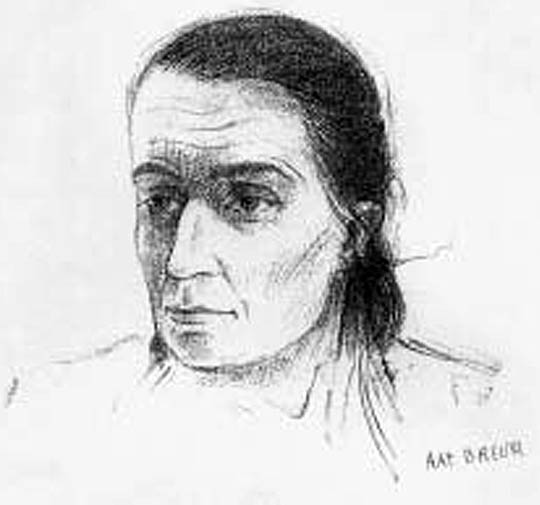
"Drawing of murdered child", by Aat Breur. Little German boy four or five years old, without parents in the camp. He was accompanied by a small group of German children in different age groups in  Ravensbrück.  Meta de Leur has made efforts to look after him. In the autumn of 1943 the children were taken with the first "Jewish transport" to Auschwitz and gassed. The portrait was carefully  kept  by Meta de Leur.   
From Ravensbrück it is often reported of friendships between any two, three or four women who worked together, slept in the same bed and supported and encouraged each other almost daily to carry on. Perhaps these small communities within a large-scale organised group existed or transversely played an important source of power for survival, the transmission of the meaning of life.  Prisoners who have had long term imprisonments in a jail or in the camps behind them, had lost increasingly touch or connection to life "outside", with their spouse, children or family members. The utter demoralisation or submission to the raison of the SS, they could only oppose by solid emotional relationships with other inmates. There are reported instances that older women as "camp mothers""adopted" girls or young women and cared for them. Thus arose relationships that were life-sustaining for both sides. Sybil Milton refers to these formation of such "small family" as a specifically female survival strategy (Überlebensstratagie).

"Friendship". Drawing by inmate Violtte Lecoq
With the use of their social role as housewives and mothers, they proved to be in mental and physical terms more resilient than men. Many women had the ability, to endure and go with little food, to mend torn clothes over and over and to make something new from textile remnants, just bits and pieces.. These skills they possessed by nature and did benefit them in the camps. With their daily struggle for physical hygiene and proper clothing (ordentliche Kleidung) they tried to keep their female identity and dignity. "I used to gain the impression", so Germaine Tillion quotes,"that the friendly help and support in the women's concentration camps was persistent, was strong and more widespread overall". Tillion also mentions that the number of deaths in concentration camps of male prisoners was on a percentage basis higher than in the female, and tried this phenomenon to explain: "They [the men] were suffering despite, from the same or higher rations even more hunger, were worse off, and came quickly to death".  In Ravensbrück, there had been less "death squads" as in the men camps, on top of that the relations of male prisoners were characterised by great hardness and arguments under each other with resulting  brutality.
Gabriele Pfingsten and Claus-Füllberg Stollberg contradict this explanation and refer to the specific female survival-strategies that have not been sufficiently researched or far too little.
One of the important survival aids at Ravensbrück were art and culture. Many women in the camp started to write poems, draw or carve figures. After their liberation, these creative activities lost most of their existential meaning again. Others told each other the contents of books, sang songs, gave lectures or painted and created imaginary refined cooking recipes. Such activities were not only part of the privileged circle of the prisoners, who had no hard physical work to do and lived in clean barracks. In a bleak and humiliating life, were all colours, pictures, songs and books had been banned, art and culture were especially in existentially-threatening situations an outlet that saved them from mental and spiritual starvation.

Carved and hand sewn objects made by the women
Unlike Auschwitz, Buchenwald, Sachsenhausen and other camps where there were official prisoner orchestras, approved cultural events, soccer games, and even film screenings, in Ravensbrück any artistic expression seem to have been forbidden (verboten). It was not until just before Christmas 1944,  that the camp administration allowed the prisoners for the first time, to form choirs. For the Christmas party for the children they were allowed to rehearse a puppet show. But since about 1943,  because of the increased overcrowding of the camp when the SS lost track of the events and the risk of being punished, these activities diminished. In the blocks the women would sing and dance instead or more frequently gave lectures. The majority of artistic expression was of individual art. For the authors, the passing of a poem was not even a piece of paper or a pen available. The little book of poems, which the Dutch Aat Breur secretly produced in the book bindery of the camp and gave to her friends at birthdays, were in this respect a major exception. Most of the poems were first orally composed, repeated and in this way passed on.

Drawing by Aat Breur of Inmate Doctor Hautval.  "Her activity and help in the infirmary saved many life's, including that of Aat Breuer's".           
The "poetry" of thoughts and feelings was for many women an opportunity to express their hopes and aspirations, but also to document the camps reality and to strengthen the will to resist. In this community of suffering, they were an appreciative and attentive audience, and made the often very simple and catchy verses their own, they learned them by heart and passed them on to others. In contrast, it was difficult and even dangerous, to make drawings and to pass them on, because one had to obtain paper and pencils first. During searches with threatened sanctions and the destruction of the pages, let alone the punishment the risk was great. Many prisoners, however, were willing to take risks for a drawing and privations. They tried to make "their" artist's life more bearable by giving them decreased heavy physical work assignments. Often, they even sacrificed their bread ration for a portrait of a loved one and hid the sketches from the grasp and destruction of the SS. It was among the inmates professional artists and amateurs, that they first began to draw in the camp. Most of their drawings, which are now on display in exhibitions, are of a women's concentration camps and were drawn after their liberation from memory because the original drawings were lost or destroyed by the SS. Like the poems they have become less important as art, but evidence of the reality of a camp that are more meaningful than the photos and documents, which are almost all from the perspective of the perpetrators. The drawings of the inmates portray the will power of self-assertion and resistance in inhuman conditions.

Stefanie Kunke
(1939 - 1942 in Ravensbrück,
gestorben 26. Dezember 1942 in Auschwitz)
Einer neuen Zukunft entgegen
Irgend wo –
ruhst du –
in irgendeiner Mutter Schoß.
Du schläfst.
In Frieden getaucht
erträumst du die Welt.
Um dich herum aber stöhnt der Mensch,
schreit auf in tausendfacher Not;
getreten, geschlagen, gemartert, gequält
nach barbarischer Stunde Gebot.
Irgend wo –
ruhst du –
verklärt in Weisheit, von Schönheit umschützt.
Du träumst.
Fern von der Erde
brennender Wirklichkeit –
auf der die Menschheit in qualvollem Ringen
schönerer Zukunft entgegengeht.
Das Branden der Welt umtost deine Mauern
und all deine schützende Schönheit verweht.
Träume du,
sei bereit
zum letzten Kampfe, für letztes Ziel
erneuter Menschheit!
Erfülle dein Schicksal
als Mensch!
IfGA, ZPA, NL 202/11

Poetry by Stefanie Kunke Poetry in German. She wrote in the political Block fairy tales and poems, in spring of 1942 taken to Auschwitz for the construction of the camp there, in December                                                                   she died of typhoid fever.                                                                        

SS OFFICERS AND FEMALE OVERSEERS
At the top of the hierarchy of the SS concentration camp at Ravensbrück was the commander. The five divisions onto which the administration was based, (as set out in any camp) were led by men. Under the camp protective custody leader(Schutzhaftlagerführer) came two female superintendents (Oberaufseherinnen), one for the office staff and one for the external commandos. They in turn controlled the supervisors (Aufseherinnen), who in Ravensbrück exercised direct control over the prisoners. According to the elitist self-understanding of the SS, women could not become members of the organisation. They belonged only to the "female SS entourage" as rapport leaders, labour service leaders, block leaders, column guides, arrest leaders, dog handlers,  in other words, technical or maintenance staff for certain areas in the camp, they formed the lower level of the concentration camp administration. For the external security of the camp, the soldiers of the SS Guard Battalion were responsible.
The first Lagrkommandant of Ravensbrück was SS Hauptsrurmführer (Captain) Max Koegel, who had previously acted as an officer in charge of KZ Lichtenburg. In August 1942 he was transferred to Lublin-Majdanek. There he had directed the construction of the gas chambers, then he took over in May 1943 the post of commander of Flossenbürg. Koekels successor at Ravensbrück was SS Sturmbannführer (Major) Fritz Suhren, an administration official who had previously been protection camp leader at Sachsenhausen . He remained until April 1945 Commandant of Ravensbruck. Among the numerous SS officers of the administrative camp staff, the survivors recalled  especially Gustav Binder, head of the tailoring department, who would beat and harass the women working there. Notorious for his brutality and always drunk was the labour leader Hans Pflaum. Anther one was Schutzhaftlagerfiihrer (camp protection) Johann Schwarzhuber who came later during  January 1945 from Auschwitz. According to Germaine Tillion Haupsturmführer of  the SS[Max Koegel,sic] was considered a "specialist of death" but that he had abstained personally from any brutality. In recent months during the existence of the camp Schwarzhuber led the murder-actions. Crime-Assistant Ludwig Ramdohr who managed since July 1942 the Political Department at Ravensbrück, was feared not only among the prisoners, but also by the SS as he had established in the camp with the help of terror and brutality an extensive spy system.
The first superintendent (Oberaufseherin) of Ravensbrück was Johanna Langefeld who had already held this function in the Lichtenburg concentration camp. In March 1942, Langefeld was transferred to Auschwitz in order to build together with overseers and Prison Functionaries from Ravensbrück the women's section at Birkenau, as the women's camp at Auschwitz was sub-ordinated from March-July 1942 to KZ Ravensbrück. In place of Langefeld came as overseer Maria Mandel originally from Austria.  By October 1942 Langefeld returned to Ravensbrück and Mandel was put in her place stayed at Auschwitz-Birkenau.
Margarete Buber-Neumann got to know Langefeld  better when she was typist-clerk for her in October 1942: "She was among the prisoners of Ravensbrück reputed to be >decent< she never violated anyone or kicked you,as others did".  Margarete Buber-Neumann  had the impression of the Oberaufseherin, a person torn by inner doubts, full of inhibitions and feelings of inferiority. From her dislike of the entire SS camp administration, she also made no secret in front of her [prison,sic] staff that worked in her office. Buber-Neumann took every opportunity to exploit this situation in the interest of prisoners. In April 1943, the culmination of the tension between the camp commander and his superintendent came finally to a head and Langefeld  was brought before an SS court. Margarete Buber-Neumenn and other women who enjoyed her sympathies, were locked into the bunker for some length of time.
The successor of Johanna Langefeld was Dorothea Binz who was the daughter of the forester from Altglobsow, a municipality in the area of Fürstenberg. From surviving prisoners Binz is portrayed as a pretty young woman who was feared for her rage and cruelty. She had already had worked since September 1939 as a Aufseherin (overseer) in Ravensbruck until 1943 when she was leader in the cell block. Germaine Tillion also reports of a second Oberaufseherin called Klein-Plaubel, who was replaced in early 1945 by Luise Brunner from Auschwitz-Birkenau.
Like Dorathea Binz some of the overseers and supervisors came directly from Furstenberg or from that region. But not all volunteered for this task. With the growth of the prison population, so grew the need for of female staff. The commandant published ads in the local newspaper. [The officer in charge Bräuning [Edmund Bräuning was the boyfriend of Dorothea Binz and lived together within the camp, although he was married at that time.sic] even went into the factories of different counties to recruit factory workers. For the women what was in sight and offered, was a light physical activity in a re-education camp. The pay was much higher than that for a worker in the defence industry. There were also other additional benefits: accommodation in cheap, comfortable houses, communal meals, free uniforms and care for children in an SS-owned children's home. Especially single mothers, this opened up the opportunity to free themselves from their social marginalisation. An example of this which was typical is that of a women from Furstenberg, Margarete Mewes, who became the cell block leader.  As a single mother who had to make a living for herself and her three children which previously she earned as a maid. As a supervisor, she climbed in society, although she was greatly feared by her neighbours ever since, rather then respected.

 SS-Obersturmführer(1st Lieutenant) Bräuning with his children
FATE AFTER
[Binz fled Ravensbrück during the death march, was captured on May 3, 1945, by the British in Hamburg and incarcerated in the Recklinghausen camp (formerly a Buchenwald subcamp). Binz was tried with other SS personnel by a British court during the Ravensbrück Trial and was hanged at Hameln on May 2, 1947 for war crimes.
Margarete Mewes; Wärterin; 10 years detention, and was released on 26. February 1952.
Two further accused, camp leader Fritz Suhren and work leader Hans Pflaum, had fled before trial began from detention and with the help of wrong names and had disappeared. They were again arrested however in 1949 and handed over to the French authorities, when a further Ravensbrück Trial had opened. Both accused were condemned to death and shot on 12. June 1950
Luise Brunner; Oberaufseherin; 3 years detention. sic]
The newly recruited women were integrated after a short briefing and training in the camp operation. After a three month trial period during which they worked in the Außenkommandos (outside work assignments) with guidance from a more experienced supervisor, the assistant supervisor (Hilfsaufseherin) was promoted to a full fledged  supervisor. Both Margarete Buber-Neumann and Germaine Tillion describe, that the "newcomers" who came from all professions and walks of life, the first contact with the camp generally looked frightening to them. After a short time, these "normal women" transformed into but screaming and beating guards. According to Buber-Neumann, on many it was already a decisive turn after they were dressed. "In top-boots, it occurred quite different to them, then the right cap (Krätzchen) was placed askew  towards the ear, and immediately they presented a certain self-consciousness". Tillion recalled that the detainees sometimes made "a small but bitter game out of it", ​​to measure the time it needed a new guard until she had reached the "level of brutality" of her colleagues. In general, the duration phase was 14 days, at most it lasted one month. Only in exceptional cases, that women left the camp again, because they did not wish to pursue this type of service. Also, since about 1943, when the Labour Exchange Department committed the women (Dienstverpflichtung) to serving in concentration camps as wardens, the staff turnover did not significantly increase.
From 1942 to 1944, Ravensbrück also became a training camp for all wardens in other women's camps such as Auschwitz and Majdanek and Bergen-Belsen concentration camp as well as satellite camps, where a growing number of female prisoners were kept as forced labourers working in armament  production factories. Overall, during this period about 3500 Aufeherinnen (overseers) were trained in Ravensbrück.
In dealing with the Nazis in the early post-war decades, the role of female concentration camp Aufseherinnen was barely acknowledged and investigated. Individually, such as Dorothea Binz and Irma Greese portrayed as "beasts" and demonized, the others forgotten. For the majority of the wardens  that were put to work in a concentration camp it appears to be a normal professional activity. Like their male colleagues, they functioned to obey the system of terror and persecution. Ruthlessness and violence were part of their daily lives, and their behaviour was probably influenced by a strong group pressure. The female  overseers at Ravensbrück were involved as well as their male colleagues in the selection of prisoners for extermination, there is no doubt. Still unknown is the total number of deaths of women's concentration camp at Ravensbrück. The memorial site is currently displaying figures on the subject of "tens of thousands" of casualties.
Wanda Kiedrzynska cited in her study of 1961, the number of 92 000 deaths dating back to an estimate of the International Committee of the former Ravensbrück prisoners. This figure is taken from a superficial account of the British prosecution at the first Hamburg's trial in 1946/47, were, however, the thousands of women living in the camps of Ravensbrück, including 33 satellite camps, that had been released just before the end of the war and others through the Action of "White Buses", these figure had not been taken into account. From entries available up to 1941 by the registry office (Standesamt) Ravensbrück,  and estimates of surviving prison functionaries, who in writing rooms had an overview of deaths, and the Sterblichkeitsstatistik (Death Statistic) of the SS Administrative Main Office from August 1943, one can conclude that in the camp complex of Ravensbrück 28,000 prisoners died. [Refer Strebel: KZ- Ravensbrück page 505ff, sic]
[The significantly lower death rate in women's, compared to men's camps, is probably due to the behaviour of the female guards. For all the unpredictability and brutality of SS wardens, what was missing was its notorious propensity for violence, apart from some excessive deeds, which was the fatal consequence that characterised the extent of violence in the men's camps. This is not to say, in the women's camps, they were ruled with less frequency of violence, but violence had other manifestations, may have had a lower overall intensity, at least not those existential consequences as in the men's camps.sic]

THE MEN'S CAMP
The first prisoners of 500 men at Ravensbrück were still there before the opening of the camp that came originally from the Sachsenhausen concentration camp. They erected 1938/39 the first barracks and then returned to Sachsenhausen. The real story of the men's camp, however, begins on April 8, 1941 with the admission of 300 male prisoners from the penal company of the Dachau concentration camp in the area separated from the main camp. [These were members of the SS that made up the so called SS-Strafkompanie who were brutally treated by their own king, only about 110 of them remained in Dachau until 1945. sic]. In remembrance and in research the men's camp remained hidden for a long time. In commemorative events, exhibitions, publications, etc. Ravensbrück was presented solely as a women's camp. Undoubtedly, this was part of the simplistic politics of the communist era, which was not interested in a complex contexts and differentiation. Presumably there was also a memorable competition between men and women. Bernhard Strebel points out that the male surviving prisoners themselves organised late and apparently found no connection to the community of the female camp at  Ravensbrück.
The men's camp at Ravensbrück consisted of five barracks used as living quarters and one barrack as Wirtschaftshaus (Utility Facilities). It had its own kitchen and infirmary and was led by an protective custody camp leader, reporting to the commandant of the Ravensbrück women's camp. By the end of April 1945 a total of 20 000 prisoners were registered in the numbering books. The average occupancy rate was constant until the end of 1944 between 1500 and 2000 prisoners. After this there was an overcrowding and chaos.
This was not a admission camp(Einweisungslager). The first prisoners arrived from Dachau, Buchenwald and Sachsenhausen. The majority came from Poland and the Sowjet Union, followed by groups of Germans and Austrians and French. About ten percent were Jews.

Gestapo secret telex of 22 June 1942 Subject: Transfer of 88 Czech children, these were orphans from the village of Lidice which was destroyed as reprisal for the assassination of Heydrich, seven of them had been taken as suitable for Germanisation and were probably adopted by German families. The sender assumes the others might receive "Special Treatment"     (Sonderbehandlung)
Most of the inmates of the men's camp were employed in further expansion of the concentration camp and its workshops which extended to building of the SS-settlement. This included, the forest clearing, levelling of roads and drainage of swamp areas. Due to the extremely hard working conditions and totally inadequate tools and equipment these particularly work details were feared. Survivors spoke of a pace, which was customary in the SS-penal companies. The prisoners were systematically worked to death, chased through the guard cordons, and shot. Many inmate construction crews were assigned to the civil engineering companies, which especially during 1941/42 was instructed to accelerate the pace to complete the camp complex. Werner Köpke who worked in 1942 as an apprentice with the Construction Company Jahn of Ravensbrück during the building of a Weaving Hall with Czech prisoners. Shaken by the hunger they suffered and the harassment to which they were exposed, he began to smuggle food into the camp. He even sent for some time letters from inmates to contacts or their families who had sent food packages, was eventually betrayed and found himself at the age of 16 years as a prisoner in the men's camp at Ravensbrück, where he was protected by the men, whom he had helped. [Köpke did not stay very long in Ravensbrück, a minor, he was transferred to the "youth camp" (Jugendschutzlager) Moringen, from which he returned to Fürstenberg in 1945 after suffering from tuberculosis. He was still alive in 1999. sic]
      Earthwork during construction of camp 
In the men's camp, the death rate due to the gruelling pace of work and the mistreatment and harassment by the SS and Prison Functionaries, was in first years much higher than in the adjacent women's camp. By the year 1942, 852 (nearly one-third) died or were in the action "14 f 13" killed.  A further 600 people (about one fifth) were in a completely exhausted state which the ambulance services took to other camps. Since 1943, men were transported to several satellite camps, where conditions were often more tolerable than in the Stammlager(main camp). The death toll rose and fell in total only rapidly again when the situation in the last months of the war due to the evacuation transports arriving from Mittelbau-Dora and the Neuengamme camp outside Salzgitter Watenstedt deteriorated quickly. In the numbering records that still survived, there is also evidence to suggest that 104 prisoners were murdered in the gas chambers of Ravensbrück. On 24 and 26 April, the SS forced the prisoners who were still capable of marching in several columns in a north-westerly direction,  where they were liberated in the first days of May by American and Soviet troops. Red Army units on the 30 April 1945 found about 800 sick and weak prisoners in the camp. During the following days, every second of them died.

 Continued under Part 4

Monday, June 4, 2012

KZ RAVENSBRÜCK-WOMEN INCARCERATED-PART 2


CHANGES IN THE PRISON SOCIETY AFTER AT THE START OF WW II.

With the onset of World War II, the number of political prisoners increased rapidly. The group also changed in composition, it became more international, and lost its former political homogeneity, because all the women had received by the SS the red triangle from the occupied countries of the armed forces, regardless of the actual reason of their arrest. In addition, women who had been involved for different reasons in their resistance against the German occupiers were mainly categorised as forced laborers (Zwangsarbeiter) that came to Ravensbrück, they may have been suspected of sabotage or were accused of violating other rules, even women who had forbidden  illicit affairs(Liebesbeziehungen) with a German had been sent to Ravensbrück.[This is not quite correct, German soldiers were encouraged(and in general terms there was no law to fall in love with a foreign female) to marry women from the so called Germanic countries, like Holland, the Scandinavian countries, the Baltic States and others with the approval of the appropriate Reichs Department, sic.]
The Polish historian Wanda Kiedrzynska gave an analysis of the proportion of women obtained from remaining transport lists with the red triangle at Ravensbrück at a total of more than 83 percent. This seems to be a realistic approximation, although the number on the percentage composition of the categories of prisoners in each year says very little.
The largest national group of prisoners in Ravensbrück formed soon after the war began, were the Polish women. Already in October 1940 their share was almost a quarter of the total number of prisoners. This increased further in 1944 to 30 percent. The Austrian and Czechoslovakian women, in 1938 and 1939 were the first foreigners that came to the camp, although the Austrians were included as Germans in the official statistics it did not reach this magnitude. With the advance of the army in the west and north since 1940/41 for the first time women from Scandinavia, France, Belgium, the Netherlands and Luxembourg, were brought to Ravensbrück. Large groups of them were, however, only in the years 1943/44 in the camp, as the actions of resistance against German occupation forces won support under the civilian population in those countries concerned and reached a level importance to participate in the fight against the invaders..
After the invasion of the Soviet Union in the fall of 1941 came the first Soviet women to Ravensbrück. With a share of more than 21 percent of them they were the second largest group in the prison society. Compared to the Poles, however, they were not a homogeneous group. Most were young laborers (many between 14 and 16 years old) from Russia, Ukraine, Belarus and the Baltic States that had allegedly or actually disobeyed any orders proclaimed or  given, either because they refused to work or simply left their specified place of residence. In addition there were at least 700-1000 POW Red Army Women (Rotarmistinnen) who were brought in February 1943 from POW camps to Ravensbrück. [Bernhard Strebel noted that about 700 female prisoners of war of the Red Army can be found in the lists. However, their total number amounted in fact to about 1000,sic] They had refused to take off their uniforms and to be recruited as a civilian forced labourers. Germaine Tillon In her memoir makes a sharp distinction between these two groups. With great distaste, she reports of the young forced labourers, who were in the camp especially noticed "because of their skill at stealing". The Ukrainians also made themselves unpopular with fellow prisoners with their unspeakable cruelty. [I could not find any reference to the type of cruelty they allegedly had committed, sic] In contrast, the captured women soldiers with their disciplined appearance throughout, received the admiration and sympathy of others. "We loved them and their attitude of resistance against the Germans," writes Tillon.
On 6 October 1942 by order of Himmler with the last transport of 522 Jewish women which went to Auschwitz-Birkenau, the women's concentration camp was "free of Jews"(judenfrei). The majority of Jewish prisoners of Ravensbrück, about 800 had already been deported in the spring of 1942 into the medical and nursing home of Bernberg and there within the framework of "Aktion 14 f 13" murdered. In the summer of 1944, however, as more and more labourers were needed in the armaments industry, again a large number of Jewesses from Auschwitz or its satellite camps arrived at Ravensbrück.  At the end of 1944 beginning 1945, with the advance of the Red Army eventually the concentration camps in the east had to be abandoned. Hungarian and Slovak Jewesses were deported during this time directly to Ravensbrück. Thousand of women and children, no exact figures is known, weakened by hunger and hardship arrived in the completely overcrowded women's concentration camp, where they had little chance of survival.
A similar thing happened to a much smaller group of Sinti and Roma women, only in reverse.  They were deported to Auschwitz from Ravensbrück, where many of them were victims of medical experiments. Just before the "Gypsy camp" at Auschwitz was disbanded in May / August 1944 and its occupants were killed,  few of the  women for some reason came back to Ravensbrück.

LIVING CONDITIONS OF PRISONERS
In June 1940, a year after the opening of the women's concentration camp at Ravensbrück, which was planned for a maximum number of 3000 prisoners already exceeded this figure at that time. In subsequent years, the capacity of the camp was expanded continuously, but the construction of the necessary barracks could not keep in step with the escalating number of prisoners. In January 1944, Ravensbrück with approximately 17300 prisoners was already overcrowded. By December, the number had risen to about 43700.
In the years 1939 and 1940, however, the external living conditions for most inmates were still acceptable: In the bedrooms, and laundry rooms, there was enough space to move around, laundry and bed-linen were changed regularly. The food was, by the women described in retrospective as a comparison to the later years of famine, still as adequate, even if in the first war winter of 1939/40 its limitations in supply was already noticeable. The German Communist, Margarete Buber-Neumann, who was extradited to the Gestapo because of the Hitler-Stalin Pact, after nearly two years in prison in a Soviet Gulag , describes her first impressions of Ravensbrück, always in silent comparison (stillen Vergleich)  with the camp in Karaganda of the USSR, from which she was released: "I looked across the great square, and could not believe my eyes This was surrounded by manicured lawns, covered by flower beds  on which bloomed bright red flowers. On a wide Sraße (Street), which led to a large open area, flanked by  two rows of wooden barracks, on both sides stood rows of young trees and along the roadside ran straight flower beds as far as the eye could see. The square and the streets seemed freshly raked. Left of us, where it went to the camp gate, I saw next to it a white wooden barrack, and a large cage, the size of a birdhouse the like you see at a zoo. There paraded (stolzierten) peacocks and on a climbing free dangled monkeys and a parrot which always screamed the same word, like "Mama". This should be a concentration camp"? [Buber-Neumann, "The Prisoner",  page 182, sic] Her first meal in Ravensbrück exceeded all her expectations.  What was served was sweet porridge with dried fruit (Backobst), plus a generous portion of bread, margarine and sausage. > But don't be  delighted too soon< (Aber freue Dich nicht zu früh) she went on to describe the whole range of everyday commandos and harassment, which (Auseherinnen), Block Elders and forewomen made life difficult for the prisoners. Even Wanda Kiedrzynska related to this regime, when she wrote: "The first intakes of the camp suffered from the perfection-driven discipline, as well as an overly serious, for Frauen (women) unsuitable work {...} The prisoners in the period of the overcrowding of the camp suffered especially from dirt (Schmutz), abandonment, confusion and chaos, hunger and disease that resulted from these circumstances. "[Kiedrzynska, Ravensbrück, page 18f, sic]
For the majority of the prisoners at that time  there was no immediate danger of death. Recorded details by Margarete Buber-Neumann indicate 47 women died during the first year of their stay in the camp (August 1940-August 1941) of whom more than half succumbed in the cells as a result of increased detention or ill-treatment, apart from that during the last year [of the camps existence,sic] about 80  prisoners died every day. The executed and murdered in the gas chamber, she  had not included.

Die Not im Zelt( The Distress in the Tent) drawing by an unknown prisoner 
The French chronicler Germaine Tillion, who were given secretly by some inmates recorded death statistics in conjunction with incoming Transport Lists (which were not reliable) for the year 1940 a total of 84 dead. In 1943 it numbered about 460 officially registered deaths (excluding death-transports to the gas chambers). Later on she maintained the mortality rate on a  monthly basis, for the year 1944 Germaine Tillion recorded the death toll as: 120 women died in January, in December it was 811. These figures give an idea of ​​how dramatically the living conditions of prisoners in the last two years of the war worsened. As of late summer and autumn of 1944 Hungarian and Slovak Jewesses, also an additional 12 000 women and children after the suppressed revolt in Warsaw arrived in Ravensbrück. To ease the overcrowding a 50 metre long tent was erected between two barracks, where up to 3,000 women and children without any blankets were housed on only a thin layer of straw lying on the ground. The inmates were totally exhausted with no water, no sanitation or medical care and received in the first few weeks only bread to eat. "In late 1944",Margarete Bober-Neumann wrote: "Ravensbrück sank slowly to the level of Karaganda in the Sowjet Union".

MAGARETE BUBER-NEUMANN 
Margarete Buber-Neumann, was a member of the Communist Party of Germany during the years of the Weimar Republic. She survived imprisonment during World War II in both the Soviet Union and Nazi Germany. After the war, she wrote a prison memoir and served as a star witness during the so-called "trial of the century" in the Kravchenko Affair in France. Margarete Buber-Neumann was born Margarete Thüring in Potsdam, and in her youth was active in socialist youth organisations. After World War I she became more radical and joined the newly founded German Communist Party (KPD). In 1922 she married Rafael Buber, communist son of the philosopher Martin Buber, who was Jewish. They had two daughters. Following her divorce in 1929 she lived in unmarried union with Heinz Neumann, a leading German Communist. When the Nazis came to power in 1933, the Neumanns went into exile in the Soviet Union. During the 1930s they both worked for the Comintern, first in France and then in Spain. In 1937, while living at Moscow's Hotel Lux, Heinz Neumann was arrested as part of Joseph Stalin's Great Purge and later executed. Buber-Neumann never learned of her husband's exact fate. Instead, she found herself arrested the following year and sent to a labour camp in Karaganda as a "wife of an enemy of the people." Following the Nazi-Soviet Pact of August 1939, she became one of a number of German Communists handed over in 1940 by the Soviets to the Nazis. Buber-Neumann was then imprisoned in Ravensbrück concentration camp, where she became friends with Orli Wald. Because she had renounced communism as a result of her experiences in the Soviet Union, she was treated as a relatively privileged prisoner. This enabled her to survive five years in the camp. She worked in a clerical capacity in the Siemens plant attached to the camp, and later as secretary to a camp official, SS-Oberaufseherin Johanna Langefeld. She was freed in April 1945. After World War II Buber-Neumann spent some years in Sweden. In 1948, she published Als Gefangene bei Stalin und Hitler (published the following year in German, French, and English -- "Under Two Dictators: Prisoner of Stalin and Hitler"). At the urging of friend Koestler, in this book she gave an account of her years in both Soviet prison and Nazi concentration camps. The book aroused the bitter hostility of the Soviet and German communists. In 1949, she testified in Paris in support of Victor Kravchenko, who was suing a magazine connected with the French Communist Party for libel after he was accused of fabricating his account of Soviet labour camps. Buber-Neumann corroborated Kravchenko's account in great detail, contributing to his victory in the case. In the 1950s, Buber-Neumann returned to Germany as a staunch anti-communist. She also continued to write for the next three decades. In 1957, she published Von Potsdam nach Moskau: Stationen eines Irrweges ("From Potsdam to Moscow: Stations of an Erring Way"). In 1963, she published a biography of her Ravensbrück friend Milena Jesenská Kafkas Freundin Milena. In 1976, she published Die erloschene Flamme: Schicksale meiner Zeit ("The Extinct Flame: Fates of My Time"), in which she argued that Nazism and Communism were in practice the same. [Many Germans echoed her sentiments, but never appreciated by outsiders, sic] By this time, she had become a political conservative, joining the Christian Democratic Union (CDU) in 1975. In 1980, Buber-Neumann was awarded the Great Cross of Merit of the Federal Republic of Germany. She died in Frankfurt am Main in 1989. Her daughters by her marriage to Rafael Buber were raised at the home of their grandfather, Martin Buber, and settled in Israel.[sic]

FORCED LABOR AND FURTHER DEVELOPMENT OF THE CAMP.
In the first two years of the camp, the labour of prisoners had not been systematically exploited for the war effort. The work at that time were mainly the erection of barracks and further expansion of the camp as well as  general  maintenance. At other work details the women performed hard physical labour in road construction, the grading of the sites, the embankment of the lake shore and the construction of new facilities. In some of these dreaded commandos, in which women were subjected to harassment by the SS-supervisors and their own overseers and exposed to the weather, especially those that had just arrived, the newcomers,  and prisoners who were categorised by the SS as the dregs of inmates, thus at the bottom of the hierarchy.
In the workshops, women were engaged in "typical" female activities. They sewed, did weaving, knitted and, at first mainly for the needs of the camp, that is, they made camp uniforms. 1940 the SS founded, the "Enterprise for Textile and Leather Recycling mbH" (Texled) to the exploitation of the prisoners so they could operate more efficiently. The camp of Ravensbrück hired out prison labour to others for money making reasons and forwarded the profits to the SS (WVHA) Administrative Main Office.[Strangely enough, profit was considered a Jewish habit and frowned upon in general by the Party,sic] The existing camp workshops were incorporated into a newly established operations, which included an Angora rabbit breeding program, a skinning/pelting and a straw braiding shoe department. Since 1941, the capacity of Texled was constantly expanding. First built in the industrial yard, which had three new barracks. It was followed by 1942, of the construction of a large hall complex for spinning,weaving and tailoring for large-scale processing of "textiles", in other words, the clothing of murdered people from extermination camps was planned. It did not eventuate that far, as a result of the war and the shortage of machines, it probably just  had a tailoring unit, which produced in addition to prison garments,  especially uniforms for the SS.

Typical women's work in the Garment Factory
Textile Cutter at work
Overall, the inclusion of concentration camp prisoners in the war production since 1942/43 was inconsistent and controversial . On the one hand, the pace of work intensified, working hours increased dramatically, it became a multi-layer working shift system that had been introduced and it was no longer free on a Sunday. On the other hand, however, the survival rate for able-bodied and healthy prisoners increased, partly with the approaching front line and retreating German Forces, there was less of an influx of forced labourers from occupied countries and less overcrowding. Labor availability of the inmates from concentration camps became of  importance. Thus, the hours spent standing for hour-long roll call was limited, senseless harassment and abuse by guards, who had been in the early days of the camp an important element of discipline, receded into the background.
GERMAINE TILLION 
Germaine Tillion was a French anthropologist, best known for her work in Algeria in the 1950s on behalf of the French government.
Studying social anthropology with Marcel Mauss and Louis Massignon. Licenciée en lettres, she receives a degree from the École pratique des hautes études, the École du Louvre, and the INALCO. She did four fieldwork in Algeria between 1934 and 1940, studying the Berber and Chaoui people in the Aures region of northeastern Algeria, to prepare for her doctorate in Anthropology
As she came back to Paris from the field, France had been defeated and, Germaine Tillion turned into one of the leading commanders in the French Resistance in the network of the Musée de l'Homme in Paris. Her missions included helping prisoners to escape and organising intelligence for the allied forces from 1940 to 1943. Betrayed by a priest, she was captured and sent to the German concentration camp of Ravensbrück, near Berlin with her mother, Émilie Tillion, also a resistante. From her arrival on 21 October 1943 to the fall of the camp in Spring 1945, she wrote an Operetta, called "Le Verfügbar aux Enfers", a comedy describing the poor life of the "Verfügbar"(Available) in the world of the camp, to help the other survivors to have fun, at the same time undertaking a precise ethnographic analysis of the concentration camp. In 1973, she published Ravensbruck: An eyewitness account of a women's concentration camp, detailing both her own personal experiences as an inmate as well as her remarkable contemporary and post-war research into the functioning of the camps, movements of prisoners, administrative operations and covert and overt crimes committed by the SS. She reported the presence of a gas chamber at Ravensbrück when other scholars had written that none existed in the Western camps, and affirmed that executions escalated during the waning days of the war, a chilling tribute to the efficiency and automated nature of the Nazi "killing machines." She documents the dual but conflicting purposes of the camps; on the one hand, to carry out the Final Solution as quickly as possible, and on the other, to manage a very large and profitable slave labour force in support of the war effort (with profits reportedly going to SS leadership, a business structure created by Himmler himself). Finally, she gives chilling vignettes of prisoners, prison staff, and the "professionals" who were central to the operation and execution of increasingly bizarre Nazi mandates in an attempt to explore the twisted psychology and outright evil behaviour of often average participants who were instrumental in allowing, and then nurturing the death machines.
She died on April 18th 2008 just before her 101st birthday.[sic]

INMATE FUNCTIONARIES
As in other camps, the SS-men installed in the women's concentration camp Ravensbrück a so-called Prisoner Self-Government,(Häftlingsselbstverwaltung) the representatives of the various areas of the camp acted on their behalf. With the help of inmate functionaries,  who did the monitoring of camp activities, from daily chores, took over and assigned work allocation, performed punishments and invoked penalties. For a relatively small number of guards, the SS were in a position to control thousands of prisoners.  At the same time, this was a perfidious system that should prevent solidarity among the prisoners. As in all concentration camps the Prison  Self-Government in Ravensbrücks was built on the mirror image based on the structure of the SS Guard Personnel Manual:  It started with the Room Orderly, then the Block Elders, the Forewomen (Anweiserin) to the labour gangs (the term "Kapo" was in the women's camp not in use) on the lower level of the central functions,  the infirmary, kitchen and laundry, the positions in the individual writing rooms, the labour input and at the top of them all the so called Camp Managers (Lagerläuferinnen) and Camp Elders (Lagerältesterin). In memoirs of the survivors the Camp Elder is not given in the Ravensbrück a prominent role, as for example in Buchenwald and Sachsenhausen. The historian Bernhard Strebel explains this with the slightly different organisational Structure in Ravensbrück concentration camp. There, the officer in charge imputed the Senior Women Superintendent  (Oberaufseherin) responsible for the connection between the SS and the prisoners.
 "The Right of the Stronger" drawing by the prisoner Violette Lecoq 
With the increase in the number of prisoners at Ravensbrück in 1942, similar to other concentration camps, a camp police was formed, which was armed with truncheons and took charge of the internal camp security and backup tasks. While in Buchenwald, a strong political resistance existed to form but on their own initiative, and organise the "camp protection" and literally presented the SS a functional Unit for approval, the Ravensbrück camp police was initiated by the SS, they specified initially as applicants primarily German and Austrian women with green triangles. 1944/45 German political prisoners, Czech, Poles and Yugoslav women were represented in the camp police. Another feature of the Ravensbrück inmate self-government was the lack of a central, almost independently acting prisoners' office, this would have offered functionaries the possibilities to manipulate instructions and obtain data. In Ravensbrück, the individual writing offices were assigned to each camp administrative division. The prisoners worked under the supervision of the SS personnel.
Most women who took such functions, [i.e.Functionaries, sic] it was a multiple dilemma in which they fell, at first, unaware of: for better food, relief from heavy physical work, an own bed and other benefits could take them into the orbit and service of the SS.  At the same time they were at risk, exposed as simple prisoners. They were responsible for rule violations in their area and could be severely punished, if regulations were not adhered to. This led inevitably almost in contrast to their fellow inmates. If they lost the favour of the SS, they also had to fear the vengeance of their fellow prisoners. The compulsion to function and be involved as an arm of the SS and their crimes, had to be constantly weighed against the opportunities to alleviate some hardships for others, and to pass on warnings to help fellow prisoners.
The judges in the early post-war trials dealt with the prison functionaries very harsh and did not take a "forced situation" of the accused into consideration. But apart from that, today one can hardly be objective of their  judgement on the basis of very different recollections of the survivors, which functionary or forewoman was "good" or "bad".
While in men's camps as recorded in reports a brutal struggle for power between factions of "political and "criminals" took place, these conflicts appeared to be more moderate under women in Ravensbrück. The Austrian Hanna Storm describes it in her memoirs  using a staged theft in the storage basement of the SS and managed to discredit the competitors with the green triangle[i.e.Professional Criminals,sic]. The main reason for the gradual penetration of the "political"[Red badge,sic] in the functions of self-government since 1941, is likely to have been mainly the fact that the prisoner society increasingly expanded and became more international. In filling the position for functionaries, the SS primarily appointed the minority of German-speaking prisoners, and it could therefore be that the "politicals" were no longer excluded. Given the complex administrative tasks and the importance of prison labour for the armaments industry these positions were also gained by a better education, discipline and reliability of the politically organised women in their make up, compared to the unconditional willingness to harass and mistreat prisoners, which would have been typical of the criminal elements. Undoubtedly a vital role played  the fact that the SS Oberaufseherin (SS-Senior Women Superintedent) Johanna Langenfeld felt sympathy for the political prisoners and she accepted their suggestions and took them into consideration when filling functions.[she used the inmate Buber-Neumann as her assistant, sic]
Since the "Bible Students"(Jehovah Witnesses) as a combined group refused to assist with any type of work in supporting the war effort they were barred from obtaining any positions as functionaries, which had been  dominated since about 1943 by communists,  especially from Germany, Austria and Czechoslovakia, together they held the most important places in the administration. The Poles occupied the functions on the lower level, in other words communists took all the central position, [not the criminals,sic]. French and Russian women who had come at a time into the camp, when the most important posts were already occupied by the long-term prisoners, held in comparison to their numerical importance very few functions. While Roma women were excluded from all functions and thus had very little opportunities to improve the living conditions for their little group. Jewesses were allowed to become in the first years  block leaders within their own barracks. In the last phase of the war, this practice changed, however onerous. Now, Jewish prisoners were able to take over functions within the camp police, in the office, and direct the use of labour in their assigned area. In the sub-camps, were mostly Jewesses were interned, they eventually occupied all functions, including that of the camp elders.
JOHANNA LANGEFELD   
JOHANNA LANGEFELD  was a German female guard and supervisor at three Nazi concentration camps.
Born in Kupferdreh (now in Essen, Germany), Johanna Langefeld was brought up in a Lutheran, nationalistic family. Her father was a blacksmith. In 1924 she moved to Mülheim and married Wilhelm Langefeld, who died in 1926 of lung disease. In 1928 Langefeld fell pregnant with another man, left him soon after and moved to Düsseldorf where her son was born in August of that same year.
Langefeld was unemployed until age 34, when she began to teach domestic economy in an establishment of the city of Neuss. From 1935 onwards, she worked as a guard in a so-called Arbeitsanstalt, (working institution) in Brauweiler. In fact, this was a prison for prostitutes, unemployed and homeless women and other so called 'antisocial' women, who were then later imprisoned in concentration camps. From 1937 on, Langefeld was a member of the Nazi party. In March 1938, she applied for a job as a camp guard in the first SS concentration camp for women in Lichtenburg. After one year, Langefeld became the female superintendent of this camp. She stayed in that position until the camp population was transferred to Ravensbrück in May 1939. The female superintendent (in German the actual term is Oberaufseherin) was the assistant of the so-called Schutzhaftlagerführer, the protective custody camp leader, who was the deputy of the Camp Commandant. According to the camp regulations, the Oberaufseherin should “consult the Schutzhaftlagerführer in all female matters.”
Johanna Langefeld was in charge of the selections in Ravensbrück during the so-called "14f13” murder campaign. In the middle of March 1942, Langefeld was assigned to build a new women's camp in Auschwitz. There she selected prisoners for the gas chamber. Rudolf Höß, the Commandant of the Auschwitz concentration camp, recalled his relationship towards Johanna Langefeld as follows:
"The chief female supervisor of the period, Frau Langefeld, was in no way capable of coping with the situation, yet she refused to accept any instructions given her by the leader of the protective custody camp. Acting on my own initiative, I simply put the women’s camp under his jurisdiction". During the visit of Heinrich Himmler on July 18, 1942, Langefeld tried to get him to annul this order. In fact, Rudolf Höß admitted after the war that “the Reichsführer SS absolutely refused” his order and that he wished “a women's camp to be commanded by a woman”. Himmler ordered that Langefeld should stay in charge of the women’s camp and that in the future, no SS man should enter the female camp. That same month, the Auschwitz women's camp was moved to Auschwitz-Birkenau camp three km away. Two weeks later, Langefeld had an injury of her meniscus and required a cartilage operation in the Hohenlychen SS Sanatorium near Ravensbrück. During her stay there, she went to see Oswald Pohl, the chief of the SS Economy and Administration Head Office, in Berlin-Lichterfelde, and convinced him to transfer her back to Ravensbrück. Maria Mandel became the new Oberaufseherin of the women's prisoner camp in Auschwitz. Oswald Pohl instructed the Chief of Department D of his SS Economy and Administration Head Office, Richard Glücks, to order that duties of protective custody camp leaders in the Women's Camps be executed thereafter by the female superintendents, the Oberaufseherinnen. Margarete Buber-Neumann, who became Langefeld's prisoner assistant in Ravensbrück, recorded that Langefeld was dismissed for excessive sympathy with Polish prisoners; she was separated from her son, taken under arrest to Breslau, where an SS tribunal prepared a trial against her. Langefeld never went to trial, and was released from her camp duties. She then moved to Munich and started to work for BMW. +On December 20, 1945, Langefeld was arrested by the U.S. Army, and in September 1946, she was extradited to the Polish judiciary preparing a trial in Kraków against SS personnel in Auschwitz. On December 23, 1946, Johanna Langefeld escaped from prison. Due to her relatively positive treatment of concentration camp inmates, the escape was organized by the Polish staff of the prison where she was kept. After the escape she hid in a convent, working in a private home. Sometime around 1957, she returned illegally to live with her sister in Munich. She died in Augsburg, Germany 1974, at the age of 73[,sic.]
A woman who  was an exception as a block elder and was respected by her fellow inmates was the Austrian Social Democrat Rosa Jochmann, who controlled from 1940 to 1943 the political block I. This block was used because of its exemplary order and cleanliness as a show-piece for visiting "guests". Many women reported later unanimously Jochmann had used with great courage, intelligence and tactical skills to improve the life of her mates.  According to her own statement, she did much to protect prisoners from rule violations and did not report them to  the block leader. Due to her easy access to the upper echelon of the SS and her congenial relationship with the Superintendent Langefeld  many of her requests were met. After the transfer of Johanna Langefeld she fell victim to denunciation and was sentenced for six months "Bunker" from which she emerged half starved.
[She survived that ordeal and returning home to Vienna, she immediately took part in political activities in the Social Democratic Party, in which she was until 1967 a member of the executive. She was considered a representative of the left wing within the party. On 28 January 1994 Rosa Jochmann died of a heart attack in Vienna Hanusch Hospital. She has an honorary grave in Vienna's Central Cemetery. sic]
To be viewed as the extreme opposite of Rosa Jochmann there can be no doubt was the much-feared and hated Inmate Block Elder Maria Carmen Mory. The Swiss came in October 1943 to Ravensbrück and was first Room Elder,  in October 1944 she was appointed Block Leader of barrack 10, where tuberculosis patients and mentally disturbed prisoners were herded together. Mory had operated in the late thirties in Paris by order of both, the German Military and Gestapo as an agent and asked to spy on German immigrants as well. She was apprehended  by the French Security and sentenced by a court to death, but pardoned upon appeal.  Why the Germans after they invaded France arrested her, remains unclear. During the first Hamburg-Ravensbrück trial in 1946/47 Carmen Mory was sentenced to death and took her own life the night before the execution. Inmates had alleged that she had acted cruelly and ruthlessly against the sick women in her block, only to have arranged favourites to the ones she liked and operated as a spy for the Gestapo within the camp. As a Functionary in a block with tuberculosis prisoners where hygienic conditions were disastrous, and in which the mentally ill women vegetated in a "little room", her behavior was completely out of step and considered inhuman. She was found repeatedly  present in her block in the final selection stages of patients for extermination transports to other camps. In these actions, however she apparently did not personally take part in. That Carmen Mory had helped  some inmates,  that she was temporarily detained in the Bunker and and received floggings, was during the trial ultimately meaningless. Decisive were the statements of French women and German communists, two powerful groups, the image of the "bad" Block Elder with her predicament that she acted under duress as a prisoner herself (Zwangssituation) was never a subject of discussion during the trial.

CARMEN MARIA MORY
Carmen Mory was born 1906 as the daughter of a physician in Adelboden. She had to give up her original career and aspirations as a singer after a throat operation.
At the age of 26 years she left Switzerland and went to Berlin, in order to work as a journalist. She was impressed by the National Socialist ideology and became 1934 an Agent of the Gestapo, for whom she spied among other things in Paris on German emigrants. 1938 she was arrested in Paris and condemned 1940 to death by the French for espionage, but pardoned by the French President. Back in Germany she was again active for the Gestapo, however after some time was taken into custody  and sent to the woman KZ Ravensbrück. In Ravensrück she ascended to block-eldest. The testimonies over her behaviour as block-eldest are contradictory. On the one hand it was called the “usually feared woman in Ravensbrück”, on the other hand she was to have used her influence, in order to improve the situation of the prisoners. During the first Hamburg-Ravensbrück trial, Mory was condemned to death by hanging, she forestalled the execution by suicide, by cutting herself with a razor-blade, the pulse and carotid artery. Mory, the "black angel of Ravensbrück" used a razor blade. When she was told that her petition was rejected, she also learned that Dr. Treite had taken a poison pill. The Mata Hari of the Second World War, received the news with equanimity, even when two guards were posted as a precaution in her cell. She went to sleep. Carmen, however, hated the scaffold, and to this 40 year old spy before it emerged from a hiding place between the mattress had a razor blade and cut through with a slow, inconspicuous movements under the covers both wrists. The guards noticed her death just as the blood dripped on the floor , for a rescue, it was too late.[sic]
Beyond such clear attributions in taking over a function in the self-government for all concerned was always a balancing act between the excesses of the SS and the expectations of different prisoner groups. The two political prisoners Berta Teege and Louise Maurer, who were 1941/42 camp elders reported after the war, they had in the spring of 1942 received an order to report all sick women in the camp. They distrusted the assurance that the persons would be moved to a "sanatorium" and asked the Oberaufseherin(Superintendent) Johanna Langefeld, to release them from this task. It later emerged that the transport was destined to the gas chamber of Bernberg. With such a refusal both functionaries risked to be placed in the bunker or the punishment block. In this case, however,  Langefeld entrusted the task to the Supervisors (Aufseherinnen), without mentioning Teege and Maurer for punishments. Margarete Buber-Neumann reported on the former prostitute and forewoman Else Krug who did time for a rule violation in the winter of 1941/42 in the punishment block. When the camp commander Max Koegel ordered her to carry out the flogging of prisoners, and in return she would be released from the block, she refused."Else Krug went back into the punishment block. A few weeks later she was sent in an ambulance transport to be gassed.  Else knew where it went and also that it was Koegels revenge."


Letter signed by Hitler, Order in regard to Euthanasia of Incurable Sick. The expression used is "Gnadentod" which could be interpreted as >Merciful Death< the German equivalent word        
                                            "Euthanasie" is not used. The German text reads:

Hitler Letter                                      Berlin 1 Ssept 1939
Reichsleiter Bouhler und Dr. med. Brandt

sind unter Verantwortung beauftragt Befugnisse namentlich zu bestimmender Ärzte so zu erweitern, dass nach menschlichen Ermessen unheilbar Kranken bei kritischer Beurteilung ihres Krankheitszustandes der Gnadentod gewährt waerden kann.


For the concentration camp at Ravensbruck, there is little evidence on the controversial practice of " sacrifice exchange"(Opfertauschs) as handed down by function prisoners in Buchenwald and other camps like Natzweiler-Struthof. Typist-Clerks from the Work Area Service Department, it is alleged, would alter and change the names sometimes of vulnerable inmates and given them names and numbers of deceased prisoners and sent them with  transports to a satellite camp, where they would be safer. But apparently this had little success, to manipulate the 1944/45 established lists for extermination transports. Only the Austrian Revier-Runner(Revierläuferin) Antonia Bruha reported in her memoirs, how she deleted and crossed out in 1944 the names of about 50 long-term political prisoners from a transport list for the death camp at Uckermark and replaced them with names of terminal ill women. The outcome of the story remains unclear.  Apparently the SS doctor Percy Treite himself eventually completed this list.


 continued under Part 3


Saturday, May 26, 2012

KZ RAVENSBRÜCK-WOMEN INCARCERATED-PART 1


PROLOGUE
The official beginning of the history of Ravensbrück concentration camp,  which can be  determined as May 15th 1939.  On that day the transfer of prisoners from the previous central concentration camp for women at Lichtenburg was started. On May 27, 1939 the appropriate police authorities of the Reich received the message that the installation in Ravensbrück was completed and transfers from Lichtenberg had now ceased. Admissions of female prisoners held in protective custody now have to be made into this  camp. At that time, 970 women  were registered as inmates. But already before 15 May, at least 310 women had been in Ravensbrück. Also, another point, they were mainly coming from Lichtenburg and had already begun in November 1938 together with about 500 male prisoners from the Sachsenhausen concentration camp with the construction of the first barracks and the camp wall.

women prisoners at Ravensbrück during excavation work
The decision, to build north-east of the town of Fürstenberg at that time in terms of a modern contemporary Concentration Camp specifically for women was decided, probably at the end of 1938. The geographic location of the site along the traditional border between Mecklenburg and Prussia was favourable for the planned project. Other factors were,  good transport links by train to Berlin,[from the city, sic] to Highway 96 and the waterways in the area of the river Havel, furthermore the camp was surrounded by lakes and forests in a natural way and shielded from the nearby town and prying eyes. At that time prosperous Berliner had used the area for their retirement villas or weekend properties. Inhabitants of the city relied on tourism and from trade of the Inland Waterways, (Binneschiffahrt) on the whole they were fishermen, trades people or occupied in agriculture. There was also a "Weaving Factory"[Spinnerei Fürstenberg AG,sic] which was due to the Treaty of Versailles camouflaged as such, but actively used as a Rearmament Factory.
 Its  name of the concentration camp came from the small village of Ravensbrück immediately adjacent to it, which had developed and became at that time already a suburb of Fürstenberg. Ravensbrück belonged administratively to Prussia, while the city of Fürstenberg was part of Mecklenburg. The land border, which ran through the midst of the Schwedt-Sea offered, again and again occasion for bureaucratic conflicts around the question, which administration was responsible for questions of problems in the camp when these occurred.
After the end of the war, was the administrative segregation an issue, the inhabitants of Fürstenberg adopted a stereotype distance formula with which they expressed that they had nothing to do with the events in the Ravensbrück concentration camp. Only in 1952 was the village Ravensbrück incorporated into the city of Fürstenberg. Against the initial plans of the SED government,[Sozialistische Einheitspartei Deutschlands,i.e.East Germany, sic] to transfer and rename Fürstenberg to Ravensbrück, on this occasion the whole community stirred in fierce opposition and it was not done.


THE BUILDING OF THE CAMP
Land which was required for the building of the concentration camp sites for the most part was owned by the Prussian Forest Administration, but some of it belonged to private individuals as well as the"Faserstoff AG" ("Fiber Company"). In December 1938, the party office of the NSDAP,  initially started to buy the plots on behalf of the SS. Later on, the land registry records had been rewritten into the "Greater German Reich, Treasury  Waffen SS".  Since 1940, the terrain of the concentration camp expanded steadily and reached 1944 about the extent of the town of Fürstenberg. By the end of the war, however, not all land bought or occupied had been entered for some reason into the Land Register.
Like all the centrally planned and built concentration camps of the SS after 1933, Ravensbrück was also typical of this"ensemble". In a sense it symbolised the core of the "nationalistic" SS-ideal: a symmetrical scale of a shanty-town for slaves in addition to the workshops and industrial plants of a driven labour force, administrative buildings and clearly separated from that, but within sight, the homes for the"Herrenmenschen"(the ruling class)
In the first phase of construction until about 1940 the camp consisted of an area of ​​100 by 200 meters. It was surrounded by a four-meter high wall, on top of this was a high voltage barbed wire netting to thwart any escape attempt. Watch towers typical at other camp facilities were missing in the camp. Only the men's camp which was built later on had four watchtowers.
The prison camp consisted during its first phase of 14 Living-Barracks, two hospital barracks and an administrative barrack with kitchen and laundry facilities. The prisoner accommodations were originally designed and developed for the RAD Reichsarbeitsdienst[German Labour Service Units, where all males from the age of 18 had to perform physical labour for two years as a rule prior to military service, this was extended to females later on  sic] as low-rise buildings (Flachbauten) with their standardised items that were assembled on site and were dismantled at any time again if need be. [in modern term these were Kit Sets, sic] The contract for the establishment and development of barracks had been  taken over by the Ravensbrück carpentry Kühn, a company that prospered thanks to the orders of the SS since 1939. In the early years Kühn also manufactured and supplied coffins for the dead prisoners. Erich Kühn, the son of the former master carpenter, keeps in his by now disused factory timber beams that still bear the stamp FKL [Frauen Konzentrations Lager,sic]on them which his father and staff used during  his time as posts for the multi-storey bed frames.
The concentration camp was initially planned for a maximum of 3,000 female inmates. About this number,  there was a disagreement between Theodor Eicke, the Inspector of the concentration camps, and Oswald Pohl, then director of administration in the Main Office(SS-Hauptamt). Pohl first insisted for a capacity of 10,000 inmates,  Eicke who advocated for a lower figure apparently prevailed. Yet from the beginning, the camp was designed in its structure for a possible extension. The security interests as a result of the 1939 war and the resulting increased demand for slave labour in the armaments industry in the coming years created the dynamics of growth and expansion of the camp complex at Schwedtsee, with its own Water Works, Treatment Plant, Transformer Station and Telephone Exchange it was ideal and self-sufficient.

Female inmates in the construction of the SS-settlement 
" Residential area of the SS guards and Aufseherinnen" 
Just as in Dachau, Buchenwald, Sachsenhausen and other main camps (Stammlager) a common cell block was also established during the first phase for the women. The building was performed by the Fürstenberger Contrator Ahlgrimm. Ahlgrimm, at the end of April 1945 had helped some prisoners to escape, after the war he was ordered by the Soviet occupying power for the dismantling and removal of the camp. A camp own crematorium was put into operation in 1943 and 1944 expanded its capacity. Until then, the bodies of prisoners to be disposed off were taken and cremated at the municipal crematorium of Fürstenberg.

Crematorium and Road Roller
In 1940, the two-story headquarters building was finished and included a basement. The columnar-lined prestigious entrance located directly across from the SS-residential development, while its rear pointed back to the prison camp. In addition to the offices of the commander and the administrative department, the building housed the political office of the Gestapo, the infirmary for members of the SS, the postal censorship office and a pharmacy in the basement.

Former SS Commandants Residence and others. Today a museum 
Führer-house in the Residential area
The first workshops, in which the women prisoners had to work were probably built at the same time with the first living quarters at the back of the camp site. Since these shacks were used for other purposes and later moved like most shops to the industrial yard, this initial phase is difficult to reconstruct. The workshops were first under the control of the camp commander,  later they came under the jurisdiction of the SS administration office. The prisoners were doing there the traditional women's work as was also typical for the so-called work-houses: they sewed, did knitting, weaving on hand looms and made ​​straw sandals (Strohschuhe) and straw mats.
  A large proportion of the houses for the SS officers and guards were built in 1939/40. The SS-settlement, which still exists today, is located in an area beyond the shores of the Schwedt-Lake, a hilly terrain between the camp and the  village of Ravensbrück. If you approached from the Himmelpforter-Way straight to the camp, you are met first at a barrier (Schlagbaum), behind which are set in the "homeland preserving style"(Heimatschutzstil) and you will see, very visible, characteristic houses with half-timbered balconies and natural stone columns between manicured lawns, ornamental walls and little entrance steps. Location, size and features of each building are designed and followed to hierarchical architectural rules[very Nordic and Germanic, but pleasing to the eye sic]. At the highest point of the land were the four, well-equipped Leader Houses (Führerhäuser) in which lived the camp commander and other high-ranking SS officers with their families. There are two other  properties of Row-Houses next to it for NCO's and further eight for female overseers (Aufseherinnen). The latter were a mix of a new type of bachelor accommodation and garrison, in which the single female guards were housed in comfortable apartments in those days. The entire complex was built by the Ahlgrimm company. The elaborate interiors of the houses with wooden stairs and wall panelling and joinery was done by the Carpentry Company of Kühn.

THE CAMP DETAINEES
The first Record of the strength of existing prisoners at Ravensbrück concentration camp, is dated the 21 May 1939. Accordingly, on that day 974 prisoners were registered at Ravensbrück. 114 of them were imprisoned for political reasons, 388 wore the purple triangle of the Bible Students (Jehovah's Witnesses), 119 women were so-called crime prevention detainees, 240 were considered to be antisocial, 95 women were detained because of allegations of racial shame. In addition, there were two so-called training prisoners and 16 miscellaneous  detainees in the camp.
The composition of this first group of prisoners in Ravensbrück principally reflected the spectrum of the Nazi policy exclusively towards women until the beginning of the war. Detained indefinitely in a detention camp, were not only as conscious opponents of the system, like the Political and the Jehovah's Witnesses, but also women who did not fit into the Nazi image of "normalcy" and "cleanliness"(Sauberkeit), although for the arrest criteria women differed in some respects from the practices of internment compared with men. Thus, for example, male homosexuals have since 1933, when exposed did face systematic arrest and once in a concentration camp had to suffer special harassment, while female homosexuality was not recognised in law as such or pursued. Male "protective custody" were mostly due to criminal grand theft and murder-related offences, while women were mostly detained for petty crime and abortion and put into a concentration camp. The females stigmatised as"asocial" prisoners were in the first place mainly prostitutes who had not adhered to government regulations,[they were legally obliged to register for health reason and income tax, sic] while men because of homelessness, begging, alcoholism were apprehended  during large scale area-wide raids and had been found as "lazy"(arbeitsscheu) and were sent to concentration camps. For women, the latter accusation played until after the war began with the introduction of compulsory service a larger role. The persecution for racial reasons , like Roma and Sinti were assigned by the SS the black triangle and considered as "asocial" elements. In June 1939 a total of 440 Roma women had been brought from the Burgenland in Austria to Ravensbrück. The Roma and Sinti women from Germany, Austria, and later from the occupied countries of Europe were up to their deportation to Auschwitz a significant group in the society of women prisoners' in the camp. Besides the Jewesses, they were exposed to the worst discrimination and harassment imaginable.
The most famous Jewish prisoner, no doubt was Olga Benario-Preste who later played in East Germany in the Tradition Of Care an important part.[Perhaps in a spiritual way, this statement by the researcher(Annette Leo) is confusing, as Olga was gassed in 1942,sic] The 31-year-old communist had belonged to the secret apparatus of the Communist-International and was during a failed attempt in 1935 after an uprising in Brazil by the authorities arrested and extradited to Germany. Olga Benario-Prestes was included  in one of the first transports of prisoners from Lichtenburg to Ravensbrück and was probably soon after Block Leader of the Jewish Block II.  Communist prison survivors later reported that she fought  bravely for the improvement of living conditions for the women in her barracks and dismissed as Block Leader for her insistence and for a time was locked in the cell block.
Testimony to the most cohesive and best organised inmates were the "Political's" and Jehovah's Witnesses, whose barracks because of the prevailing cleanliness and order wee considered the show piece of the blocks. A similar unity and discipline was also observed in barracks of the captive women (POW) of the Red Army. The Jehovah's Witnesses were not only numerically the largest group in the camp, but they also took a special place as prisoners. There were significantly more females detained as a religious community as fellow believers, while others were almost all persecuted groups, where the men had been in the majority. It has often been said, Jehovah's Witnesses were "voluntarily" in the camp. This opinion would probably be expressed that they could have been immediately released if they had renounced their religious beliefs and left their community by signing a waiver.. The women with the violet triangles were in eyes of the SS as particularly reliable. Margarete Buber-Neumann, who was nearly two years their block leader reported that: "The Jehovah's Witnesses up to 1942 (when a special punitive measure against the members of this group started), were the sought after workers that  had been in the concentration camp. "They cleaned the houses of the high-ranking SS officer and the guards headquarters, they cared for the children of the SS in their homes, they were maids in the commanders office, and to the officers in charge and the rest of the camp administration, they toiled in the SS nursery,  they took care of the bloodhounds of the SS,  as well as pigs, chicken and angora rabbits. In their devotion to duty, diligence, absolute honesty and in strict compliance with all SS commands, one could not imagine any ideal and better slaves under the camp prisoners. It went as far as that they were issued with special passes that allowed them to work without supervision and walk through the camp gate, for a Jehovah's Witness would never escape from the concentrate camp, it was simply against their belief, never to be deceitful".
The group of women with the red triangle of political prisoners was made up until the beginning of the War at first mostly from German and Austrian Communists, and Social Democrats. Many of them were there for an indefinite term of imprisonment and serving as "incorrigible" subjects time in a concentration camp. These women had been practising obstructive conduct, discipline, and solidarity before their detention in different jails. Numerically, they formed a small group in the prison society. In the post-war period until the end of the GDR, they published by their specific memories, a political organisation of a solid cohesion the image of Ravensbrück concentration camp to the public. The German Communist Gertrude Marx quoted the condition in Ravensbrück, and dedicated part in her narration with the words: "What impressed me in Ravensbrück from the outset was that comrades, mostly Communists, progressive people, received me at once into their circle, that they addressed me with 'Comrade' {...} These were all things that gave strength, courage and made ​​one help to survive.

APPENDIX:
OLGA BENARIO-PRESTES.

OLGA BENARIO-PRESTES.

Olga Benário Prestes was a German-Brazilian communist militant.
She was born in Munich as Olga Gutmann Benário, to a Jewish family. Her father, Leo Benário, was a Social-Democrat lawyer, and her mother, Eugenie (Gutmann), was a member of Bavarian high-society. In 1923, aged fifteen, she joined the Communist Youth International and in 1928 helped organize her lover and comrade Otto Braun's escape from Moabit[Berlin, sic] prison. She went to Czechoslovakia and from there, reunited with Braun, to Moscow, where Benário attended the Lenin-School of the Comintern and then worked as an instructor of the Communist Youth International, in the Soviet Union and in France and Great Britain, where she participated in coordinating anti-fascist activities. She parted from Otto Braun in 1931.
After her stay in Britain, where she was briefly arrested, Olga attended a course in the Zhukovsky Military Academy, something that led her to be charged in rightist histories with being an agent of Soviet military intelligence. Be it as it is, due to her military training, in 1934 she was tasked with helping the return to Brazil of Luís Carlos Prestes, to whom she was assigned as a bodyguard. In order to accomplish this mission, false papers were created stating that they were a Portuguese married couple. By the time they arrived at Rio de Janeiro in 1935, this cover had become a reality, as the couple had fallen in love. After a failed insurrection in November 1935, Benário and her husband went into hiding, and after barely escaping a police raid at their bunk in Ipanema, they were both eventually arrested in January 1936, during the harsh anti-communist campaign declared after Getúlio Vargas had proclaimed martial law and was already plotting the 1937 coup that would eventually lead to the institution of the fascist-like Estado Novo régime.
Pregnant and separated from Prestes, Benário clung to her alias, only to have her real identity disclosed by Brazilian diplomacy, working hand-in-hand with the Gestapo. Her lawyers' attempted at avoiding extradiction by means of an habeas corpus at the Brazilian Supreme Court (Supremo Tribunal Federal), based on her pregnancy, that would have left a newborn Brazilian national in the power of a foreign government. As Brazilian law forbids the extradiction of nationals, Olga's lawyers expected to win time until Olga gave birth on Brazilian soil to an ipso facto Brazilian citizen - irrespective of the child's paternity, which remained legally doubtful in the absence of evidence for Olga's and Prestes' actual wedding - something that would have rendered extradiction quite unlikely. The plea, however, was speedily quashed, the rapporteur-justice alleging that habeas corpus was superseded by martial law and that Olga's deportation was justified as "an alien noxious to public order". She was then, despite an international campaign, taken back to Germany in September 1936, the commander of the German liner that took her having cancelled scheduled stops in non-German European ports, therefore foiling communist attempts at rescuing her. On arrival, she was put in prison, where she gave birth to a daughter, Anita Leocádia. The child was subsequently released into the care of her grandmother, Leocádia Prestes.
Olga, however, was eventually sent to Ravensbrück concentration camp and from there to an experimental extermination camp set up at an old psychiatric hospital in Bernburg Euthanasia Centre in 1942, where she was gassed.

                                                                        continued under Part 2