GÖTHS ARREST BY HIS OWN KIND
On 17 April 1944 the then Town Captain in Krakow, Josef Krämer, sent
a letter of complaint to the Governor General Hans Frank regarding
the tenure of the commander Göth. He accused him of violating the
Policies and the "promotion with steps taken to improve the
treatment of the Polish population", and noticed: Göth had
arbitrarily acted and unconstitutionally seized the Easter
Inventories [which belonged to the Reich, sic] and valuables of
residents in the camp area, which Krämer saw undermining his efforts
to improve relations with the Polish people: "It is quite a blow
(Faustschlag) against our policy, to achieve the loyal cooperation
of Poland by caring and fair treatment. All of our efforts,
including the opening of the Polish People's Theatre have no
success, if such Wild West methods are not suppressed. What this
gentleman (dieser Herr) Göth has broken here in a few hours, we can
not build up in months of painstakingly work again". SSPF Julian
Scherner tried to cover for Göth and reported the seizure as goods
from a bandit robbery (Bandenüberfall).
 |
| "SS-Oberführer Julian Scherner" |
But Krämer called for Göth's transfer and the initiation of a
criminal and partisan judicial proceedings. The next day Governor
Frank called, Göth's approach: "[...] the Reich Policy of the
Führer, for this is a most seriously and incriminating range of
hostile behaviour." [ibid]
In August 1944, Himmler was given a letter from his school friend,
Hans Stauber, Paymaster of the Army Management Location in Kracow,
who wrote to his "Dear Heini" dutifully: "About the Plaszow camp,
where all the Krakow hostages (Poles that had been taken prisoner
after the outbreak of the Warsaw Uprising in a street raid in
Krakow) are housed, there is just nothing good (nichts Gutes) to say
about it. For example that the detainees had to give up their
cigarettes and were then divided among the guards, or that the
prisoners are offered a loaf of bread for 600-1000 Zloty's for sale
(supposedly to Jews housed in the vicinity !!), this throws a bad
light over the supervision of the camp's control ". [Excerpt from
the letter of the Top Paymaster Stauber to the Reichsführer SS,
16.8.1944, in: BArch Berlin, NS 19/2586, sic]
Since SS colonel Brandt, on Himmler's staff had received on the 6th
of September 1944 a telex from HSSPF in Krakow, William Koppe, who
briefed him about the court action proceedings against Göth because
of insubordination. The telegram from Wilhelm Koppe HSSPF East,
conveyed to Brandt as a response to the position in terms of Göth:
 |
| "Koppe's Telegram to Brandt regarding Göths pending Judicial Enquiry" |
"Against Captain Göth at the moment a judicial inquiry for abuse of
authority is proceeding. During this procedure other suspicious
factors surfaced and are investigated simultaneously.
On 13 September 1944, Amon Göth was taken into custody and picked up
from his villa by two Gestapo agents and taken away. Göth will never
be returned to Plaszow . The arrest warrant for Göth has been served
by the SS and Police Court VI in Krakow: The charges include
suspected acquisition of personal property and money from Jewish
prisoners with the aim of personal enrichment as well as the
improper treatment of prisoners in the Plaszow concentration camp.
In Vienna, Goeth will appear before the SS-investigator Dr. Konrad
tomorrow". [Dr. jur. Rudolf Brandt was born on 2 Born June 1909 in
Frankfurt / Oder, member of the NSDAP.
SS banner leader since 20 April 1944. Brandt was Himmler's personal
adviser, Under-secretary and Chief of the Ministerial Office in the
Reich Interior Ministry. He was brought on 9 December 1946 before a
U.S. military court in Frankfurt / Main, and sentenced on 20 August
1947 to death and hanged June 1948 at Landsberg am Lech. Brandt was
probably on 21 or 22 taken in May 1945 at Bremervörde, together
with other SS men who were with Himmler on the flight to the south.
sic]
At the end of January Amon Göth appears in Brünnlitz and put the
prisoners in fear and terror. Schindler reassures them: "This is not
the same Göth, he can do nothing more. He only comes here to pick up
his things". Göth takes the opportunity to questions Mietek Pemper.
He wants to know what the SS had asked him about. Pemper replied to
him that he could not give him any information, but then told him
that they had questioned him about 'this' and 'that'. Because The
conversation did not take long, Göth sees Pemper only in autumn
1946 again in the dock in Krakow as a star witness against him. [Mr.
Pemper died at age 91 on June 7th 2011 in Augsburg, Germany, where
he lived. His death was announced by the Jewish Historical Society
of Augsburg, where he had settled in 1958, becoming a German citizen
and a management consultant. sic]
.jpg) |
| SS-Standartenführer Rudolf Brandt prior to his Execution' |
It only took a few days later until Koppe was informed about
Staubers letter to Himmler. In May 1943 SS- Lieutenant Colonel Dr.
Georg Konrad Morgen , was appointed chief judge from autumn 1944 in
Krakow, to investigate the abuses in the concentration camps as
such. As a result of his research he had Göth arrested and brought
before an SS and Police Court while on vacation in Vienna on 13
September 1944. Goeth was staying in Vienna in February, perhaps due
to his divorce form his wife. On 13 February, he is admitted to the
hospital in the 74 Sternwartestraße. There was a suspected ulcer of
the duodenum. On 17 February 1945 he was then arrested again by the
SS military police and taken to the police prison Rossauerlände.
Göth was charged for corruption, abuse of power and murder of
prisoners. From Vienna Göth was transferred to Krakow, where Dr.
Morgen was SS chief judge. Probably he was soon dismissed. Since
80,000 RM in cash were found in Amon Göth's possession, and that he
claimed the money came from Oskar Schindler, an investigation was
launched and OSKAR SCHINDLER was brought back handcuffed from
Brünnlitz to Krakow in October 1944. Oskar was scared during the
eight days he was in SS custody. He was no longer certain that his
contacts could get him out of jail because the charge of corruption
was so serious. He had been brought to Gestapo Headquarters instead
of Montelupich prison (where he had been incarcerated earlier),
which also frightened him because 'only the [word of a] top Nazi,
Himmler, could save you'.
On the fourth day of his imprisonment, one of his friends, Hut,
visited Oskar and told him that Plaszows new Kommandant ,
SS-Obersturmführer Arnold Büscher, refused to send the three hundred
women initially selected to go to Brünnlitz via Auschwitz. According
to Schindler, Büscher thought that Oskar was shipping these women to
his new camp "for his own special reasons, and that he wasn't
sufficiently anti-Jewish". Büscher wanted to take the Schindler
women off the list and replace them with a different group of women.
Oskar, who was becoming increasingly worried about the length of his
detention, now had even more reason to try to find a way out of the
Gestapo jail. And though Emilie Schindler does not mention this
arrest, ( Schindlers third), in her memoirs, Itzak Stern said it was
Emilie who got Oskar released after eight days "due to connections
and a great bribe".
It was Baer, the Kommandant of Auschwitz, who finally agreed to
release the 300 original Schindler women to Oskar in return for a
payment of six RM ($2.40) a day for each women for the time they
were in Auschwitz. Bear then pocketed this money.
Even though Schindler was treated well by the SS, he feared for his
life. One of the Nazi Officers who entered his cell spit on him and
called him "a Jew lover, King of the Jews". Later, after his
release, Schindler met the SS Officer in public and got into a fight
with him. Schindler knocked the SS-man unconscious.
Jewish prisoners who had been unloading railway wagons at Krakow
hastily began hiding Göths personal stuff ("treasures") which could
have led to additional investigations. Schindler maintained that he
knew nothing of the embezzlement and that he had never at any stage
bribed Göth.[winch was a lie, sic] However, he admitted that Göth
received money from him, which were in the form of a loan (Darlehen)
After 8 days of investigations, thanks to his friendly relations
with Arms Inspector, Lieutenant General Maximilian, Schindler was
set free, just in time to oversee in Plaszow the "loading" of the
300 Schindler women to his factory. The new Kommandant of the camp
SS First Lieutenant Arnold Büscher,had sent them together with
1,700 other women first to Auschwitz without separating them as had
been ordered. Göth was also interrogated by the Sicherheitspolizei
(Security Police) for giving information to the engineer Grünberg
about the liquidation of the Krakow Ghetto. Grünberg a German who
was sympathetic to the Jews and closely associated with Stern,
Pemper and Schindler. He passed the information on to Schindler, who
in turn warned the ghetto leaders. Philip Grimm testified as a
witness during preliminary hearings at Göths scheduled trial: "Some
time after I had left Plaszow, I was interrogated in Oranienburg by
the SS judge, Lieutenant Colonel Dr. Kauke about Göth, and I heard
that he would stand trial before an SS and police court and that he
was accused of indiscriminate killings of Jews in Plaszow". In
January 1945, Göth was taken to the Stadelheim prison in Munich, to
be put on trial there. This trial never took place.
One reason that Göth was never brought to justice by the SS was
Himmler's decision in the spring 1944 to limit Dr. Morgen's
investigation to the Koch case. Morgen, who had set up investigative
commissions in most of the concentration camps, evidently pursued
the case against Göth against Hiummler's wishes. The Morgen
investigations had caused quite a stir in the SS, which oversaw the
mass murder of millions of Jews and others during the war. Moreover,
given the widespread corruption within some of the KZ-SS, an
aggressive investigator such as Morgen could create all sorts of
problems for any number of officers in the large network of camps.
In the end, the SS dropped the charges against Göth, though there
was enough evidence to convict him of various crimes. Unfortunately,
politics and the end of the war kept Morgen from adding Amon Leopold
Göth's name to the list of legal victories.
 |
| Identification Amon Göths as Prisoner of War" |
Göth was released on 27 April 1945 from Munich-Stadelheim prison and
transferred to the Flack and Replacement Regiment 3 in
Munich-Freimann. From there, he was hospitalised due to poor health
into a sanatorium in Bad Tölz. Already on May 5, 1945 American
investigators had traced him in Bad Tölz and locked him up in the
detention centre at Kornwestheim. On 8 February 1946 he was
transferred to the camp for war criminals on the former grounds of
the concentration camp at Dachau. After his identity as a former
commander of the Plaszow concentration camp had been established, he
was delivered on May 28 to the Polish Justices. On 27 August 1946
began the criminal process in Krakow before the Polish National
Supreme Court.
 |
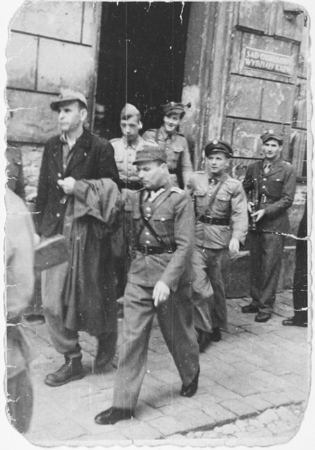
| "Göth on the way from court to prison" |
During the eight days of the trial the prosecution was able to
reconstruct what happened in the camp. The public interest was
enormous. As the courtroom could accommodate only 250 people, loud
speakers were installed in front of the courthouse. The daily press
commented the course of the process, and it was obviously difficult
for journalists to maintain their professional distance. The titles
of the articles read: "A silhouette of a monstrous criminal", "The
Plaszow Executioner brought to justice," "And yet he murdered", "He
personally killed", "The brown Beast" this gives an indication of
the mood that had set in during the process. Göth was finally
sentenced to death by the rope as well as the loss of public and
political rights[which is a formality] and confiscation of all
property. The President did not exercise the right of pardon. During
his trial Göth displayed a provocative indifference.
 |
| "Göth arrest photo" |
In fact there was no effective defence, although two court
appointed lawyers had been available to him. Göth was fully aware
of the outcome and accepted what was coming to him, without any sign
of remorse, he pleaded not guilty. Among the various charges he
says: It was not true that there were thousands of people that died
in Plaszow. It is also not true that he had tortured prisoners in
the camp or were torn by his dogs. He believes that there are not a
single witness that could claim that a single prisoner was tortured
to death. In Plaszow there had been no murders for no reason. And he
had to shoot Chilowicz on command of Koppe, he had been informed
earlier about the intentions of the camp elder. Enrichment from the
possessions of Jewish prisoners can not be proven, he bought
everything properly, the invoices had been recognised by a former SS
court. Fraud and embezzlement of food destined for the the care of
the prisoners did not take place. He accepted responsibility for
what happened at Plaszow. He had been given authority and permission
to do everything he had done, he said, and was only carrying out
orders and instructions received from his superiors. He also
contended that the penalties he was inflicting upon the inmates
including putting them to death, were within his disciplinary
jurisdiction as commandant of the camp, and were in accordance with
the German regulations in force.
.jpg) |
| Göth hears his Death Sentence.
|
Göth appealed for mercy[which is rather surprising, sic] to the
President of the National State Council. After the President had
decided not to avail himself of his prerogative of pardon, the
sentence was carried out on 13th September 1946, he was 37 years
old.
 |
| Handwritten Appeal Göths for Mercy |
The Botched Hanging Execution of Amon Göth:
http://www.youtube.com/watch?v=5BLbqADnPVg
The hanging took place not far from the former site of the Płaszów
camp. At his execution, Göth's hands were tied behind his back. The
executioner two times miscalculated the length of rope necessary to
hang Göth, and it was only on the third attempt that the execution
was successful. [The claim is made that Göth defiantly performed the
Hitler salute, as the eternal Nazi, this statement is incorrect,
following is Spielbergs Hollywood version of the final act.:
http://www.youtube.com/watch?v=4XL2lJj8248&feature=related,
sic]
Göth was married and divorced twice. His first marriage was to Olga
Janauschek in January 1934. They were divorced in July 1936. His
second marriage was to Anny Geiger in October 1938, which ended in
1944. Soon after his second marriage ended, Göth was engaged to Ruth
Irene Kalder, (nicknamed "Majola" in the Płaszów camp during her
stay in Göth's "Red Villa"), who had taken Göth's name shortly after
his death. Through these relationships, Göth had two sons and two
daughters. Göth's first child, a boy named Peter, died seven months
after his birth from a diphtheria infection. Göth had two more
children with Anny Geiger, a daughter named Ingeborg and a son named
Werner. Göth's last child was a daughter named Monika (chosen mainly
from Göth's childhood nickname, "Mony") whom he had by Ruth Irene
Kalder. Monika was born on 23 October 1945.
LAST MONTHS
After the replacement of Göth, SS-Captain Arnold Büscher became the
new commander of Plaszow. The Security Protection responsibility of
the camp fell to SS-Hauptsturmführer Kurt Schupke. Büscher was born
on December 16, 1899 in Bad Oeynhausen, and since 1931 member of the
SS. At the beginning of the war he performed duties only in
concentration camps, serviced in them from Buchenwald to
Sachsenhausen and Neuengamme. From April 1944 he was head of the
camp's guards (Wachmannschaft) in Plaszow. Büscher was condemned to
death for his actions in Plaszow on 23 January 1948. Kurt Schupke,
was born on 15 May 1898 in Greitz, and did service in the camps of
Sanok, Zaslaw, Rzeszow and from April 1944 to January 14, 1945 in
Plaszow, then at Buchenwald. He was sentenced on 10 June 1948 in
Krakow to death.
After the huge transports of male prisoners from the concentration
camp at the beginning of August 1944 to KZ Mauthausem the number of
inmates for the first time since early 1943 sank below the figure of
10.000. On 1 September 1944, a total registered prisoners was
4952, of these were 2843 men and 2109 women, a month later this
figure fell to 4595, of these 272 men and 177 women were on the 23
September classified as "unable to work." It is most likely that
they were Polish inmates who were sent as forced labourers into the
Reich for other assignments.
On 6 September 1944 HSSPF Koppe cabled to Himmler that the camp "is
already in the process of being dismantled," and "the problem should
be resolved in the near future". In September and October 1944 less
and less raw material was available for processing, so that many
inmates had very little work or none at all. The metal workshop and
Madritsch's company worked half shifts and in some Departments at
reduced hours. The plant manager of the DAW Joseph Neuschel fought
desperately against the deportation of his skilled workers from the
camp.
As the front line approached forever nearer, machinery and raw
materials were systematically shifted. Already in August and
September 1944, the barracks were dismantled and sent in part by
goods-trains to Bergen-Belsen and Neuengamme. With additional
Transports of inmates, mainly in October 1944, the occupancy rate
fell by January 14, to 625 prisoners. Of the remaining guards only
87 of them remained. In the meantime due to the clearance of the
guard barracks, an emergency shelter was established for the
remaining prisoners. Until then, the vehicles, construction
machinery, and the so-called special assets, of confiscated books
and scientific works, were packaged and loaded for shipment. Some
of the remaining prisoners were still working for the Office Group
"C" (Construction), the official Group (EIG-DAW), the chemists for
the SS office, and for the defence contracting firm Korgeld &
Rasner.
DESTRUCTION OF ALL TRACES
Probably in August / September 1944 they began with the exhumation
of bodies from mass graves and the burning of all evidence in the
Plaszow camp. This lasted about six weeks, with the fire burning
from early morning. At night, the prisoners dug out the corpses and
prepared them prior for cremation at the funeral pyre, by
alternately placing a layer of wood and a layer of corpses. To
prevent air attacks, the pyre burned only during the day. The
exhumation were performed simultaneously in two places in the old
cemetery and on the "Hujowa Gorka". Twenty to thirty prisoners were
employed ten to twelve days in the "Burning Commando" or the
"Excavation Commando", for a total of six weeks. After work vodka,
sugar and JUS-soup (Jusowka) was provided for an in unimaginative
abhorrent task . At that time, an unbearable stench hung over the
camp. Seventeen loads of ashes left the camp. Taking the fact that
many prisoners that took part in this operation and a relatively
high number of witnesses reported the events after the war, one can
safely assume that prisoners were not killed after finishing their
assignments, as was the case with inmates attached to
"Sonderkommando 1005" at some other camp locations.
EVACUATION OF THE CAMP
"On Sunday, 14 January 1945, the SS Obergruppenführer Koppe issued
by 1200 hours to the commandant of KL Plaszow a direct order to
report back by 1400 hours that all the prisoners, the entire force
of 625 men and women will be ready by 1700 hours to march towards
Auschwitz", thus reported the Camp Administration of Krakow in its
report. The artillery fire was heard in the immediate vicinity of
Krakow, and constantly Russian bombers flew over the city, the
telephone connection was broken. The march lasted three days, almost
without interruption. Some prisoners escaped, and although the SS
had threatened to shoot for one escapee ten other prisoners,
nothing happened. Protective Custody Camp Leader Kurt Schupke
oversaw the death march, he behaved relatively decently. One truck
drove with the prisoners loaded with documents and goods, but did
not include any inmates. Two days after arriving at Auschwitz some
prisoners had to walk to a the sub-camp at Gleiwitz, where they had
to spend eight days and nights under the open sky. With that the
camp was empty.
NUMBER OF VICTIMS
From the Chronicle of occupied Krakow and Tadeusz Wonsli figures
indicate that a minimum of 1702 Polish resistance fighters were
killed at Plaszow. With regular transports twice a week, this
results in the course of the history means an average of eleven
victims per transport. This does not seem too high, especially since
we know that in the summer of 1944 almost daily shootings were
organised. There are also 270 Jewish victims who were taken in the
days and weeks after the Ghetto Closure thatwere taken from their
hiding places and shot. The Gestapo killed at least 531 other Jews
who had been detected outside the camps. Furthermore, in November
1943 about 200 selected Jews from the three Jewish labourwere shot
within the camp ground. As can be backed and verified, the murder
of at least 237 Jewish camp inmates. This results in almost 3,000
murdered in Plaszow, including 1700 non-Jewish Poles. Together with
the approximately 2,000 bodies that were brought out of the
evacuated Ghetto to Plaszow, this indicates that nearly 5,000 people
were either buried or burned on the site. The majority of these
deaths were not inmates, even if the shootings carried out on the
camp grounds.
REVENGE OR OUTRIGHT MURDER-THE JEWISH BRIGADE
Jewish soldiers who served in the British Army hunted down and
executed up to 1,500 high-ranking Nazis in the immediate aftermath
of the Second World War. The soldiers were members of the Jewish
Brigade, part of the British Eighth Army, which fought with
distinction in northern Italy in the latter stages of the war. As
the conflict in Europe ended, the Jewish soldiers started their own
mini-war. They formed "revenge squads", and with the help of their
British Army credentials travelled around Germany and Austria
searching for men responsible for the Holocaust. The brigade's
officers and NCOs were British Jews - Edmund de Rothschild, scion of
the banking dynasty, was a young captain - but the ranks were filled
with Jewish volunteers from Palestine, and refugees who had fled
Nazi-occupied Europe.
The hitherto untold details of the story have emerged in a new book,
The Jewish Brigade: An Army with Two Masters, by author and
historian Morris Beckman. He told the Independent on Sunday: "These
were the first post-war executions of selected top Nazis. There were
several dozen revenge squads operating; the highest estimate of
executions was 1,500. The exact figure will never be known". Secret
orders from Zionist leaders in Tel Aviv instructed members of the
brigade to ensure that at least some of the senior members of the SS
would be punished for their crimes against humanity.
 |
| Jewish Brigade Group Emblem
|
Working under the codename "Operation Judgement", brigade members
formed secret killing squads. In the book, one of the executioners,
Israel Carmi, explains how they dealt with their selected targets.
"When we arrived at the home of our suspect we would put on
[British] Military Police helmets with the white band and police
armlets. Then we would enter the home and take the suspect with us,
saying that we wanted him for interrogation. Usually they came
without a struggle. Once in the car we told the prisoner who we were
and why we took him. Some admitted guilt. Others kept silent. We did
the job."
Those who volunteered for the killings had lost their families and
communities in the Holocaust and were burning with hatred. "We were
young Jewish soldiers," one recalled. "We knew that our people would
never forgive us if we did not exploit the opportunity to kill
Nazis". Initially, they used to shoot them in the head but later
adopted the method of strangling with their own hands. The Avengers
would not reveal anything to their targets before the execution –
not who they were nor why they are killing them. They said the
killing was like "a killing of an insect".
 |
| Antwerpen, Belgium, The "Buchenwald Group" with Jewish Brigade soldiers, before moving to Eretz Israel, 1946".
|
THE 'NAKAM' GROUP
The most extremist group was the Nakam ("vengeance") Group. They
numbered around 60 Jews who were former Partisans as well as other
Jews who survived the Holocaust. The group arrived in Germany after
the war in order to conduct more complicated and fatal vengeance
operations. Their ultimate purpose was to execute an operation that
would cause a broad international response that would be a warning
to anyone who might consider trying to harm Jews again, as the Nazis
had. Notables among the Hanakam group were Abba Kovner, Yitzhak
Avidav, and Bezalel Michaeli. Through Chaim Weizmann later President
of Israel according to Harmatz, Kovner obtained from Ephraim and
Aharon Katzir a poison. He claimed it was to be used on 3000 loaves
of bread for former SS guards, currently in American Prisoner of war
camp in "Stalag XIII", but he was concealing their bigger plan of
poisoning the water supplies of Munich, Berlin, Weimar, Nuremberg
and Hamburg. The Nakam group intended to kill 6 million Germans – as
many as the Jews who were murdered in the Holocaust. According to
Harmatz, they would have taken care to except American residential
areas from the area, so as to murder only Germans as far as
possible. The Katzir brothers supplied Harmatz with the poison and
the Haganah gave Kovner false documents of a supposedly Jewish
Brigade soldier, and he boarded a ship in Port of Haifa. When the
ship approached Toulon in France, the British discovered that
Kovner's papers were forged. His accomplices managed to throw the
poison overboard. Kovner was sent to an Egyptian jail. According to
Joseph Harmatz, leader of Nakam after Kovner's arrest, they were
betrayed. Although uncertain, he suspects the Zionists sabotaged out
of fear that such a crime would diminish support for a Jewish state.
As a result of the failure of the mass poisoning plan, it was
decided to move to Plan B. Under the command of Kovner's deputy,
Yitzhak Avidav, the Hanakam group poisoned hundreds of loaves of
breads that were designated for the S.S. prisoners. On April 14th
1946, Nakam painted with diluted arsenic some 3,000 loaves of bread
for the 12,000 German POWs from the Langwasser internment camp near
Nuremberg (Stalag XIII). The camp was under US authority. 1900
German prisoners of war were poisoned in the US camp, and all got
"seriously ill". The Associated Press:
Did it work? Just check the New York Times for April 20th 1946,
where on page six you will find an Associated Press report that
begins as follows: "Nineteen hundred German prisoners of war were
poisoned by arsenic in their bread early this week in a United
States camp and all are 'seriously ill', United States headquarters
announced tonight". How many of those SS men actually died following
the poisoning at Stalag 13 has never been verified, but some put the
figure at several hundred, others at a thousand. According to
Harmatz (Nakam leader), 300 to 400 Germans died. He said this "was
nothing compared with what we really wanted to do".
The public prosecutor's office within the higher regional court at
Nuremberg stopped the preliminary investigation of attempted murder
in May 2000 against two Nakam activists, who professed to have
involvement in the incident. The public prosecutor's office cited
statute of limitations laws (In German: "Verjährung) "due to unusual
circumstances" as reasoning for the suspension of the investigation.
The 'Nakam' Group British-born soldiers did not take part in the
revenge killings, but provided practical support, such as forged
papers. Londoner Mark Hyatt, who was an NCO in the Jewish Brigade,
told the author that he provided the hit squads with "logistical
support". He said: "We did what had to be done and there was no
compunction about it."
He had transferred from the ranks of Eighth Army, with which he had
fought in north Africa. He summed up the Jewish Brigade as a "very
unorthodox outfit".
As well as the execution of the suspected SS and Gestapo war
criminals, the brigade assisted tens of thousands of concentration
camp survivors to reach Palestine, despite the fact that the British
government was implacably opposed to Jewish immigration at the time
and that the country was the subject of a naval blockade. The
brigade also gave the Palestine-bound refugees military training and
stole, from the British Army stores, thousands of weapons to help
arm the Haganah, the embryonic Israeli army. While the Foreign
Office, under the arch anti-Zionist Ernest Bevin, was hostile to the
Jewish Brigade and wanted it to be stopped, the British military
command refused to act and turned a blind eye to the brigade's
clandestine activities. "The commanders of the Eighth Army knew what
was going on but they were sympathetic, [as] they had fought
alongside the brigade," said Mr Beckman. Ken Sanitt, an artillery
sergeant who had transferred into the Jewish Brigade after four
years of fighting in north Africa, Mesopotamia and at Monte Cassino,
said: "The British and the Indian soldiers I had been fighting with
were elite troops, but they were war-weary, while the Jewish Brigade
were spoiling for action. Their fighting spirit was fantastic."
Indeed, the brigade became the template for the Israeli army and 35
former members of the Brigade later became Israeli generals.
EPILOGUE
In 1964, a 7-metr4 High 'Memorial o the Victims of Fascism in
Krakow' (Polish: Pomnik Ofiar Faszymu w Krakowie) designed by Witold
Ceckiewicz was unveiled. It is dedicated in general to the victims
of Fascism. Few traces of the former camp remain. In 2003, memorial
plaques were affixed to the former camp entrance, presenting
information about the history of the camp. Next to it are two
further memorial plagues. In 2000, one of them was dedicated to the
Hungarian Jewish women who were deported from Plaszow to Auschwitz
and murdered there. Another plague, one which honoured all of the
victims of Plaszow, was donated by the Jewish community of Krakow.
On one of the execution sites, Hujowa Gorka, there is a cross with
barbed wire on it. The history of the camp is also dealt with in the
permanent exhibition on the history of Krakow during World War II at
the "Schindler Factory" museum (Polish: Fabryka Schindlera). The
museum was opened in 2008 in the former Administration building of
Oskar schindler's enamelware factory. Prisoners from Plaszow worked
here, and Schindler could save about 1200 of them from being
transported to death camps.
Acknowledgements
"Plaszow" the German text is published in the series of books "Der Ort
des Terrors" by Wolfang Benz and Barbara Distel, published by C. H.
BECK, volume 8, which was written by Angelina Awtuszewska-Ettrich which
I translated into English.
Literature sources used:
Aleksander Biberstein, Zagla zydow w Krakowie, Die Vernichtung der
Juden in Krakau, Krakow 2002.
Halina Nelken, Freheit will ich noch erleben. Krakauer Tagebuch,
Gerlingen 1996
Angelina Oster, Im Schatten von Auschwitz. Das KZ Krakau-Plaszow,
Geschichte und Erinnerung, in: Dachaauer Hefte 19 (2003)
David M. Crowe, Oskar Schindler, The untold account of his life, wartime activities and the true story behind the list
Mietek Pemper, Der rettende Weg. Schindlers Liste, die wahre
Geschichte, Hamburg 2005
172 references to Witness Statements and Court Documents
Wikipedia





.jpg)

