PROLOGUE While Hitler was busy that summer of 1940 directing the conquest of the West, Stalin was taking advantage of the Führer's preoccupation by moving into the Baltic States and reaching down into the Balkans. On the surface all was friendly between the two great dictatorships. Molotov, acting for Stalin, lost no opportunity to praise and flatter the Germans on every occasion of a new act of aggression or a fresh conquest. When Germany invaded Norway and Denmark on April 9, 1940, the Soviet Foreign Commissar hastened to tell Ambassador von der Schulenburg in Moscow that very morning that 'the Soviet Government understood the measures which were forced on Germany'. 'We wish Germany', said Molotov, 'complete success in her defensive measures'. A month later, when the German Ambassador called on Molotov to inform him officially of the Wehrmacht's attack in the West, which Ribbentrop had instructed his envoy to explain 'was forced upon Germany by the impending Anglo-French push on the Ruhr by way of Belgium and Holland', the Soviet Statesman again expressed his pleasure. 'Molotov received the communication in an understanding spirit', Schulenburg wired Berlin, 'and added that he realised that Germany must protect herself against Anglo-French attack. He had no doubt of our success'. On June 17, the day France asked for an armistice, Molotov summoned Schulenburg to his office 'and expressed the warmest congratulations of the Soviet Government on the splendid success of the German Wehrmacht'. Although he had other matters on his mind.
Hitler with members of his General staff
CHANGE OF EVENTS The Foreign Commissar had something else to say, and this did not sound so quite pleasant to German ears. He informed the German envoy, as the latter wired Berlin 'most urgent', of 'the Soviet action against the Baltic States', adding 'that it had become necessary to put an end to all the intrigues by which England and France had tried to sow discord and mistrust between Germany and the Soviet Union in the Baltic States. To put an end to such 'discord' the Soviet Government, Molotov added, had dispatched 'special emissaries' to the three Baltic countries. They were in fact three of Stalin's best hatchet-men: Dekanozov, who was sent to Lithuania, Vishinsky, to Latvia, Zhadanov, to Estonia. They carried out their assignment with the thoroughness which one would expect from this trio, especially the latter two individuals. Already on June 14, the day German troops entered Paris, the Soviet Government had sent a nine-hour ultimatum to Lithuania demanding the resignation of its government, the arrest of some of its key officials and the right to send in as many Red Army troops as it pleased. Though the Lithuanian government accepted the ultimatum, Moscow deemed its acceptance 'unsatisfactory', and the next day, June 15, Soviet troops occupied the country, the only one of the Baltic States to border Germany. During the next couple of days similar Soviet ultimatums were dispatched to Latvia and Estonia, after which they were similarly overrun by the Red Army.
Soviet tanks enter Riga on 17, July 1940
Stalin could be as crude and ruthless in these matters as Hitler - and more cynical. The press having been suppressed, the political leaders arrested and all parties but the Communist declared illegal, 'elections' were staged by the Russians in all three countries on July 14, and after the respective parliaments thus 'elected' had voted for the incorporation of their lands into the Soviet Union, the Supreme Soviet (Parliament) of Russia 'admitted' them into the motherland: Lithuania on August 3, Latvia on August 5, Estonia on August 6. Adolf Hitler was humiliated, but, busy as he was trying to organise the invasion of Britain, could do nothing about it. The letters from the envoys of the three Baltic States in Berlin protesting Russian aggression were returned to them by order of Ribbentrop. To further humble the Germans, Molotov brusquely told them on August 11 to 'liquidate' their legations in Kaunas, Riga and Tallinn within a fortnight and close down their Baltic consulates by September 1. The seizure of the Baltic States did not satisfy Stalin's appetite. The surprising quick collapse of the Anglo-French armies spurred him on to get as much as he could while the getting was good. He obviously thought there was little time to lose. On June 23, the day after the French formally capitulated and signed the armistice at Compegne, Molotov again called in the Nazi Ambassador in Moscow and told him that 'the solution of the Bessarabian brooked no further delay. The Soviet Government was determined to use force, should the Rumanian Government decline a peaceful agreement'. It expected Germany, Molotov added, 'not to hinder but support the Soviets in their action'. Moreover, 'the Soviet claim likewise to Bucovina'. Bessarabia had been taken by Romania from Russia at the end of the First World War, but Bucovina had never belonged to it, having been under Austria until Romania grabbed it in 1919. At the negotiations in Moscow for the Nazi-Soviet Pact, Ribbentrop, as now reminded Hitler, who had questioned him about it, had been forced to give Bessarabia to the Russian sphere of interest. But he had never given away Bucovina.
Soviet T-26 tank leading a column of BA-10 armoured cars into Romania, circa late Jun 1940
There was some alarm in Berlin, which spread to OKW Headquarters in the West. The Wehrmacht was desperately dependent on Rumanian oil and Germany needed the foodstuffs and fodder it also got from this Balkan country. These would be lost if the Red Army occupied Rumania. Some time back, on May 23, at the height of the Battle of France, the Rumanian General Staff had sent an S.O.S. to OKW informing it that Soviet troops were concentrating on the border. Jodl summed up the reaction at Hitler's Headquarters in his diary the next day: 'Situation in the East becomes threatening because of Russian concentration of force against Bessarabia'. On the night of June 26, Russia delivered an ultimatum to Rumania demanding the ceding to it to Bessarabia and the northern Bucovina and insisting on a reply the next day. Ribbentro, in panic, dashed off instructions from his special train to his minister in Bucharest telling him to advise the Rumanian government to yield, which it did on June 27. Soviet troops marched into the newly acquired territories the next day and Berlin breathed a sigh of relief that at least the rich sources of oil and food had not been cut off by Russia's grabbing the whole of Rumania. It is clear from his acts and from secret German papers that though Stalin was out to get all he could in Eastern Europe while the Germans were tied down in the West, he did not wish or contemplate a break with Hitler.
Soviet occupation of Bessarabia and Northern Bukovina
BRITISH REACTION Towards the end of June Churchill had tried to warn Stalin in a personal letter of the danger of the German conquests to Russia as well as to Britain. The Soviet dictator did not bother to answer, probably, like almost everyone else, he thought Britain was finished. So he tattled to the Germans what the British government was up to. Sir Stafford Cripps, a left-wing Labour Party leader, whom the Prime Minister had rushed to Moscow as the new ambassador in the hope of striking a more responsive chord among the Bolsheviks, a forlorn hope, as he later ruefully admitted, was received by Stalin early in July in an interview that Churchill described as 'formal and frigid'. On July 13 Molotov, on Stalin's instructions, handed the German ambassador a written memorandum of this confidential conversation. It is an interesting document. It reveals, as no other source does, the servere limitations of the Soviet dictator in his cold calculations of foreign affairs. Schulenburg sped it to Berlin 'most urgent' and, of course, 'secret', and Ribbentrop was so grateful for its contents that he told the Soviet government he 'greatly appreciated this information'. Cripps had pressed Stalin, the memorandum said, for his attitude on this principal question, among others: The British Government was convinced that Germany was striving for hegemony in Europe...This was dangerous to the Soviet Union as well as England. Therefore both countries ought to agree on a common policy of self-protection against Germany and on a re-establishment of the European balance of power...Stalin's answers are given as follows: He did not see any danger of hegemony of any one country in Europe and still less any danger that Europe be engulfed by Germany. Stalin observed the policy of Germany, and knew several leading German statesmen well. He had not discovered any desire on their part to engulf European countries. Stalin was not of the opinion that Germany military success menaced the Soviet Union and her friendly relations with Germany... Such staggering smugness, such abysmal ignorance leave one breathless. The Russian tyrant did not know, of course, the secrets of Hitler's turgid mind, but the Führer's past behaviour, his known ambitions and the unexpectedly rapid German conquests ought to have been enough to warn him of the dire danger the Soviet Union was now in. But, incomprehensibly, they were not enough. From the captured German documents and from testimony of many leading German figures in the great drama that was being played over the vast expanse of Western Europe that year, it is plain that at the very moment of Stalin's monumental complacency Hitler had in fact been mulling over in his mind the idea of turning on the Soviet Union and destroying her. The basic idea went back much further, at least fifteen years, to "Mein Kampf"...'this colossal empire in the East is ripe for dissolution, and the end of the Jewish domination in Russia will also be the end of Russia as a state'...This basic idea lay like bedrock in Hitler's mind, and this pact with Stalin had not changed it at all, but merely postponed acting on it, and but briefly. In fact, less than two months later the deal was signed and had been utilized to destroy Poland the Führer instructed the Army that the conquered Polish territory was regarded 'as an assembly area for further future German operations'. The date was October 18, 1939, and Halder recorded it that day in his diary.
Hitler (hand on side) and German Military officers staring at, WWI French marshall, Maréchal Foch's memorial statue before entering the railway carriage where will be signed the 1940 armistice, at Compiègne, France.
GERMAN PREPARATIONS Five weeks later, on November 23, when he harangued his reluctant generals about attacking in the West, Russia was by no means out of his mind, 'We can oppose Russia', he declared, 'Only when we are free in the West'. At that time the two-front war, the nightmare of German generals for a century, was very much on Hitler's mind, and he spoke of it at length on this occasion. He would not repeat the mistake of former German rulers, he would continue to see to it that the Army had one front at a time. It was only natural then, that with the fall of France, the chasing of the British Army across the Channel and the prospects of Britain's imminent collapse, Hitler's thoughts should turn once again to Russia. For he now supposed himself to be free in the West and thereby to have achieved the one condition he had laid down in order to be in the position to 'oppose Russia'. The rapidity with which Stalin seized the Baltic States and the two Rumanian provinces in June spurred Hitler to a decision. The moment of its making can now be traced. Jodl said that the 'fundamental decision' was 'as far back as during the Western Campaign'. Colonel Walter Warlimont, Jodl's deputy at OKW, remembers that on July 29 Jodl announced at a meeting of Operation Staff officers that 'Hitler intended to attack the U.S.S.R. in the spring of 1941'. Sometime previous to this meeting, Jodl related, Hitler had told Keitel 'that he intended to launch the attack against the U.S.S.R. during the fall of 1940'. But this was too much even for Keitel and he had argued Hitler out of it by contending that not only the bad weather in the autumn but the difficulties of transferring the bulk of the Army from West to the East made it impossible. By the time of this conference on July 29,Warlimont related, 'the date for the intended attack (against Russia) had been moved back to the spring of 1941'. Only a week before, we know from Halder's diary, the Führer had still held to a possible campaign in Russia for the autumn if Britain were not invaded. At a military conference in Berlin on July 21 he told Brauchitsch to get busy on the preparation for it. That the Army Commander in Chief and his General Staff already had given the problem some thought, but not enough thought, is evident from his response to Hitler. Brauchitsch told the Leader that the campaign 'would last four to six weeks' and that the aim would be to defeat the Russian Army or at least to occupy enough Russian territory so that Soviet bombers could not reach Berlin or the Silesian industrial area while, on the other hand, the Luftwaffe bombers could reach all important objectives in the Soviet Union'. Brauchitsch thought that from eighty to a hundred German divisions could do the job, he assessed Russian strength as 'fifty to seventy-five good divisions'. Halder's notes on what Brauchitsch told him of the meeting show that Hitler had been stung by Stalin's grabs in the East, that he thought the Soviet dictator was 'coquetting with England' in order to encourage her to hold out, but that he had no signs that Russia was preparing to enter the war against Germany.
A German and a Soviet officer shaking hands at the end of the Invasion of Poland.'
At a further conference at the Berghof on the last day of July 1940, the receding prospects of an invasion of Britain prompted Hitler to announce for the first time to his Army chiefs his decision on Russia. Halder was personally present this time and jotted down his shorthand notes of exactly what the warlord said. They reveal not only that Hitler had made definite decision to attack Russia in the following spring but that he had already worked out in his mind the major strategic aims. Britain's hope, Hitler said, lies in Russia and America. If that hope in Russia is destroyed then it will be destroyed for America too because elimination of Russia will enormously increase Japan's power in the Far East. The more he thought of it the more convinced he was, Hitler said, that Britain's stubborn determination to continue the war was due to its counting on the Soviet Union. Something strange (he explained) has happened in Britain! The British were completely down. [Halder uses the English word "down" here in the German text,sic]. Now they are back on their feet. Intercepted conversations. Russia unpleasantly disturbed by the swift developments in Western Europe. Russia needs only to hint to England that she does not wish to see Germany too strong and the English, like a drowning man, will regain hope that the situation in six to eight months will have completely changed. 'But if Russia is smashed, Britain's last hope will be shattered'. Then Germany will be master of Europe and the Balkans. Decision: 'In view of these considerations Russia must be liquidated. Spring 1941. The sooner Russia is smashed, the better'.[The emphasis in the report is Halder's, sic.]
The Berghof" on the Obersalzberg, the house of Adolf Hitler. In the foreground, the main entrance
The "Great Hall"
The Nazi warlord then elaborated his strategic plans which, it was obvious to the generals, had been ripening in his mind for some time, despite all his preoccupations with the fighting in the West. The operation he said, would be worth carrying out only if its aim was to shatter the Soviet nation in one big blow. Conquering a lot of Russian territory would not enough. 'Wiping out of the very power to exist of Russia! That is the goal1'. Hitler emphasized. There would be two initial drives: one in the south to Kiev and the Dnieper River, the second in the north up through the Baltic States and then towards Moscow. There the two armies would make a junction. After that special operation, if necessary, to secure the Baku oil fields. The very thought of such new conquest exited Hitler, he already had in mind what he would do with them. He would annex outright, he said, the Ukraine, White Russia and the Baltic States and extend Finland's territory to the White Sea. for the whole operation he would allot 120 Divisions, keeping sixty divisions for the defence of the West and Scandinavia. The attack, he laid down, would begin in May 1941 and would take five months to carry out. It would be finished by winter. He would have preferred, he said, to do it this year but this had nor proved possible. The next day, August 1, Halder went to work on the plans with his General Staff. Though he would later claim to have opposed the whole idea of an attack on Russia as insane, his diary entry for this day discloses him full of enthusiasm as he applied himself to the challenging new task. Planning now went ahead with typical German thoroughness on three levels: that of the Army General Staff, of Warlimont's Operation Staff at OKW, and of General Thomas' Economic and Armaments Branch OKW. Thomas was instructed on August 14 by Göring that Hitler desired deliveries of ordered goods to the Russians "only till spring of 1941". In the meantime his office was to make a detailed survey of Soviet industry, transportation and oil centres both as a guide to targets and later on as an aid for administrating Russia. [In his report on this, Thomas stresses how punctual Soviet deliveries of goods to Germany were at this time. In fact, he says, they continued to be 'right up to the start of the attack', and observes, not without amusement, that 'even during the last days, shipments of India rubber from the Far East were completed by the Russians over express transit trains', presumable the Trans-Siberian Railway,sic]
Warlimont at the Nuremberg Trials, 1948. In October 1948, Warlimont was tried as a war criminal before a United States military tribunal in the High Command Trial because he passed on Hitler's directive that Allied commandos should be executed instead of being held as prisoners-of-war. Although he argued that he had tried to dilute Hitler's directive, he was convicted and sentenced to life imprisonment. However, in 1951 his sentence was reduced to 18 years. In 1957 there was an amnesty for certain prisoners, and he was finally released from Landsberg Prison, he die 1976, aged 82.
A few days before, on August 9, Warlimont had got out his first directive for preparing the deployment areas in the East for the jump-off against the Russians. The code name for this was 'Aufbau Ost' (Build-up East). On August 26, Hitler ordered ten infantry and two armoured divisions to be sent from the West to Poland. The Panzer Units, he stipulated, were to be concentrated in south-eastern Poland so that they could intervene to protect the Rumanian oil fields. The transfer of large bodies of troops to the East could not be done without exiting Stalin's easily aroused suspicions if he learned of it, and the Germans went to great lengths to see that he didn't.[The Germans had kept only seven divisions in Poland, two of which were transferred to the West during the spring campaign. The troops there, Halder cracked, were scarcely enough to maintain the customs service. If Stalin had attacked Germany in June 1940, the Red Army probably could have got to Berlin before any resistance was organized, sic]
General Franz Halder. During the 1950s, Halder worked as a war historian advisor to the U.S. Army Historical Division, for which he was awarded the Meritorious Civilian Service Award in 1961. During the early 1950s Halder advised on the redevelopment of the post-World War II German army. He died in 1972 in Aschau im Chiemgau, Bavaria
Since some movements were bound to be detected, General von Köstring, the German military attaché in Moscow, was instructed to inform the Soviet General Staff that it was merely of replacing older men, who were being released to industry, by younger men. On September 6, Jodl got out a directive outlining in considerable detail the means of camoflage and deception. 'These regroupings', he laid down, 'must not create the impression in Russia that we are preparing an offensive in the East'. So that the armed services should not rest on their laurels after the great victories of the summer, Hitler issued on November 12, 1940, a comprehensive top-secret directive outlining new military tasks all over Europe and beyond in particular in dealing with the Soviet Union. It reads in part: 'Political discussions have been initiated with the aim of clarifying Russia's attitude for the time being. Irrespective of the results of these discussions, all preparations for the East which have already been verbally ordered will be continued. Instructions on this will follow, as soon as the general outline of the Army's operational plans have been submitted to, and approved by, me'. As a matter of fact, on that very day, November 12, Molotov arrived in Berlin to continue with Hitler himself those political discussions. continued under Part 2
Monday, April 15, 2013
AMERICAS FIRST MILITARY TRIBUNAL-EXECUTION OF GENERAL ANTON DOSTLER
BRIEF SUMMARY OF DOSTLER
Anton Dostler, born on 13-06-1884 in Munich, entered the Army Service on 23-07-1910, at the age of 25, in the 6th Bayerischen Infanterieregiment. He ends World War I as a 1st Ordinance Officer in the same Regiment and is allowed in the new Reichswehr. At the beginning of World War II he is assigned to Operation Chief in the General Staff of the 7th Army and is promoted to Major General. Dostler is twice in the infamous Führer Reserve and served with several Corpses. His last command, from 01-12-1944, is of the LXXIII Army Corps and he is in American captivity on 08-05-1945. After the war Dostler was tried in the first trial after the war and found guilty of war crimes and sentenced to death by firing squad. On March 22/23, 1944.
MURDER ON COMMAND
Anton Dostler was a German general of infantry in World War II. Dostler had fifteen prisoners U.S. soldiers executed during the Second World War. He was sentenced after the war by a U.S. court to death and shot shortly afterwards. On the 8 May 1945 he was captured by the Americans and brought to trial before a U.S. military court in Caserta for the shooting of the 15-member American saboteurs. The charge against him, was that he had issued an illegal instruction relied on the so-called Commando Order of 18 Oktober 1942. This personal order from Hitler stated the immediate execution of captured Allied commandos, whether uniformed or not. Dostler saw himself only as a bearer of this command to Colonel Almers. The court did not follow his argument, despite the more than dubious but legal interpertation and sentenced him on 12 October 1945 to death.
Gravestone of Aton Dostler
PROLOGUE
Late at night, on 22 March 1944, the 'Ginny Mission' stole out of Bastia, Corsica, on PT boats, Lieutenants, Vincent Russo and Paul Traficante commanded 13 enlisted men on this OSS operation. Close to the shore near La Spezia, the commandos set of in rubber rafts, their purpose, to blow a rail-road tunnel on the main supply line to the German front, 400 miles south od Cassino and Anzio.
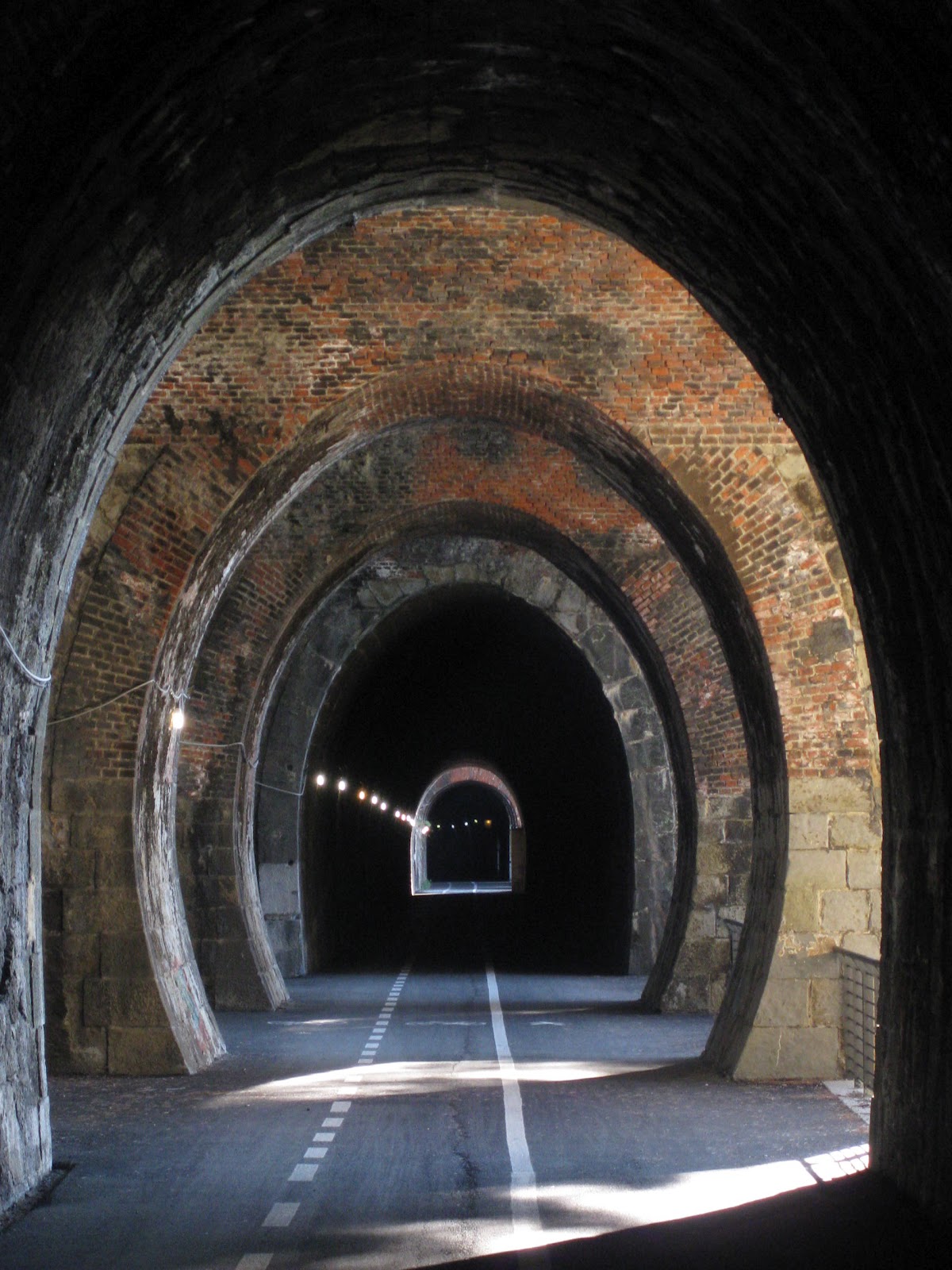
The Ginny II mission objective, vaulted tunnel arcades that open to the sea, Framura
tunnel arcades that open to the sea, Framura.
They reached land still not knowing their exact position, but it was soon clear they were not near the right promontory and there was no access to the rail tunnel. They had apparently drifted down the coast while paddling and put ashore near the locality named Sca. Scouts were sent to locate the rail line but travel on the very steep and rocky slopes made it impossible to locate before dawn. Since an attack on the tunnel could not take place, they had to hide and try the next night, according to the mission plan. They hid the yellow rubber boats and the explosives as best they could and began moving up-slope. The team found an unused farm building on the edge of the locality of Carpeneggio, and settled in. On the morning of March 23, two team members, 1st Lt. Russo and Sgt. Mauro, went out to get food and information at the nearest farm. They made contact with an Italian farmer named Franco Lagaxo, who agreed to buy food for them, and later in the day guided them on reconnaissance which succeeded in locating access to the Genoa-La Spezia rail tunnel.
La Spezia
The mission plan called for the OSS team to make contact with the PT boats at prearranged radio contact times before setting off the explosives. On the evening of March 23rd however, the mission took another bad turn - the PT boats ran into trouble. One had a mechanical breakdown on the trip from Corsica and had to return to base. The second encountered enemy activity as it approached the coast, and was also forced to turn back. Lacking a coordinated means to escape after the attack, the team was forced into another day of hiding.
In the morning light of March 24, an Italian fisherman noticed the rubber boats pulled up along the shore, and mentioned them to authorities at nearby Bonassola. Soon a search of the area began, involving both Italian and German personnel. Eventually, as the search area widened, searchers encountered an Italian girl who had seen strangers with rifles on a road near her home. Quickly the area was sealed off, the farm building surrounded, and the American team forced to surrender. They were questioned briefly by Italian Fascist authorities in Bonassola, then turned over to the German military, and transferred to the German headquarters of the 135th Fortress Brigade in La Spezia. There interrogation began in earnest. Details of the interrogation methods are lacking, but eventually at least one of the soldiers divulged the details of the mission. Ominously, the information that it was a commando raid was relayed up the German hierarchy.
The mission was not accomplished. The men did not return. Nothing was heard of them until after VE-Day, when OSS found 15 bodies in a seaside grave. With hands bound behind them, the Americans had been put to death by a German firing squad, in violation of the Geneva Convention forbidding execution of uniformed enemy soldiers taken prisoners.[Other sources claim, although they did wear US uniforms, but had them turned outside in when they were apprehended by a fascist Italian Patrol, sic]
Five months later, Anton Dostler commanding General of the German LXXV Corps, was tried by an American Military Commission in the Palace of Justice at Rome as the officer chiefly responsible for the executions. Dostler pleaded not guilty, but was sentenced to die. Anton Dostler was the first German General brought to trial after the war, and the first executed. This case became a precedent for the Nuremberg war crime trials of German generals, officials and Nazi leaders beginning in November, 1945. The precedent thus contributed to the codification of Principle IV of the Nuremberg Principles, which rejects 'Superior Orders', and a similar principle found in sections of The Universal Declaration of Human Rights.
Memorial at
Punta Bianca, Ameglia.
THE COURT
The Trial was conducted by a Military Commission appointed by command of General McNarney, consisting of the following: Major-General
L. C. Jaynes (President), Brigadier-General T. K. Brown, Colonel H. Shaler, Colonel James Notestein, Colonel F. T. Hammond, Jr., Major F.
W. Roche (Judge Advocate), 1st Lt. W. T. Andress (Assistant Judge Advocate), ColonelC. O. Wolfe (Defence Counsel), and Major C. K. Emery (Assistant Defence Counsel).
In the conduct of its proceedings, the Commission was ordered to follow the provisions of circular 114 of Headquarters, Mediterranean Theatre of Operations, 23rd September, 1945, entitled " Regulations for the Trial of War Crimes."
From October 8th to the 12th, a parade of witnesses, mostly German officers, told the commission of the circumstances under which the OSS men were condemned. The execution without trial, was ordered on the basis of the Führerbefehl ( command of Adolf Hitler) which demanded the 'extermination...without mercy...on general principals' of all commandos found behind German lines.
Dostler spent a whole day on the witness stand testifying through a GI interpreter in an effort to save his life. Sweating and nervous, the chunky, florid defendant admitted he had ordered the Americans shot, but said he had no choice. 'An order was given by me that the men were to be shot', the accused conceded on the stand. 'Than I mediated further and decided to talk with Col. Almers, commander of the 135th Fortress Brigade, were the prisoners were held'. Dostler said he ordered Almers to hold the execution while he consulted next higher headquarters, that of the army group commanded by General Gustav von Zangen. When von Zangen's headquarters demanded the firing squad for the Americans, Dostler ordered the prisoners shot by 7 A.M. the following morning, he said. Von Zangen, however, testified for the prosecution that he did not give that order. Almers and three Naval Officers, who were interrogating the prisoners, appealed by telephone and telegram to Dostler and Marshall Kesselring to spare the OSS party or, at least, postpone the execution. Kesselring never replied, the appeal to Dostler failed and the 15 Americans were shot on March 26. [ There are conflicting reports, that no weapons were used, I quote from another source:
Memorial at
the site of the mass grave/
La Ferrara area, Bocca di Magra.
'On the morning of March 26, 1944, the 15 American soldiers -still in uniform - were brought to Punta Bianca, above the sea on the rocky tip of Ameglia's peninsula. Eleven were executed by being struck on the head with great force, two were shot in the head at close range, and two had no known wounds. The bodies were taken to the La Ferrara area of Bocca di Magra and buried in a shallow, hidden mass grave. The circumstances make clear that the German command knew this was a war crime, and sought to hide it. They chose Punta Bianca because it was remote, with no houses nearby, and under military control. There was no firing squad, both to reduce the number of witnesses and the noise. They did not inform the De Lutti cannon batteries close by. They chose to bury the soldiers in an area of Bocca di Magra with no houses at the time, and camouflaged the grave site. Two days later a German communiqué was issued falsely reporting that the commandos had been annihilated in combat. Four days later, General Kesselring, Commander in Chief of German forces in Italy, ordered all written records of the affair destroyed.
The trial was carefully watched by virtually the entire world press, since the issue, whether all Nazi war crimes may be attributed to Hitler alone and whether 'obeying orders from above' is a valid defence for illegal acts of war, was tested here for the first time.
Alexander zu Dohna-Schlobitten, who refused to sign the execution order, was dismissed from Wehrmacht for insubordination, Zu Dohna was a German aristocrat died on 24-02-1997, at the very old age of 97. [He was in no other way prosecuted or demoted in rank and thus received his pension,sic]
TRIAL OF GENERAL ANTON DOSTLER, COMMANDER OF THE 75TH GERMAN ARMY CORPS
Anton Dostler was accused of having ordered the shooting of fifteen American prisoners of war in violation of the Regulations attached to the Hague Convention Number IV of 1907, and of long-established laws and customs of war. A plea was made to the jurisdiction of the Commission by his Counsel, on the grounds, first, that the accused was entitled to the benefits of the Geneva Prisoners of War Convention of 1929 in the conduct of his trial, and, secondly, that the Commission had not been legally established. These arguments, and the plea of superior orders later put forward on Dostler’s behalf, were rejected, and he was condemned to death.
Anton Dostler was charged with violations of the laws of war in that, as commander of the 75th German Army Corps, he, on or about 24th
March, 1944, in the vicinity of La Spezia, Italy, ordered to be shot summarily a group of United States Army personnel consisting of two officers and 13 enlisted men, who had then recently been captured by forces under General Dostler, which order was carried into execution on or about 26th March, 1944, resulting in the death of the said 15 members of the United States Army.
THE PLEA TO THE JURISDICTION OF THE MILITARY COMMISSION
At the beginning of the trial the Defence presented a plea to the jurisdiction of the Military Commission to try the accused. Article 63 of the Prisoners of War Convention of 1929, it was stated, provided that a sentence shall only be pronounced on a prisoner of war by the same tribunals and in accordance with the same procedure as in the case of persons belonging to the armed forces of the detaining Power. This provision was also set out in para. 136 of the American Basic Field Manual, Rules of Land Warfare. By virtue of the provisions of the Constitution of the United States, the Geneva Convention had become part of the United States Municipal Law (Footnote: Counsel could also have pointed out that Congressional Legislation had made the Convention part of United States Law), and Article 16 of the American Articles of War (an Act of Congress) provided that officers of the United States Army shall be triable only by Genera1 and Special Courts-Martial, and in no case shall an officer, when it can be avoided, be tried by officers inferior to him in rank.
From this the Defence argued that the proper tribunal to try the accused would have been a Court Martial. (Trial before Courts Martial affords to the accused a higher degree of safeguards than trial by a Military Commission.)
The Prosecution replied that the provisions of the Geneva Convention with regard to the trial of prisoners of war, which the Defence had put forward, pertained to offences committed by a prisoner of war in captivity, and did not pertain to offences committed against the Law of Nations prior to his becoming a prisoner of war. If the accused, being a prisoner of war, had struck a guard, Counsel for the Defence would be absolutely correct ; the accused would have had to be tried by a Court Martial, for that would have been an offence against the American Articles of War, but in the present case he was being tried for an offence, not against the Articles of War, but against the Laws of War, for which a Military Commission might be, and had been for more than a hundred years, the proper method of trial. Counsel for the Prosecution quoted from Winthrop’s Military Law and Precedents, p. 835, enumerating the classes of persons who in United States law might become subject to the jurisdiction of Military Commissions, and expressly naming individuals of the enemy’s army who had been guilty of illegitimate warfare or other offences against the laws of war. The Prosecutor also referred to paragraph 346 (c) of the Basic Field Manual, Rules of Lund Warfare, according to which, in the event of clearly established violation of the laws of war, the injured party may legally resort to the punishment of captured individual offenders. He further quoted two further arguments were then put forward by the Defence. The first was to the effect that the Commission had been set up by order of an American General, whereas the forces operating in that theatre were Allied forces of several different nationalities under a British Commanding General, Field Marshal Alexander. Counsel claimed that the accused was " entitled to be tried at least by a Court or a Commission appointed by the Commanding General of the theatre of operations in which the offence allegedly was committed," since he was " charged with being a war criminal rather than committing an offence against or which is peculiar only to the forces of the United States."
Fortress were Americans were held
Secondly, the Defence argued that, should the foregoing argument be regarded as unsound, the appointment of the Commission was in any case invalid since, as far as the accused knew, no order had been given by the President of the United States appointing, or authorising the appointment of, the Commission, whereas its appointment required to be carried out either by the President or by some person legally authorised in the matter. Counsel quoted Article 38 of the Articles of War, to the effect that the President " may by regulations . . . prescribe the procedure . . . in cases before courts-martial, courts of inquiry, military commissions, and other military tribunals . . ." He admitted that this provision concerned rules of procedure and evidence, but claimed that the implication was that the President was also the authority who should establish the procedure whereby Military Commissions were to be appointed.
The Prosecution claimed in reply that by long-standing practice, custom and even laws of war the Supreme Commander in the field had the authority to appoint a Military Commission. The belligerent injured by the offence was the United States, and the Supreme Commander for all American Forces in that theatre was General McNarney, who had appointed the Commission and had referred the case to it.
Under the provisions of Rules of Land Warfare, it was the injured belligerent who could bring the captured before a Military Commission, and Counsel therefore doubted whether Field Marshal Alexander would have had authority to appoint the Commission and refer the case to it.
Finally, Article 38 was purely permissive in character, not mandatory, and there was nothing in the Articles of War which took from General McNarney the power to appoint the Commission and to make rules for its procedure.
The Commission overruled the pleas of the Defence.
THE CASE FOR THE PROSECUTION
The Prosecution claimed, by virtue of the witnesses and evidence produced, to be able to establish the following facts :-
On the night of 22nd March, 1944, two officers and 13 men of a special reconnaissance battalion disembarked from some United States Navy boats and landed on the Italian coast about 100 kilometres north of La Spezia. The front at the time was at Cassino with a further front at the Anzio beach head. The place of disembarkation was therefore 250 miles behind the then established front. The 15 members of the United States Army were on a bona fide military mission, which was to demolish the railroad tunnel on the mainline between La Spezia and Genoa. On the morning of 24th March, 1944, the entire group was captured by a party consisting of Italian Fascist soldiers and a group of members of the German army. They were brought to La Spezia where they were confined near the headquarters of the 135th Fortress Brigade. The 135th Fortress Brigade was, at that time, commanded by a German Colonel, Almers (who was not before the Military Commission). His next higher headquarters was that of the 75th German Army Corps then commanded by the accused, Anton Dostler. The next higher headquarters was that of the Army Group von Zangen, commanded by the General of the Infantry von Zangen, who was called as a witness in the case. The next higher command was that of the Heeresgruppe C or Heeresgruppe South West, which was at that time under Field Marshal Kesselring.
The captured American soldiers were interrogated in La Spezia by two German Naval Intelligence Officers. In the course of the investigation one of the officers of the American party revealed the story of the mission. On 24th March a report was made by the 135th Fortress Brigade to the 75th Army Corps about the capture. On the next morning (25th March, 1944) a telegram was received at the headquarters of the 135th Fortress Brigade signed by the accused Dostler, saying in substance " the captured Americans will be shot immediately."
On receiving this cable, the commanding officer of the 135th Fortress Brigade and the Naval Officers interrogating the prisoners got into touch with the 75th Army Corps headquarters in order to bring about a stay of the execution. Late on the afternoon of the 25th March, Colonel Almers (then commanding the brigade) received another telegram from 75th Army Corps which said in substance that by 7.0 o’clock the next morning (26th March) he would have reported compliance with the order of execution.
Colonel Almers then gave orders for the conduct of the execution, for the digging of a grave, etc. During the night from Saturday 25th to Sunday, 26th March, two attempts were made by officers of the 135th Fortress Brigade and by the Naval Officers to bring about a change in the decision by telephoning to the accused Dostler. All these attempts having been unsuccessful, the 15 Americans were executed on the 26th March, early in the morning.
They were neither tried, nor given any hearing.
The argument of the Prosecution was that since the deceased had been soldiers of the United States Army, dressed as such and engaged on a genuine military mission, they were entitled to be treated as prisoners of war. Their execution without trial, therefore, was contrary to the Hague Convention.
THE EVIDENCE
Witnesses for the Prosecution included a Captain in the United States Army who had directed the operation against the tunnel. He stated that the fifteen soldiers had been bona fide members of the United States Forces ; he also bore witness as to the nature of the mission on which they were sent, and as to the clothing and equipment which they wore. Witnesses for the Prosecution included also an Italian employee of the Todt Organisation and two German Naval Intelligence Officers who gave further evidence regarding the deceased’s, clothing. One of the last two identified a document before the Commission as representing in substance the Führerbefehl to which reference was made by the Defence. Three ex-members of the Wehrmacht gave evidence of attempts made to induce Dostler to change the order regarding the execution, and on the circumstances of the execution. General Zangen appeared in the witness box, and denied having ordered the execution of the prisoners.
Two depositions and the notes of a preliminary interrogation of General Dostler were also allowed as evidence. The first deposition was made by a German lieutenant in hospital, who bore witness to the contents of the telegram containing Dostler’s orders regarding the immediate execution of the prisoners and to the efforts which were made to avert the latter. The second deposition was made by a Captain in the United States Army who had been present at the exhumation of the bodies of the soldiers. The Defence recalled General Zangen, who bore witness to the accused’s merits as a soldier, and called a second Wehrmacht General, von Saenger, who described the oath which officers of the German Army had had to take on the accession of Hitler to power. As will be seen, General Dostler himself also appeared as a witness under oath.
Although it was not possible to produce the witnesses primarily needed by the Defence (one of them, the commander of the Brigade, had escaped from captivity and had not been recaptured, while the others could not be traced in the American and British zones), the decisive facts were not controversial, namely that the victims had been members of the American Forces, carrying out a military mission, that the accused had ordered their shooting without trial and that they had been so shot.[This may not quite correct, there is not sufficient evidence aftyer exhumination that all were shot,sic]
THE ARGUMENTS OF THE DEFENCE AND REPLIES MADE BY THE PROSECUTION
That the Deceased were not entitled to the Benefits of the Geneva Convention The Defence claimed that for any person to be accorded the rights of a prisoner of war under the Geneva Convention, it was necessary, under Article 1 thereof, for that person, inter alia, " to have a fixed distinctive emblem recognisable at a distance." The submission of the Defence was that the American soldiers had worn no such distinctive emblem, and that their mission had been undertaken for the purpose of sabotage, to be accomplished by stealth and without engaging the enemy. They were not therefore not entitled to the privileges of lawful belligerents, though it was admitted that they were entitled to a lawful trial even if they were treated as spies. (Footnote: While the Defence made no use of the facts in argument, the United States Captain who directed the operation bore witness that all of the soldiers were possessed of an Italian background, and that most of them could speak some Italian. He stated that the mission had had sabotage as its aim and that the whole company from which the men were drawn had been recruited in the United States with a view to work behind the enemy’s lines. As it might be necessary to live off the land, a knowledge of the language of the country in which they were expected to operate was deemed very helpful.)
The accused relied on the defence of superior orders which was based on two alleged facts :-
(a) The Führerbefehl of 18th October, 1942, the text of which is provided in the Appendix. The Führerbefehl laid down that if members of Allied commando units were encountered by German troops they were to be exterminated either in combat or in pursuit. If they should fall into the hands of the Wehrmacht through different channels they were to be handed over to the Sicherheitsdienst without delay.
The Defence Counsel submitted that pursuit could go on for weeks, and that it was not ordered that the allied troops should necessarily be killed on the spot.
In answer to the argument of the Prosecution that Dostler had exceeded the terms of the Führerbefehl, the Defence pointed out that Dostler had received no punishment for his action, whereas para. 6 of the order stated that all leaders and officers who failed to carry out its instructions would be summoned before the tribunal of war.
(b) Alleged orders received from the Commander of the Army Group, General von Zangen, and from the Commander of the Heeresgruppe South West, Field Marshal Kesselring.
Dostler also claimed that he had revoked his first order to shoot the men and that he had eventually re-issued it on higher order.
Dostler tied to the stake prior to execution
The Defence tried to establish the fact that in 1933 all officers of the German Army had had to take a special oath of obedience to the Führer Adolf Hitler.(Footnote: Actually this happened in 1934, when Hitler " succeeded " Hindenburg as " head of the State.) This fact was confirmed both by General von Zangen and Dostler himself in the witness box. The Prosecution put a question to General von Saenger whether he could cite to the Commission any single case of a general officer in the German Army who was executed for disobedience to an order. Von Saenger replied that he had heard of two cases, one of which he knew ; the second was only a rumour. The witness did not know a case in the German Army in which a general officer was executed for disobedience to the Führerbefehl of 18th October, 1942.
General von Saenger admitted that the Führer gave out orders which in their way interfered with International Law. The officers at the front who had to execute these orders were convinced, however, that in those cases Hitler would make a statement or by some other means inform the enemy governments of his decisions, so that the officers were not responsible for crimes committed while carrying out his orders. He also said that during the war officers could not resign from the German Army.
Dostler himself said that under the oath to Hitler he understood that it was mandatory upon him to obey all orders received from the Führer or under his authority.
Defence Counsel quoted a statement from Oppenheim-Lauterpacht, International Law, 6th edition, volume 2, page 453, to the effect that an act otherwise amounting to a war crime might have been executed in obedience to orders conceived as a measure of reprisals, and that a Court was bound to take into consideration such a circumstance.
The Defence invoked the text of the Führerbefehl which in its first sentence itself refers to the Geneva Convention and represents itself as a reprisal order made in view of the alleged illegal methods of warfare employed by the Allies. Counsel claimed that retaliation was recognised by the Geneva Convention as lawful, that the Führerbefehl stated the basis on which it rested and that the accused therefore had a perfect right to believe that the order, as a reprisal order, was legitimate.
The Defence quoted also paragraph 347 of the United States Basic Field Manual F.M.27-10 (Rules of Land Warfare), which says that individuals of the armed forces will not be punished for war crimes if they are committed under the orders or sanction of their government or commanders.
Dostlers body immediately after execution
In so far as the defence was based on the Führerbefehl, the Prosecution submitted that, apart from an illegal order being no defence, the shooting of the prisoners in the present case had not even been covered by the terms of the Führerbefehl, because the latter ordered that Commandos should be annihilated in combat or in pursuit, but that if they came into the hands of the Wehrmacht, through other channels, they should be handed over without delay to the Sicherheitsdienst. The prosecuting Counsel pointed out that the deceased had not been killed in combat or in pursuit, and had been executed instead of being given up to the Sicherheitsdienst.
As far as the Defence relied on orders received from Army Group headquarters, and headquarters of the Heeresgruppe South West, this defence had not been substantiated. As far as the Army Group command was concerned, it had not been confirmed by the witness, General von Zangen, and as far as a command of the Heeresgruppe South West was in question, it was even rebutted by the statement of a witness that some hours after the execution a cable had been received from the headquarters of Heeresgruppe South West to the effect that the execution of the 15 Americans should not take place.
With regard to the text of the Führerbefehl of 18th October, 1942, which was used in evidence, the Defence Counsel said : " It is a matter of common knowledge that this Führerbefehl was kept extremely secret. As a matter of fact practically no originals of it have ever been found. This does not purport to be an original we have ; it is a copy on which the signature of whoever signed it is illegible. I understand it was secured from the French intelligence and they passed it on, and that one copy is the only one they have been able to find."
During his examination, the accused, on being handed a copy of the text of the Führerbefehl of October, 1942, said that a document which he had received in 1944 through Army Group channels contained substantially everything that was in the 1942 text, but with certain additions. He stated further that " this copy is not the complete Führerbefehl as it was valid in March, 1944. In the order that laid on my desk in March, 1944, it was much more in detail . . . the Führerbefehl which was laying in front of me listed the various categories of operations which may come under the Führerbefehl. In addition there was something said in that Führerbefehl about the interrogation of men belonging to sabotage troops and the shooting of these men after their interrogation. . . . I am not quite clear about the point, whether a new Führerbefehl covering the whole matter came out or whether only a supplement came out and the former Führerbefehl was still in existence. . . . The Führerbefehl has as its subject commando operations and there was a list of what is to be construed as commando operations. I know exactly that a mission to explode something, to blow up something, came under the concept of commando troops."
With regard to the mission of the 15 American soldiers he claimed that, after making consultations with staff officers, " as it appeared without doubt that the operation came under the Führerbefehl an order was given by me and sent out that the men were to be shot."
General von Saenger said that in the Autumn of 1943 he had been acquainted with a Führerbefehl on the same subject which was different in contents from that before the Commission. On the other hand, three witnesses, namely, one of the German Naval Intelligence Officers, an ex-Wehrmacht Adjutant and General von Zangen, could remember no amendments to the Führerbefehl of October, 1942.
THE VERDICT
The Commission found General Dostler guilty.
THE SENTENCE
General Dostler was sentenced to be shot to death by musketry. The sentence was approved and confirmed, and was carried out.General Ridgway was in involved in the trial of the German General Anton Drosler, who was found guilty of a war crime and sentenced to death. On 27-11-1944, the Mediterranean Theatre Commander, Lieutenant General Matthew B. Ridgway, confirmed the sentence. At 8 a.m. on the morning of 01-12-1944, General Dostler was executed, age 54. He is buried on the war cemetery of Pomezia, Italy.
THE GERMAN REPORT
On 22 March 1944 an American sabotage commando landed on the Italian coast 100 kilometres north of the port city of La Spezia. These consisted of two officers and thirteen soldiers of the U.S. Army. None of these men were dressed in uniforms, which would have them recognised as combatants. Their mission was to destroy a railroad tunnel between La Spezia and Genoa. On 24 March 1944 this group was captured and interrogated by Italian and German soldiers and kept under guard. One of the officers revealed the plan of the mission. This information was transmitted to the LXXV Army Corps. General Dostler reported the case to Field Marshal Kesselring and ordered the shooting of the saboteurs. Dostler relayed this command as ordered. The Americans were still being held by Fascist partisans as they were dressed in civilian clothing. After reading to them of their imminent execution, they revealed their troops belonging and their mission. Because as non-uniformed combatants they were not entitled to the treatment under the Geneva Convention, the shooting during war-time was legally legitimate. [This part of the Defence is rather vague and was solely based on the 'Führerbefehl', sic]
General Anton Dostler was after his capture by the Americans, tried by a 'Victors' Military Tribunal and in revenge for his militarily-correct behaviour and sentenced to death. On 1 December 1945 he was executed by a firing squad. The killing was filmed by Americans for propaganda purposes.
General Ridgway was in involved in the trial of the German General Anton Drostler, who was found guilty of a war crime and sentenced to death. On 27-11-1944, the Mediterranean Theatre Commander, Lieutenant General Matthew B. Ridgway, confirmed and signed the sentence. At 8 a.m. on the morning of 01-12-1944, General Dostler was executed, age 54. He is buried on the war cemetery of Pomezia, Italy.
EPELOGUE
> On December 1, 1945, German General Anton Dostler was shot by the American military at Aversa, Italy, for war crimes.
Specifically, General Dostler was condemned for having ordered the summary execution of American saboteurs who had been taken behind enemy lines. Dostler was the first German general tried by an American military commission, and the first put to death for war crimes .And his sentence did not sit well with all.
There had been a group of German saboteurs captured in the United States during the war who had themselves been executed (after becoming the subject of Supreme Court landmark Ex parte Quirin). Here, a mirroring act on the German side brought a death sentence for its (supposed) author. Dostler’s scenario therefore raised interesting questions of war crimes law, jurisdiction … and politics. The essential legal difference between the German saboteurs and the OSS men shot at La Spezia was that the latter were found to have been taken in uniform. If uniformed, they were entitled to prisoner of war status; if not, then a summary execution might have been (however repugnant) permissible. It seems to be generally agreed, and even conceded by Dostler’s defense, that the saboteurs were indeed in uniform, though the notes of the trial are rather vague on the point; there’s an intriguing indication that the defense disputed the notion that the captive saboteurs’ uniform had the necessary “fixed distinctive sign recognizable at a distance.” (Time said that “they wore no insignia, had turned their field jackets inside out.”) In a do-over, Dostler’s defense might have dug very deep into what met the Geneva Convention’s definition of a uniform. For the Germans, however, the saboteurs’ fate was decided by Hitler’s notorious Commando Order, inflicting immediate death on any enemy personnel (uniformed or not) captured behind German lines. Understandably, then, Dostler’s counsel seems to have been much more interested in pursuing the “superior orders” defense, and did so with gusto: in this early landmark trial, it was an as-yet untested strategem even though the Allied Powers had decided as a matter of policy not to protect potential war criminals on that basis. Not only was the Führerbefehl at work in general, but Dostler had kicked this specific decision upstairs to the office of Gen. Albert Kesselring, which had insisted upon the executions (to the point of directly phoning the fortress which held the Americans to ask why they weren’t dead yet). Dostler defense attorney Col. Claudius Wolfe appeared to strike a chord with the tribunal’s career military officers in his closing summation, impressing upon them the danger to military order or to their own persons of establishing a precedent that subordinates can be held accountable for illegal orders from above We won the war this time, but no one knows who will win the next time. We might lose and then you gentlemen might find yourselves sitting where this man is now sitting…If we find this man guilty because of political pressure or because he lost the war and is in our power, we might as well not have won the war. (New York Times, Oct. 12, 1945) But a more immediate precedent was at stake: the many imminent war crimes trials including the Nuremberg proceedings. Many of those would never get off the ground if a “superior orders” plea could work for someone as high-ranking as a general — or if the first war crimes trial out of the gate resulted in an acquittal.
APPENDIX
THE TEXT OF THE FÜHRERBEFEHL AS PRODUCED IN THE TRIAL
The Führerbefehl of 18th October, 1942
1. Recently our adversaries have employed methods of warfare contrary to the provisions of the Geneva Convention. The attitude of the so-called commandos, who are recruited in part among common criminals released from prison, is particularly brutal and underhanded. From captured documents it has been learned that they have orders not only to bind prisoners [this was in first done during a commando raid by the British on the Channel Islands which choked some Germans to death, sic] but to kill them without hesitation should they become an encumbrance or constitute an obstacle to the completion of their mission. Finally, we have captured orders which advocate putting prisoners to death as a matter of principle....[The text of another order by Hitler relating to the treatment of captured saboteurs was produced in evidence at subsequent war crime trials.]
2. For this reason, an addition to the communique of the Wehrmacht of 7th October, 1942, is announced; that, in the future, Germany will resort to the same methods in regard to these groups of British saboteurs and their accomplices---'-that is to say that German troops will exterminate them without mercy wherever they find them.
3. Therefore, I command that: Henceforth all enemy troops encountered by German troops during so-called commando operations, in Europe or in Africa, though they appear to be soldiers in uniform or demolition groups, armed or unarmed, are to be exterminated to the last man, either in combat or in pursuit. It matters not in the least whether they have been landed by ships or planes or dropped by parachute. If such men appear to be about to surrender, no quarter should be given to them on general principle. A detailed report on this point is to be addressed in each case to the OKW [German High Command,sic] for inclusion in the Wehrmacht communique.
4. If members of such commando units, acting as agents, saboteurs, etc., fall into the hands of the Wehrmacht through different channels (for example, through the police in occupied territories), they are to be handed over to the .Sicherheitsdienst [Security Service, sic] without delay. It is formally forbidden to keep them, even temporarily, under military supervision (for example, in POW camps, etc.).
5. These provisions do not apply to enemy soldiers who surrender or are captured in actual combat within the limits of normal combat activities (offensives, large-scale air or seaborne landings). Nor do they apply to
enemy troops captured during naval engagements, nor to aviators who have baled out to save lives, during aerial combat.
6. I will summon before the tribunal of war all leaders and officers who fail to carry out these instructions-either by failure to inform their men or by their disobedience of this order in action.
In the early afternoon, on the 24th of June 1944, an SS officer exited Birkenau Concentration Camp escorting a prisoner who was carrying a bathroom sink.
The guard at the gate, who did not even glance at the pass, opened the gate and allowed the escort to leave. Several hours later, the sound of a siren announcing an escape filled the Camp.
Edek Galinski, prisoner number 531 was missing from the Men's Camp, while from the Women's Camp the same was true of Mala Zimetbaum, prisoner number 19880. This escape became legendary within the Camp...
A telegram informing the escape of a female prisoner Mala Zimetbaum
"The love of Edek Galinski and Mala Zimetbaum became camp legend in Auschwitz; a symbol of the victory of good over evil, of what is human over what is bestial. They gave us hope". (Statement: Camp Survivor Rene Raindorf of Brussels)
MALA
Mala Zimetbaum was a Jewish woman born in the Polish city of Brzesko on 26 January 1918. In 1928, her father Pinkus, a merchant, emigrated to Antwerp with her whole family. Mala attended elementary school in Belgium, where she became fluent in Flemish, French, German, English, as well as Polish and some Russian. Because of the difficult financial situation due to her father's blindness, she was not able to attend high school and began working as a seamstress. Mala was arrested on 11 September 1942, during a round-up of Jews at the main railway station in Antwerp and was in a convoy of 1,048 Jews sent to Auschwitz. On 17 September 1942, the convoy reached the camp; 717 people were sent to the gas chambers from the ramp. Mala was among those judged fit for work and was given number 19880.
'Fragment of a list of transports sent to Auschwitz with prisoner numbers September 19, 1942 a transport from Malines. The female prisoners were given the numbers 19821-19921 (underlined in red)'.
EDECK
Edward Galinski was born in Jaroslaw on October 5th, 1923 and was a student at the maritime school in Pinsk when war broke out. In the spring of 1940, he was arrested and several weeks later, on 14 June 1940, he was brought in the first transport of political prisoners from Tarnów to the Auschwitz concentration camp. He became prisoner 531 out of the 728 transported. He survived the next four years of camp life, until, thanks to help from fellow prisoners and chance, he got into a "better" commando and began to work in the camp locksmith workshop. He served under chief Kommandoführer (Corporal) Edward Lubusch. Lubusch was an SS-man, who rather than tormenting the prisoners, helped them.
Photo was taken in the camp metal workshop. In the foregrround SS-man Edward Lubusch who provided Galinski with SS uniform before the planned escape and next to him is Edward Galinski'.
'A blonde, she was liked by Maria Mandel (Commander of the Women's Camp). Mala... was one of those who worked in transferring female prisoners, who had been released from the infirmary to the housing barracks. When one of our prisoners, a Communist, was returning from the infirmary, it was then that we would ask Mala to take the weakened prisoner to a barrack, from which she would not be sent to do heavy labour. Mala was not a member of our organisation, however she helped us and knew about its existence. We were aware that Mala was helping many other prisoners.
Portrait of Mala Zimetbaum. It was made in the camp by fellow prisoner Zofia Stepien-Bator
"I knew Edek, he was a sympathetic prisoner with a cheerful disposition; he often came to the Women's Camp and was friendly to the female prisoners... Mala and Edek loved each other very much. A few days before their escape, I knew what they were planning. When we heard the sound of the siren, we were aware of its meaning. You could hear the whispers: "That's Mala, That's Mala!". Mala had escaped from the Camp with Edek.' (Statement: Ewa Feldenkreis, former Auschwitz prisoner, Camp number 29682)
A document from the file of prisoners working in the camp metal workshop. Galinski Edward, prisoner 531, trained profession: high school student, employed in the camp as metalwork apprentice'.
PREPARING TO ESCAPE
At the end of 1943, Edek began to make efforts to be transferred from the camp locksmith workshop in Auschwitz to the fitters` commando in Birkenau, because he hoped that from there it would be easier to arrange an escape with his good friend and colleague from Jaroslaw, Wieslaw Kielar. Edek and Wieslaw Kielar had persuaded Antoni Szymlak, a tiler by trade, who had entry to the camp zone as a civilian worker, to provide shelter for them once they had escaped before they went further to Zakopane, to Wieslaw Kielar's sister. When everything was ready, Edek became abstracted and reticent. Kielar suspected that Mala Zimetbaum was the reason. They met when Edek went with the fitters commando to the women's camp to make repairs. Since their first meeting at the turn of 1943/1944, a deep affection had grown between them.
"I love and am loved", Mala told one of her fellow prisoners. Edek also confessed his feelings to his friend.
Phograph of Wieslaw Kielar taken 1978'
After that confession, Wieslaw Kielar gave up his part in the planned escape. His place was taken by Mala. On 24 June 1944, she put on work clothes prepared earlier. Edek put the SS uniform on. He attached a holster holding a pistol with two bullets to his waist. Like the uniform, he had received it earlier from SS-man Lubusch. [One could assume, that Lubusch only gave Edek two bullets, in case they preferred suicide to re-capture, sic]
They crossed the line of camp guard post by showing a forged SS pass, for which Mala had stolen the form. They successfully reached the village of Kozy and received help from Antoni Szymlak.
Wieslaw Kielar's testimony on the events of 24th June 1944'.
Wieslaw Kielar's testimony on the events of 24th June 1944'.
Map showing sited related to the escape'.
At Mala's insistence, they changed the next stage of escape route. Instead of Zakopane, they went towards Slovakia, where Mala's relatives lived and where they wanted to take refuge until the liberation.
However, luck had abandoned them. On 6 July 1944, they met a German border patrol. Mala, who was in front, was stopped.
Edek, not noticed by the Germans, could easily have withdrawn to safety, but he refused to do so. They were recognised as fugitives and sent back to the camp. In a telegram dated 27 July 1944, Auschwitz headquarters informed the superior authorities of their arrest.
elegram announcing the recapture of Edek and Mala'.
Edek and Mala were put in separate cells in the cellars of the Death Block. Edward Galinski was in cells 19, 20, 21 and 23 in turn. In each of them he scratched "Edward Galinski no. 531, Mally Zimetbaum no. 19880, 6 VIII 1944" in the plaster on the wall or on the interior side of the door. The interrogations of the fugitives were long and torture was used. The camp Gestapo wanted to force them to confess where Edek got the SS uniform and the gun. Edek and Mala kept silent.
Testimony of Boleslaw Staron'.
Interrogation and imprisoment sites'
The basement of the Death Block where Mala and Edek were detained after their failed escape from the camp'.
Fragment of the wall from cell 20 in the basement of Block 11 of the former Auschwitz I camp
Escapee Edward Galinski was held in this cell after his capture and he was probably the author of the inscription "531 Galinski Edward = 6 VII 1944 + 19880 Mally Zimetbaum +. The inscription includes the names and prisoner numbers of the escapees, as well as the date they were captured July 6, 1944'.
In secret messages sent to Wieslaw Kielar they reassured Lubusch and the prisoners who knew about the escape that they had nothing to fear. In the camp they were talked about as heroes.
"... Now, everyone made their way towards the kitchen and stood at the edge of a square, where a gallows had been placed in the centre. After some time, the cell doors were opened and Edek appeared in the doorway. There was a sudden silence. Only the gravel beneath their shoes could be heard as they walked towards the gallows, Edek (the condemned) and Jupp (the executioner)... [ One could contemplate, that the tiger would pity the fawn, the wolf would weep over its lamb, before a hangman would cringe at the corpse of a dangling prisoner, sic] Then I saw his upright back and his hands twisted behind him and tied with wire. This was the work of Jupp, who, was walking after him with a truncheon in the direction of the gallows. Here, Edek stepped onto the podium without hesitation and then immediately onto the stool that was placed beneath the gallows... An SS-man came forward from the group of SS standing at the side of the guardhouse and started to read the sentence in German from a piece of paper that he was holding in his hand.
The current appearance of the "Death Bloc" in the Main Camp
At that very moment, Edek, standing on the stool, placed his head in the noose and with his feet, he pushed himself away with considerable force, hanging himself... However, the SS-men did not allow for such a demonstration. The Lager capo realised, just in time, and caught Edek by the waist and placed him back on the stool - loosening the noose. The German finished reading the sentence in his language and then started reading it in Polish. Edek waited patiently until he had finished. And in a moment of complete silence, he suddenly yelled with an astonishing voice "Long live Pol...", but he could not finish. Jupp had suddenly pulled the stool away. The noose tightened completely this time and Edek's body became rigid and then hanged limp. He was dead. "Hats off!" was the command in Polish that spread from the side where block 4 stood... This was the moment that the entire camp paid its respect to the departed. One of the SS-men realised what was happening and screamed: "Alles Raus Wegtreten". Danisch and Jupp were now violently screaming "Raus! Raus!" In a single moment, the square by the kitchen was empty. Only Edek remained." (SMA-B. Collection of Testimonies: t. 9, c.123-126.)
Quote: "He suddenly yelled with an astonishing voice 'Long live Pol...', but he could not finish"
Execution by hanging was also planned for Mala. However, a young Slovak woman and fellow prisoner described to Wieslaw Kieler what really happened:
"When she (Mala) was already on the platform, as the sentence was being read she cut her veins with a razor that she had prepared beforehand, but as with Edek she was not allowed to die that way.
Testimony of Wieslaw Kielar, "Execution".
Rapportführer Taube ran over to her and she slapped his face with her bloody hands. At the same time, the SS-men practically trampled her to death before the eyes of the whole women's camp. She died on the way to the crematorium."
"I donate two locks of human hair to the Museum. They are wrapped in paper with German printed on it. On the edge of the paper is a pencil inscription: Mally Zimetbaum 19880, Edward Galinski 531. It is an inscription made by Galinski and his hair and that of Mala Zimetbaum. The camp Lager kapo, Jupp Windeck, who hanged Edek, gave me the hair and the note an hour after his death in the presence of Rapportschreiber Kazimierz Gosek, stating that it had been the last request of the condemned that I take them and give them to his father. That tragic memento went with me through all the camps and I kept it to this day". (Statement from Wieslaw Kieslar dated January 29th, 1968)
Tragic momentous left of Mala and Edek. Locks of their hair
CREDITS;
Curator- Dr. Maria Martyniak and Alicja Bialecka.
Acknowledgements:
The exhibition featured many, in some cases have been created by an independent third party and may not always represent the views of the institutions. Listed who have supplied the content: Auschwitz-Birkenau State Museum.

.gif)