Saturday, September 28, 2013

FLOSSENBÜRG KZ PART 2/6


CONSOLIDATION AND EXPANSION PLANS 1939-1940
Unlike the losses  of the DESt new operations in Mauthausen and Buchenwald the enterprise at Flossenburg posted modest gains from the beginning. Although this may have been created by a very generous managed balance sheet of their accounting method, for the SS Economic Administration the quarry was a profitable and a  promising object. Therefore, they invested more in the infrastructure within the camp. At the same time the initially sceptical SS-Chief Administrator Pohl ordered in April 1939 increasing the occupancy strength of the KZ  by the end of July to 3000 prisoners and four squadrons of SS guards. He instructed: "This date must be adhered to, as to achieve  a full occupancy by this time". [There was a good reason for this order, as we will see later,sic]. Both in the camp and in the quarries the construction of additional buildings was begun. Using prison labour they erected on the premises of the DESt, a blacksmith, a carpenter, a machine shop, garages and several other workshops. in addition a community hall (Gefolgschaftshalle) was built. In the SS area and in the prison camp some temporary functional buildings were converted into permanent facilities or newly built. Thus far, the prisoners' kitchen housed in a wooden hut was replaced by a massive stone building. The new prisoner kitchen with the laundry under construction since June 1939 was now bordering the parade ground. In the basement of the laundry there was the 'prisoners bath' with adjoining rooms for disinfection of clothing.

The prisoners’ bathroom in the basement of the laundry (photograph 4th May 1945).
On orders of 24 March by Eicke, who marked this as 'Urgent', began the construction in April, of a 112 meter long building on the southern edge, a massive Detention Building, which, however, was only completed in March 1940. The infirmary was permanently established in the same year in a wooden building. Also SS administrative and residential areas were extended into some functional [utility] buildings.


The gate to the prisoner area, with one of the gateposts, can be seen just to the right of the small gatehouse building in the centre of the period photo. The buildings seen here were all razed after the war, except the two large buildings in the centre distance - the kitchen and laundry buildings for the prisoners - and the guard tower on the hill

A schedule of work performed by prisoners at the concentration camp as from 1 July 1939 broken down in detail, gives an accurate picture of the number of work details and their assignments. Of the 1509 total inmates, 646 prisoners were employed in the quarry, another 863 engaged in individual construction projects to improve or extend the camp. The main applications here, were during the construction of the SS settlement and the camp's  workshops, as well as in the four 'macrolevellings', (Planierungen) with the expanding camp area due to the removal of granite from the quarry, inmates levelled and extended further into southern, northern and eastern directions to gain badly needed building sites.


This original building of the SS camp also survives, just outside the memorial grounds. It was the SS Casino (officers club and dining hall), and is now a privately-owned restaurant. This building can be seen in the period photos below, above the headquarters building (left) and over the camp gate area (right)

NEW FRAMEWORK AT THE START OF WW II
On January 20, 1939 the first commandant of the camp, Jacob Weiseborn died unexpectedly. About the circumstances of his death different rumours were circulating. [Jakob Weiseborn turned up dead in his apartment under mysterious circumstances, spawning rumours that he had committed suicide to avoid scandal, sic] Among the prisoners it was said that he,(Weiseborn) had taken his own life, as it had been proven that during his tenure at Buchenwald he was involved in embezzlements. A suicide is however not recorded in any of the official death reports. He was succeeded by Karl Künstler, who had previously served with the Totenkopfverbände (SS-Scull Head Unit) in Dachau. The leader of theTotenkopfverbände, Theodor Eicke, considered him unreliable and alcohol dependent. However, after Weiseborn's death, Eicke gave SS-Sturmbannführer Karl Künstler one last chance to prove himself, by appointing him as the new commander of the concentration camp Flossenburg. Among the Administration Staff there, since May 1938 was the Protective Custody Camp Leader (Schutzhaftlagerführer) Hans Aumeier whose performance against prisoners under Karl Künstler made changes and clearly radicalised the internal structure of the camp, only these two were directly responsible for the conditions that followed. The situation in Flossenburg for the prisoners deteriorated significantly. Actually, the camp would have been able in July 1939 to accommodate 3,000 inmates, but the construction continued to be sluggish. Although  more transports of prisoners arrived in the spring, the reduction through deaths, individual releases and departures to other camps made very little difference, yet the number of 2,000 prisoners never exceeded its occupancy rate until September 1939. With  its maximum capacity, however, the camp had  already substantially outnumbered what they could actually absorb. In the protective custody area at this time only eight accommodation barracks with a planned capacity of 224 inmates per barrack was available. In autumn, the prisoner strength and thus the occupancy of the camp continued to increase. On 27 September, a transport arrived with nearly 1000 prisoners from Dachau concentration camp. The Dachau camp was almost completely cleared after the invasion of Poland for half a year, to make room for the reorganization and training of an SS division.[They used the KZ barracks and installations which were in fact built to military standards as at that time, sic] The incoming prisoners were housed on a temporary basis in concentration camps like Mauthausen, Buchenwald and Flossenburg and later returned.
Distribution of food to prisoners in Flossenbürg. The prisoners, who were assigned to the granite quarry, stood to attention before receiving a portion of food from the kapos. Germany, 1944. (Ordnung muß sein im Dritten Reich"!)
The 'Dachau' prisoners wore mostly the red triangle of political prisoners. They were housed in separate barracks, received not the Flossenburg camp numbers, but were included in the daily work details. With them there was in November 1939 a total of 2242 able prisoners fit for work. Of these 1297 had been employed in the two quarries of the DESt,  and 945 were engaged on the building construction sites, in the supply or sewage treatment facilities such as it existed, in the  effects room and kitchen. Even for long term 'Dachau' arrivals in the Flossenburg it was a shocking experience. In almost all their memories of their time in Flossenburg the murderous work in the quarry, the extreme cold, the totally inadequate nutrition and the dominance of the 'green' prisoner functionaries stands out as the worst time during their entire incarceration.
From the first moment on, the SS showed a tendency to humiliate the political prisoners and make them understand that they are far more dangerous and reprehensible as any habitual criminal. Most thoroughly was a SS Lieutenant, a work commando-leader who temporarily was supervising the quarrying, and treated the 'Greens' relatively gentle, but addressed the political prisoners with nothing less than 'pig'(Schwein) or 'dog'.(Hund) [both expression more than derogative in the German language,sic]. Partly due to overcrowding and penetrated full confinement combined with inadequate water supply to the prisoners, a dysentery epidemic among prisoners broke out at Christmas 1939. Only after the prison doctor, an Austrian Anton Hittmair, made it clear to the SS garrison physician that the spreading of the infection to the SS accommodation would occur, he, the SS-doctor, imposed then a quarantine over the detainee area on 26 December to protect the ranks of the SS and all work in the quarry and the camp expansion were stopped until February 9th 1940. Thus Hittmair had saved the lives of hundreds of prisoners who were thereby not exposed during this period to the tortures by the SS and the debilitating work in the quarry.[source:'Ncht über Deutschland, page 77, Maleta, Bewältigte Vergangenheit, page 222 sic]
Work in the quarry was one of the hardest and most murderous work details (photograph from around 1940
The Death Register of the Flossenburg shows for the year 1939 that a total of 87 deceased prisoners were officially notarized. In its second year, the last assigned (and highest)concentration camp prisoner number was 1748.  Taking into consideration the deceased and prisoners transferred to other camps, or released from detention, we can assume that the total number of about 2,000 people were imprisoned in Flossenburg in the year 1939, plus the nearly 1000 temporarily detainees from Dachau. On 3 March 1940, the Dachau prisoners were transferred back again. Many of the prisoner that arrived back there, died  shortly after, still as a result of hunger and diseases during the winter months of 1939/40 at Flossenburg.[Source:Statement by the former mayor of Vienna, Richard Schmitz, 27 and 28.5.1945 in Berlin BArch, microfilm FC 6279, sic]
FORCED CAMP EXPANSION 1940
The returning Dachau prisoners were replaced by two transports with prisoners from the Sachsenhausen concentration camp, so there were in Flossenburg in April 1940 approximately 2200-25000 prisoners. 1122 were employed to expand the facilities of the camp and 902 at the German Earth and Stone Works (DESt). Compared to the period of November 1939, the ratio of employment had now reversed. Following the lifting of the quarantine of the camp, the SS forced the development of the required infrastructure very vigorously moving forward under stringent conditions. The construction project included primarily the completion and commissioning of the camp's own Crematorium, the establishment of six massive watchtowers of granite and perfecting the barriers with a double row, electric fence around the protective custody camp. Besides that they also started the construction of a gate for the surveillance headquarters building, at the entrance from the prisoner-area. With the completion of these buildings, the first stage of the KZ Flossenburg should have been be completed. However, in late summer of 1940, a new overall plan for the camp, which meant war-related activities and also the associated decline in available building material, another strategy was developed.


'The crematorium was actually a small building with only a dissection room and one oven.'

In the case of the composition of the inmate population, only crude statements can be obtained for 1940 and 1941. The highest (prisoner) number recorded and allocated in 1940 was 2697. More than 400 other had passed through the camp in the same year, but they've been given numbers of previous prisoners. At least 240 of these had died during 1940 in Flossenburg. With the arrival of two transports in April from Sachsenhausen, the proportion of political prisoners had increased significantly in the camp. Although the numerical and percentage of Preventive Detainees (Vorbeugehäftlinge) to the inmate population of the camp through deaths, transfers to other camps and releases from detention had been steadily decreasing since the year 1939, but the political new comers, did not succeed to break the dominance of the "Greens" as prison-functionaries. As in other camps, the composition of the prisoners from 1940 changed fundamentally and permanently. From the 'Protectorate of Bohemia Moravia' the first Czech prisoner were transferred directly to Flossenburg from Stapo (Gestapo) points Brno(Brünn) and Prague. In April few Polish prisoners arrived, also the first eleven Jewish prisoners were noted in the camp registries on the 24th May. Almost all had been entered the additional expression as 'Political'. Although the German prisoners in 1940 still constituted the majority in the camp, the inmate community gradually became more and more  internationalized. The sophisticated hierarchy of the SS, the allocation of the coloured Triangle and with that the system of power which derived from it, favouring certain groups of prisoners, was now staggered according to national and racial criteria.
ADVANCED LABOUR APPLICATION AND SYSTEMATIC EXTERMINATION 1941-1942
From the second half of 1941, the use of concentration camp prisoners working for the SS leadership gained a new significance. Himmler, Pohl and the head in autumn appointed Civil Engineer of the SS, Hans Kammler developed jointly considerations for the use of concentration camp prisoners who should now no longer work exclusively in the SS-owned stone factory plants or in the concentration camp workshops. The new emphasis were initially not war economic needs, to increase their position much more was on the intended evaluation of German settlement areas as part of the 'General Plan East' and the needed labour productivity of the quarries and the quality of the required building stone, which began in winter of 1941 on the part of DESt . It went so far as to introduce even an instructional program to train inmates as Stone Masons and other required skills, which had been arranged by Himmler on December 5. 1941 and started with the training of 179 Flossenburger prisoners to stonemasons and would increase to a total 600-700 by 1942. This led to efforts in the increase of production in the DESt plant to a significant profit in sales of around 640,000 RM in 1941 to approximately 966.800 RM in 1942. However, this increase was not due to the optimization of prison labour or by improving prison conditions. Rather, the proportion of less valuable road material in the total production through greater use of more and more prisoners which had risen considerably. The sheer amount of material as well as the rising price of natural stones made ​​for the profit of the company and not the quality of the work they produced in granite stones.
SS members at Flossenburg concentration camp, September 1938
The increased labour demand and the changing trends in the internal structure of the SS administration  within concentration camps affected inmates rather drastically. Himmler sought to expand the labour input specifically to the introduction of new groups of prisoners to concentration camps, such as prisoners from occupied countries and Soviet POW's. This was accompanied at the same time, with the systematic selection of incapacitated prisoners and the murder through 'Action 14f13', which also began and was held in Flossenburger in spring 1942. The inmate population was increasingly differentiated by nationality and based by the SS on racial principles of 'prison administration'. While the German prisoners, and of those with the green triangle stood at the top, engaged, onto a forced community in the camp, keeping central function within it's administration, thus the elimination pressure increased significantly on the Polish, and Jewish prisoners.
THE EXECUTION OF POLISH PRISONERS.
After 1940, the first Czech and Poles were deported to Flossenburg, it came increasingly to admissions of Polish prisoners with the beginning of 1941. On 23 January 1941, a large transport of nearly 600 political prisoners arrived from Auschwitz at Flossenburg. Until the arrival of the first Soviet prisoners the Poles were at the lowest level of the camp hierarchy. They were rushed to the quarry commands specificly to perish and systematically disadvantaged in the food distribution and functions as compared to German prisoners, so that their health deteriorated quickly. Immediately after their arrival in late January at the same time began the deliberate extermination of that group.
Shortly before his 18th birthday the worker Stanislaw Rydel from Huta Dobrowa was shot on February 6, 1941 on a 'command of the Reichsführer SS' (Auf Befehl des Reichsführers SS) in KZ Flossenburg. The murder of the young Pole was the beginning of a number of executions, which continued until 8 September and 184 detainees of this transport were killed. The selection for execution were taken after the evening roll call, their numbers were called out in the courtyard of the detention centre who was, at that time Hans Aumeier, leader of the Schutzhaftlager ( protective custody camp), the death sentence was read out by him without any pre-amble or reason and the condemned taken away . After a night in the cells of arrest they were shot in the early hours by a firing squad on the shooting range of the SS, which was located in a valley below the prison camp in the immediate vicinity of the crematorium.


A part of one of the prison buildings where the Resistance prisoners were held has been refurbished and now has a display on the history of the camp. A memorial plaque on the wall outside honours
Bonhoeffer, Canaris, Oster, and others who were executed here in April 1945

(On 7 February 1945 Canaris was brought to the Flossenburg concentration camp. For months Canaris baffled the SS-interrogators
with one ruse after another, and he denied all personal complicity in the conspiracy against Hitler. He never betrayed his fellow participants in the Resistance Movement. In the closing days of World War II, in the grey morning hours of April 9, 1945, gallows were erected hastily in the courtyard. Wilhelm Canaris, pastor Dietrich Bonhoeffer, Major General Hans Oster, Judge Advocate General Carl Sack, Captain Ludwig Gehre - all were ordered to remove their clothing and were led down the steps under the trees to the secluded place of execution before hooting SS guards. Naked under the scaffold, they knelt for the last time to pray - they were hanged, their corpses left to rot.Two weeks later the camp was liberated by American troops - on 23 April 1945. One of Canaris' fellow-prisoners, the Danish Colonel Lunding, former Director of Danish Military Intelligence, was imprisoned in the cell next to Canaris. He had contact with Canaris shortly before he watched the naked figure of the Admiral being led to execution. Through tapping on the wall of his cell Canaris told him: "This is the end. Badly mishandled. My nose broken. I have done nothing against Germany. If you survive, please tell my wife .." Eberhard Bethge, a student of Bonhoeffer's, writes of a man who saw the execution: "I saw Pastor Bonhoeffer... kneeling on the floor praying fervently to God. I was most deeply moved by the way this lovable man prayed, so devout and so certain that God heard his prayer. At the place of execution, he again said a short prayer and then climbed the few steps to the gallows, brave and composed. His death ensued after a few seconds. In the almost fifty years that I worked as a doctor, I have hardly ever seen a man die so entirely submissive to the will of God
[It is most likely that a Lynching Method was used during the hanging of Canaris. After the war the hangman made the statement:"Nun, ja, wir mussten den kleinen Admiral mehrmals hoch und herunter ziehen, da er lange strappelte ehe er sein Leben aufgab."(Well, yes, we had to pull the little Admiral few times up and down as he struggled quite long before he gave up his life). [I am unable to find the source to verify this statement, HKS]


Formal orders for the massacre for a series of execution were given  by command of the RSHA, which had also arrived with the prisoners in January and probably arose for reason of retaliation. On July 2nd, 40 Polish prisoners and another  20 were shot simultaneously, liquidated on the 8th September, with this series of execution, it came to an abrupt end with the deaths of the transport, but still it continued  in Flossenburg, until the end of 1941, by that time about two-thirds of the nearly 600 Poles that arrived in January were no longer alive.
The extent between the completion of the shootings of Polish prisoners and the start of mass executions of Soviet prisoners of war on 3rd September 1941, if there was a connection, it is difficult to assess, however, the time proximity of the two events is significant. In addition, the infrastructure of the camp  and the number of daily tasks to cremate corpses seems to have grown and could not sufficiently cope. On the 2nd of October, the head of the crematorium reminded the Administration of the urgent need of a second furnace in order to to conserve the existing oven to continue and maintain the proper operation of the camp's cremation.

 The ramp ended above the crematorium (photograph around 1945   


  US-army investigative commission examines the tunnel entrance (photograph 24th April 1945 

View YouTube:
https://www.youtube.com/watch?v=czbUP6cl2NE&feature=em-subs_digest-vrecs


'Bodies from the upper part of the camp were moved to the crematorium on the lower left by means of a ramp with an entrance near one of the guard towers. The ramp led downhill to the crematorium.'
 CONTINUED UNDER PART 3/6


Wednesday, September 25, 2013

FLOSSENBüRG KZ PART 1/6

FLOSSENBÜRG COMCENTRATION CAMP PART 1/6

PROLOGUE
Until the formation of the concentration camp in May 1938 Flossenbürg was a small community with about 1,200 inhabitants in the Eastern Upper Palatinate Forest (Oberpfälzer Wald) on the border of the Czechoslovak Republic. The entire Eastern Bavarian area was in the twenties considered as backward and underdeveloped. A harsh climate, poor soil conditions, lack of raw material, generally poor transport links had made this into a 'natural poverty area' and  had brought them the unflattering by-name as the 'Bavarian Siberia' long before the First World War.
Flossenbürg as a poverty area located on the very edge of it, was economically, socio-structurally, politically and religiously a special case in this largely agrarian small border region. Thanks to the rich granite quarries numerous quarries were opened in Flossenbürg since the 19th century, which provided, despite the high migration losses of the working population in Eastern Bavaria, an influx of workers from neighbouring Bohemia. During 1925 there lived in Flossenbürg about 1074 inhabitants, two-thirds Catholic and one-third of Protestant religion. Apart from that the agricultural community maintained a social-democratic oriented outlook, but workers were  still strongly divided in denominational groups. The work ethic of stone masons, with all the connotations linked to poor living conditions, became culturally a very sorry picture of a place. Although Flossenbürg possessed with its medieval castle ruins an attraction for a tourist infrastructure, this village, as opposed to other places in the central mountain regions took a timidly approach and did very little, in fact nothing at all to exploit a possible tourist potential.

'The castle Flossenbürg, also called castle near Flozze, was founded about the year 1100. First there was only a sort of residential tower built, then in 13th and 16th century the castle was extended with a donjon (The fortified main tower of a castle) and gate'

With the end of the First World War, the political geography of Eastern Bavaria changed fundamentally. Until 1918/19, the Bavarian-Bohemian border marked 'a barely perceptible geographical concept'. After the Treaty of Versailles and the creation of the First Czechoslovak Republic, a century-long existing natural stone industry at Flossenbürg with the new political importance of the border and particularly the economic crisis in the late twenties the area was slowly but drastically affected. With the onset after the National Socialist (Nazi) takeover the labour market policies promoting the natural stone industry had hitherto a moderate acceptance, however, the National Socialists rapid rise to power in 1933 changed Flossenbürg and its environments.


This building located on top of the hill overlooking the quarry was the administration building of the SS DESt company.                                    

With the support of small settlement constructions (Siedlungen) and large public buildings under the National Socialist autarky and architecture planning, the medium-sized granite works took an unexpected upturn, which soon brought them to the brink of their capacity. One of the main consumers of the local granite were the sites of the Reich's Party Rally Grounds (Reichsparteitagsgelände) at Nuremberg.  The Flossenburg quarries had already full employment, as from 1934 onwards, at the same time new settlements were designed and built for the required civilian workforce and their families.
Not only in Flossenburg but also on a Reich level the labour shortage worsened from 1936/37 in the construction industry, so that problems were foreseen in the realization of the extensive military and urban construction programs. The Reichs-Leader of the SS, Heinrich Himmler, in agreement with Hitler and the 'General Construction Inspector for the Reich Capital' (GBI), Albert Speer, sanctioned the use of concentration camp prisoners in the production and supply of building material. A direct consequence was the establishment of new camps, including the concentration camp at Flossenburg. In April 1938, the SS-owned operation 'German Earth and Stone Works Ltd.' (DESt) was founded with the aim to organize and provide building materials through newly formed concentration camps.

Flossenbürg
Flossenbürg Panoramic view
1938 THE YEAR THE KZ WAS FOUNDED
On May 1st 1938 came the first members of SS guards to Flossenburg. These had been sent from several other SS units such as staff drivers from Frankenberg near Chemnitz who were set on a 'train' in the direction of Flossenburg. But the majority of SS men recruited, probably came from the first Totenkopfstandarte (Death Head Unit) 'Oberbayern', the guards of the concentration camp at Dachau. As the first Commandant in early May was Jacob Weiseborn transferred to the northern Oberpfalz. Weiseborn had served in various concentration camps since 1934 and had worked before his promotion to commander of the concentration camp Flossenburg as Deputy and General Protective Custody Camp Leader as well as temporary adjutant to the commandant of Karl Koch at Buchenwald. Two days after the arrival of the SS members on May 3, the first transport of 100 prisoners arrived from Dachau at Flossenburg. The task of these prisoners was the structural development of the camp. They had to build living quarters for prisoners and storage barracks, erect the first administration building as well as security systems. All the barracks were delivered as pre-fabricated components from Kamper & Seeberg and provided to the inmates to put them into place with the assistance of local construction workers.  Prisoners had to live initially in unsafe  temporarily shelters exposed to all weather conditions for a few weeks, until the first barrack, Block 1, was completed on May 28, 1938. But the construction of the camp was not proceeding in the planned pace, as deliveries of building materials were hampered and slow in arriving.   SS-Hauptsturmführer Weiseborn complained already on May 10th to the Administrative Office of the SS, that the SS barracks needed further improvements urgently. Likewise, he requested, that immediate facilities for an SS doctor has to be provided, in addition, a supply depot and garages are in urgent need.


 Flossenbürg headquarters building, in the SS camp area. Today it houses a film room with an interpretive video.
The circumstances of the first few months of the existence of Flossenbürg and the short time span between the site selection and arrival of the first prisoners suggests that the decision to set up the camp had been made in  great haste. No fundamental decision had yet been taken as to the status and the planned state of expansion for this camp. Although at the end of May, 200 prisoners worked on the physical infrastructure and from July 1938 away from the camp at the southern slope, permanent houses were built for staff members. The Chief of the SS-Main Office (SS-Hauptamt) Oswald Pohl was prompted to ask Theodor Eicke on September 7, 1938, if the camp at Flossenburg should be continued and used as a 'hiking camp'(Wanderlager), or whether the camp's only aim was to keep the required prisoners for the quarry and the commandant plus the necessary guards (Bewachmannschaft), or whether it was intended to build a strong camp with its own Skull Head Unit (Totenkopfverband) and the associated training camp. He made no bones about finishing off that he thought the yield of the quarry was very limited, estimated at not more than 5-10 years, and after completion of the constructions, saw no way for any use of inmates on a larger scale.
Hand-drawn plan of the Flossenbürg concentration camp by Stefan Kryszczak, a survivor of the camp.'
In addition to the initial difficulties to build up inventories and the prevailing scepticism about the productivity of granite deposits the camp had already attained by the end of 1938 a considerable stage of expansion. In addition to the three quarries that had been opened on the DESt site, the actual camp was structurally sound, although rudimentary, yet by the method of zoning for prisoners, separated from the Administration and the range of working facilities pointed already towards the typical structure of a concentration camp. At the end of 1938 in the area were ten prisoner barracks, but not all used as accommodation, rather as functional utility buildings and converted later to inmate's accommodations. The entire area was surrounded by a two to three-strand fence but was not electrified, however, the camp side was reinforced and secured by 'spanische Reiter' [virtually means Spanish riders, and is a German expression for wooden obstacles (cross-bars) similar during horse jumping competition,sic]. The entrance into the camp area led past a small block leader guardhouse. To oversee this sector as a whole, wooden watchtowers were built at a distance of about 50 meters apart

Watch Tower at Flossenburg'
The first SS-houses for their leaders and families were ready for occupancy on the Plattenberg mountain in December of that year. The establishment of the SS settlement had led to a violent dispute in the summer between Pohl and Eicke. Pohl told Eicke in a sharp letter of 31 August 1938 to discontinue the construction of the SS settlement immediately, since the relevant area was only leased from the municipality and lie too close to the camp. Eicke responded immediately, and he used Pohl's equally strong language in his reply: "I demand that the apartments for the supervisory staff who are in constant need, be in the immediate vicinity of the camp. Moreover, I have concocted this scheme myself which gave me stomach spasm.." According to this view of Eicke's, the structure of 15 houses of the SS settlement was proceeded with in undiminished pace.
                                                                                                                                                                     

' Some of the camp officials and higher ranking SS-personal were housed in a specially constructed housing area on the hill side near the camp. These period log houses with stone foundations are still in use today'.
Nevertheless the entire endeavour was characterized by the scarcity of space since the establishment of the camp, a condition that, despite continuous expansion throughout the seven years of its existence would not change.  Flossenbürg remained structurally in a period of continuing provisions.
THE FIRST INMATES
The fact that the concentration camp Flossenburg was built in the midst of a phase of restructuring of the German police force, and the extension in persecution and the restructuring of the concentration camp system, was clearly reflected during the years 1938/39, it also showed up in the increase of prisoner occupancy. These events can almost be completely reconstructed for 1938.  The first prisoner transport from the Dachau concentration camp came with 100 inmates to Flossenburg on May 3, and ​​ further transfers were made on May 9, so that at the end of May there were 200 prisoners in the camp. These were almost invariably prisoners identified with green triangles which came under the category "BV" (professional criminals) or "VH" (preventive detainees). They included primarily men who were convicted of various criminal offences or after serving a prison sentence under the "Decree for the Prevention of Crime Reduction through the Police" of 14 December 1937, which extended the protective custody decree dated January 25, 1938 with the result of an additional holding period in a concentration camp.
On July 1, the transfer of another 127 prisoners from Dachau took place, bringing the total of prisoners to 400 prisoners nearly two months after the camp was opened. Until the end of July only prisoner from Dachau had been transferred to Flossenburg, and then on 8 August, the first  transport with 60 people arrived  from  Buchenwald, with another expected to follow in November. Between the 17 and 26 November, in two separate shipments from Sachsenhausen with a total of 602 inmates arrived. In the first eighteen months of its existence Flossenburg was not directly an admission camp for first time offenders. All Flossenburger prisoners had been previously been interned in other concentration camps. Even in the wake of the pogroms of November from 9/10 November 1938 onwards, arrests of Jewish citizens of northern Bavaria were not transported to Flossenburg but went to Dachau.
Among the deportees to Flossenburg was a significant proportion of violent criminals who were deported from the three mentioned camps, and specifically selected for Flossenburg to act there in a working commando . Of the total of 1505 men, which can be traced as prisoners of the concentration camp for the year 1938, the overwhelming majority did have the green triangle of preventive detainees (Vorbeugehäftlinge). There were  only three prisoners who would come under the category "asocial" and two "Bible Students" (Bibelforscher), plus nine homosexuals and few political prisoners. In later years communists arrived, but for entirely other reasons.

Work in the quarry: In the foreground one of the "blue label"(Blaupunkte) prisoners, a group of 18 German Communists, who were transferred from Sachsenhausen to be executed at Flossenburg in November 1942

There are no recollections of former prisoners who can give an insight into the perceived life and prison conditions, or on labour inputs in Flossenburg for the first year. Based on the existing construction and management files, but mainly on the basis of later trial testimonies of former prisoners a picture can be drawn, which negatively contrasted Flossenburg in this phase of development mainly due to the extreme climatic changes, topographical conditions and the severity of the work compared with other camps. In the quarry, the prisoners worked together with civilian workers of stone masons from Flossenburg , where the prisoners were forced to do the hardest and most dangerous physical work. They had to clear away unfinished granite blocks from the blasting area to drag them to the loading trolleys and push them to the civilian stonemasons, but firstly to open up the entire quarry site with simple rotary hammers and pickaxes. All qualified work, such as the precise forming of building stones, was done by qualified civilian masons, the prisoners were only used for severe physical auxiliary functions.

The quarry as it appeared in 1945, and the quarry site today. The quarry is still in use
Although the camp had been built against the background of a new economic focus on the part of the SS, the SS considered this type of work primarily as an instrument of harassment and 'education'. 'Education' within the meaning of the camp SS was basically aimed at the destruction of the individual personality. Even the commandos that were used to build up the initial complex had to suffer under the same conditions. Since the camp site while lying on a plateau, and limited to the north and south sides by steep rock walls, the area to place the barracks in terraces had to be literally shaped and carved out of the mountain. The incidence of injuries in this type work was so high that in 1938 a prisoner barrack had to be converted into an Emergency Revier(Hospital) to cope with injured inmates.

Not even three weeks after the arrival of prisoners at the concentration camp the first death was officially recorded. Born in Tauberfeld near Eichstätt the baker Joseph Herzner died on 21 May 1938 and reported to the registry office (Standesamt) Flossenburg two days later by the camp physician Dr. Walter Weyand without giving the cause of death. Since the camp still had no means at that stage for the cremation of dead bodies, the deceased was taken to the nearest civilian crematorium in Selb and was cremated on May 24. The entry in the city cremation register indicates the cause of death as 'poor circulation' (Kreislaufschwäche). The urn was finally buried on November 18 in an anonymous mass grave at the municipal cemetery in Selb. This practice of burial was repeated until the completion of the camp's own crematorium in May 1940, the certification of dead concentration camp inmates was continued as far as September 1942, at the registry office of the municipality of Flossenburg. From the accurate and unbroken records of both registries show that in 1938 a total of twelve prisoners died in the concentration camp. Until December 31, 1938 at least 1505 prisoners had passed through it.  At year's end of 1938 a total of 1475 people were imprisoned in the camp, which was the last and highest prison number assigned for the year. If this is claimed to be correct, it can be assumed that thirty detainees had perished, not twelve!


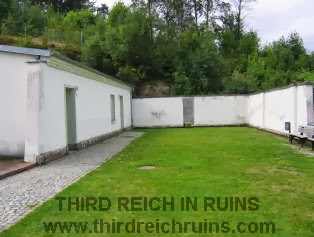
None of the period barracks remain at the Flossenbürg site, but some hard buildings such as the prisoners laundry and kitchen have been preserved, as well as three of the original guard towers.

Continued under Part 2/6


Sunday, August 4, 2013

DEATH MARCHES PART 2/2


GARDELEGEN ATROCITY

The  crime that is often referred to as the "Gardelegen massacre" occurred on April 13, 1945, on the Isenschnibbe estate near the northern German town of Gardelegen. German SS and Luftwaffe troops forced 1,016 slave labourers who were part of a transport evacuated from the Mittelbau-Dora labour camp into a large barn which was then lit on fire. Most of the prisoners were burned alive; some were shot trying to escape. The crime was discovered two days later by F Company, 2nd Battalion, 405th Regiment, U.S. 102nd Infantry Division when the U.S. Army occupied the area.
It is not clear if a brief and slightly confused summary, the story of an escaped inmate by the name of Antoniak was written before the American soldiers reached the site of the massacre or whether they found him, one of the few survivors, after witnessing the consequences of the deed itself. Nonetheless, when they continued their patrol, they climbed a small hill not far from the town. From there, they spied, some distance away, a burnt brick structure, which as still smoking. When they approached the building, a nightmarish sight met their eyes. Hundreds of charred corpses, dressed in the remnants of prison camp uniforms, were lying in several trenches that had been dug hastily alongside the building. The doors of the building, which was revealed to be a large barn, were also charred, and from beneath the doors were protruding the heads or hands of murdered prisoners. When the soldiers opened the doors, they discovered hundreds of horribly distorted charred corpses inside, all glued together. It was the most harrowing experience those men underwent throughout the war. One of them wrote to his mother several days later about the event.
'Dear Mother,
   Yesterday I saw something I'll never forget. It was one of those war crimes that the Germans are noted for. This time the Americans came up to fast and they weren't able to cover up their crime. It took place in a large barn in the town of Gerdelegen. It started out that the Germans were bringing some two thousand Russian prisoners of war from East Prussia on a march to Hannover. While marching to their destination, about one thousand Russians weren't able to continue the march on account of the light meals they were getting. By that I mean two potatoes for each meal. As they dropped out, they were killed where they fell. The balance were taken to Hannover, but the Americans were already east of Hannover, and put about five hundred of these prisoners of war in a large barn in which the floor had a light layer of straw and potatoes soaked with gasoline.
They closed the doors and put the place on fire and BURNED THEM ALIVE. The balance of them were told to dig trenches around the barn and when they got through digging, they were lined up along the trenches and shot and buried. Some were buried alive.
The Americans moved up so fast that they weren't able to get rid of the evidence. Only two men escaped and that is how the story was told.
I was up to see the mass[sic] and words can't explain how bad it was. I took a few pictures of the place and bodies. Now I wonder how many American boys met the same death.
It would be a good idea if you told some of the people about it so that they will know just rotten these Germans are. Even a dead German isn't good because he stinks.
I guess this story must already be in the newspapers back home. It's the real dope and much worse than I can explain in a letter. I don't think the Japs are half as bad.
I hope you didn't get sick reading this. I just thought I'd let you know what's going on
Love...'
The details and facts reported by the young soldier are not necessarily exact, but every line in his letter reflects his deep emotional shock and his burning rage at the murderess and the entire German people. In the first hours and days after the discovery of the barn and the adjacent pits with hundreds of charred corpses of prisoners, it was impossible to clarify the details and answer the grim questions underlying the bloody massacre: who had they been, these individuals slaughtered so cruelly several hours before the Americans arrived? What were the circumstances that led to this deed and, of course, who were the murderess and what were their motives?
[The discovery of the massacre seems to have been by chance. The consensus account is that American Lieutenant Emerson Hunt, a liaison officer between Ozark HQ and the 701st Tank Battalion, was captured by German forces on April 14, 1945, that he bluffed the German forces defending the town of Gardelegen into believing that American tanks were approaching the city, and that this induced the German commander to surrender to the American forces. The Americans arrived at the site before the Germans had time to bury all of the bodies.sic]

The barn set on fire in the Gardelegen Massacre

pictures of the dead

The man who gave the order to burn the prisoners, Gerhard Thiele, escaped by disguising himself in the uniform of a German soldier and travelling with false papers. He lived in the Western zone of occupation and later in West Germany under a false name. He was never brought to justice and died June 30, 1994. SS-Untersturmführer(2nd Lieutenant) Erhard Brauny, the transport leader for the prisoners evacuated from the Mittelbau-Dora concentration camp who subsequently wound up in Gardelegen, was put on trial in 1947 before a US military tribunal and was sentenced to life in prison. He died in 1950.[sic]

Erhard Brauny
The accused Erhard Brauny receives his judgement on 30 December 1947.
UNITED STATES ARMED FORCES APPROACH TOWARDS GARDELEGEN
On Saturday, April 14, 1945 the 102nd Infantry Division's 405th Regiment 2nd Battalion approached Gardelegen from the north. The Luftwaffe had a large airfield within the perimeter of the ancient, moated town. To capture Gardelegen would be a big prize. But first they had to get through the village of Estedt, which guarded the entrance to Gardelegen.
A battle group of German paratroopers, with small arms and 20mm flak, occupied Estedt. The 405th, accompanied by eight tanks from the 701st Tank Battalion, swiftly overran the paratroopers. On Sunday, the 15th, they had no sooner emerged from Estedt, than they found themselves under heavy automatic weapons fire from the woods adjacent to Gardelegen. Meanwhile earlier in the day, LT. Emerson Hunt, a liaison officer between Ozark HQ and the 701st Tank Battalion, had been captured. When questioned by his captors he demanded, that as an officer, an officer of rank equal to or greater than his own interrogated him.
He was taken to the German Air Force colonel commanding the Gardelegen garrison. He promptly informed the colonel that American tanks were ½ hour away and they would blow Gardelegen off the map. It would be wise for him to surrender to the nearest American commander. In reality LT. Hunt had no idea how close the 2nd Battalion was. The Luftwaffe colonel, not aware of the ruse, immediately lost all desire to defend the fatherland any longer. He sent LT. Hunt back to his own lines with a Luftwaffe major, to assure his safe passage through German lines, to offer surrender.
LT. Hunt returned to Estedt and the German major surrendered to Colonel Williams, C.O. of the 405th. Colonel Williams sent the Luftwaffe major back to Gardelegen with specific surrender orders. Per orders, the Gardelegen garrison commander drove into Estedt, in his white flagged staff car, and escorted Colonel Williams back into Gardelegen where the entire garrison, its' arms stacked, awaited surrender. By nightfall Gardelegen was in the hands of the Americans.
The surrender however was ill timed. On the outskirts of town the SS had not yet completed disposing of the evidence of a horrendous crime. On April 4th a transport train carrying 2000 religious, political, and military prisoners pulled out of Nordhausen, Rottleberode, Wieda and Ilfeld Concentration Camps and headed northwest. All these camps occupants were slave labour in air-plane parts and V-weapons production. The knowledge these slave labourers possessed would be detrimental to the Germans if they fell into Allied hands. The SS therefore was forced to move them away from the advancing Allied Army.
On Wednesday, April 11th the train could travel no further than Letzlingen. Allied bombers had destroyed the railway lines ahead. The prisoners were unloaded from the train and forced to march toward Gardelegen. The sick and lame who could travel no further were shot where they fell. The remaining prisoners that reached Gardelegen were temporarily housed in the stables of the Remonteschool Garrison. Upon learning the American Army was quickly advancing from the west the SS began to implement recognized Nazi policy for disposing of their human freight.
On Friday, the 13th, the SS guards, with the help of some Luftwaffe troops, marched the prisoners to a masonry barn on the nearby estate of Isenschnibbe. They were herded into the hay storage shed and ordered to sit down on gasoline soaked straw scattered on the floor, knee deep. Nazi policy stated that the prisoners were to be killed to prevent any possibility of having them turn on their guards in the event of liberation. By order of the Gardelegen Nazi Party leader, Kreisleiter Thiele, policy was carried out. Shortly thereafter, an SS corporal set fire to the straw with incendiary bombs (phosphorus grenades). Luftwaffe guards encircled the building and shot down any prisoners that tried to escape to freedom. The remaining prisoners burned alive.
Seven prisoners successfully escaped. One, a Pole named Eugene Sczwincz, lay buried under a mass of charred bodies for three days.
"I stumbled, and others coming behind me were mowed down. Some of the Germans firing the machine guns were Luftwaffe troops. I could see their uniforms. I lay under a pile of dead from Friday until Sunday morning without moving, because on Saturday the Germans came in and asked who needed medical attention. When someone moved and asked for help, the Germans shot them. I got out when the Germans left and the Americans arrived".
Local civilians heard the machine gun fire. They saw the flames and smoke rising from the barn and heard the screams of the dying. The next morning, April 14th, the SS gathered together some civilians to dig trenches behind the building to bury the dead. The SS, SA, Volksstrum and Hitlerjugend successfully buried some 700 bodies before the garrison surrendered. Another day and all evidence of one of the most overwhelming Nazi crimes yet discovered in Western Europe would have disappeared.
On Monday, April 15th, members of the 405th Regiment F Company were searching the area around the airfield. In nearby wheat fields they found several bodies, clad in prison striped clothing. A little further along they came upon the large masonry storage shed. Scattered about were bullet-riddled bodies. Opening one of the large wooden doors they were greeted with a cloud of smoke and the stench of burned flesh. There were some 300 charred and smoking bodies inside.
Behind the barn were six trenches, eight feet deep and eight feet wide and varying in length from 15 to 65 feet. Some of the trenches were covered over; others partially covered, entombing some 700 burned bodies. Later investigation disclosed 1016 religious, political, and military prisoners lost their lives in that building. One military prisoner was American, the remainder Russian. Ed Motsko, of the 2nd Battalion 548AAA witnessed the atrocity's aftermath firsthand.
"I saw these people charred black from the smoke and fire. Most had the Star of David on their clothes. Some seemed very young, fourteen or sixteen years old. There were piles of bodies in front of the doors, still smouldering. The barn floor was dirt and some prisoners tried so hard to dig under the barn doors that they wore down the flesh and bone on their fingers up to the second joint".
General Frank Keating, Commander of the 102nd Infantry Division, ordered all the residents of Gardelegen taken to the barn to view the crime committed by the German Army. He then ordered the townspeople to create a military style cemetery. They had to unearth the bodies from the mass graves and dig a separate grave for each victim. A cross or Star of David was constructed for each grave and a white fence enclosed the site. At the entrance to the cemetery a large sign was erected immortalizing the dead and ordering the residents of Gardelegen to forever maintain the cemetery under penalty of Military Law.[sic]
ESCAPING INMATES ON THE MARCH
As they advanced into the forest area between Breitenfeld and Estedt  there was unrest in the column. The guards, soldiers from the nearby paratroopers base and local Volkssturm men, were terrified that by dawn they might be captured by the advance units of the U.S. force that was approaching Gardelegen. The prisoners realized that liberation was only a few hours away. Hundreds of them fled into the forest under the cover of darkness, and about 120 suddenly found themselves unguarded. The guards had either simply taken to their heels or had allowed the prisoners to escape amidst confusion. The prisoners could not grasp where their guards had gone and why they were now free. They split into small groups of five to seven men each and began to seek shelter, and above all, food. Some were unfortunate enough to be caught during the savage manhunt conducted in the forest. Others succeeded in gaining another few days grace.
On April 11 Wilhelm Berlin, mayor of Estedt, was already aware that the prisoners were crossing his village on their way to Gardelegen. He saw the first group pass through on its way south, and so did local farmers. Berlin, who was 66, had served mayor since 1927. He had been a member of the NSDAP (Nazi Party) since 1940, but was not involved in political activities. The fact that escaped prisoners were roaming the forest around the village and that the American Army was due to arrive at any moment was a source of great anxiety for him and for the 400 or so inhabitants. They felt that their public safety and security were being threatened. [Due to their striped prison uniforms, escaped prisoners was called by the civilian population "Zebras",sic]
At about 3 a.m. on April 12, Helmut Hockhaup, a paratrooper officer from Gardelegen area, came to Estedt and called out the members of the local Volkssturm Unit. They were ordered to join in the hunt for prisoners hiding near the village. Several of them refused because they realized the practical implication of the order, while others joined unhesitatingly. A nocturnal manhunt was launched in the forest around Estedt and in the village itself. Forty-year-old Henryk Kostrzewa, a former Polish soldier, was one of a small group of Polish slave labourers who was  working for local farmers.[Note: This statement by researcher in general that they were slave labourers is false, they worked "voluntarily" in a civilian capacity and were able to bring their families from Poland, we had them on our estate as well at Briesnitz, county of Crossen on the Oder, until the end of the war. H.K.S,sic]  He had been labouring in Germany since 1939, when he was taken prisoner in September 1939 campaign. At 5 a.m. he heard shots from the forest near the village. After a short time, some people he had never seen before came to the house of his employer and demanded that Kostrzewa be sent with a shovel to the little restaurant in the centre of the village. When he arrived there, he found another eight forced labourers, all equipped with shovels. A man in SS uniform and another group of soldiers were waiting for them. The nine labourers were taken to the forest, and there the soldiers told them to begin digging a pit. At the same time a wagon arrived with 15 corpses of prisoners and another 20-25 who were still alive. The soldiers ordered  Kostrzewa and his comrades to unload the corpses. The surviving prisoners refused to climb down, but the soldiers shoved the Poles aside and dragged them off the wagon. The Poles then threw the corpses into the pit they had dug. Kostrzewa described the horror he witnessed: The prisoners who were alive were lined up on the edge of the ditch, and were ordered to kneel down facing the ditch. The soldiers then came along and shot the prisoners in the back of the head. Those who did not fall into the grave after being shot were pushed in by the soldiers with their feet. Then the second wagon came with about 30 prisoners and five dead prisoners. They were taken off the wagon and we had to give them our shovels and they had to throw a thin covering of dirt over the bodies in the ditch.  Even then, legs, arms and heads still showed. These prisoners were then lined up along the ditch and had to kneel down. They also were shot in the back of the head. I saw a Polish brother[sic] who told the soldiers they didn't do anything why do you want to shoot us. The soldier said "keep quiet" and shot them both... All the soldier were enjoying themselves and smoking cigarettes.

Namering exhumed bodies of SS murdered slave workers WW 2
                                                                                 
After some time another wagon arrived with 15 prisoners. They too did not want to climb down and pleaded with the soldiers to spare them. They were dragged off the wagon and murdered in the same fashion as the previous group. When the nine slave labourers finished burying victims they returned to the village. On the way they met a local farmer driving a wagon carrying another six to seven prisoners. He had found them hiding in his barn and immediately informed the soldiers, tow of them came and took them.  The nine Poles were taken back to the forest and witnessed the murder of these prisoners, who were shot in the back of the head. Then they covered the corpses with soil and returned to the village. On the way they they saw yet another wagon with six prisoners, but this time they succeeded in keeping their distance from the soldiers. The Poles feared that if they were again forced to bury victims, their luck would no longer hold and they, in their turn, would be killed in order to cover the traces of the crime. On their way back to their employer's farms, Kostrzewa and his friend witnessed another murder, this time of two prisoner caught in the village street and shot on the spot by the soldiers. Not only foreign labourers but local farmers as well were summoned to bury the dead. In several cases, corpses of the murdered prisoners were heaped onto wagons and transported to the burial trenches in the local forest.
Word of the massacre at Estedt reached the Americans on April 19, when they interrogated captured German soldiers. The following details appeared in the report of the interrogation:
'POW's consistently denied any connection with either of the foregoing, but admitted having seen the bodies of two political prisoners (identified by the striped clothing) in the woods by Estedt... 6 km, of Gardelegen. his information was transmitted through the channels to Div CIC, who visited the area with PW Nachtigall on19 April 1945,and and there found the bodies and graves of a large number of prisoners who had been killed by shooting or having their skulls cracked. CIC questioned the Bürgermeister of Estedt as well as a number of other local people and French and Polish liberated prisoners, and found that knowledge of the affair was quite widespread. Among other facts ascertained was that a 3rd Co of an unidentified Para Unit from Gardelegen had furnished escort guards for the prisoners killed at Estedt and the man directing the affair was Helmut Hockhau.' The interrogator, Lieutenant Kenneth Russ, conducted a thorough inspection of the mass graves of prisoners murdered at Estedt on May 9, 1945. He discovered two pits to the west of the village, identified through the fresh mounds of soil above them. They were located only about 295 yards (270 meters) from farmhouses. hen they began exhuming the graves, the interrogators found it difficult to estimate the number of corpses. It was decided to transfer the victims to the local cemetery  for proper burial. The mayor, Wilhelm Berlin,was ordered to supply the necessary manpower for the task. The graves were exhumed on May 11, with 60 corpses found in the first pit and 30 in the second. A third burial pit was discovered, containing four corpses. Others were discovered in pits dug by the farmers, which were scattered over various sites around the village. In all, 110 corpses of victims of the Estedt massacre were laid to rest in the village cemetery.

May 11, 1945 German civilians are forced to walk past bodies of 30 Jewish women starved to death by German SS troops in a 300-mile march across Czechoslovakia.'
In the first few postwar years the preoccupation with the victims and their graves helped fuel rumours of a revisionist nature as to the identity of the buried victims, Some claimed that local German civilians were buried there. Others conjectured that the extra graves were those of individuals whom Soviet authorities immediately after the war suspected of Nazi sympathies. This theory after the collapse of the DDR (East-Germany), naturally gained popularity.[This is not surprising, it is still not known were the 520 SS-men murdered by the Americans at the Dachau coal yard are buried, still withheld by the United States almost 70 years after that massacre. sic]  
THE JUSTICE SYSTEM AND IT'S PREDICAMENTS
The East German authorities exploited the Thiele affair in the 1960's in their propaganda against the Federal Republic, claiming that West Germany was evading the task of bringing Thiele to justice, although they knew he was living under false identity. This claim was part of the DDR official line, which asserted that the Federal Republic was not doing enough to uncover the identity of thousand of Nazi criminals living within its borders. In practice however, the DDR failed to hand over the information in its possession to West German investigators.
It was known in East Germany that Rosemarie Thiele played a central role in preparing the infrastructure that enabled her husband to escape to the West. After the war she engaged in illegal trading in gold and sent her husband considerable sums of money after the escape. This money enabled him to fabricate a solid identity as Gerhard Lindemann, respectable businessman, backed by the necessary documents, fake family ties, accommodation, and source of income. His common-law wife Margaret-Gertrude Glandien, knew nothing about the Gardelegen affair. He told her about his career in the Wehrmacht and his capture by the Americans after the war, but naturally said nothing to suggest that he had been a Kreisleiter. Nor did she know that from the 1960's on, he transferred monthly sums to his wife and children, who were still living in Thale [East Germany,sic]. Only in 1997, when Thiele was no longer alive and the Criminal Police of Magdeburg filled in the missing details regarding his evasion and punishment, did she learn about the massacre for which her life partner had been responsible almost 40 years earlier.
STRUCTURAL HIERARCHY
In those places where it was Germans  who perpetrated the murders (in contrast to gangs and civilians, such as Ukrainians, Lithuanians, and Poles in the eastern territories), the killers wee usually uniformed men. They included camp guards and men of the Waffen-SS, Wehrmacht, the Gendarmerie,the Order Police, Auxiliary Units of Volksdeutsche, and others. Most of the murderers during the evacuation and death marches were concentration camp personal and hence belonged to the uniformed category. Service in defined military or semi-military frameworks promoted a certain sense osf shared destiny and collective responsibility, which helped considerably to expand the circles of accomplices in murder. The unique 'Kameradschaft' (brotherhood and shared destiny) that evolved among members of the same Unit was not confined to combat frameworks. It also existed in those uniformed Units that did not take part in specifically military operations but, owing to local circumstances, became involved in terror operations against civilian populations or in the murder of Jews.
Two distinct groups that were serving in the concentration camps in early 1945 fulfilled separate functions during the evacuation of the camps. The first consisted of the senior camp-SS administration (Konzentationslager SS), and included the camp commandants, their deputies, or senior functionaries, namely department heads (Abteilungsleiter). One can describe them as a group of murderers, their political, professional, and even socially had a common denominator. This group, which consisted about 320 individuals, displayed all the political and ideological characteristics of senior functionaries of the regime. They had usually served in the concentration camp system from its early days and were promoted from post to post during the 1930's and after the outbreak of war. They constituted a relatively stable element within the system, although some members left in order to serve in the SS fighting Units.
The vast number of guards who were given the task of evacuating  hundreds of thousands of prisoners from camp to camp in the final months of the war left behind very little documentation of their conduct.  It is very difficult to investigate and expose the motives and motivations of the ordinary men who perpetrated horrific crimes during this period of the war. They did not belong to the higher echelons of a clearly defined organisation identified with perpetration of war crimes, they were moved from place to place within the system, and they were not part of  an orderly bureaucracy. Even when they joined an organisation that committed war crimes, it was in the capacity of reserve units, which took part in later stages and were junior elements in the system.
Although the murder of the Jewish women prisoners near Stary Karomierz, illustrates the central role these guards played in the massacre that occurred in those months. The Polish farmer Florjan Drymala, who witnessed the murders, recalled vividly that the uniforms of the guards were identical to those of the Wehrmacht troops and that he saw no SS-men in the vicinity: "I stress that the guards who committed the murder were relatively elderly and they were wearing green Uniforms." Thirty years after his first testimony to the Polish commission of inquiry, Drzymula recalled clearly that they were elderly (stare dziady), although he was not entirely sure whether they were soldiers or older Volkssturm men.
Violence, terror, and killing of Jews or Soviet partisans were important components in the operational activity of their Units, even if they had not been specifically trained for such missions. The system encouraged them and created awards and acknowledged their action. Most of them naturally regarded their victims as a marginal inferior group, and it was immaterial to them whether they survived or were savagely exterminated. What was important to them was the fact that their actions, the cruel manhunts, the killing of Jews and of other enemies of the state, had been legitimized by the system they served and that approval was granted lavishly.
Even when the prisoners set out on their evacuation marches, the older guards tried to avoid over-involvement in dealing with them and left the important decisions to those in charge of the evacuation, namely, the veteran camp-SS. The instructions  they received before setting out did not include more than a general directive to shoot any prisoner who tried to escape. However, when, as often occurred, the columns they were guarding were wandering aimlessly and various prisoners were lagging and holding up the column, the permission to shoot escaping prisoners was expanded into far-reaching license to kill indiscriminately whoever they chose.
Many of them had Party careers spanning more than a decade, and, from early stages of those careers, they were inspired by the National Socialist spirit. In spring 1945 men such as Thiele, Meissle, Schmidt, or Anton wielded extensive powers in the civilian and security matters in the new hierarchy of responsibility created in the final months of the Reich. Once the framework fell apart, the Kreisleiters or Ortsgruppenleiters remained the sole authorities in charge of the security of the population. Those prisoners who were roaming freely were a threat to the safety of their townspeople and so it was only natural for them to take decisions that were coloured by their Weltanschauung and their understanding of their responsibility. The consequence was elimination of the prisoners in order to eradicate the threat they posed.
These functionaries could not have succeeded so fully in implementing their decisions without the extensive aid of other factors.  

EPILOGUE
The graves of these nameless victims are strewn along paths, forests, and villages of Germany and Austria. In the last stage of Nazi genocide, the burial sites of its victims  spilled beyond the traditional territorial borders, such as the  crematoria in Death Camps in Poland, the burial trenches in Lithuania and Byelorussia, and the snow-covered POW camps in the Ukraine, they were dug on the very doorstep of the society that had produced the perpetrators from its midst.
Sources:
Wikipedia
The Death Marches by Daniel Blatman, translated from Hebrew

Signed Affidavit dated 14. August 1947, regarding the trial of Josef Bielmeier, my father in law, by about 15 Dachau inmates on a 'Death March' until they met up with American Forces and returned to Dachau. As ardent Marxist/Communists they had rather seen the Red Army and were disdainful of American opulence.Their signature and KZ numbers attached as follows,


Other sources;
SS-Men:
K.Tobias - Guard
E. Rippelt - Guard
Josef Bielmeier 1941,
He made extensive motion pictures for his private collection of the Dachau Concentration Camp, and were partly confiscated by American Investigators and never returned. He retained one reel which I have kept.


End