Tuesday, February 14, 2012

TREBLINKA Part 5

 
TREBLINKA Part 5
THE REVOLT OF PRISONERS

In late February or early March 1943, Himmler visited the headquarters of the "Aktion Reinhardt" and the three death camps. The conclusion and closure of "Aktion Reinhardt" by December 31, 1942, the Reichsführer had already ordered on 19 July 1942. The majority of the Jewish population of the Generalgouvernment had been murdered by the end of 1942, the main aim therefore had been achieved. The first camp was  Belzec that ceased its operations  early March 1943. The liquidation of Treblinka began about  the same time. The exhumation and burning of the corpses still needed time, also transports still arrived, The last Deportees from the Warsaw Ghetto, as well as Transports from Yugoslavia, Greece and Bulgaria, arrived in Treblinka as late as March and April 1943.

During spring of 1943, the "Arbeitsjuden"(Working Jews) had very little to do and suspected that they would be killed as what they were going to witness when the closure of the camp takes place. That is why earlier that year they organized a Jewish resistance movement. Planned since March 1943 in the lower camp, the "organizing committee" planned for an uprising. Members among others was camp elder Marceli (Alfred)Galewski and the Czech Rudolf Massarek, who would lead the rebellion militarily. In the upper camp (Camp II), there was also resistance activities in which the Slovak Zelomir (Zelo) Bloch was involved. He was in April 1943 transferred for disciplinary reasons to the upper camp.
The resistance was able to procure weapons: Some carbines they had bought from the Ukrainian guards, two boxes of hand grenades came from the ammunition chamber. The prisoner Stanada Lichtblau, car mechanic in the SS vehicle fleet (Motor Pool) had stolen gasoline and had it bottled. While trying to buy from the Trawnikis weapons,  the prison doctor, Dr. Julian Chorazycki had been seen and had committed suicide after a scuffle with Commander Franz. The deputy camp elder Rakowski was shot because he was caught with a large amount of money and Gold he carried with him,  in order to bribe the Ukrainians. Zelo Bloch who should lead the military uprising was dropped from the committee, because he was transferred to the upper camp to the gas chambers. Rudolf Marsalek, who had been a lieutenant in the Czech army took his place.

The uprising broke out on 2 August 1943 at 16.00 hours. Part of the Ukrainian guards was setting out  to swim in the Bug river. Hand grenades exploded at several places in the camp, Standa Lichtblau set fire to the petrol tank, which was a beacon, "a gigantic torch in memory of his wife and daughter" who were deported from Theresienstadt to Treblinka  with him. The Ukrainians fought, contrary to the expectations of the Jewish resistance, on the side of the SS, the only chance the rebel prisoners had were their escape from the camp. SS and Ukrainian guards fired machine guns, took up the pursuit of fugitives and combed in the following days the area around the camp
                                                   
Burning Treblinka II perimeter during the prisoner uprising, 2 August 1943. Barracks were set ablaze, including a tank of petrol which exploded set fire to the surrounding structures. This clandestine photograph was taken by Franciszek Ząbecki.

Two refugees, Richard Glazar and Karl Unger had luck. They were immersed in a small lake on the outskirts of the camp, as a security guard shot at them. They saved themselves under water in a thicket near the shore: "During the seven to eight hours in our muddy hide with willow branches that bowed down to the water surface, we heard around and above us screaming, gunshots, dogs barking, and the repeated sound of a plane . In the dead of night when everything was quiet, we crawled out, and when we straightened up, we saw a huge glow about Treblinka, it was larger and differently colored than the nights before when it was fed by the large incineration grate.

The two tramped in the long weeks ahead across Poland, had been arrested in Tomaszow Mazowieki and from there, because they maintained to be Czech foreign workers were sent to Mannheim, Germany, working at the agricultural machinery factory Lanz. There they eventually as experienced "Rüstungsarbeiter" celebrated their liberation. Another, Samuel Willenberg, who was born in Czestochowa, and was taken from the Warsaw Ghetto to Treblinka assigned into the Sorting Commando could, after the uprising with occasional help from the locals reach  Warsaw, where he arrived in the Jewish Underground, meeting Yankel Wiernik and other survivors .. Of the roughly 700 Jewish workers who on 2 August 1943, rose and sought to flee, only 60 have survived.(34).

Reference (34) Vlg. Yoram Lubling, Twice-dead.Moshe Y.Lubling, The Ethics of Memory and the Treblinka Revolt, New York 2007.

CLOSURE AND REMOVAL OF THE EVIDENCE

The revolt accelerated the closure of the camp. The last two shipments of 8,000 victims came from the Bialystok Ghetto on the 18 and 19 August at Treblinka. At the end of August 1943  the head of the "Aktion Reinhardt" Odilo Globocnik, was appointed as the higher SS Commander and Police of Trieste. With him, went Christian Wirth, the "Inspector of the Extermination Camps," the commander of Treblinka Stangl, and other German Personnel went there too. The formal closure of the extermination camps, Globocnik announced on 4 November 1943 to the Reichsführer SS: "I have closed as at the 19.10.43 the Operation Reinhardt, which I had been managing  in the Generalgouvernment and completely disbanded all camps." (35)

Reference(35) Nürnberg,document PS 4042

A residual command of Jewish prisoners remained in addition to some SS men and Ukrainians to ensure the demolition and clearing work at Treblinka was carried out. They would remove all traces of the murders that had taken place there. Fences, sheds, storage facilities were all (if they had survived the uprising) demolished. The land was plowed up, trees were planted, lupines were sown  and a farmhouse built, where a member of the Ukrainian guards was to guard the territory. The last 25 and 30 Jews, including two women, were killed at Treblinka in November 1943 in smaller groups. The bodies were taken by the surviving Jews to the incineration grates,The Ukrainian took the bodies of the remaining murdered Jews there as well.
In spite of the revolt, Treblinka II continued to function and remained a top priority for the SS for another year. Stangl met the head of Operation Reinhard, Odilo Globocnik, and inspector Christian Wirth in Lublin, and decided not to draft a report, as no native Germans had died putting down the revolt. Stangl wanted to rebuild the camp, but Globocnik told him it would be closed down shortly and Stangl would be transferred to Trieste to help fight the partisans there. The Nazi high command may have felt that Stangl, Globocnik, Wirth, and other Reinhard personnel knew too much and wanted to dispose of them by sending them to the front. With almost all the Jews from the German ghettos (established in Poland) killed, there would have been little point in rebuilding the facility. Auschwitz had enough capacity to fulfil the Nazis' remaining extermination needs, rendering Treblinka redundant
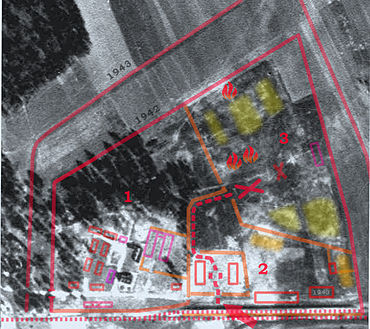
                                            
The 1944 aerial photo of Treblinka II after "cleanup". The new farmhouse and livestock building are visible to the lower left. The photograph is overlaid with already-dismantled structures (marked in red/orange). On the left are the SS and Hiwi guards living quarters (1) with barracks defined by the surrounding walkways. At the bottom (2) are the railway ramp and unloading platform (centre), marked with the red arrow. The "road to heaven" is marked with a dashed line. The undressing barracks for men and women, surrounded by a solid fence with no view of the outside, are marked with two rectangles. The location of the new, big gas chambers (3) is marked with a cross. The burial pits, dug with a mechanical digger, are in light yellow.


[GLOBOCNIK
was tracked down and captured by a British armoured cavalry unit, the 4th Queen's Own Hussars, at the Möslacher Alm, overlooking the Weissensee on May 31, 1945. The British unit, under the command of a Major Ramsey from SIS (MI6)[citation needed], had been tracking potential war criminals in Austria. Globocnik was taken to Paternion to be interrogated, and around 11.30 hours committed suicide in by biting on a cyanide capsule. At least two contemporary photographs show Globocnik's body shortly after his death, and there are several reliable reports, including the Regimental Diary and Field Reports of the 4th Queen's Own Hussars, detailing the circumstances of his capture and suicide. His body was taken to be buried in a local churchyard, but the priest reportedly refused to have 'the body of such a man' resting in consecrated ground. A grave was dug outside the churchyard, next to an outer wall, and the body was laid to rest without ceremony.
CHRISTIAN WIRTH
On 1 August 1942, Globocnik appointed him to the post of Inspector of Aktion Reinhard camps, which would grant Wirth overall command of the Sobibor and Treblinka death camps as well. Wirth's official title in this capacity was Abteilung Reinhard - der Inspekteur des SS-Sonderkommandos beim SS- und Polizeiführer Lublin.
Wirth was noted for his unusually brutal rule. He established the regime of terror and death which was carried out in all Operation Reinhard camps more than any other camp commander. During his time at Bełżec, Wirth experimented with different methods to most efficiently deal with prisoners. He developed much of the systematic policy for interaction with the prisoners. For instance, Wirth decided that newly arrived prisoners to be murdered should be beaten with whips incessantly to drive them into the gas chambers, thus creating a sense of panic and terror in which the prisoners felt forced to comply. Such policies were soon implemented at the other death camps.Wirth was killed in May 1944 by Yugoslav Partisans while travelling in an open-topped car on an official trip to Fiume. He was buried with full military honours in the German Military Cemetery in Opcina, near Trieste. His remains were transferred in 1959 to the German Military Cemetery at Costermano, near Lake Garda, northern Italy.sic]

HEINRICH HIMMLER
Unwanted by his former colleagues and hunted by the Allies, Himmler wandered for several days around Flensburg near the Danish border. Attempting to evade arrest, he disguised himself as a sergeant-major of the Secret Military Police, using the name Heinrich Hitzinger, shaving his mustache and donning an eye patch over his left eye, in the hope that he could return to Bavaria. He had equipped himself with a set of false documents, but someone whose papers were wholly in order was so unusual that it aroused the suspicions of a British Army unit in Bremen. Himmler was arrested on 22 May by Major Sidney Excell and soon recognized while in captivity. Himmler was scheduled to stand trial with other German leaders as a war criminal at Nuremberg, but on 23 May committed suicide in Lüneburg by means of a potassium cyanide capsule before interrogation could begin. His last words were: Ich bin Heinrich Himmler! ("I am Heinrich Himmler!"). Another version has Himmler biting into a hidden cyanide pill embedded in one of his teeth, when searched by a British doctor, who then yelled, "He has done it!" Several attempts to revive Himmler were unsuccessful. Shortly afterward, Himmler's body was buried in an unmarked grave on the Lüneburg Heath. The precise location of Himmler's grave remains unknown.sic]PS>: My own opinion is that Himmler was killed during his captivity by British Agents, it is unlikely that he had the cyanide capsule embedded in his tooth, an incredulous statement.  I had my own capsule, which was oblong and rather large for a tooth, sewn and secreted near the collar of my tunic which I was able to reach and bite into if tortured with my hands bound at the back.]
ERNST LERCH, STAFF OFFICER
After the German surrender in Italy (1 May 1945), Lerch fled to Carinthia (Southern Austria), a region he knew very well. There, at an alpine pasture (Möslacher Alm) near the Weissensee Lake, he was captured by a British commando on 31 May 1945. Lerch was captured with his comrades Globocnik, Hermann Höfle, and Michalsen.
Being imprisoned in Wolfsberg, Lerch was interrogated by the British. He insisted on having spent just a short time in Lublin, and had nothing to do neither with Globocnik nor the mass killings of Jews in Poland. Lerch escaped from prison and lived in hiding from 1947 to 1950. He was captured again in 1950.
In 1960, Lerch was sentenced to two years of imprisonment by a de-Nazification court in Wiesbaden (8JS 1145/60 StA Wiesbaden). In 1971, he was accused again of being involved in the Holocaust. The trial was held in Klagenfurt. His case was finally dropped on 11 May 1976 because Lerch denied having done anything in Poland and because of a lack of witnesses (LG Klagenfurt: 25VR 3123/71)
HERMANN HÖFLE-SS-STURMBANNFÜHRER
After the war, he was interned by the British, but was released. For only a brief period of time he worked in the Gehlen organization. He was eventually arrested, but committed suicide by hanging in a Vienna prison cell before his trial could begin
RICHARD GLAZAR-TREBLINKA PRISONER
Following the end of the war, when Glazar and Unger were liberated by the Americans, Glazar attended the trials of many of the Nazis concerned with Treblinka, including Franz Stangl. Glazar also went on to study in Prague, Paris, and London, and received a degree in economics — the field he had been forced into by anti-Jewish legislation in 1939. In 1968 he and his family moved to Switzerland after the invasion of Czechoslovakia by the armies of the Warsaw Pact. Glazar also helped Michael Peters, the founder of the Aktion Reinhard Camps (ARC, a network of private Holocaust researchers), build a model of the Treblinka death camp.
Glazar committed suicide on December 20, 1997 by jumping out of a window in Prague after the death of his wife, leaving the model incomplete.

Continued in Part 6

Monday, February 13, 2012

TREBLINKA Part 4

Treblinka Part 4


ENTERTAINMENT IN THE EXTERMINATION CAMP

The leisure and entertainment facilities for the German team's camp was organized mainly by the Deputy Commander Kurt Franz. The SS had riding horses available to them, but were apparently used just for Franz's own use. In the upper camp, there was a small ensemble of musicians, an orchestra in the lower camp consisted of ten professional musicians, conducted by the renowned conductor Arthur Gold of Poland. During rehearsals , the musicians were freed from work, they would wear tuxedos during performances that were cut and tailored from white and blue silk. The orchestra was playing in the first few weeks in the vicinity of the "tube" to play opera tunes directed to drown out the screams of horror in the gas chambers . They regularly played during  the evening assembly, martial music and some folk songs. The orchestra was also participating at major events during 1943-such as boxing-at theaters-and dance evenings.

SS RIDERS AT TREBLINKA The photo shows unknown SS men, riding somewhere in the vicinity of Treblinka
During entertainments of the SS, they were generously supplied with food and alcohol, they did wear a Taylor-made uniform and coat during these evenings, made to measure ​​in the camp workshops. Female inmates cleaned the quarters of the SS, the clothes were repaired, and they cleaned their shoes. The SS-men received a supplementary payment during their stay, and after duty they were free and went out. Every three months they were entitled to three weeks of Leave (Urlaub). Those men who were from the Euthanasia T4 Organization and did service at Treblinka, spent time with their wives in the "T4" rest home  on the Attersee in the Salzkammergut in Austria.
What was for the SS an amusement, was often for the Working Jews(Arbeitsjuden) served as additional pain(Qual) their derision and agony of the ritual Jewish weddings the SS arranged between prisoners, only for their own entertainment. The coquettish SS-Sergeant Kurt Franz ("Lalka") had a song composed and set to music by conductor Arthur Gold. These verses testify to the artistry of the deputy commander, who wanted a Treblinka-Hymn. [I will only give the German verse, as in any translation the meaning and impact of it is lost.sic]

Frei in die Welt geschaut
Marschieren Kolonnen zur Arbeit.
Für uns gibt es heute nur Treblinka
Das unser Schicksal ist

Wir hören auf den Ton des Kommandanten
Und folgen dann auf seinen Wink.
Wir gehen Schritt und Tritt zusammen für das,
Was die Pflicht von uns verlangt.

Die Arbeit soll hier alles bedeuten
Und auch Gehorsamtkeit und Pflicht
Bis das kleine Glück
Auch uns einmal winkt.

One prisoner, who stood out because he could not sing the song correctly was, as those who were not quick enough to bow and salute properly, or for other offenses, at the evening roll-call victim of corporal punishment. But many were killed or subsequently liquidated in the "hospital"(Lazarett). This was also serving the people of the SS guards as entertainment.
Reference(24) Quoted by:Rückerl,"NS-Vernichtungslager", page 213.

THE UKRAINIAN GUARD COMPANIES.
The German Personal with about 30 to 40 members of the SS was supported by 90-120 "guards". They were "Trawnikis" named after the SS Trawniki training center, they were all "volunteers"[they had not much choice sic.] who were taught during several months of training to be the "foot soldiers of genocide". These protection teams were "recruited" from Ukrainians and ethnic Germans from the Soviet Union, but also Estonians, Latvians, and Lithuanians were among them. They had mostly been Soviet prisoners of war and were used for guard duties of prisoners  and  partisans during  the ghetto uprising in Warsaw. In the camps of "Aktion Reinhardt" they were participating and deeply involved in the extermination methods of the SS. The"Trawnikis" wore black uniforms and were armed with rifles and leather whips. Organizationally these guards (Wachmannschaft) were structured along standard military lines. They were divided into platoons, platoon leaders were in the main German nationals(Volksdeutsche). They patrolled the camp boundaries, manned the watch towers, supervised the work details, were present on the arrival of transports, and maintained the engines from captured Russian Tanks generating carbon monoxide, the deadly Gas.

                              One-way journey: Jews being loaded onto cattle-truck-style trains that would roll virtually straight into the gas chambers of Treblinka in occupied Poland
    One-way journey: Jews being loaded onto cattle-truck-style trains that would roll virtually straight into the gas chambers of Treblinka in occupied Poland
Follow us: @MailOnline on Twitter | DailyMail on Facebook    
The victims were immediately faced by the "Trawniki men" who appeared quickly: For the simple reason, "That people did not have time to think of possible resistance, they were now in the the tube(Schlauch) where a platoon of Guards(Bewachmannschaft) was posted with sticks and with whip attacks, rifle butts and punches pushed the victims through, they had to run in four and five rows deep, naked and with their hands up, thus driven into the gas chambers.The capacity of every each and individual chamber was used to the last available square centimeter under constant beatings and abuse, so many people were pushed in,  that no freedom of movement remained. Infants and young children were frequently just thrown into the chambers above the heads of standing adults. Finally, if no more could be absorbed at all, the doors of the chambers were closed and the German commanding NCO, for example, would give the order with the cry(geschrien) of "Ivan, water!", (Iwan, Wasser)the Ukrainians in the engine compartment upon this command would fire up the engine, the exhaust gases  then passed into the chambers.
The extermination process itself took about 30 to 40 minutes. Then the engine was stopped and an assessment by eavesdropping on the doors whether some movement of life still existed in the chamber was made. If this was not the case, the command was given to open  the folding doors (Klapptüren) which were affixed to the exterior walls, and  the transportation of corpses began. It showed from time to time, even after the gassing, nevertheless it did happen,  that one or the other victim still showed signs of life, so it was either still on the ramp or on the way forward to the pit or later to the incinerator place that the German commanding NCO or a member of the Ukrainian guards would shoot and kill the person. Furthermore, even those late comers and smaller groups that would not fit into a gas chamber were taken directly to the burial pits and shot there, mainly due to overcrowding in the gas chambers, and for a small number of victims concerned, a new gasification process was considered to be uneconomical. "(26)
Reference(26)Rückel,NS-Vernichtungslager,page224(Verdict I Treblinka-Process,Düsseldorf)
Jankiel Wiernik describes as to the horrors of the place was slowly increased by the working guards of the Ukrainian SS: "When I had for the first time to watch, as people were driven into these chambers, I thought I was going crazy, and I have wept bitterly,... because I was desperate that I could not help, the kids were quite mute with terror, the older people were petrified, they huddled together and waited for the grisly end. Suddenly the door opened and Ivan with Nikolai were there with rifles and sabers screaming and chasing and beating the unfortunates in the chambers. The children crying, and the screaming of women,  the sight I will never forget. 450-500 people could hardly stand in the chambers. They were attacked with dogs, who  were barking and biting, apart from that  the guards were beating  the victims with sticks and poles, so that the stronger overtook the weaker ones, and ran to escape the blows,  but soon all was over,  the room filled itself, the doors were closed, the gas pipes were connected to the motor, and it took 25 minutes until everything was quiet. "(27)
Reference (27)Jankiel Wiernik managed to escape during the Uprising, from his published  Yiddish and English Report "One Year In Treblinka" Heinrich Böll prepared in the "Frankfurter Hefte" extracts: "Belcec[sic!] und Treblinka."An SS-Officer and a Jew reporting of the Extermination Camps in Poland, in Frankfurter Hefte 8(1953),pages 548-557. The English Edition was already published 1944 under: Yankel Wiernik, "A Year in Treblinka". An inmate who escaped tells the day-to-day Facts of one year of his torturous experience,New York o.J. (published by American Representation of the General Jewish Workers Union of Poland,New York).

Three participants in the Treblinka uprising who escaped and survived the war. Warsaw, Poland, 1945
Abraham Kolski (left) is seen here with Erich Lachman and a man named Brenner. The three men participated in the Treblinka uprising of August 2, 1943, and successfully found refuge in the nearby forest. A short time later, all three were taken in by a gentile family, which hid them until Poland was liberated.

THE GERSTEIN REPORT
An eyewitness from the ranks of the SS wanted to inform the world about the murder of Jews in the extermination camps. The report of Obersturmführer Gerstein, dated 20 April 1945,[He left it a bit late, this date was Hitlers last birthday in the Berlin Bunker and the war was almost over.sic] written in French, so an unusual document much the same as the personality of the author. Gerstein had joined the NSDAP in 1933, but was involved in the Bekennenden Church and was persecuted as an enemy of the State, imprisoned in concentration camps, expelled from the party and the civil service.
By his own admission, to be an eyewitness, he joined the SS and was employed from November 1941 as a specialist at the Disinfection Hygiene Institute of the Waffen-SS as a director of the Office of the Health Technology. In August 1942 he made ​​an official trip to the headquarters of the "Aktion Reinhardt" in Lublin. Gerstein was, as the head of the action, Odilo Globocnik, explained to him, first and foremost to solve the problem of the disinfections within the Textile Industry, but the far more important task is the conversion of our gas chambers operating with diesel exhaust fumes into a better and quicker system. "I am thinking especially of prussic acid".(Blausäure) (28)
On 19 August 1942, Gerstein went with Christian Wirth, the "Inspector of the Extermination Camps" to Treblinka. In his report it says: "The equipment was nearly the same, only much larger than in Belzec, 8 gas chambers and mountains of suitcases, textiles and laundry. In our honor a banquet was given at the community hall in a typical Himmler style, in the old German fashion way, the food was simple.. , but everything was available in any quantity. Himmler himself had ordered that the men of this command should have as much meat, butter and other things , especially alcohol as they wanted.
On the way home, Gerstein met on the train in Warsaw the Secretary of the Swedish Legation in Berlin, Baron von Otter. He told him about his impressions and asked to report to the Swedish government and the Allies of the murder scenes and mentioned to his credibility as a reference a wide range of personalities, among them the General Superintendent Otto Dibelius. Gerstein also sought contact with the Papal Nuncio in Berlin. His report, written in French found its way into the major war criminals and was later used in the Doctors Trials at Nuremberg. The author died in July 1945 in a Paris prison cell under unexplained circumstances.
Reference (28) Eye-witness account of the mass gassings in:Vierteljahreshefte für Zeitgeschichte I (1953) page 177-194
On 22 April 1945 Gerstein contacted the French occupying authorities in Tübingen. He was transferred to Paris in May, where,along with other SS officers, he was locked away in prison. On 25 July he was found hanged in his cell. The question as to whether he committed suicide or was murdered by fanatical fellow SS prisoners remains unsolved.(soure:Ernst Klee,"Schöne Zeiten"page 259. Friedländer,"Kurt Gerstein"page 224,concludes that it is plausible that he committed suicide

CRITICISM
[The Gerstein Report has been targeted by holocaust deniers and antisemites. Distinguished French historian, Pierre Vidal-Naquet in "Assassins of Memory" discusses such criticism.
While some aspects of Gerstein's report include false or exaggeratedly attributed statements to Odilo Globocnik, and inaccurate claims regarding the total number of Jews gassed at places where he was not an eyewitness, Gerstein's claim that gassing of Jews occurred at Belzec is independently corroborated by SS-Standartenführer Wilhelm Pfannenstiel's testimony given at the Belzec trials, as well as by the accounts of other witnesses that can be found in Gitta Sereny's Into That Darkness, a biography of one-time Treblinka commandant Franz Stangl.
The historian, Christopher Browning, has written: "Many aspects of Gerstein's testimony are unquestionably problematic. ...[In making] statements, such as the height of the piles of shoes and clothing at Belzec and Treblinka, Gerstein himself is clearly the source of exaggeration. Gerstein also added grossly exaggerated claims about matters to which he was not an eyewitness, such as that a total of 25 million Jews and others were gassed. But in the essential issue, namely that he was in Belzec and witnessed the gassing of a transport of Jews from Lwow, his testimony is fully corroborated .... It is also corroborated by other categories of witnesses from Belzec.sic] 


DID HITLER KNOW?
The question is often asked did Adolf Hitler know and approved of the extermination of the Jews in the East, following is part of comments made by Gerstein and it is up to the reader to judge: "SS-Sturmbannführer Guenter ...came to me in my office...he ordered me to get hold of 100kg of hydrocyanic (prussic) acid, and to accompany him to a place known only to the driver of the lorry. We drove to the potash factory in the vicinity of Kolin (Prag). Once the lorry had been loaded, we drove to Lublin(Poland). We took Professor Dr Pfannenstiel, Profesor of Hygiene at the University of Marburg /Lahn, with us. In Lublin SS-Gruppenführer Globocnik received us and told us: "This is one of the most secret missions...Anyone who talks about it is immediately shot...Your task is to convert the technical installation of our gas chambers, which up to now has been functioning on the exhaust fumes of an old diesel engine, from now on it will be dispensing a much faster-working poison, namely hydrocyanic acid.. However the Führer and Himmler, who were here om 15 August, (1942 sic) i.e. the day before yesterday, have assigned me the duty to accompany anyone who needs to see the installations. Professor Pannenstiel:'What did the Führer have to say about this,then?'To which Globocnik,....replied:'Faster,faster. get on with the job!'...Please, gentlemen, if future generation were to be so cowardly and degenerate as not to understand our deed, which is so good and necessary ,well, gentlemen, the entire National Socialist movement will have been for nothing. On the contrary! We should bury bronze plaques along with them as well, to say that it was us, that possessed the courage to accomplish this gigantic task!' To which Hitler said: 'Yes, my dear Globocnik, you're right and I fully agree with you.'
                                              
                  Official announcement of the founding of Treblinka I, the forced-labour camp

                                             Continued under Part 5


Saturday, February 11, 2012

TEBLINKA Part 3


TREBLINKA PART 3


THE CAMP COMMANDERS

Irmfried Eberl, the 31-year-old physician who had previously been director of the extermination department of the institution at Bernberg belonged to the staff of the "Action T4", which was ordered to the "Eastern Front", as the murder of patients in the German Reich in 1941 on Hitler's orders was slowed down. Eberls task was to build a station near Minsk, the Treblinka camp. He was pleased as he wrote in a letter to his wife, about  the new task. It was busy and it is fun. And Eberl wrote with zeal on the matter. "I've got the time and nerves of steel. My nerves can not fail. It is not an option. Much less, that I may break down physically. I make full use of my person and succeeded in recent days with only half the staff to cope with my task. However, I have used  my people with determination wherever it was needed and my people have pulled through bravely in this performance, and I am happy and proud". He refused to make ​​clear which method he employed. ("The task  put to me, is completely accomplished and that's the main thing"), but hinted at, in so dark and stilted phrases that he needs understanding, he wanted his wife as his dearest friend but not "to pollute her with dirt and filth". For since you represent the good side in my life, you shall know nothing of it at all".
Eberl was from the Vorarlberg (Austria), he had studied in Innsbruck, had joined the NSDAP in 1931 and in 1936 moved to Germany. After working in the health service in Dessau and Berlin, he was one of the first physicians who entered the service of the organization T4, the camouflaged headquarters for the murder of sickness and disability patients at the Tiergarten Strasse 4, Berlin. Under the pseudo-legitimacy of the "Chancellery of the Führer," healing and nursing homes were turned into Jew killing facilities. Eberl worked since 1 February 1940 in Brandenburg, and gained experience with Giftgas (Poison Gas). The zeal of Dr. Eberl, he was the only doctor at the head of a Nazi extermination camp, which was as big as the chaos that he in his short tenure (beginning July to late August 1942 created). During the criminal process, at the Court of Düsseldorf in 1965 found, that Eberl was not equal to his task, so that "indescribable conditions prevailed in his camp because he always had Jews killed before the bodies of those dead victims from previous action were not removed or buried, the disembarking Jews from the transports were thus right after leaving the wagons faced with mountains of innumerable, already largely and partly in decay of previous corpses and therefore at once in the know about their imminent fate, so that only under the greatest difficulties the procedural  process of settlement could be done."

Driven by fanaticism, but apparently incapable of organizing the murder operation, he was re-assigned for duty again to the euthanasia center Bernberg. In the short time that he had been at Treblinka he was responsible for the murder of 280 000 people. In just six weeks this death toll, measured in a time frame that he was at Treblinka, and compare this also in relation to Auschwitz-Birkenau, where within half a year, the Death Machinery ran at its peak  (May to October 1944) of extermination,and 500,000 people were murdered, taken Eberls activity in one dimension, that is by far a singular highest figure in the entire Holocaust (Völkermord) history. At the end of January 1944, Eberl was drafted into the Wehrmacht, came in April 1945 into American captivity and was released in July 1945. He lived in Blaubeuren, married a second time, trying to get authorization to practice medicine again and to erase the traces of his activity in the Nazi era. During interviews in the wake of the Nuremberg doctors trial, he denied his membership in the "Action T4", denied his role in Bernberg, pretended to be ignorant and was stood up in January 1948, when a nurse identified her former boss. On 16 February 1948, he was found dead in his prison cell. He had hanged himself.

 [Eberl was dismissed from Treblinka on August 26, 1942, for incompetence in disposing of the bodies of the thousands of people who had been killed, and was replaced by Franz Stangl, who was previously the commandant of Sobibor extermination camp. Eberl was also relieved of his duty because he was not killing people in an efficient and timely enough manner, and also because he was not properly concealing the mass murder from locals. For instance, the stench from decomposition of unburied bodies was such that it could be smelled 10 kilometers (6.2 miles) from the camp, such as at the nearby village of Treblinka, Masovian and Voivodeship, which in turn would make it self-evident that unnatural amounts of deaths were happening nearby, causing concern among locals. The Nazi leadership wished to avoid any inconveniences to their operations that would result from local outcries. Eberl was apparently also part of a ring at the camp that was stealing the possessions from the people whom they had murdered and sending them back to cohorts at Hitler's Chancellery in Berlin. This last activity had been expressly forbidden by Himmler, as he wanted this property to be contributed to the German war effort.In 1944 he joined the Wehrmacht for the duration of the war. After the war, Eberl found himself a widower following his second wife's death, and continued to practice medicine in Blaubeuren until he was arrested in January 1948, and hanged himself to avoid a trial after a month in jail.sic]


The longest serving commandant of Treblinka for the period from August 1942 to August 1943, was Franz Stangl. He came from the Austrian police and joined the NSDAP in May 1931(which was illegal at that time in Austria. sic) and since 1940 as a supervisory officer in the euthanasia Institution Hartheim.(He had difficulties with his Gestapo boss in Linz and purposely solicited for this job.sic) Since October 1941 at Bernburg in the service of "T4". Transferred to Lublin in March 1942, he was participating in the construction of the extermination camp Sobibor, and appointed its first commander. The appearance of Stangl, as a person who was promoted in February 1943 to Captain (Hauptsturmführer) was not militaristic, rather of a quiet nature. He laid emphasis on distance and style. Richard Glazar described him as a commander after a lord of the manor: "He had no heavy Whip like all other SS men, but only a light riding crop and always bright buckskin gloves, on his head a small cap, a few of his fingers of his right hand stuck on the chest in the narrow tailored green uniform jacket, as he solely and simply looked down from the Wall, he keeps his distance from everyone and had a view from the top down on everything. From the bottom of the commander's hut he would look around, he is rarely seen in the operation of the camp, avoids all contact with the working Jews as well as the Ukrainian guards. If he sometimes comes to the roll calls, then he takes only a look from the side of the barracks corner, using the riding crop and lightly tapping his boot, he goes away without saying a word before the end of the roll call.With a slightly hooked nose and protruding chin, caused by loose posture and movements that pertain only to higher ranks, he looks like a lord of the castle, who distributes the power among the other gentlemen."
 [The question is, was he immune to the suffering that was going on within his camp, looking at his background as a youngster, his relationship with his natural father who was a night-watchman, was emotionally distressing. He was deeply frightened of him, Stangl claimed that his father died of malnutrition in 1916 and to support his family he earned money giving zither lessons, yet in his post as commandant, Stangl accepted and grew accustomed to the killings, perceiving prisoners not as humans but merely as "cargo" that must be destroyed. Stangl accepted the extermination of Jews as a fact, he is quoted as saying:"To tell the truth, one did become used to it...they were cargo. I think it started the day I first saw the Totenlager [extermination area] in Treblinka. I remember Wirth standing there, next to the pits full of black-blue corpses. It had nothing to do with humanity — it could not have. It was a mass — a mass of rotting flesh. Wirth said 'What shall we do with this garbage?' I think unconsciously that started me thinking of them as cargo....I rarely saw them as individuals. It was always a huge mass. I sometimes stood on the wall and saw them in the "tube" — they were naked, packed together, running, being driven with whips."
About this time, Stangl began drinking heavily.sic]

Stangl was transferred to Italy in August 1943 to fight the partisans. His deputy Kurt Franz succeeded him as commander during the last phase (August to October 1943), when the camp was to be dissolved and its traces obliterated. Franz, born 1914, was a butcher's assistant and chef, before he entered the SS in 1937 and initially was doing guard duty in the concentration camp Buchenwald and Pirna-Sonnenstein. He came over from Belzec in August or September 1942 to Treblinka. The prisoners gave this cunning sadist, a big wig  who laid importance on his appearance, they nicknamed him in (Yiddish) "Lalka" (the doll). He was, as Richard Glazar characterizes him and the hierarchy of Treblinka, "in this operation something like the junior manager, they may have appointed him to replace Stangl, but against Franz himself again they put someone more experienced like Sergeant Küttner in charge. Lalka was representing the extraordinary and major incidents there. Küttner-Kiewe took care of the everyday operation of routine matters. His eyes peering into every corner, he rushes past the shops, beats someone bloody, because he is too slow for him, and then he rushes between the people up silently into the "A" Barrack with his whip[....] as if a ghost appears. Unterscharführer August Willi Miete,  was every where, when someone could no longer go on, he had his victim marked, who would simulate strength to be economically still useful, he had him "stamped", and would soon join the march through to tube:His nose and his face is a little bent to one side. The long legs and the short torso on him so that he moved in a rocking motion. [....] A nickname is not enough for him. This murderous pussy-footer and careful "Cleaner" of waste at Treblinka has several of them: in Czech, "the pious shooter," in Yiddish, "the crooked Cop," and in a major Biblical language, "Malchamowes- the angel of death", for his is the domain of the Lazaret - Empire. "

Kurt Franz was 28 years old when he came in the summer of 1942 to Treblinka. He was previously in Belzec, Kammandeur of the Ukrainian guards, rose to deputy and then to camp commander and was promoted at the behest of Himmler on June 21, 1943 to SS lieutenant. After the dissolution of the camp he was, like most officers, transferred to Trieste.  He was able to escape from an American POW Camp. He worked as a construction worker, then as a cook, and lived unknown in the Bundesrepublik. In December 1965 he was arrested and in 1965 appeared in a court at Düsseldorf. The judgment states of him: "A big part of the rivers of blood and tears that have flowed in Treblinka is, only on your account". To witness statements Franz responded with great excitement. He had never killed a man, or even beaten any one. Hitting, he corrected himself, perhaps, yes may be once. Basically, I've never done a man any wrong or wanted to do wrong. I deny emphatically that I allegedly assaulted prisoners. I maintain that the whole procedure is a "Make-Up ". I think I am here to finish me off for the simple reason, I was an SS man, I wore the uniform of an SS officer and this is the sole reason and the the focus of the survivors who appear as witnesses.
He was sentenced to life imprisonment. He was released in 1993 for health reasons. Kurt Franz died in Wuppertal in 1998.

THE WORKING JEWS (ARBEITSJUDEN)
Literally at the last moment on the ramp or on the way to the gas chambers, the SS selected when needed the most vigorous young men from the newcomers. They were given a reprieve, for theirs would be the necessary services required to make the mass murder of the victims to run as smoothly as possible: they had the new arrivals driven to be undressed,  to sort through their belongings, clean trains, search the corpses of the murdered for hidden valuables, they had to break out the gold teeth of the corpses, drag the dead into the mass grave or onto the cremation grates. After some time the working Jews were killed off, as it was the intention,  that no witnesses should survive the crimes that had been committed.
The retention of Jewish slave labor was prolonged, and over time more and more, because the SS realized that the efficiency of the machinery of extermination was best assured when an experienced and skilled work force could be used, instead of new ones that had to be constantly instructed in learning the necessary skills. The survival also depended on how many Transports arrived. The closer the frequency of the deportation trains, the more indispensable were the working  Jews. The SS and their Ukrainian helpers, the Trawnikis, limited themselves to commanding, driving, screaming, punishing, physical labor they avoided as (Herrenmenschentum) a master race.[Although I have translated the German text "Herrenmenschentum" as "master race", which is not quite appropriate, the meaning should imply more to a people in general that are able to "RULE" over those that are weak or inferior and has nothing to do with "RACE" but there is no other word in the English language I could find.sic]
http://www.youtube.com/watch?feature=endscreen&NR=1&v=_qW8m8Y8Ois Video Concentration and Extermination Camps

From the beginning, many Jewish workers were indispensable than others: artisans such as tailors, saddlers, shoemakers, barbers, blacksmiths, carpenters, locksmiths, who worked in the camp workshops, whose skills were needed as well as the musicians who could not be easily replaced. They called this group "court Jews" (Hofjuden), the members of these teams were marked with a yellow armband, which had initially even the word "court Jew" written on them. About 80 men formed the group of these people.
The yellow armband was also worn by the Jews working in the sorting commando of the A-hut, where the better clothes were separated and processed.The Sorting and re-arranging started in advance at the sorting site in the detention center, where signs were nailed onto stakes with the categories of material to be put into regulatory functions: cotton-silk-wool-rags. At the other end of the sorting site things were piled up that had been left at the unloading Ramp: suitcases, bags, purses, bags of all types and everything coming from the disrobing place (Entkleidungsplatz): bundled shoes, lingerie, dresses, suits, jackets and coats.
           Unloading: A rare photo of Jews being taken off the trains. There was only a one per cent chance that any vistor to the camp would still be alive after three hours
  Unloading: A rare photo of Jews being taken off the trains. There was only a one per cent chance that any visitor to the camp would still be alive after three hours

On the arrival at the ramp, the imaginary train station,  prisoners with blue armbands was stationed there as a working commando. The "Blues" were obliged to assist the new arrivals with  their luggage and  as soon as possible to get them to the undressing place or the sorting site. At the undressing center (Entkleideplatz) a prisoners working detail was set up with red armbands to help them to undress, while to hurry them on and those women who refused, they would simply tear the clothes off them.
The" Gold Jews" were busy with the collecting, registering, assortments and the packing of gold, funds, jewels, foreign currency, jewelry etc. Their work station was called " Large Kassa"(Große Kassa) . At most on the average there were altogether 1000 working Jews that belonged to the sorting commandos. They carried red armbands and had the task to collect all property of the ones that were murdered to make arrangements from the arrival place, from the undressing place to the sorting place and into the sorting barracks to pack and stack every thing for shipment back to the Reich.Other working details were used to build roads, in agriculture, repair and maintain buildings, were used during camouflage, and 25 men formed the "twigs brigade" that tore or removed in the vicinity of the camp branches from the trees, and mended fences to prevent any type of visibility between sections within the camp.
In the death camp section(Totenlager) operated the "corpse commando" with the highest number of Jewish workers, several hundred in fact were used there. They had to get the bodies from the gas chambers, and initially put them into mass graves, subsequently took them to the cremation ground. Other commandos in Camp II cleaned the gas chambers and burned the victims, had to exhume bodies from mass graves, sieve the ashes, and crushed the  bones. The commando of the "dentists" had to remove not only the victims' gold teeth with pliers, they had also examine the orifices of the dead bodies, whether there were any valuables hidden. The gold teeth had to be cleaned and delivered to a collection point. Since the upper camp was hermetically sealed, there were also craftsmen in the death camp (Totenlager)  (such as the "court Jews" in the detention center) for maintenance and the like. The working Jews (Arbeitsjuden) had their own accommodation barracks there, which was surrounded by a barbed wire fence.

Excavator at old Gas Chamber, Treblinka:
http://www.holocaustresearchproject.org/ar/treblinka/treblinkagallery/Alte%20Gaskammer.html

As in other concentration camps there existed a prisoner hierarchy,  placed at first at the head was a native of Warsaw an engineer Marceli (Alfred) Galewski, he was replaced by a Jew named Rakowski from Czestochowa (Tschenstochau), who was shot in May 1943. (23) and again was followed by Galewski. The work details (Arbeitskommandos) were led by Jewish Kapos, they were assisted and represented by "deputies". For each of the two camps a Kapo was in charge. The Prison Functionaries of the concentration camp as far as the SS was concerned for the smooth operation of all camp functions and performance of all orders was their (i.e.Funcftionaries) responsibility alone. The camp life of the Jewish labor was regulated as in other concentration camps during assembly and punishments announced. During selection processes those who were repeatedly unable to work it was then determined to have them killed.[There is an old German saying:"Wer nicht arbeiten kann, soll auch nicht essen!"sic.] In residential and detention centers such as the death camp,(Totenlager) there were female prisoners, in the lower one about 20 to 30, in the upper approximately 15, which were mainly used in each laundry.
Reference(23)Richard Glazar erwähnt als Kapo und Lagerältesten den Namen Rakowski. Rückel, NS-Vernichtungslager, Seite 212, bezeichnete den Lagerältesten mit dem Buchstaben "R",nennt aber den Herkunftsort Tschenstochau. Glazar nennt außerdem einen Häftling namens Singer, der aus Österreich stammte, er soll Lagerältester im Lager II gewesen sein. Die Schreibweise der Namen von Häftlingen ist uneinheitlich, was durch Nationalität und Nachkriegsschicksal zu erklären ist.
Reference(23)Richard Glazar mentioned as a capo, and Elder bearing the name Rakowski. Rückel, in NS Vernichtungslager, page 212,  mentions the camp elder by the letter "R", but called the place of origin Czestochowa (Tschentochau). Glazar also called an inmate named Singer, a native of Austria, he is said to have been senior camp inmate in the camp II. The spelling of the names of detainees is not uniform, which can be explained by nationality and post-war fate.

                                                     continued under Part 4

Monday, February 6, 2012

TEBLINKA Part 2

 TEBLINKA Part 2

ARRIVAL AND EXTERMINATION
The first deportation train from the Warsaw Ghetto reached Treblinka  with a total of 5,000 people on 23 July 1942. The Pole Franciszek Zabecki was an eye-witness:.. "A small locomotive was waiting at the station in order to shunt the first section of freight cars into the camp. Everything was planned in advance and prepared The train consisted of 60 sealed freight cars loaded with people: Young and old men and women, children and infants. The wagon doors were locked from the outside and the air vents blocked and covered with barbed wire. On the running boards on both sides and on the roof stood or were crouching approximately a dozen SS-soldiers with machine guns at the ready. It was hot, and most people in the wagons were dead tired ... as the train approached, it seemed as if an evil spirit seized the waiting SS-men, they drew their pistols, put them back into the holster and pulled them out again, as if they were ready to shoot and wanted to kill,  they approached the wagons and tried to calm the noise and the crying , but then they screamed at the Jews and cursed them, and they hurried all the time the railway workers to be quicker. >Tempo, schneller '< Then they returned to the camp to accept the deportees in the reception center."


[THE WARSCHAU UPRISING:
The Stroop Report.


The cover page of The Stroop Report with International Military Tribunal in Nuremberg markings.
In January 1943, Heinrich Himmler visited the Warsaw Ghetto, where tens of thousands of Jews still remained after having been concentrated there for the last three years. He ordered it cleaned out. SS-Brigadeführer (Major-General) Jürgen Stroop was assigned this task and took his military troops to fight the starving Jews. The operation began in April 1943.This operation was unlike most others performed against the Jews for several reasons. Those who remained in the ghetto knew their cause was hopeless, as they had witnessed hundreds of thousands sent to their deaths since July 1942. They fought back with great determination. They lacked for military weapons but, mostly with improvised explosives and the few rifles they had, managed to delay Stroop's operation for four weeks and to kill many Germans in the process.
Stroop commemorated his successful "murder expedition" by producing a 75-page book, plus 50 pages of photographs, about the event. Consisting largely of telegrams about the operation, this book is a very important historical record. The so-called "Stroop Report" has never had its authenticity challenged.
The telegrams on four particular days reveal facts about Treblinka, however, which many may prefer to ignore. Its T-II camp, where the exterminations took place, is explicitly identified as the destination for the "liquidation" and "destruction" of captured Jews.
The last mass exterminations at Treblinka took place after an uprising of the Jewish prisoners in August 1943, and the last equipment was dismantled by the remaining Jews (who were then shot) that November.


Two Askaris (i.e. Soviets in German service) peer into a doorway past the bodies of Jews killed during the suppression of the uprising. Stroop Report original caption: "Askaris used during the operation.
The original German caption reads: "Forcibly pulled out of dug-outs". Captured Jews are led by German soldiers to the assembly point for deportation. Picture taken at Nowolipie street looking East, near intersection with Smocza street. On the right townhouse at Nowolipie 63 further the ghetto wall with a gate. On the left burning balcony of the townhouse Nowolipie 66.

April 25, 1943:
 In total, 1690 Jews were captured alive. According to stories from the Jews, there have definitely also been parachutists dropped here and bandits who have been supplied weapons from an unknown location. 274 Jews were shot, and as on other days, uncounted Jews were buried alive in the blown-up bunkers and, as near as can be determined, burned. With today's bounty of Jews, a very large portion of the bandits and lowest elements of the Ghetto has, in my opinion, been captured. Immediate liquidation was not carried out due to the onset of darkness. I will attempt to obtain a train for T II for tomorrow, otherwise the liquidations will be carried out tomorrow 


Photo from Nowolipie Street. In the back one can see (from the left) townhouses at Nowolipie 32 (fragment), 30 and 28. Possibly second from right is Josef Blösche. Stroop report original caption: "Jewish Rabbis"
Surrounded by heavily armed guards,SS-Brigadeführer Jürgen Stroop (center) watches housing blocks burn. SDRottenführer at right is possibly Josef Blösche
April 26, 1943:
At this time there are no more captured Jews in Warsaw. The previously mentioned transport to T.II was successful.


Picture taken at Nowolipie street, between Smocza and Karmelicka street. On the right visible building at Nowolipie 34. Stroop Report original caption: "Smoking out the Jews and Bandits".
German sentries with a Maschinengewehr 08 machine gun at one of the gates to the ghetto. Original Caption read "Measures for covering a street."
May 13, 1943:
The few Jews and criminals still remaining in the ghetto have for 2 days used the refuges available in the ruins in order to go back to their well-known bunkers at night, and there to eat and supply themselves for the next day. No evidence on further bunkers known to them can be obtained from the captured Jews. The rest of the inhabitants, where the fire fight took place, were destroyed by the strongest explosive charges. From a Wehrmacht operation 327 Jews were captured today. These captured Jews will only be sent to T.II.


Stroop Report original caption: "A patrol." SS men on Nowolipie street of Warsaw Ghetto during the uprising. Buildings in the image from the right: Nowolipie 50a, then 52, 54 and wall of the townhouse nr. 56.
May 24, 1943:
Of the overall total of 56,065 captured Jews, about 7,000 have been destroyed in the course of the large-scale action in the former Jewish living quarter. 6,929 Jews were destroyed by transport to T. II, so that overall, 13,929 Jews were destroyed. It is estimated that, in addition to the number of 56,065, 5 - 6,000 Jews were destroyed by explosions and fire.
In this last entry, the most explicit, I have translated the German word "vernichtet" as "destroyed." It is incidentally the same word used to refer to the destruction of bunkers. Other acceptable translations would be "exterminated" or "annihilated." There is no doubt as to its meaning.sic]


Photo from Jürgen Stroop's report to Heinrich Himmler from May 1943 and one of the best-known pictures of World War II. The original German caption reads: "Forcibly pulled out of dug-outs". The boy in the picture might be Tsvi Nussbaum, who survived the Holocaust.
Alleged Jewish fighters. Stroop Report original caption: "Women captured with arms." (Other versions of caption read "He-Chaluts women captured with arms" and "Armed hags of the Haluzzen movement captured!". Jewish resistance women, among them Malka Zdrojewicz (right), who survived Majdanek extermination camp.
The tension and nervousness (or do you call the behavior of the SS, lust for murder and hatred of Jews?) Contrasting to the impression of the place, with billboards and signs that should give you the illusion of a transit camp. The new arrivals saw a hut, the outer front was converted into a station building, and signs that  read and  proclaimed in Polish and German instructions and the deceptions:> Attention Warsaw Jews! You find yourself here in a transit camp, from which you will be taken onward to travel into a labor camp. For the prevention of diseases both clothes and bags, you are to leave them behind for disinfection. Gold, money, currency and jewelry are handed over against a receipt and returned  once again. For Body Cleansing, all new arrivals have to bathe before further transports. For the staging of this illusory station> Treblinka-Obermajdan<i included timetables and direction and destinations.
Richard Glazar, who on October 10, arrived in 1942 in Treblinka and was recruited from Theresienstadt as a "working Jew",and lived there until the uprising August 1943 in the camp, these are the events he describes of the arrival of a shipment in Treblinka: "Before the entrance at the gate on the single line railway track on the branch line a certain number of wagons were detached. Sometimes these cattle wagons held up to five hundred, sometimes there were a lot more people crammed into them, the locomotive pushed the wagons slowly through the gate, then it was a matter of sliding the wagon doors open for the disembarking and what I have personally experienced:.. >Everybody out, schneller, vorwärts, take your hand luggage, leave heavy luggage behind, it will be replaced later<. Around the access ramp are a mass of people that are taken to the Undressing Area (Entkleidungsplatz). This is the green fenced-in place (Platz), where they had to strip naked for the "disinfection-bath." The naked women with children are then lead to the main  hairdressing parlor, where their hair is cut. From women's hair it is understood that  seals,(gaskets) are to be be made for engines. [rather unlikely story sic]. The men also moved out naked and must now move  the  hand luggage, which they brought with them, stack them in the corner of the undressing place which is next  to the sorting site. The SS-men,  then drove them forward in a running pace (Laufschritt). The lungs breathe harder, and it goes then quickly into the gas chambers. All of them together, the shaven women with children and the panting men, they hurry them later through the 'tube'(Schlauch) into the second part of the camp. The tube is a narrow lane of barbed wire, which is reminiscent of the "Schleuse", a narrow entrance, through which wild animals in the circus ring are guided.. The alley, however, is long and stretches into an arc, and they can not see out or even into it . The barbed wires are braided with green pine branches. On the border between the two parts of the camp is the "Cashiers Office" installed and located in a simple shack, the> little box office<. At this "little box office", a  tiny Holzbude), at the counter they must deposit all their documents, watches and jewelry. Here, their personality is taken away, and further on their nameless life".
The fate of the deported Jews to Treblinka was sealed after their arrival within a few hours. From the " railway station" they were rushed into a fenced yard of barbed wire ("transport" or "hub"), which was flanked by two barracks. In the left side barrack, women and children had to strip themselves naked, the right hut served as a changing room for men only at the beginning, but later on they had to undress in the open ( the barrack was then used as a sorting room for clothes and storage facility). On the women's side of the barrack started the 80-90 Meter long road to the death camp, the "tube" (Schlauch), which was also called "Ascension Avenue" or "path of no return".

The tube, (Schlauch) was 4.5 to 5 meters wide, and made an almost right-angled bend, which only allowed a view of the camp II until the last moment and enabled the blocking of access of large crowds if necessary. The road ended in front of the entrance of the new gas building The tube "Schlauch" was surrounded about a 2 meter high barbed wire fence interwoven with pine branches which limited any vision.  In the new as well as the old gas houses, the only buildings that had concrete foundations with brick masonry within the camp, were the exhaust gases of a diesel engine was used as the murder weapon. The old gas building contained three gas chambers, each 4 x 4 meters wide and 2.6 meters tall, and stood next to the engine room, a wooden corridor was built to give access. The gas chambers were tiled and had pipes and should (actually gas flowed through them) had given the Illusion with the shower heads in the ceiling of a genuine shower room.

Treblinka: View of the Reception Camp, the undressing barracks, the sorting site and the ramp. In the center of the sorting site accumulated clothing and belongings of the dead. (Drawing by Samuel Willenberg).

The "new gas house" had a corridor in the center and on both sides the ten gas chambers were located. The building was decorated with a cynical Star of David on the pediment above the entrance, potted plants trimmed the final journey of the victims, and five steps leading in front of the entrance. At the corridor hung a curtain from a synagogue with the Hebrew writing "This is the gate through which the righteous go." The engine room was at the end of the building.

[During the first stage, three gas chambers were in operation, each of them, much like those in Sobibor,4 x 4 m. in size and 2.6 m. high. A diesel engine producing poisonous carbon monoxide, as well as a generator which supplied the whole camp with electricity, were housed in a built-on room. The entrance doors of the gas chambers opened into a passage in front of the building; each door was 1.8 m. high and 90 cm. wide. They could be hermetically closed and bolted from the outside. Inside each gas chamber, opposite the entrance door, was a thick door made of wooden beams, 2.5 m. high and 1.8 m. wide, which could also be hermetically closed. The walls in the gas chambers were covered with white tiles up to a certain height, shower heads had been installed, and water pipes ran along the ceiling--all this so as to maintain the "showers" fiction. In reality the pipes conducted the poisonous gas into the chambers.
This killing process differed significantly from the process at Auschwitz and Majdanek, where the poisonous gas Zyklon B was used. At Sobibor and Belzec, exhaust fumes from petrol engines was used. The victims died from suffocation and carbon monoxide poisoning. This also means that, frequently, victims were not completely dead as a result of the exhaust. The few prisoners who had worked in the Sonderkommandos and survived the camp later testified that victims frequently let out a final gasp of breath from their lungs when they were extracted from the gas chambers.sic]


                  The victims may have had no more illusions as to their fate when they arrived at the end of the tube(Schlauch). In any case, what had happened to them until then, they broke out  in panic. The survivor Abraham Goldfarb described it: "On the way to the gas chambers stood Germans with dogs on both sides of the fence, the dogs were trained to attack humans, they bit the men in the genitals and the women's breasts and tore out pieces of flesh. The Germans beat them with whips and iron bars, so that the "shower" was quickly  crowded. The women's screams could be heard up into the other Camp areas. The Germans drove the running victims with calls such as: "Faster, faster, the water is cold, and others must also get under the shower, [as most inmates were Polish they would not have understood the abuse, only the meaning of the shouting. sic] To escape the beatings, the victims ran  faster as they could, to the gas chambers, where the strong pushed the weak aside. At the entrance to the gas chamber stood the two Ukrainians Ivan Demjanjuk and Nikolaj (12), the one with the iron rod, the other armed with a sword. Thus, they drove the people into chambers ..... Once the gas chambers were full, the Ukrainians closed the doors and started the machine. 20-25 minutes later an SS man or an Ukrainian looked through a window in the door. When they realized that they were all suffocated inside, a Jewish prisoners had to open the doors and commenced extracting the bodies, since the chambers were overcrowded and the victims had touched against each other, they all stood upright and were like an entire meat block (13)
Ref: (12) According to the findings of American and Israeli courts the Trawinki-man, was "Ivan the Terrible," who did the gas chamber services, not Ivan Demjanjuk,but an Ukrainian, Ivan Marchenko. The other murder assistant was Nikolaj Schalajew. [Demjanjuk was stripped of his US Citizenship twice and tried again in Germany, to my understanding, due to his poor health he is out on bail, and is living at the time of writing in Munich, awaiting the pleasure of the courts.sic]
Ref: (13) references cited in the report YAY. by: Kogon e.g. Nazi mass killings, Page 181

[After the suffocation of the victims in the gas chamber, when the doors of the gas chamber were opened, "the disfigured, bitten prisoners, with ears torn off, lay on top of each other in the most varied posture." The bodies were initially buried in large mass graves; in a later stage of the camp's operation, they were burned on open-air grids made of concrete pillars and railway tracks. Sometimes, the people were not dead and began to revive in the fresh air, especially pregnant women. They were shot by the guards and burned like the others. Some 800–1,000 bodies were burned at the same time, and would burn for five hours. The incinerator operated 24 hours a day.
The killing centers(like Treblinka)had no other function, unlike concentration camps, in which prisoners were used as forced labor for the German war effort. In order to prevent incoming victims from realizing their fate, the camp was disguised as a railway station, complete with train schedules, posters of destinations, and what appeared to be a working clock (in reality, a prisoner would move the hands to the approximate time before each convoy arrived) The camp and the process of mass murder is described by Vasily Grossman, a military reporter serving in the Red Army, in his work " A Hell Called Treblinka", which was used as evidence and distributed at the Nuremberg Trials.sic]

The dogs of Treblinka are mentioned in many accounts of survivors, in particular, this single animal, a St. Bernard-mix named Barry, who in late 1942 early 1943, was brought to Treblinka from Sobibor. Commander Franz had Barry on patrols with him, and rushed with the command "man, touch the dog" on detainees, at which the great calf size animal would bite into its victim. During the first Treblinka Trial, the court spent considerable time and engaged an expert in Dog Behavior the Director of the Max-Plank Institute. The dog was obviously so under the dominance of Kurt Franz, that he identified himself, even without explicit instruction with its sadistic intentions. Outside the influence of Franz the dog was meek ​​and friendly. After the liquidation of the Treblinka camp he was given to the chief physician at the military hospital at Ostrow  where he did no harm to any one. [Barry usually slept under the office desk of the doctor, due to his old age he was put to "sleep" in 1947.sic]

Following web site: "The Nazis: The Road to Treblinka" is a video in five parts and includes graphic images of execution and may disturb some readers.
http://www.youtube.com/watch?v=U7VsV7NscQo&feature=relatedQ

                                                                             Continued under Part 3