Friday, October 4, 2013

FlOSSENBÜRG KZ PART 4/6


CHANGES OF KZ-ADMINISTRATIONS 1942
In the spring of 1942, the management structure changed for all concentration camps and as a result, the conditions in these facilities altered fundamentally and it remained permanent. After the failure of the 'Blitzkrieg' strategy during the winter of 1941/42, and with the transformation of the German armaments industry for a long war of attrition, this had again given a new power-political importance for Himmler, which was the reservoir of prisoners in labour camps . Through the establishment of a 'Plenipotentiary for Manpower' (Genralbevollmächtigten für den Arbeitseinsatz) in March 1942 for KZ-inmates, from Himmler's perspective, as in 1938, there was the risk of loss of control over the army of KZ-inmates, since they would inevitably arouse the interest of the new defence industrial authority under Fritz Saukel. Himmler responded with the organizational co-ordination of previous inspection of the concentration camps through various SS offices with the newly founded SS Economic and Administrative Main Office (WVHA) with Oswald Pohl as chief on February 1, 1942. Because Pohl held some concentration camp commanders not suitable to carry out the new economic priorities, in the summer of 1942, he ordered the replacement of eight of the 15 commanders. Also, the Flossenburg camp commandant Künstler who had already fallen out of favour with Himmler in April 1942 after a drinking session during his, Künstlers, 22-year military anniversary, was replaced in August and transferred to the SS Volunteer Mountain Division 'Prrinz Eugen'. As his successor Pohl suggested SS-Obersturmbannführer Hans Hüttig. However, he was not yet available in August, as he was responsible with the establishment of a concentration camp in Norway. Thus as an interim solution until October 1942, acted the former protective custody leader Karl Fritzsch as the concentration camp commandant at Flossenburg. Karl Fritzsch became on January 15, 1942 the successor of the previous protective custody camp leader Hans Aumeier, who had been transferred to Auschwitz. After the designated new commander Hans Hütting still could not be dispensed with, in October from Norway,  Richard Glücks, Chief of Office Group D in the WVHA, on 26 October 1942, appointed the former head of the Natzweiler camp, Egon Zill, as the new commander of Flossenburg. [ Zill lived until his death in the town of Dachau,sic]. Fritzsch now held again his previous position as first protective custody leader, thus his violent accesses towards prisoners increased for some reason with more vigour. In this function Fritzsch had within a short time the nickname 'Dustbag' (Stäubchen) acquired by the prisoners, he distinguished himself by extreme pedantry and unpredictability, which led regularly to excessive violence towards the prisoners. [In October 1943, he was arrested as a part of an internal SS investigation into corruption. An SS court charged him with illegal murder. As a punishment he was transferred to front line duty (SS-Panzergrenadier-Ersatzbatallion 18). It is assumed that he was killed in action during the battle of Berlin in May 1945.  Other sources claim that MI 5 caught him in Norway, sic]
FRIZ SAUKEL
Ernst Friedrich Christoph "Fritz" Saukel was a German Nazi politician, Gauleiter of Thuringia and the General Plenipotentiary for Labour Deployment from 1942 until the end of the Second World War.
Sauckel was among the 24 persons accused in the Nuremberg Trial of the Major War Criminals before the International Military Tribunal. He was found guilty of war crimes and crimes against humanity, and was sentenced to death by hanging.
After a defense led by Robert Servatius, Sauckel was found guilty of war crimes and crimes against humanity, and together with a number of colleagues was hanged on 16 October 1946, just 11 days shy before his 52nd birthday. His last words were recorded as "Ich sterbe unschuldig, mein Urteil ist ungerecht. Gott beschütze Deutschland!" (I die an innocent man, my sentence is unjust. God protect Germany!).

The body of Fritz Sauckel after execution, October 16, 1946.
  [Someone must have closed his eyelids, before rigor mortis sets in, they are normally open after a hanging, the position of rope versus head would suggest strangulation, rather than immediate breaking of the vertebrae,sic]
 Wearing a sweater with no coat ( he had refused to dress), so he went to the gallows coat-less and looking wild-eyed, Sauckel proved to be the most defiant of any except Streicher. Here was the man who put millions into bondage on a scale unknown since the pre-Christian era. Gazing around the room from the gallows platform he suddenly screamed, 'I am dying innocent. The sentence is wrong. God protect Germany and make Germany great again. Long live Germany! God protect my family.' At that instant the trap opened with a loud bang, he went down kicking. When the rope snapped taut with the body swinging wildly, groans could be heard from within the concealed interior of the scaffold. Finally, the hangman, who had descended from the gallows platform, lifted the black canvas curtain and went inside. Something happened that put a stop to the groans and brought the rope to a standstill. One must assume that he grabbed the swinging body and pulled down on it, he had been strangled.sic]
[The Minister for Labour during the Third Reich was actually Dr. Robert Ley. He was the first, very early on, to commit suicide while awaiting trial at Nürnberg. All so-called 'Forced Labourers' from occupied countries had been recruited through the Labour Exchange (Arbeitsamt) and had no desire to go back to their own countries during wartime, my father-in-law had thirty males of different nationalities working in his bakery and lived freely in another building on his property, they had the same rights as any other German citizen, but changed their tune after war's end. HKS]
As a side issue:
The hangman was John Clarence Woods a United States Army Master Sergeant who, with Joseph Malta, carried out the Nuremberg executions of ten former top leaders of the Third Reich on October 16, 1946 after they were sentenced to death at the Nuremberg Trials. He executed a total of 347 people during his 15-year career. After the Nuremberg executions, Woods stated:
"I hanged those ten Nazis... and I am proud of it... I wasn't nervous.... A fellow can't afford to have nerves in this business.... I want to put in a good word for those G.I.s who helped me... they all did swell.... I am trying to get [them] a promotion.... The way I look at this hanging job, somebody has to do it. I got into it kind of by accident, years ago in the States...."
Woods kept small pieces of the rope used for each convict as his souvenir, considered to be against the policy adopted at Nuremberg Trials by the Colonel in charge of executions.  At a later duty Woods touched accidentally a high voltage cable during Atomic Trials at Eniwetok, Marshall Islands on July 21, 1950. [Is there a righteous God in Heaven as I was taught as a youngster ?] He is buried in Toronto Township Cemetery.
Master Sergeant John C. Woods, hangman at Nürnberg
About Zill's term of service, which lasted just over half a year, little is known. At the beginning of his tour of duty there were approximately 3760 prisoners in Flossenburg, six times more than in the little Natzweiler camp, his earlier command. The security and management of about 550 SS-members alone at this time stationed at Flossenburg was a difficult task in itself. The SS started for the first time to employ concentration camp prisoners as labour units away from the actual main camp. In this context, the establishment of the first sub-camp was in 1942. An attempt to extend the field of these assignments was in February, even before the formation of the Administrative Main Office, with the the building of a sub-camp at Stulln. There, about 100 prisoners had to work a 'Flussspatgrube' (Shaft to extract minerals) to mine raw materials for the aluminium industry. Obviously, this designed experimentation was found to be extremely inefficient,  already in June, almost all the prisoners employed there were moved to Dresden as a construction unit in the barracks of the SS-Maintenance-Replacement Battalion (SS-Pionerersatzbataillon) where the second sub-camp from Flossenburg was established. More satellite camps of the concentration camp were created 1942 in the Reich District of Sudetenland. There the SS had already secured in the summer of 1938, access to industrial companies, which had previously been in Jewish or Czech possession. By expanding the economic interests of the SS and thus the prisoner use, now also emerged in SS-owned enterprises  as sub-camps in Krondorf-Sauerbrunn and Neurohlen, both in the vicinity of Karlovy-Vary (Karlsbad), the first of these developments  was far away from the main camp, that of the operation of a mineral water source for the SS requirements (SS-Ernährungsbetrieb) 'Sudetenquell GmbH', the second was an 'Aryanised' porcelain factory at the 'Bohemia' - Ceramic Works Ltd. '. Also for the SS-owned building and construction management for the Waffen-SS at the Oberfränkischen settlement of Pottenstein a  sub camp had been built.
Satallite camp in Rabstein (today Rabstejn, Czech Republic), October 1944'
At year-end 1942, 3515 prisoners were in the concentration camp Flossenburg, 442 of them in the  newly established satellite camps Dresden (199), Krondorf (120), Pottenstein (82) and Neurohlau (41). Yet the majority of the prisoners were used in the quarry (1943) where at the end of the year working, however, had stopped. Only in 1943 shifted the focus of prisoner activities de facto into the field of the defence industry. Despite the functional change of concentration camps and the exchange of commandants, the conditions under which prisoners were living,  little had changed. Abuse, harassment, malnutrition, violence and death were the defining factors of the prisoners daily life . In Flossenburg, the death rate had increased again significantly in 1942. While 711 deaths in the registry office of the municipality for the full year 1941 were reported, their number had increased by September 1942 to 1057. For lack of secured documents, as from October 1, 1942, the camp's own peculiar civil registry for deaths was formed and the dead were not reported from this point on to the municipality authority (Standesamt) in Flossenburg. It is assumed that the death rate in Flossenburg more than doubled in 1942, not factored in are the number of murdered Soviet prisoners of war in these figures  because they were neither registered  as inmates in the camp's register, nor reported as deaths to the registrar of the civil municipality of Flossenburg

Concentration camp prisoners on the station of Roztoky during the evacuation of the Flossenbürg concentration camp. Photograph from Vladimir Fyman, April 30 1945
Since the spring of 1942, Himmler and Pohl had negotiated with the just appointed 'Reich Minister for Armaments and Munitions' Albert Speer to relocate vital war production facilities into the concentration camps. In September 1942, Speer was able to prevail with the approval of Hitler's the idea of using concentration camp prisoners targeted in existing armaments factories. Regardless of these decisions, the SS tried yet further the relocation of armament operations into the concentration camps. In Flossenburg this effort was crowned with success, the initiative for the relocation in so far is remarkably as it came from a defence contractor and was not considered by the SS. At the turn of 1942/43 there had been initial negotiations by representatives of the Regensburg Messerschmitt factory with the management with the DESt. The aim of the discussions was the employment of concentration camp prisoners in the manufacture of components for the Me 109 fighter plane, which should be in Flossenburg, after a relatively short discussion a deal was struck in January 1943, which formally left the DESt on paper one of the few defence companies that were not under the control or interference of any SS operations. Thus, in Flossenburg, the Operating of the German Earth and Stone Works played a leading role, which would later on, to change some facets in other DESt works. The cooperation agreement was established that the company supplied the Messerschmitt DESt Flossenburg all means of production, the raw material a fee to be paid and also leading foremen for training the prisoners be provided. The Messerschmitt DESt in turn calculated the wages for the prisoners and for producing armaments. The prisoners were thus not given by this Agreement to a private company that of the DESt rather they only advanced and enlarged their production capabilities in the  Flossenburger armament facility.

Wing Production at Flossenbürg from a Messerschmitt company photo album, 
Streaking above Leipheim, Messerschmitt test pilot Fritz Wendel's Me 262 beat the first Allied jet into the skies by about nine months. As the aircraft was refined, the BMW 003 engines were abandoned due to poor performance and replaced by the Junkers Jumo 004. Though an improvement, the early jet engines possessed incredibly short operational lives, typically lasting only 12-25 hours. Faster than any Allied fighter, production of the Me 262 became a priority for the Luftwaffe. Due to Allied bombing, production was distributed to small factories in German territory, with around 1,400 ultimately being built
DAYTON, Ohio -- Messerschmitt Me 262A at the National Museum of the United States Air Force. (U.S. Air Force photo)
When the Flossenburg Messerschmitt production began operations, it is not clear. Specifying February 5, 1943 probably relates to the measures taken for the reconstruction of stonemason halls for aircraft production, one can assume that this is the actual beginning of the defence industry within the KZ. In the daily work schedules there appears a reference to the 'Commando 2004', the code name for the Flossenburg Messerschmitt factory, for the first time at the end of June 1943, with 211 prisoners listed.  However, the monthly reports of the DESt Flossenburg show already in March and April  the delivery of cooler panels.  From the end of May cone part components for the fighter Me 109 were produced on another production line. Even before the air raid on the Regensburg Messerschmitt plant on August 17, the company management decided to shift more production lines of the company to Flossenburg in 1944, almost all the parts of the ME 109 were produced by concentration camp prisoners in the camp, with the exception of engines and control panels. The number of prisoners employed in the  armament manufacture rose steadily during the year, while the quarry workers declined analogy during that phase of development. In September, more than 700 prisoners worked on an average for the Messerschmitt company,  in December the figure reached already 1700. At years end of 1944, only 530 prisoners were employed in the quarries. Although in the same year a fourth quarry at Bocksbühl had been put into operation yet, the production volume of quarrying decreased through the armament economic restructuring of the prisoners' use more and more. Starting in 1940 the stated target of an annual dismantling of 12,000 Kubikmeter of granite was never achieved. Nevertheless, the Flossenburg DESt's plant in 1943 was still supplying numerous large orders, for example, for various highway construction sites, for the 'Soldiers' Hall', which would be built at the new North-South-Axis in Berlin, furthermore for the SS-Cult site at Wewelsburg, but also for the construction of the Rhine-Main-Danube Canal on behalf of the Wsserstraßenbauamtes (Waterways Building Department) Regensburg. In addition, the granite processing was partially restructured for the armament requirement.In addition to the ornamental granite blocks and road construction materials, there were now granite acid vats for defence contractors to be manufactured, among these, for the Messerschmitt Works.
THE SCHWEINFURT-RGENSBURG MISSION
The Schweinfurt–Regensburg mission was an air combat battle in World War II. A strategic bombing attack flown by B-17 Flying Fortresses of the U.S. Army Air Forces on August 17, 1943, it was conceived as an ambitious plan to cripple the German aircraft industry. The mission was also known as the "double-strike mission" because it entailed two large forces of bombers attacking separate targets in order to disperse fighter reaction by the Luftwaffe, and was the first "shuttle" mission, in which all or part of a mission landed at a different field and later bombed another target returning to its base.
The mission inflicted heavy damage on the Regensburg target, but at catastrophic loss to the force, with 60 bombers lost and many more damaged beyond economical repair. As a result, the Eighth Air Force was unable to follow up immediately with a second attack that might have seriously crippled German industry. When Schweinfurt was finally attacked again two months later, the lack of long-range fighter escort had still not been addressed and losses were even higher. As a consequence, deep penetration strategic bombing was curtailed for five months
Casualties and losses:
60 bombers, 3 P-47s, and 2 Spitfires lost
58-95 bombers heavily damaged
203 civilians killed
Result:Pyrrhic Allied victory
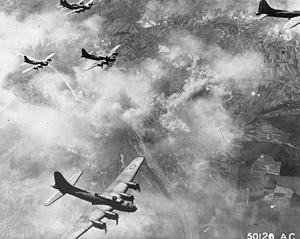
 1st Bomb Wing B-17's over Schweinfurt, Germany

Newly formed Areitskommandos (work details) for granite mining and the manufacturing of aircraft parts commenced  in 1943, and thereby intensified the required employment of prisoners from the camps. Simultaneously with the 'command 2004' at the end of June 1943 a 'weaving' detail was opened in the quarantine camp with 176 prisoners. These were mainly physically weakened prisoners used in basketry items for military use or weaving
 items such as camouflage nets or straps. Notwithstanding the practice as was fund in Dachau, Neuengamme, Stutthof or Auschwitz, this work located in Flossenburg was not under the organizational umbrella of the German Equipment Works (DAW) but instead lead under the management of the DESt. Other companies also made ​​use of increasing need for prison labour.  Even in areas aside from the normal economy, the SS originated a working group for an animal farm. Since the end of 1942 it consisted of an Angora breeding programme, which was cared for by a small working commando attended by 'Bible Student prisoners' Bibelforscher). In the neighbouring village of Floß, the later domiciled  commandant of Auschwitz, Richard Baer, started on private land a pond with rainbow trout there which prisoners had developed. The increase in the number of satellite camps took place about 1943. In June 1942 a few kilometers from Flossenburg near the remote village of Grafenreuth a huge clothing warehouse was established near this settlement by a construction unit consisting of prisoners, first employed temporarily by the Waffen-SS. This building commando was kept and the huts converted into a permanent-camp in the autumn of the same year. In Eisenberg at Brüx, Neuhirschstein at Meissen, Nuremberg, Schlackenwerth near Karlsbad and Würzburg new sub-camps were established with construction commandos by detainees from Flossenburg. SS departments and units of the Waffen-SS then in December, controlled by them, used the first satellite camp at an armaments factory, the Erla Machine Works (Erla Maschinenwerke),  in the erzgebirgischen (mountenous) town of Johanngeorgenstadt .
JOHANNGEORGENSTADT
Germany’s first ski jump was built in 1929 near Johanngeorgenstadt. It bore the name “Hans-Heinz-Schanze”. In 1934, the formerly abandoned mining industry was taken up again. In the Second World War, with the seizure of owner Arthur Krautmann’s “Deutsches Haus” hotel across from the railway station, the town became home to a military hospital. Furthermore, the town harboured an outlying camp of the Flossenbürg concentration camp in which countless inmates died. The Johanngeorgenstadt camp was emptied on 13 April 1945 and the inmates were sent on a death march towards Theresienstadt.

The place where uranium was first discovered (1789)
Beginning in 1945, through the founding of SAG Wismut and later SDAG Wismut (Sowjetisch-Deutsche Aktiengesellschaft Wismut – Soviet-German Bismuth Corporation) uranium mining underwent growth that was both rapid and without much regard to the effects on either human beings or on the environment. A great deal of the Old Town had to be torn down between 1953 and 1960 owing to mining damage, and new residential areas were built


RISE OF PRISONER NUMBERS
The year 1944 represents a separate phase in which the concentration camp system is radicalised and represents a separate phase in which the existing development lines of work and elimination  in their dimensions shows up in a  most extreme way. In addition to the main camp there was a cosmos of satellite camps, which assumed gigantic proportions by the year's end, and led to the formal delimitation of the camp complex. This now covered an area of several thousand square kilometres. At the same time, 1944, the increase of inmates in the main camp reached extreme proportions and could not cope. This was worsened by the mass of intake during the second half of the year.  Solely due to the prevailing epidemics and poor hygienic living conditions conditions, all camp areas had infirmaries and dying enclosures (Sterbearealen) in which the incapacitated prisoners vegetated a waiting  their death.
The prison population of 1943 make it clear that the expansion of the KZ Flossenburg first occurred primarily geographically through the creation of new satellite camps (Außenlager). This trend continued up to 1944, but the occupation of the main camp (Stammlager) from the second half of the year more than doubled at the same time. On 31 March 1944 a total of 7322 prisoners were part in the existence of all their camps, of which about 4000 were located in the main camp Stammlager) and the rest in satellite camps. For the first time on May 31, 1944 the total number of 10,000 prisoners was exceeded in the concentration camp of Flossenburg, in September of that year the strength of the camp had reached over 25,000. Of these, between 6,000 and 7,000 prisoners were interned in the main camp itself, the rest in sub camps. The ratio in the main camp and sub camps had completely reversed within half a year and continued to develop in this direction. While the number of prisoners had doubled in the main camp camp, satellite camps had increased six-fold during the same period.
The prisoners were now for the most part relatively young foreigners, mainly from the Soviet Union and Poland, as well as many for various offences apprehended by the Gestapo and Criminal Police Sections, like civilian workers, members of national resistance groups or victims of larger deportation measures, such as in the wake of the crushed Warsaw Uprising. On 1 September 1944,  located in the geographical responsible area of Flossenburg were the sub-camps with over 10,000 female prisoners from Ravensbrück and up to now managed by them [Ravensbrück,sic] were transferred and came under the administration of the Flossenburg KZ. In the last available remaining strength report of 1944 and in November over 31,000 prisoners of the concentration camp were registered, more than 8,000 in the main camp, almost 23,000 in one of the then existing 60 sub-camps. Also the mode of inmate registry was changed out of necessity due to the rapid increase in the number of prisoners. As of March 1944, the SS-administration moved from the previously common practice using the numbers who had died or of prisoners transported to other camps several times over. Newly arrived transports were now numbered consecutively, for female prisoners, the series of numbers reserved were 50.000 to 69.999.
Although during September 1942 all the Jewish prisoners were still deported from Germany and still living in the Reichsgebiet into the concentration camps at Auschwitz, Himmler decided in April 1944 in the face of labour shortages for renewed mass use of these Jews in concentration camps located within the boarders of the Reich.
Wall near which victims in Concentration Camp at Flossenburg were executed. Soldier of 97th Infantry Division points to blood stains on wall.

From the summer of 1944 onwards thousands of Jewish prisoners were deported to Flossenburg, where from 1938 to 1942 only a few hundred Jewish prisoners had been interned there. Most of these [new,sic] Jewish prisoners were mainly born in Poland or Hungary, and rarely not older than 30 years. While the extermination of Jews at Auschwitz in the summer of 1944 with the murder of deportees from Hungary reached its climax,  on the 4th of August 1944, came the first major transport of Jewish prisoners to Flossenburg that were selected on the basis  as 'fit for work'. It consisted over 2600 teenagers and young men of Polish origin from the sub-camps from Wieliczka, and Mielec which were cleared with the liquidation of the Plaszow concentration camp. From Auschwitz also came for the first time 1,000 Gypsies which had to be absorbed in the concentration camp system, many of them women, who were admitted directly to one of the many satellite camps for female prisoners. From autumn 1944, the transports with non-Jewish Polish prisoners increased again. Among them were many female participants of the Warsaw Uprising, which were also retained in the women-camps. Since at least 1943, based on these large intakes  of new arrivals, the German and Austrian prisoners were numerically very much in the minority, but continued to hold and filled key positions which ensured their survival.
enter picture:

Prisoners of the Flossenburg Concentration Camp in Germany were hung from this flagpole in the camp's courtyard. 800 Germans supervised this camp which was opened in 1939. Since that time according to records found in the camp, 54,890 men and over 10,000 women were held prisoners here. In the 14 month period preceding 20 April, 1945, 14,000 inmates died from starvation, exhaustion, mistreatment and various diseases. The prisoners worked in stone quarries and a nearby Messerschmitt Air-plane Factory. On 20 April, 1945, 15,000 inmates, including children and elderly people, were marched away. Those that could not keep up the march were killed by the wayside. About 2,000 were left in the camp when U.S. troops arrived. Among those reported to have been in the camp were Kurt Von Schuschnig, former Chancellor of Austria; Leopold, King of Belgium, Prince Albrecht of Austria and Hjalmar Schacht, Reich Minister of Finances.
Main entrance to Flossenburg Concentration Camp, where hundreds of French, Jewish, Russian and Slav slave labourers died weekly. Note quarantine sign. Camp was discovered by 97th Inf. Div. Troops, 3rd U.S. Army
                                                   

Operating room in Nazi Concentration Camp at Flossenbrg, found by 97th Infanctry Division of U.S. 1st Army. Surgeon was civilian who reportedly did operations without anaesthetics being administered to patients and complete lack of sterilization.
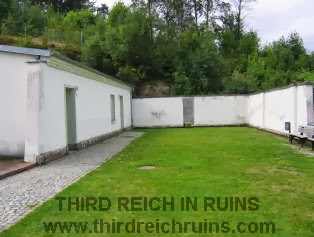
Although KL Flossenbürg was not an extermination facility and did not possess a gas chamber, it had a reputation for brutality that was exceptional even among concentration camps. The death rate there was very high. Executions were common. Among the last to be hanged were Admiral Wilhem Canaris and the noted theologian, Dietrich Bonhöffer, both of whom were executed on April 9, 1945, for conspiring against Hitler. They, along with several alleged co-conspirators, had first undergone a quick trial at the camp, but more often even this much of a formality was ignored. Rather, prisoners were hanged or shot capriciously. Furthermore, beatings were commonplace and often resulted in death. Each of the successive commandants promoted the culture of violence, as did every adjutant. The lower-ranking SS and most kapos likewise pursued the policy. The camp doctor during most of the last year of the war, Heinrich Schmitz - who had been given a choice between taking up this assignment or being committed to a mental hospital - not only killed patients with injections and operated on them without anaesthesia, but purposely allowed typhus to spread among the prisoners. Schmitz was executed in November 1948
.
CONTINUED UNDER PART 5/6


Saturday, September 28, 2013

FLOSSENBÜRG KZ PART 3/6


THE MASS MURDER OF SOVIET PRISONERS OF WAR
Since the beginning of 1941, the High Command of the Wehrmacht (OKW) and the Reich Leader SS (Himmler) had given consideration to the handling of Soviet prisoners of war, which made it clear that it was an ideological war within the terms of a military operation (Weltanschauungskrieg) towards the Soviet Union. Although using at least a portion of the prisoners for work assignments from the beginning, had been considered, but the primary goal remained the extermination of the 'Bolshevik Enemy'. Political Officers, Communist Functionaries, Intellectuals and Jews, who were to be deprived of combatant status per se and ordered their immediate execution even in the operational area. A majority of the prisoners of war should never get near the vicinity of the Reich according to their original plans. A few weeks after the attack on the Soviet Union, due to the rapid advance of German troops there were already tens of thousands of poorly trained members of the Red Army in camps on the territory of the German Reich and had even sometimes sent to individual work assignments. [We had on our estate about forty Russian prisoners working in various functions and had been the most reliable workers after their physical conditions had improved, there were never any indication from the population, that they were enemies of the Reich,HKS]. The principle of isolation, selection and systematic extermination of the Ideological Enemy threatened to fail in practice. With the instruction (Einsatzbefehle)of commands 8, 9, 17 and 21 July, and complementary policies dated the 27th August 1941 ordered by the Chief of the RSHA, Reinhard Heydrich, that all Gestapo sections to check areas under its jurisdiction in "Russian camps" (Russenlager) for "intolerable" prisoners and send them to the nearest concentration camp for instant execution.
Flossenbürg execution site next to the crematorium. US Army Signal Corps, April 30 1945

 The first execution of Soviet prisoners of war took place on September 3rd 1941 in Flossenburg. This was a contingent of 41 members of a labour unit from the Grafenwöhr Training Area, who had been selected on 25th August by a Gestapo (Einsatzgruppe) Task Force from Regensburg. After spending a brief time on the 3rd September in Flossenburg they were murdered there on the same day. [The Stapostelle Regensburg was responsible for the administrative district of Upper Palatinate/Lower Bavaria with the Stalag XIII-A Sulzbach-Rosenberg and XIII-B Weiden. The exudate's by Stapo Regensburg compare ibid, page 123-138. sic] Between August 25 and 26 September 1941 the Regensburg Upper Palatinate (Oberpfalz) examined a total of 2344 members of the Red Army, of whom 330 men, between the 3rd September and December 17th they were liquidated in Flossenburg for being classified as'intolerable' and found undesirable. Some of these have now been identified through personal records, including Franz Yankovsky, Kazimir Petrutik and Denis Misjutschenko,  farm workers from Belarus, the first two common soldiers, the last obviously a civilian. They arrived in July, shortly after their capture,held in Stalag IV-B Mülberg in Saxony, registered there in mid-August and then moved to Weiden. On 29 August, the Regensburg Gestapo members reviewed the work detail at the post office basement in Weiden and handed the three with another 14 Red Army soldiers to the camp at Flossenburg, where they were shot on the same day.

At left, a column of Soviet prisoners of war, under German guard, marches away from the front. Place uncertain, July 1, 1941
By year end, groups of prisoner of war from across the Military District XIII, which covered an area of ​​Würzburg to Karlsbad were periodically selected, and murdered in in Flossenburg. Their total number has to date only be roughly estimated. The sheer number of those Soviet prisoners of war nominated by the State Police-office in Regensburg until the summer of 1942 and sent to Flossenburg for execution can be established between 800 and 1000. The various  Transports with Red Army Prisoners for this period and also from the field of Stalag 359 in Falkenau by the State Police-office Karlsbad prove equally correct. Figures by the Gestapo office Nürnberg-Fürth, in their area of ​​responsibility was the only camp for Soviet officers on the territory of the German Reich, the Oflag XIII-D in Hammelburg, as well as the huge POW-Lager XIII-A located near the Nazi Party Rally Grounds in Nürnberg-Landwasser, which transferred at least 1000 of these men to have them murdered at Flossenburg.  Taking  a conservative estimate that during September of 1941 to the summer of 1942 almost 2,000 Soviet prisoners of war were killed on the basis of operational orders No. 8 and 9.  As of 31 July 1942, the systematic selections of Soviet prisoners of war for execution were stopped on the territory of the German Reich following a decision by the Chief of the Security Police and the SD. As envisaged in the original plan against the invasion of the Soviet Union, the Red Army soldiers were now selected directly at the front or in POW camps within the Generalgouvernment (Occupied Eastern Countries) and murdered. Thus, in 1942  the scheduled execution of Russian and Ukrainian soldiers in the camp Flossenburg was temporary at an end. Nevertheless, still a large number of Soviet prisoners of war were sent to the concentration camps. The use of directives No. 8 and 9 were still in force, and thus the activity of Stapo offices now focused on a review of prisoner who had become conspicuous in the POW camps and labour detachments (Arbeitskommandos). The transfer to a concentration camp meant, no automatically liquidation of the prisoners as from the summer of 1942. Part of the captives were formally released from a POW camp, however, and were then sent  as labourers into concentration camps. There, they received the category 'E. r. Kgf '(former Russian prisoners of war) and be reclassified as concentration camp prisoners at the lowest level of the prisoner hierarchy. [As a side issue, one of Stalin's sons was kept in Germany as a POW, he, Stalin was desperately trying to find out the fate of his son after the war, who had committed suicide on top of an electric fence. Although American Intelligence were fully aware of the circumstances, they never revealed their knowledge to Stalin, nor the fate of his son, HKS]

Dugouts, which served as living quarters for prisoners in Stalag 319—a German-built camp for Soviet prisoners of war. Chelm, Poland, between 1941 and 1944.

Parallel to the beginning of the systematic murder of Soviet prisoners of war, Himmler tried the High Command of the Wehrmacht to get a number of several thousand Soviet prisoners of war to work in the concentration camps. Since the mass executions of Soviet POW's and the transfer of the 'working Russians' took place at the same time, both events has to be interpreted in the context of parallel measures, namely: 'liquidation' and 'work'. On October 2nd, the OKW ordered the release of a total of 25,000 Red Army soldiers as labour requirements to the SS. In all concentration camps separate accommodation areas had been set up for the 'working Russians'. The Flossenburger camp commander Künstler in mid-September 1941, offered to take 5,000 prisoners of war, their accommodation should be provided in a most 'primitive form'. On October 15th Flossenburg finally received  2000 Soviet soldiers from the prisoner of war camp Mühlberg in Saxony. These men formally retained their status as prisoners of war and were kept separately in the registry of the concentration camp.
The building expansion of the camp, however, did not yet provide for the inclusion of these ' working Russians' and so the huts 11,12 and 13 were cleared and fenced as a stopgap. In the remaining ten barracks at the same time 3,300 other prisoners were housed. Many of the 'working Russians' that reached Flossenburg were so exhausted and ill that they were not able to work. Of the 2,000 consigned young men only 1597 still lived by the 15th April 1942, and of these 1150 were considered to a limited degree "operational". The work assignments targeted for these Russians was even by the standards of the SS themselves as unthinkable.  It was not until April that only 500 were employed in the quarries of DESt. In July 1942, the surviving 'working Russians' moved into an area now completed as the "prisoner of war camp "which consisted of four horse stables and the vacated barracks 11,12 and 13 filled with newly arriving prisoners. The fate of the 'working Russians' is so far unclear. Proven is that 650 of them, together with other 170 prisoners were transferred to the Mauthausen concentration camp on September 9th 1942. The vacant accommodations which was termed as a special area as a POW camp was dissolved and converted into a quarantine section.
Soviet prisoners of war receiving their meager rations. More than three million Soviet prisoners of war died in German custody, mostly from malnutrition and exposure. Rovno, Poland, 1941.

From the very beginning, German policy on the treatment of Soviet prisoners of war (POWs) was determined by National Socialist ideology. German political and military leaders regarded Soviet POWs not only as racially less valuable but as potential enemies, obstacles in the German conquest of "living space."(Lebensraum) The German regime claimed that it was under no obligation for the humane care of prisoners of war from the Red Army because the Soviet Union had not ratified the 1929 Geneva Convention on Prisoners of War, nor had it specifically declared its commitment to the 1907 Hague Convention on the Rules of War. Technically both nations, therefore, were bound only by the general international law of war as it had developed in modern times. Yet even under that law, prisoners of war were to be protected. [German soldiers in Soviet captivity did not fare any better as far as treatment was concerned, sic]


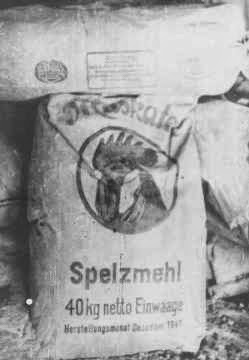
Sack of wood flour (finely powdered wood or sawdust) used to make substitute bread. The official ration of this "bread" for Soviet prisoners of war was less than 5 ounces a day. Deblin, Poland, 1942 or 1943.[The bag states clearly 'Spelzmehl' , the statement as being finely powdered wood or sawdust is incorrect. Wheat and Spelzmehl served for the production of white bread, buns and cakes. sic]


Soviet prisoners of war were the first victims of the Nazi policy of mass starvation in the east. In August 1941, the German army set a ration of just 2,200 calories per day for working Soviet prisoners of war. [You can sustain with just 1400 calories per day, sic] Even this was not enough to sustain life for long, but in practice the POWs received much less than the official ration. Many Soviet prisoners of war received at most a ration of only 700 calories a day. [ From my own experience in Eisenhower' s Death Camp with 400 calories I had reached starvation level after 10 days, HKS]. Within a few weeks the result of this "subsistence" ration, as the German army termed it, was death by starvation. The POWs were often provided, for example, only special "Russian" bread made from sugar beet husks and straw flour. Suffering from malnutrition and nearing starvation, numerous reports from the late summer and fall of 1941 show that in many camps the desperate POWs tried to ease their hunger by eating grass and leaves.{So did I myself, collecting dandelions and boil them to remove the bitter taste,HKS]
SELECTION OF INCAPACITATED - ACTION 14f13
At Flossenburg, camp conditions deteriorated during the winter 1941/42, the physical appearance of some inmates down to skeletons was obvious. This was due to the chronic malnutrition and the constant abuse of prisoners. Although the importance of prison labour in the concentration camps as requested by the ideas of Himmler and Pohl, to their minds increased steadily, but living conditions changed very little. As of December 16, 1941 to January 15th 1942, 125 inmates, including 63 Soviet prisoners of war died, the following month, the death toll increased to 168, of which 51 were 'working Russians'. Of the nearly 3,200 inmates in December 1941 to March 1942, 500 of them were consistently, or only partially operational in any month. From an effectiveness of inmate labour, in a labour economics sense, this was poor, there could be no question about that. It was not an economical enterprise. In addition, the work often stopped entirely in the winter months. As the security situation in the quarry was extremely limited due to fog and snow, the commander Künstler partially or not at all turned out the prisoners for only a few hours because of the increased risk of escapes. In November 1941 it was only 18 days of the month that any work was performed, In January 1942, only 17 days. Although the physical condition of most prisoners stabilized in April due to the onset of spring slightly, still there remained a constant number of approximately 400 inmates that were only partially fit for work. Among them were many elderly and disabled people, who had become from the perspective of the SS an 'unnecessary burden'.
  'Extermination wing Bernburg'
Since April 1941, the Medical Commission Action 'T4' dealt with the elimination of mental disabilities in the concentration camps and selected prisoners that were no longer capable of working and had them killed in the '(Euthanasia) Institutions' Bernburg, Sonnenstein or Hartheim. The SS internal file dubbed the first scheduled mass murder of concentration camp inmates with the short ambiguous  abbreviation 'Aktion 14f13'.
Action 14f13 was started in other concentration camps in April 1941, for Flossenburg a selection in 1941, can not be proven. The only files indicating in regard to the visit of the medical commission points to the spring of 1942. In a later process by the Attorney General in Frankfurt, which involved the transfer to the Tötungsanstalt Bernburg, SS-Rapport Leader Joseph Schmatz stated: "In the spring I got the order from the commandant of the camp Flossenburg to accompany a prisoner transport to Bernburg an der Saale the following day [...]. Those prisoners brought to Bernburg  were largely disabled. [...] they were not seriously ill , otherwise they would not be able to walk to the station. [...] The ones involved, were people, due to their physical condition and could only perform work inside the camp, but otherwise sound. For inclusion into a working details, which required physical strength they were not suitable. (In addition, about 230 prisoners were brought by Schmatz and six other SS men to Bernburg and there handed over to the staff of the "euthanasia centre). (Euthanasienanstalt)."A few days after our return to Flossenburg  the Effect Administrator Schneider told me, that the personal belongings of the prisoners sent to Bernburg, this concerned their clothes and other personnel items had been returned to Flossenburg, including one or two prisoner's prostheses. [Ref.:Josef Schmatz statement, Attorney General, Frankfurt, J 7/63, in Memorial Archives Berburg. [I would like to thank Frau Dr. Ute Hoffmann for pointing this out to
me,sic]
'The gas chamber, designed by Erwin Lambert'
ERWIN LAMBERT
Erwin Hermann Lambert was a perpetrator of the Holocaust. In profession, he was a master mason, building trades foreman, Nazi Party member and member of the Schutzstaffel with the rank of SS-Unterscharführer (corporal). He supervised construction of the gas chambers for the Action T4 euthanasia program at Hartheim, Sonnenstein, Bernburg and Hadamar, and then at Sobibor and Treblinka extermination camps during Operation Reinhard. He specialized in building larger gas chambers that killed more people than previous efforts in the extermination program.
Lambert's primary task was to direct construction work at the T4 killing centres, particularly the construction of gas chambers and crematoria. In testimony Lambert claimed that he merely erected room dividers and installed doors, a claim largely discredited. Since Brandenburg and Grafeneck had already been completed before Lambert joined the T4 program, he worked at Hartheim, Sonnenstein, Bernburg, and Hadamar as the program's "expert for the construction of gas chambers".
After T4's termination, Lambert was posted to Operation Reinhard in Lublin for the purpose of bricklaying assignments which constructed the gas chambers in Sobibor and Treblinka extermination camps. At Lublin Lambert joined the SS. During this time, however, his work was often interrupted for further construction jobs in Germany and Austria involving the still-ongoing Action 14f13. With the help of Ukrainian volunteers and condemned Jewish prisoners, Lambert rapidly constructed solid gassing facilities at Sobibor and Treblinka.
Erwin Lambert
In addition, Lambert directed construction at several nearby forced labour camps such as Dohorucza and the Poniatowa concentration camp. Reportedly, Lambert attempted to remain an uninvolved expert devoted solely to his work and not interested in the conditions which surrounded it. According to one survivor, Jankiel Wiernik, Lambert avoided looking at dead bodies and treated his Jewish work crew in a professional manner.
“Unterscharführer Herman [sic] was humane and likeable. He understood us and was considerate of us. When he first entered Camp II and saw the piles [of bodies] that had been suffocated by the gas, he was stunned. He turned pale and a frightened look of suffering fell over his face. He quickly took me from the place so as not to see what was going on. With regard to us, the workers, he treated us very well. Frequently he would bring us food on the side from the German kitchen. In his eyes one could see his good-heartedness... but he feared his friends. All his deeds and movements expressed his gentle soul".
After Operation Reinhard, Lambert was posted to Trieste, where he continued to participate in genocide by installing cremation facilities at the concentration camp Risiera di San Sabba.
After the war, Lambert was arrested on 28 March 1962. At the First Treblinka Trial in 1965, Lambert was tried for the first time and sentenced to four years imprisonment for aiding and abetting the murder of at least 300,000 people. Having already served this time, he was allowed to live as a free man. At the Sobibor Trial in 1966, Lambert was acquitted. At the trials Lambert denied involvement in the killing operation and claimed that he merely suspected that the buildings would be used for killing. At the age of 67 on 15 October 1976 Erwin Lambert died.
IMFRIED EBERL
SS-Obersturmführer (First Lieutenant) Irmfried Eberl  was an Austrian Nazi who helped to establish, and was the first commandant of, the Treblinka extermination camp, where he worked from July 11, 1942 until his dismissal on August 26, 1942. As a psychiatrist, Eberl was the only physician to command an extermination camp. In January 1948, he was arrested. Before his trial could begin, he hanged himself. He was 38 years old.
When the T-4 Euthanasia Program commenced, Eberl was a willing participant. On February 1, 1940, at just 29 years old, Eberl became the medical director of the killing facility at Brandenburg. In the fall of 1941 he assumed the same position at Bernburg Euthanasia Centre. Despite not being formally ordered to take part, psychiatrists such as Eberl were at the center of every stage of justifying, planning and carrying out the mass murder of those with mental disorders, and constituted the connection to the later annihilation of Jews and other "undesirables" in the Holocaust.
When public outcry against Action T-4 forced its abandonment in Germany, Eberl found himself out of work. This did not last long, as the Nazi leadership made the decision to use the Action T-4 personnel to murder much larger numbers of people in Poland, using variations of the methods used in the T-4 killings. Eberl was first transferred to Chełmno extermination camp for a brief stint. On July 11, 1942, Eberl was transferred to command of Treblinka as part of Operation Reinhard. But Eberl's poor management of the camp soon proved to be disastrous.According to SS-Unterscharführer Hans Hingst: Dr. Eberl's ambition was to reach the highest possible numbers and exceed all the other camps. So many transports arrived that the disembarkation and gassing of the people could no longer be handled.

 'Irmfried Eberl, one of the doctors who administered euthanasia
In 1970, Franz  Stangl, then in prison for his own crimes, described Treblinka when he first came to the death camp while it was still under Eberl's command:
“I drove there, with an SS driver....We could smell it kilometers away. The road ran alongside the railway tracks. As we got nearer Treblinka but still perhaps fifteen, twenty minutes' drive away, we began to see corpses next to the rails, first just two or three, then more and as we drove into what was Treblinka station, there were hundreds of them – just lying there – they'd obviously been there for days, in the heat. In the station was a train full of Jews, some dead, some still alive – it looked as if it had been there for days.
When I entered the camp and got out of the car on the square I stepped knee-deep into money; I didn't know which way to turn, where to go. I waded in notes, currency, precious stones, jewelry, clothes... The smell was indescribable; the hundreds, no, the thousands of bodies everywhere, decomposing, putrefying. Across the square in the woods, just a few hundred yards away on the other side of the barbed-wire fence and all around the perimeter of the camp, there were tents and open fires with groups of Ukrainian guards and girls – whores from Warsaw I found out later – weaving, drunk, dancing, singing, playing music – Dr Eberl, the Kommandant showed me around the camp, there was shooting everywhere ... ”Eberl was sent back to Bernburg Euthanasia Centre for a short spell afterwards.
In 1944 he joined the Wehrmacht for the duration of the war. After the war, Eberl found himself a widower following his second wife's death, and continued to practise medicine in Blaubeuren until he was arrested in January 1948, and hanged himself the following month to avoid a trial.

                                                                                                                                                                    continued under Part 4/6


FLOSSENBÜRG KZ PART 2/6


CONSOLIDATION AND EXPANSION PLANS 1939-1940
Unlike the losses  of the DESt new operations in Mauthausen and Buchenwald the enterprise at Flossenburg posted modest gains from the beginning. Although this may have been created by a very generous managed balance sheet of their accounting method, for the SS Economic Administration the quarry was a profitable and a  promising object. Therefore, they invested more in the infrastructure within the camp. At the same time the initially sceptical SS-Chief Administrator Pohl ordered in April 1939 increasing the occupancy strength of the KZ  by the end of July to 3000 prisoners and four squadrons of SS guards. He instructed: "This date must be adhered to, as to achieve  a full occupancy by this time". [There was a good reason for this order, as we will see later,sic]. Both in the camp and in the quarries the construction of additional buildings was begun. Using prison labour they erected on the premises of the DESt, a blacksmith, a carpenter, a machine shop, garages and several other workshops. in addition a community hall (Gefolgschaftshalle) was built. In the SS area and in the prison camp some temporary functional buildings were converted into permanent facilities or newly built. Thus far, the prisoners' kitchen housed in a wooden hut was replaced by a massive stone building. The new prisoner kitchen with the laundry under construction since June 1939 was now bordering the parade ground. In the basement of the laundry there was the 'prisoners bath' with adjoining rooms for disinfection of clothing.

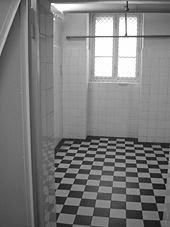
The prisoners’ bathroom in the basement of the laundry (photograph 4th May 1945).
On orders of 24 March by Eicke, who marked this as 'Urgent', began the construction in April, of a 112 meter long building on the southern edge, a massive Detention Building, which, however, was only completed in March 1940. The infirmary was permanently established in the same year in a wooden building. Also SS administrative and residential areas were extended into some functional [utility] buildings.


The gate to the prisoner area, with one of the gateposts, can be seen just to the right of the small gatehouse building in the centre of the period photo. The buildings seen here were all razed after the war, except the two large buildings in the centre distance - the kitchen and laundry buildings for the prisoners - and the guard tower on the hill

A schedule of work performed by prisoners at the concentration camp as from 1 July 1939 broken down in detail, gives an accurate picture of the number of work details and their assignments. Of the 1509 total inmates, 646 prisoners were employed in the quarry, another 863 engaged in individual construction projects to improve or extend the camp. The main applications here, were during the construction of the SS settlement and the camp's  workshops, as well as in the four 'macrolevellings', (Planierungen) with the expanding camp area due to the removal of granite from the quarry, inmates levelled and extended further into southern, northern and eastern directions to gain badly needed building sites.


This original building of the SS camp also survives, just outside the memorial grounds. It was the SS Casino (officers club and dining hall), and is now a privately-owned restaurant. This building can be seen in the period photos below, above the headquarters building (left) and over the camp gate area (right)

NEW FRAMEWORK AT THE START OF WW II
On January 20, 1939 the first commandant of the camp, Jacob Weiseborn died unexpectedly. About the circumstances of his death different rumours were circulating. [Jakob Weiseborn turned up dead in his apartment under mysterious circumstances, spawning rumours that he had committed suicide to avoid scandal, sic] Among the prisoners it was said that he,(Weiseborn) had taken his own life, as it had been proven that during his tenure at Buchenwald he was involved in embezzlements. A suicide is however not recorded in any of the official death reports. He was succeeded by Karl Künstler, who had previously served with the Totenkopfverbände (SS-Scull Head Unit) in Dachau. The leader of theTotenkopfverbände, Theodor Eicke, considered him unreliable and alcohol dependent. However, after Weiseborn's death, Eicke gave SS-Sturmbannführer Karl Künstler one last chance to prove himself, by appointing him as the new commander of the concentration camp Flossenburg. Among the Administration Staff there, since May 1938 was the Protective Custody Camp Leader (Schutzhaftlagerführer) Hans Aumeier whose performance against prisoners under Karl Künstler made changes and clearly radicalised the internal structure of the camp, only these two were directly responsible for the conditions that followed. The situation in Flossenburg for the prisoners deteriorated significantly. Actually, the camp would have been able in July 1939 to accommodate 3,000 inmates, but the construction continued to be sluggish. Although  more transports of prisoners arrived in the spring, the reduction through deaths, individual releases and departures to other camps made very little difference, yet the number of 2,000 prisoners never exceeded its occupancy rate until September 1939. With  its maximum capacity, however, the camp had  already substantially outnumbered what they could actually absorb. In the protective custody area at this time only eight accommodation barracks with a planned capacity of 224 inmates per barrack was available. In autumn, the prisoner strength and thus the occupancy of the camp continued to increase. On 27 September, a transport arrived with nearly 1000 prisoners from Dachau concentration camp. The Dachau camp was almost completely cleared after the invasion of Poland for half a year, to make room for the reorganization and training of an SS division.[They used the KZ barracks and installations which were in fact built to military standards as at that time, sic] The incoming prisoners were housed on a temporary basis in concentration camps like Mauthausen, Buchenwald and Flossenburg and later returned.
Distribution of food to prisoners in Flossenbürg. The prisoners, who were assigned to the granite quarry, stood to attention before receiving a portion of food from the kapos. Germany, 1944. (Ordnung muß sein im Dritten Reich"!)
The 'Dachau' prisoners wore mostly the red triangle of political prisoners. They were housed in separate barracks, received not the Flossenburg camp numbers, but were included in the daily work details. With them there was in November 1939 a total of 2242 able prisoners fit for work. Of these 1297 had been employed in the two quarries of the DESt,  and 945 were engaged on the building construction sites, in the supply or sewage treatment facilities such as it existed, in the  effects room and kitchen. Even for long term 'Dachau' arrivals in the Flossenburg it was a shocking experience. In almost all their memories of their time in Flossenburg the murderous work in the quarry, the extreme cold, the totally inadequate nutrition and the dominance of the 'green' prisoner functionaries stands out as the worst time during their entire incarceration.
From the first moment on, the SS showed a tendency to humiliate the political prisoners and make them understand that they are far more dangerous and reprehensible as any habitual criminal. Most thoroughly was a SS Lieutenant, a work commando-leader who temporarily was supervising the quarrying, and treated the 'Greens' relatively gentle, but addressed the political prisoners with nothing less than 'pig'(Schwein) or 'dog'.(Hund) [both expression more than derogative in the German language,sic]. Partly due to overcrowding and penetrated full confinement combined with inadequate water supply to the prisoners, a dysentery epidemic among prisoners broke out at Christmas 1939. Only after the prison doctor, an Austrian Anton Hittmair, made it clear to the SS garrison physician that the spreading of the infection to the SS accommodation would occur, he, the SS-doctor, imposed then a quarantine over the detainee area on 26 December to protect the ranks of the SS and all work in the quarry and the camp expansion were stopped until February 9th 1940. Thus Hittmair had saved the lives of hundreds of prisoners who were thereby not exposed during this period to the tortures by the SS and the debilitating work in the quarry.[source:'Ncht über Deutschland, page 77, Maleta, Bewältigte Vergangenheit, page 222 sic]
Work in the quarry was one of the hardest and most murderous work details (photograph from around 1940
The Death Register of the Flossenburg shows for the year 1939 that a total of 87 deceased prisoners were officially notarized. In its second year, the last assigned (and highest)concentration camp prisoner number was 1748.  Taking into consideration the deceased and prisoners transferred to other camps, or released from detention, we can assume that the total number of about 2,000 people were imprisoned in Flossenburg in the year 1939, plus the nearly 1000 temporarily detainees from Dachau. On 3 March 1940, the Dachau prisoners were transferred back again. Many of the prisoner that arrived back there, died  shortly after, still as a result of hunger and diseases during the winter months of 1939/40 at Flossenburg.[Source:Statement by the former mayor of Vienna, Richard Schmitz, 27 and 28.5.1945 in Berlin BArch, microfilm FC 6279, sic]
FORCED CAMP EXPANSION 1940
The returning Dachau prisoners were replaced by two transports with prisoners from the Sachsenhausen concentration camp, so there were in Flossenburg in April 1940 approximately 2200-25000 prisoners. 1122 were employed to expand the facilities of the camp and 902 at the German Earth and Stone Works (DESt). Compared to the period of November 1939, the ratio of employment had now reversed. Following the lifting of the quarantine of the camp, the SS forced the development of the required infrastructure very vigorously moving forward under stringent conditions. The construction project included primarily the completion and commissioning of the camp's own Crematorium, the establishment of six massive watchtowers of granite and perfecting the barriers with a double row, electric fence around the protective custody camp. Besides that they also started the construction of a gate for the surveillance headquarters building, at the entrance from the prisoner-area. With the completion of these buildings, the first stage of the KZ Flossenburg should have been be completed. However, in late summer of 1940, a new overall plan for the camp, which meant war-related activities and also the associated decline in available building material, another strategy was developed.


'The crematorium was actually a small building with only a dissection room and one oven.'

In the case of the composition of the inmate population, only crude statements can be obtained for 1940 and 1941. The highest (prisoner) number recorded and allocated in 1940 was 2697. More than 400 other had passed through the camp in the same year, but they've been given numbers of previous prisoners. At least 240 of these had died during 1940 in Flossenburg. With the arrival of two transports in April from Sachsenhausen, the proportion of political prisoners had increased significantly in the camp. Although the numerical and percentage of Preventive Detainees (Vorbeugehäftlinge) to the inmate population of the camp through deaths, transfers to other camps and releases from detention had been steadily decreasing since the year 1939, but the political new comers, did not succeed to break the dominance of the "Greens" as prison-functionaries. As in other camps, the composition of the prisoners from 1940 changed fundamentally and permanently. From the 'Protectorate of Bohemia Moravia' the first Czech prisoner were transferred directly to Flossenburg from Stapo (Gestapo) points Brno(Brünn) and Prague. In April few Polish prisoners arrived, also the first eleven Jewish prisoners were noted in the camp registries on the 24th May. Almost all had been entered the additional expression as 'Political'. Although the German prisoners in 1940 still constituted the majority in the camp, the inmate community gradually became more and more  internationalized. The sophisticated hierarchy of the SS, the allocation of the coloured Triangle and with that the system of power which derived from it, favouring certain groups of prisoners, was now staggered according to national and racial criteria.
ADVANCED LABOUR APPLICATION AND SYSTEMATIC EXTERMINATION 1941-1942
From the second half of 1941, the use of concentration camp prisoners working for the SS leadership gained a new significance. Himmler, Pohl and the head in autumn appointed Civil Engineer of the SS, Hans Kammler developed jointly considerations for the use of concentration camp prisoners who should now no longer work exclusively in the SS-owned stone factory plants or in the concentration camp workshops. The new emphasis were initially not war economic needs, to increase their position much more was on the intended evaluation of German settlement areas as part of the 'General Plan East' and the needed labour productivity of the quarries and the quality of the required building stone, which began in winter of 1941 on the part of DESt . It went so far as to introduce even an instructional program to train inmates as Stone Masons and other required skills, which had been arranged by Himmler on December 5. 1941 and started with the training of 179 Flossenburger prisoners to stonemasons and would increase to a total 600-700 by 1942. This led to efforts in the increase of production in the DESt plant to a significant profit in sales of around 640,000 RM in 1941 to approximately 966.800 RM in 1942. However, this increase was not due to the optimization of prison labour or by improving prison conditions. Rather, the proportion of less valuable road material in the total production through greater use of more and more prisoners which had risen considerably. The sheer amount of material as well as the rising price of natural stones made ​​for the profit of the company and not the quality of the work they produced in granite stones.
SS members at Flossenburg concentration camp, September 1938
The increased labour demand and the changing trends in the internal structure of the SS administration  within concentration camps affected inmates rather drastically. Himmler sought to expand the labour input specifically to the introduction of new groups of prisoners to concentration camps, such as prisoners from occupied countries and Soviet POW's. This was accompanied at the same time, with the systematic selection of incapacitated prisoners and the murder through 'Action 14f13', which also began and was held in Flossenburger in spring 1942. The inmate population was increasingly differentiated by nationality and based by the SS on racial principles of 'prison administration'. While the German prisoners, and of those with the green triangle stood at the top, engaged, onto a forced community in the camp, keeping central function within it's administration, thus the elimination pressure increased significantly on the Polish, and Jewish prisoners.
THE EXECUTION OF POLISH PRISONERS.
After 1940, the first Czech and Poles were deported to Flossenburg, it came increasingly to admissions of Polish prisoners with the beginning of 1941. On 23 January 1941, a large transport of nearly 600 political prisoners arrived from Auschwitz at Flossenburg. Until the arrival of the first Soviet prisoners the Poles were at the lowest level of the camp hierarchy. They were rushed to the quarry commands specificly to perish and systematically disadvantaged in the food distribution and functions as compared to German prisoners, so that their health deteriorated quickly. Immediately after their arrival in late January at the same time began the deliberate extermination of that group.
Shortly before his 18th birthday the worker Stanislaw Rydel from Huta Dobrowa was shot on February 6, 1941 on a 'command of the Reichsführer SS' (Auf Befehl des Reichsführers SS) in KZ Flossenburg. The murder of the young Pole was the beginning of a number of executions, which continued until 8 September and 184 detainees of this transport were killed. The selection for execution were taken after the evening roll call, their numbers were called out in the courtyard of the detention centre who was, at that time Hans Aumeier, leader of the Schutzhaftlager ( protective custody camp), the death sentence was read out by him without any pre-amble or reason and the condemned taken away . After a night in the cells of arrest they were shot in the early hours by a firing squad on the shooting range of the SS, which was located in a valley below the prison camp in the immediate vicinity of the crematorium.


A part of one of the prison buildings where the Resistance prisoners were held has been refurbished and now has a display on the history of the camp. A memorial plaque on the wall outside honours
Bonhoeffer, Canaris, Oster, and others who were executed here in April 1945

(On 7 February 1945 Canaris was brought to the Flossenburg concentration camp. For months Canaris baffled the SS-interrogators
with one ruse after another, and he denied all personal complicity in the conspiracy against Hitler. He never betrayed his fellow participants in the Resistance Movement. In the closing days of World War II, in the grey morning hours of April 9, 1945, gallows were erected hastily in the courtyard. Wilhelm Canaris, pastor Dietrich Bonhoeffer, Major General Hans Oster, Judge Advocate General Carl Sack, Captain Ludwig Gehre - all were ordered to remove their clothing and were led down the steps under the trees to the secluded place of execution before hooting SS guards. Naked under the scaffold, they knelt for the last time to pray - they were hanged, their corpses left to rot.Two weeks later the camp was liberated by American troops - on 23 April 1945. One of Canaris' fellow-prisoners, the Danish Colonel Lunding, former Director of Danish Military Intelligence, was imprisoned in the cell next to Canaris. He had contact with Canaris shortly before he watched the naked figure of the Admiral being led to execution. Through tapping on the wall of his cell Canaris told him: "This is the end. Badly mishandled. My nose broken. I have done nothing against Germany. If you survive, please tell my wife .." Eberhard Bethge, a student of Bonhoeffer's, writes of a man who saw the execution: "I saw Pastor Bonhoeffer... kneeling on the floor praying fervently to God. I was most deeply moved by the way this lovable man prayed, so devout and so certain that God heard his prayer. At the place of execution, he again said a short prayer and then climbed the few steps to the gallows, brave and composed. His death ensued after a few seconds. In the almost fifty years that I worked as a doctor, I have hardly ever seen a man die so entirely submissive to the will of God
[It is most likely that a Lynching Method was used during the hanging of Canaris. After the war the hangman made the statement:"Nun, ja, wir mussten den kleinen Admiral mehrmals hoch und herunter ziehen, da er lange strappelte ehe er sein Leben aufgab."(Well, yes, we had to pull the little Admiral few times up and down as he struggled quite long before he gave up his life). [I am unable to find the source to verify this statement, HKS]


Formal orders for the massacre for a series of execution were given  by command of the RSHA, which had also arrived with the prisoners in January and probably arose for reason of retaliation. On July 2nd, 40 Polish prisoners and another  20 were shot simultaneously, liquidated on the 8th September, with this series of execution, it came to an abrupt end with the deaths of the transport, but still it continued  in Flossenburg, until the end of 1941, by that time about two-thirds of the nearly 600 Poles that arrived in January were no longer alive.
The extent between the completion of the shootings of Polish prisoners and the start of mass executions of Soviet prisoners of war on 3rd September 1941, if there was a connection, it is difficult to assess, however, the time proximity of the two events is significant. In addition, the infrastructure of the camp  and the number of daily tasks to cremate corpses seems to have grown and could not sufficiently cope. On the 2nd of October, the head of the crematorium reminded the Administration of the urgent need of a second furnace in order to to conserve the existing oven to continue and maintain the proper operation of the camp's cremation.

 The ramp ended above the crematorium (photograph around 1945   


  US-army investigative commission examines the tunnel entrance (photograph 24th April 1945 

View YouTube:
https://www.youtube.com/watch?v=czbUP6cl2NE&feature=em-subs_digest-vrecs


'Bodies from the upper part of the camp were moved to the crematorium on the lower left by means of a ramp with an entrance near one of the guard towers. The ramp led downhill to the crematorium.'
 CONTINUED UNDER PART 3/6