Friday, July 11, 2014

MITTELBAU-DORA CONCENTRATION CAMP PART 2


REICH-OWNED (STATE-OWNED) KZ-ENTERPRISE : THE FORMATION OF 'MITTELWERK' FACTORY GmbH
The term "Mittelwerk" had been established in the early days and was familiar to most rocket program managers, long before the place was incorporated as a Limited Company (GmbH). Presumably it was intended from the beginning to organize the new company along commercial lines. The strings attached for the planned company formation was in the hands of Karl-Maria Hettlage, who was Head of the General Referat (Speaker)  of Economy and Finance in the Ministry of Munitions. After several preliminary negotiations on the missile program, the participants met on September 21, 1943 in Hettlage's board room,  based in Berlin for the founding meeting of the Mittelwerke GmbH. Present were, besides Hettlage, among others, Karl-Otto Saur, Walter Dornberger, Hans Kammler, Gerhard Degenkolb and his deputy as well as representatives of WIFO and the Reich-owned Armour Kontor GmbH (Trading House). It was agreed to leave the reconstruction of the tunnel system to the missile factory of WIFO, who owned the tunnel system and should remain their property. The Raketenproduktion (Rocket-production) was transferred to the newly established 'Mittelwerk' GmbH, which was funded by the Armur Kontor GmbH and thus was a privately organized state operation. Up to this point, that the company was founded on this basis,  was nothing special.  Reich-owned (State-owned) arms factories were by no means rare. Unusable, however, was the decision that "a KZ-Administrator would be  provided as an over-all operator [...]". It is quite obvious that the SS had enforced this recommendation, and it is no coincidence that the Advisory Board of the Mittelwerk GmbH next to Degenkolb, Hettlage, Dornberger, Kunze and the Amor Kontor boss Heinz Schmidt-Loßberg as well as SS Brigadefürer Kammler should belong to the board.
Three days after the meeting, on 24 September 1943 the new company was officially established in the presence of a notary, and since October 7, 1943, it existed upon entry into the Berlin commercial register also de jure (by Law). Kurt Kettler took over the management as intended. As a second managing director was the commander of the satellite camp Dora, SS-Sturmbannführer Otto Förschner in October 1943, after the WVHA chief Oswald Pohl and Kammler had named him as the representative of the SS on the board of the Mittelwerk enterprise.
Otto Förschner in US custody, 1945. In April, 1945 Förschner was taken prisoner by the US Army. He was a defendant in the Dachau concentration camp trial in which he was indicted for war crimes stemming from his tenure at Kaufering. Namely, Förschner was charged with responsibility for the brutal conditions which prevailed in the camp and his role in the management of prisoner executions. After being relieved of command at Mittelbau-Dora, Förschner was transferred to Dachau, where he served briefly as commandant of the sub-camp of Kaufering. He was convicted by a US military tribunal and sentenced to death, along with 35 other co-defendants, on December 13, 1945. He was hanged in Landsberg prison on May 28, 1946

The former professional soldier Förschner, born in 1902 in the Bavarian Dürrenzimmern was already in 1934 a member of the SS (Allgemeine SS) and took over after various assignments as an instructor in the Waffen-SS,   the leadership in 1942 of the guards at the concentration camp Buchenwald, before he was transferred in September 1943 and became Kommandant of the newly founded camp at Dora. Officially Förschner was indeed a member of the management of the Mittelwerke, but his real job in the operation was not initially well defined, they could hardly have been, because the SS officer was neither trained, technically nor economically and thus for his new job anything but suitable . The title as a director was therefore purely formal in nature, and documented the claim of the SS participation in its administration of the company. The actual technical and commercial tasks were performed by director Kurt Kettler and the third Managing Director Otto Karl Bersch appointed in December 1943 . All three of them of them were sub-ordinated to the new member since April 1944, as Chairman of the Board Georg Rickhey, who came from the Demag-Vehicle Assembly Plant located at Berlin-Falkensee and appointed to this position at Nordhausen.

Georg Rickey under arrest in June, 1947
He became head of Mittelwerk GmbH in Dora-Mittelbau from April 1944, overseeing production of the V-1 flying bomb and V-2 rocket. His work on these weapons saw him awarded the Knights Cross of the War Merit Cross along with Walter Dornberger and Wernher von Braun. Arrested in 1945, he was taken by the U.S. Army to live at Wright-Patterson Air Force Base, Ohio where he worked under the terms of Operation Paperclip. He was subsequently indicted as part of the Dachau Trials of 1947 under accusations that he had worked closely with the SS and Gestapo and witnessed executions. A lack of evidence however saw Rickhey acquitted. He did not return to his work in the United States.

STRUCTURAL CHANGES: THE BEGINNING OF THE ROCKET ASSEMBLY AND THE RELOCATION OF PRISONERS INTO THE CAMP BARRACKS.
The gradual inclusion of the rocket assembly began in the early 1944 at 'Dora' and with that a transition of structural changes began.  Prisoners had previously been used primarily in the gruelling construction work that did not require special skills, the Mittelwerke needed now a trained workforce for the machines with highly qualified operators. Unlike on the construction sites, the exploitation of labour of the prisoners were now subject to technical and economic limits in production of rockets. Just work on technically sensitive missile components required technical know-how, a highly and skilled workforce, and who was not a skilled worker, had to be trained usually over a longer period of time. Thus, it was in the interest of management of the Mittelwerke to ensure that the living conditions of prisoners had to be greatly improved and get their work force into such conditions that they were able to perform at least initially a required standard of workmanship in the assembly process.
A major reason for the high levels of absenteeism and the  huge death toll was in the disastrous sanitary conditions in the sleeping tunnels. The basic requirement for improving work performance, therefore, was the move into the above-ground barracks. After the Mittelwerke and the SS camp, from January 1944 was almost completed, the prisoner commando that was used in the construction of that camp, had been considerably enlarged. Gradually, what emerged were 18 wooden watchtowers  surrounding the area with an electric fence in addition to some massive Administration Buildings, the crematorium and an equally massive detention cell building (bunker) and numerous barracks that served as logistic- and accommodation blocks.
From prisoners secretly taken photo from the building of the inmates infirmary barracks building of the camp Dora, early summer 1944
In late summer 1944, the camp had received largely its final appearance, although not until the last few days before the camp was disbanded in 1945 expansion work was still carried out in April. The entrance gate - which, incidentally, did not have the usual concentration camp slogans such as "Work makes you free" or "To Each His Own" - was located between two elongated administration barracks in which the SS administration and the camp Gestapo were housed. Behind it lay a vast parade ground which was surrounded with other administrative barracks and outbuildings.
To the left of the parade ground - seen from the entrance gate - was a 'sports ground' and right next to that, the massive arrest cell construction. On the right side of the parade ground the Library. Since the beginning of 1945, a prisoners' brothel was located behind some accommodation barracks and a little further set back the prisoner hospital barracks and not far from here,  the crematorium, which was built on top of a hill and went in the late summer of 1944 into operation after the bodies were originally taken first for cremation to Buchenwald, but this procedure was done now locally from April 1944 in a mobile crematorium near the laundry barrack. In the rear area of the camp was the majority of the 56 housing barracks, many of which were obscured by trees, because the SS left the surrounding trees standing to camouflage the area.
As of December 1943 inmates were gradually transferred from the sleeping gallery into barracks which were under construction - at first mainly those prisoners who were not used in construction commandos, but the rocket  production. The move into the barracks which stretched out until early June 1944. Some prisoners therefore had to spend up to nine months in the dark - if they survived such time.

Gallery 46 was the first side passage on the south end of Tunnel A, but it did not go all the way through to Tunnel B. This chamber was used as living quarters for the prisoner labourers and later for V-1 construction'
With the building of the above-ground camp, the living conditions for many prisoners improved significantly. The mere fact of being housed in a warm, dry and relatively clean place, meant a substantial improvement over the stuffy, damp and slippery with dirt of the sleeping gallery. In addition, there were in the barracks latrines and washing facilities, while the prisoners in the tunnel for months had not been able to wash themselves. At the same time the possibilities of medical treatment with the establishment of the infirmary were significantly expanded, catering has been improved and the prisoners employed in the missile assembly had to suffer no longer quite the harsh working conditions, thus since April 1944, the death rate fell significantly.
However, the reduction in the death rate was not only a result of improved living conditions. First of all, it was due to the fact that all seriously ill and dying were summarily deported to Majdanek and Bergen-Belsen. There, the dying went on - so it was only outsourced. In addition, a large number of  about 12,000 prisoners present during the summer of 1944 were not all exposed to the catastrophic phase of the winter 1943/44,  and had thereby survived. Since the Mittelwerke required skilled and efficient manpower for the A4 assembly, it was through its engineers, who selected in all concentration camps new, and  "unused" prisoners and deported them to Dora - even the director of the Peenemünde development work, Werner von Braun, mustered in August 1944 in Buchenwald concentration camp prisoners for missile assembly plant at Mittelwerk. (Although he denied ever been there, but there is evidence on record: 'Letter of Braun, to Sawatzki, dated 15.06.1944, in NASM, FE 694, (reprinted in facsimile. Eisfeld, Mondsüchtig, page 135f) The  exhausted tunnellers, however, were deported from April 1944 into the newly created adjacent satellite camps  where they were continued to be used as a construction workers. There was a distinct artificial drop in the  death-rate, due to this move from the sleeping gallery into the above-ground barracks that included a gradual replacement of the exhausted against "fresh" detainees. The death rate would thereby in the Dora camp without improvement of living conditions, as not all inmates benefited from it, still higher then indicated, as the exhausted workers died in associated sub-camps.

Between the main tunnels (A and B) every few yards were connecting galleries. These housed machine and sub-assembly shops and parts storage areas. This gallery was one of the machine shops. 
Despite the numerous rendition of "fresh" and professionally qualified inmates, the rocket assembly plant in the Mittelwerke never ran according to plan. It soon turned out that the use of concentration camp prisoners in the complex missile assembly was  limited,  because they were slow and thereby worked over a longer, (time study) standard set period,  and also after that, they had to be constantly monitored of their performance, since they did not voluntarily worked there for non-economic reasons, they had to be inspired and coerced to work. It did not go as smoothly as the representatives of the business and missile engineers in Nordhausen and Peenemünde had anticipated. A "building prisoner" who would go ahead with his shovel in his hand to do the tunnelling, the guards could literally exploit him with physical duress till he dropped. A "manufacturing prisoner"(Fertigungshäftling) who had to make the rocket filigree welding work was, however, not be  moved to work by physical violence without further ado, management did not and could not jeopardize the product. Nevertheless,  with specialized forced labour it was not possible without having permanent supervision and control, especially with prisoners who had to assume that the weapons they made by them put relatives at risk at home.
The management  of the Mittelwerke were trying to overcome the inherent structural dilemma inherent of forced labourers, in collaboration with the SS, which meant, for the prisoners engaged in manufacturing, to introduce  a performance incentive, in form of a bonus system, ie payment of vouchers with which the prisoners in the camp, in addition - usually could buy additional food (mainly inferior) -  or given access to the camp cinema and the brothel, were female inmates had been forced into prostitution. For a premium system to work,  the introduction of a group piece method (Akkord), which was for prisoners and German foremen alike and should thus enhance the interest of the German civilian workers to higher work performance including the inmates alike. In addition, the management of the Mittelwerke constantly corrected the ratio between prisoners and German civilian workers downward. In the fall of 1943, the ratio of prisoners to civilian workers was still at eight to one,  in practice as of April 1944, it stood only about two to one (on May 1, 1944, in the A4 assembly of the Mittelwerke were 2,500 German civilian workers including other employees and 4,910 concentration camp inmates.)


Two views of the workshop areas inside the tunnel systems while in use. Some of the tunnels were two stories in height, for larger machines.

Considerable difficulties arose for the production process in the Mittelwerke by political and military decisions that were precipitated by Hitler, the top Wehrmacht hierarchy  and in the defence ministry. At the direction of the Armaments Ministry, the Mittelwerke was forced in April 1944, to clear the northern half of its tunnel system in favour of the Junkers Group. This was code named "North Werk AG", and  started in the summer of 1944 with the production of jet engines. As a result the Mittelwerk by moving within the tunnel system and the reduction of the production area by almost half had a dramatic drop in their own output: They assembled not more than 430 A4-rocket  in May 1944, the production decreased further in June to 132 and in July 1944 only 86 missiles. And even if the monthly output levelled off during September 1944 to about 600 to 700 missiles, it was still a far cry from the 1,800 rockets that had been planned in October 1943 by the management of the Mittelwerke to be fully mounted on a monthly basis.  Even the revised plan of November 1943, which provided for a monthly output of 900 pieces, could never be fulfilled.

As to production inhibitory which turned out at the start of the rocket assembly, the fact that you had to struggle in the underground facilities despite elaborate supply of fresh air with dust and high humidity, the people and machines were always at risk.  Management had to deal with replacement of resources, not only replacing the workforce, but deal with a host of other problems. In an internal report of May 1944, doctors indicated that a large number of sick German civilian workers - apart from the many thousands of mortally sick KZ prisoners were unfit to work in underground tunnels. The report it states clearly, there is no question about it. Around the same time a circulated memorandum noted of the condition that "the work in tunnels is a major health risk in the long run. The production in there will therefore probably need to be taken out in peacetime ". Compared to Hitler's demand of March 1944, "The final relocation of the entire German industry works will be under the earth".  This was a significant downbeat assessment of the underground movement, to which in the last year of the war the hopes of the Nazi armaments planners,  as for them it was a successful model project.
Initial V-2s were plagued by bad welds, soldering problems, and faulty parts. At first electrical components were installed and final testing was performed at Degenkolb’s DEMAG facility at Berlin-Falkensee. Later in 1944, these activities were moved to the Mittelwerk.
Many prisoners involved in electrical assembly and testing were required to put slips of paper, bearing their unique identification numbers alongside of parts they had produced or certified. Then, if problems were found with these during later inspections, the workers responsible would be punished. Prisoners did in fact whenever possible urinate into the electrical wiring.  Still, minor forms of passive sabotage could be accomplished by the prisoners for example by accepting for assembly subcontractor parts that they knew did not meet specifications. There were instances of prisoner workers knowingly passing along electronic sub-assemblies that contained “cold solder” connections—ones that were likely to produce intermittent or no electrical contact at all, and thus lead to failures. Other prisoners recount making partial arc welds in hidden locations on the rocket (for example, inner welds on fins that would hopefully come apart later under launch stresses).
Sabotage was a dangerous undertaking, however. The penalty was death, and the SS guards often carried out individual or group hangings as an object lessons to the prisoners. The huge cranes in Hall 41 were used to hoist victims up by their necks and let them slowly strangle, in full view of the members of each of the Mittelwerk shifts, who were called to witness these hangings. The dead were then left to hang there, about five feet off the floor, for a day or so, while the prisoners came and went beneath them.  A permanent gallows was later erected in the roll call yard at Dora.

Plan of concentration camp Mittelbau-Dora Memorial'
Mittelbau Currency
Mittelbau, also known as Dora, was the contraction for "Mitteldeutsche Baugesellschaft A.G.," the industrial complex that produced VI and V2 rockets. It consisted of three sub-camps: Mittelbau 1, the main camp, located near Nordhausen; Mittelbau 2, located near Ellrich; and Mittelbau 3, the smallest sub-camp, located near Harzungen. The Mittelbau camp notes are the most complex of all camp issues, because of the many series that were made. The notes range from .01 RM (which are easy to obtain today) to 10 RM denominations. The other denominations are extremely rare. There is no list of the complete nominal values issued. The notes were printed at the Buchdruckerei Theodore Müller in Nordhausen, Konugshof. The printing orders for Mittelbau notes were destroyed by the Nazis before the liberation of the camp by the Russian Army in April 1945. Thus no documentary materials pertaining to the issuance of camp money at Mittelbau-Dora are extant.
The legend printed on the reverse side of all the notes reads: "The safekeeping of funds for these vouchers is maintained by the Central Administration of the SS canteens in the Mittelbau area garrison. Counterfeiting will be dealt with in the most severe manner." Below the legend is a stylized six-pointed star and the serial number. The obverse wordings are always the same: "Work Camp Mittelbau. " The notes differ in colour, series, and denomination. All notes were printed on watermarked paper as a security device. Since the notes are similar in layout, their designs were probably created locally.
Mittelwerk related currency
LIVING CONDITIONS AND COPING STRATEGIES OF WOMEN IN CAMP BROTHELS.
For many years it was impossible to find out how women selected for camp brothels dealt with their life. In the 1990, German activist and writer Chrisinta Paul managed to interview women who had been forced into sexual exploitation in concentration camps. The Sonderbau in Buchenwald, to which Magdalena Walter was abducted, was a wooden barrack in the peripheral area of the prisoners' camp. It was divided into a day room. a room for the SS-Guard, a medical room, small brothel rooms, and bedroom, in each of which two forced sex workers slept. The clothing in the Buchenwald brothel consisted of a white plaid skirt, under which they were allowed to wear panties, and a bra. Every morning the women were required to get up at 7:30, wash themselves, and get dressed. During the day they were occupied with cleaning the barracks and airing the rooms. They could also read non-political books from the camp library, according to Magdalena Walter. This routine suggest a level of civil normality inside the brothel, but this picture is deceptive. The daily routine was monotonous and consisted of waiting for the 'terrible hours' in the evining, after the male prisoners had finished their daily work. Then,  as if she were part of an assembly line, Magdalena Walter had to let the male prisoners use her:
'Now every night we had to let the men get on top of us for two hours. That meant they could come into the brothel barrack, had to go to the medical room to get an injection, could go to the number assigned - then the prisoners, could do their thing, come into the room, on top, down, out,  back to the medical room, where they again got an injection. The prisoner had to leave the brothel after a fifteen minutes performance. We had a bathroom with a certain number of water closets. It did not lack cleanness there. And then right away there came the next one. Non-stop. And they didn't have more than a quarter of an hour.
In another interview By Christina Paul, with a women who had to suffer in the camp brothel of Mittelbau-Dora, she explains, that the women had few opportunities to resist. There was often nothing they could do but bear their fate, as they already were mentally broken by their long imprisonment in concentration camps and faced almost certain death if they rebelled. Linda Bachmann (pseudonym), who was abducted to the Mittelbau-Dora camp brothel in 1945, reported:
We put up with our fate. Each woman had to accommodate at least six “visitors” each evening although this varied from camp to camp. We always said: it's still better than Ravensbrück or Belsen-Bergen, What can you do? Do you want to stand up against it? We did so much. Well deep down, of course, it was a shock, that's understandable, isn't? You know, we were so deadened by the whole thing and everything. We practically had - you know, even in Ravensbrück, when you woke up in the morning, you were lying next to a dead body. And if you said to the senior prisoner, there is a dead body here, then she just said: "Yes, throw it down". You see? And you know, you only look out for yourself. I never thought I'd survive or anything. I was deadened by the whole thing, and I'd practically said goodbye to life. sic]
There were not the necessary need to sexual gratifications in concentration camps to establish brothels nor the so-called Bonus System as it is claimed, rather in part of it was, to avoid rectal rape between males, of which the SS were fully aware of.  SS-Doctors reported, that the physical consequences are the tearing and abrasions of rectal and anal areas, which demand immediate attention because they put the victims of rape at increased risk of bacterial infections. I do not think the SS were that stupid as to it's happening. It is a clinical established fact that most men have 3 to 5 full erections during deep (rapid eye movement, or REM) sleep. Men who do not have erections because of psychological or physical problems can still have erections during deep sleep. Occasionally, some sleep problems or serious depression can prevent these normal night-time (nocturnal) erections. What happened in a three-men bunk (in a number of camps) that a fellow inmate just mounted his next neighbour, which had nothing to do with homosexuality. (The Catholic Priesthood is doing it to this very day!) I can only relate incidents as it often took place in Dachau, as retold by younger prisoners.HKS]

                                                                                                                                              CONTINUED UNDER PART 3

Tuesday, July 8, 2014

MITTELBAU-DORA CONCENTRATION CAMP PART 1


PROLOGUE
Many people regard Peenemünde on the Baltic Island of Usedum as the birthplace of space travel. In 1942, the first liquid-fuelled rocket took off from here into space at the speed of sound, yet it was undoubtedly designed as a long-range weapon. But after its first successful launch, Generalmajor Dr. Walter Robert Dornberger jumped up and uttered the words: Der erste Schritt für Menschen zur Weltraumerforschung. (The first step for mankind to start the world space exploration.) The so-called "Retalliation Weapon" was apparently far from his mind at this moment. From 1932, with Wernher von Braun, Walter Dornberger began to perfect the rocket engine. During WWII he directed construction of the V-2 rocket, the forerunner of all postwar spacecraft. In the U.S. after the war, he worked as an adviser on guided missiles for the Air Force. In the 1950s he participated in the Air Force–NASA project Dyna-Soar, which eventually became the space shuttle program.
Mittelbau-Dora was one of the last concentration camps founded by the National Socialists. The history of this concentration camp clarified paradigmatically the last stage of development of the concentration camp system: At the beginning of the Nazi regime concentration camps were used as improvised sites in order to fight the opponents of the dictatorship. From 1936 it had developed in the context of racial persecution to permanent places of detention. Finally, prisoners were ruthlessly exploited in concentration camps as forced labourers from 1943. Their death toll was factored into this. Mittelbau-Dora was one of the first and ended up by far the largest concentration camps, which was only established with the aim to exploit the labour of its inmates in the defence industry. Due to the forced labour in industrial plants and on construction sites and the establishment of numerous satellite  camps the concentration camp system came in the second half of the war more and more openly known to German society, fully aware what was going on, without doing anything about it, just on individual motivation to help inmates, often with dire consequences.  Here, the history of Mittelbau-Dora is a typical example of it..
Original German contract for the production of A-4 rockets.'
In the post-war era the public knew that  Mittelbau-Dora, if at all, was primarily known for the underground production of the so-called V-weapons, of which the NS- leadership promised a turn-around for Germany, a war that was already lost. Indeed prisoners of the concentration camp assembled and built in the underground "Mittelwerk Gmbh" In the last year, approximately 6,000 V-1 wing bombs and V-2 rockets. However, the image of the missile-KZ obscures the fact that only a minority of the inmates of the concentration camp was used in the rocket assembly. Many more prisoners, around 80 percent of the total workforce, had to work on numerous underground and above-ground construction projects that had been established since the beginning of 1944 under the name "Enterprise  Mittelbau," (Unternehmen Mittelbau) it was an unsound experiment, part of the German air defence under the auspices of the Junkers Group  to move newly created underground assembly lines into the Harz mountains. Far more than a Rocket-KZ, Joachim Neander in his  1997 dissertation pointed out from the death marches, that the concentration  camp Dora had only been more than anything, but a construction camp.
Entrance to the tunnel road 'A' in Kohnstein, summer 1944
"THE HELL OF DORA": THE RELOCATION OF ROCKET ASSEMBLY
 The name Mittelbau refers to a complex of factories, storage depots, facilities and prisoner camps, some underground, that were used from August, 1943 until April, 1945 to manufacture and test the V-2 rocket near Nordhausen in central Germany. The main V-2 assembly line was located in an underground factory called Mittelwerk that was excavated beneath Kohnstein Mountain, about 2 km south-west of the town of Neidersachswerfen. The Dora concentration camp (later called Mittelbau KZ), where most of the Mittelwerk workers were imprisoned, was located on the south-west edge of the Kohnstein, near the southern portals of Mittelwerk tunnels A and B.
The immediate cause of the establishment of the Buchenwald satellite camp Dora was a heavy British air attack on the Army Research Centre Peenemünde on the Baltic island of Usedom during the night from 17 to 18 August 1943. Peenemünde was since 1936 under the leadership of the young Engineer Wernher von Braun and his military Counterpart General Walter Dornberger which had mushroomed into an extensive research centre for the development of missile weapons from scratch for the Army Ordnance Department (Department Wa Test II). The main point of the development work at Peenemünde was the so-called unit 4 (A 4), a ballistic missile, which under the Goebel's propaganda designation became known as "V 2"in 1944. (Vengeance Weapon 2), [This description is not quite correct, the German terminology was 'Vergeltungswaffe', which translates into 'Retaliation Weapon'.HKS]. In the summer of 1943, the series production of the rocket at Peenemünde and the planned other two production sites in Friedrichshafen and Wiener Neustadt  was anticipated to start shortly. At all three  assembly cites shall commence with the use of concentration camp inmates who were housed in satellite camps that are located close in proximity or even within the assembly halls.
Location of Peenemünde at the Island of Usedom as indicated'
The result of the massive air raid on Peenemünde were not only the bombing of factories but also victims of hundreds of forced labourers, German military service personal and civilian employees were counted among the dead. Also 18 camp inmates who worked as skilled experts were housed in the hall of the FI "test series work" in which the A-4 rockets were assembled, who died there. The air raid had already forced the planning for a shift of an underground missile assembly, especially as the Production Sites in Friechshafen and Wiener-Neustadt in mid-June and August 1943 had been targets of Allied air raids. Immediately after the attack on Peenemünde Hitler ordered during a meeting with SS-Chief Himmler and Armaments Minister Speer the shift of missile production into protected sites against air attacks into underground spaces. Furthermore, it was determined during the meeting that both, the necessary construction work and the later assembly work should be done by concentration camp prisoners. What was also clarified who should take over the management of the project: The head of the Office Group C in the SS Economic-Administrative Main Office (WVHA), SS Brigade Commander (later SS-Group Leader) Dr. Ing Hans Kammler.
Operation Hydra was a Royal Air Force attack on the Peenemünde Army Research Centre on the night of 17/18 August 1943. It began the Operation Crossbow strategic bombing campaign against Nazi Germany's V-weapon programme. At a cost of 215 British aircrew members, 40 bombers, and hundreds of civilian deaths in a nearby concentration camp; the air raid killed 2 V-2 rocket scientists and delayed V-2 rocket test launches for seven weeks.After Operation Hydra, Peenemünde fabricated signs of bomb damage by creating craters in the sand (particularly near the wind tunnel), blowing-up lightly damaged and minor buildings, and according to Peenemünde scientist Siegfried Winter, "We … climbed on to the roofs … and painted black and white lines to simulate charred beams!" Operation Hydra also included the use of bombs with timers set for up to three days, so along with bombs that had not detonated (e.g., because of the sandy soil), explosions well after the attack were not uncommon and hampered German salvage efforts.
Target 3/Air/389, Attack order on Peenemünde, with highlighted targets
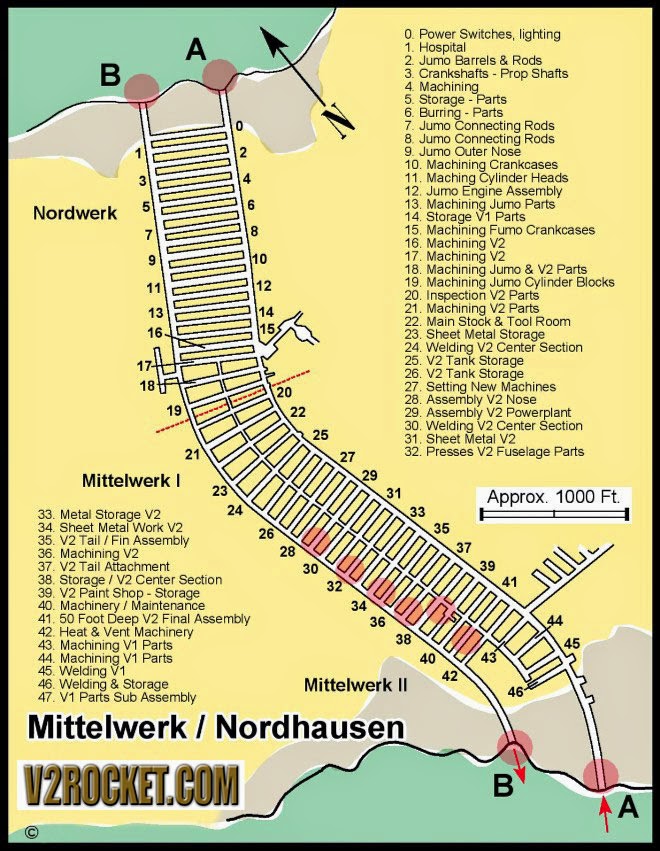
On 26 August 1943 Kammler met with General Dornberger, Speer, his deputy Karl-Otto Saur and Gerhard Degenkolb, who headed the Special Committee A 4 previously formed in the year to coordinate the production of missiles in the Defence Ministry. This was probably was the final decision for the relocation to a tunnel system of the Economic Research Institute (WIFO) in Kohnstein, a mountain ridge on the north-western outskirts of Nordhausen in the southern Harz region. According to his own statement, Diektor Paul Figge, the head of the Working Committee for Deliveries in the Special Committee A 4, it was brought to his attention during a visit in Kassel,  July 1943 of this tunnel complex near the village Niedersachswerfen. This was funded by the Ministry of Economics WIFO which had allowed them since 1936 to create an oil and lubricant storage for the Wehrmacht, whose completion in the summer of 1943 was imminent. The tunnel system seemed to be well suited for the relocation project: It had two usable centre road tunnels that were connected by 46 cross chambers, which offered a perfect production area of ​​around 100,000 square meters. In addition, the facility had a rail-road connection, and because of its location in the centre of Germany it was in view of the numerous suppliers of the A-4 program, which extended over the whole of Germany and the occupied territories, relatively conveniently located. The forests around the Kohnstein also provided good camouflage and possibilities for the construction of camp barracks for the forced labourers. Finally, like the choice of location, the fact that played a vital role was the anhydrite massif of Kohnstein, into which they had driven the tunnel system, and offered an excellent expansion capability.
Konstein Mountain Ridge'
The Ministry of Economic Affairs and the Wifo  were not pleased about the relocation plans of the Special Committee A 4, but had to bow to the instructions from the Speer Ministry. Then the Wifo not only had to vacate their oil storage, but it was also obliged to provide the local construction companies and make them available for the underground planned production complex for the SS and the Special Committee A 4 (Sonderausschuss).
The labour, both for the expansion as well as in the field of the underground factory, Kammler ordered prisoners from some 90 miles away Buchenwald concentration camp. Already on 28 August 1943, just ten day after the air raid on Peenemünde, the first 107 concentration camp prisoners from Buchenwald with their SS guards arrived at Kohnstein. Thus the Buchenwald concentration camp received a new sub-camp, the "Lobar Camp Dora" as it was termed in the correspondence of the SS. In the coming weeks and months, there followed almost daily, transports of prisoners from Buchenwald. At the end of September 1943 there were already more than 3,000 and by the end of October 6,800 concentration camp prisoners at the building site.
'Latrines in the former Sleeping Gallery'
From the point of view, as to a proper camp, in the true sense of the word, however, there could not be any question about it, it did not exist. Since the autumn of 1943 no barracks or any other permanent accommodations were still not available for the prisoners, they were first kept at the entrance of the tunnel in Finn tents, but very soon then placed inside the vaulted caves. First, in the chamber 39 on the bare rock floor. At the same time, the rooms set out (the chambers 43 to 46) and expanded to transept to the south chambers of the ladder-like tunnel system as "sleeping tunnels". There, four-story wooden bunks were built that ran through the makeshift illuminated, twelve feet wide and nine feet high chambers from beginning to end. Access to the "blocks" was via the driving lanes, tunnels A, from which they were separated by wooden partitions and tarpaulins. In the winter of 1943/44, the four chambers were filled with more than 10,000 prisoners who had the task of expanding the tunnel system to an underground missile factory. Gradually from Peenemünde arrived not only the dismantled machinery, but also about 600 prisoners and a part of the German staff, including the directors Albin Sawatzki and Arthur Rudolph. In November 1943, the prisoners, the civilian staff and the machines from the Rax-Werke in Wiener Neustadt came to Kohnstein after the rocket assembly was finally closed down there in order to protect them from Allied air attacks.

Mittelwerk Nordhausen
Note; To view hotspot, click: http://www.v2rocket.com/start/chapters/mittel-map.html 

Actually it was planned from the beginning, on a long-term basis, that prisoners to be accommodated in above-ground barracks, but its construction was delayed again and again, the expansion of the missile factory had priority. The working and living conditions in the tunnel exceeded in horrifying shock almost everything that the prisoners have had to experience in their previous prison camps. The wooden bunks were soon completely filthy with vermin and faeces. Washing facilities did not exist, and as to latrines they there were halved gasoline barrels that were placed at the front entrances of the road tunnel A. In the immediate vicinity of the sleeping tunnel work was performed continuously to the completion of the road tunnel A, whivh still had no outlet to the south side of the Kohnstein. Blasting and drilling machines spread a constant noise. High humidity, dense rock dust and toxic fumes made breathing a pain, and there was an unbearable stench of rotting corpses in the dark corners as well as the stink that permeated the air from the latrine tubs.. Working and "resting" was taken in "by turns". The shifts lasted twelve hours after which completed the working day, and rest was allowed, as it says in an inspection report of an SS-doctor dated December 23, 1943, "a consecutive three bedrooms layers (1 bedstead for three men '). Nevertheless, in the chambers there was a narrowness full of urge. Dead lay among the living".
Usually the corpses were stacked at one point in the driving tunnel 'A' and removed after registration. Unlike in other concentration camps, the SS took the daily prisoner strength messages in Kohnstein not too seriously, as prisoners could hardly escape from the tunnel system. For this reason, there were no daily roll calls, and soon the initially Sunday counts carried out in the open in front of the tunnel entrance were not continued,  after several hundred prisoners were missing during  a "General Appell" in the fall of 1943. Most of them were dead, collapsed and died from exhaustion, hunger and thirst or because of abuse or illness. Somewhere in the dimly lit tunnels were their bodies
'German civilians preparing a mass grave for camp victims after liberation by the U.S. Army
The high death toll in the tunnel were not only the consequences of the catastrophic hygienic conditions in the sleeping tunnels, but also the totally inadequate nutrition and the murderous working conditions. Every day the prisoners had to perform twelve hours the heaviest and debilitating installations and construction work. About the health of workers, the SS members and site manager of the central station and Wifo paid little or no attention to their general condition or plight. Industrial accidents were commonplace, and who could not seem to keep up the pace of work was driven mercilessly by the Kapos and foremen with punches and kicks. The clothing was not suitable for the work in the galleries. Day and night the prisoners wore the same striped suit, which consisted of a thin jacket, trousers and a shirt. After a few days in the tunnel, the clothes were filthy and torn. Street-shoes or even work-boots were the rare exception. Usually, the prisoners wore chunky wooden clogs that caused repeatedly abrasions on the feet,  thin foot-wraps (Fußlappen) could not protect them from sore feet. [Triangle cotton Fußlappen was a standard German Army issue and I myself preferred them on long marches, as socks tended to be holed at the heels creating blisters.HKS] . Many had no shoes. Provisionally they tried to protect themselves from the sharp rocks by strips from cement sacks wrapped around their feet. Painfully from leaching and constant hunger and thirst took its toll. Although water pipes were in the tunnels, but they could not be tapped by prisoners.
Comments by SS-Doctor Kahr inside the Tunnels:
Air choked with dust. The clamour assaulted the eardrums. Shrivelled men coated in white limestone dust squatting in the rubble to relieve their bowels. Pissing in their hands to wash their faces. The rock falls. The screams of the agony. The stony indifference of the SS. The prisoners bunks sprayed with liquid excrement. Blankets mobile with lice. The cannibalistic ritual of the dead being stripped of their clothes and wooden clogs by their friends. Back at his quarters Dr. Kahr with grim irony that day he had returned from the front in Russia, to what he felt was a semblance of civilization...The clothing situation was impossible: thin cotton stripes all year around. No socks. Half the prisoners without shoes. sic
The working conditions were already extremely debilitating. Given the catastrophic conditions in the sleeping tunnels (Schlafstollen), this looked deadly. Sleep deprivation, starvation, overwork and disease emaciated prisoners  physically. As to medical care, there was hardly any sign. [Ref.: Tauke, 'Genesung', page 73f]. Depending on the physical constitution and mental defences of an individual, the hard work and vegetating in the tunnel, at the latest after four to eight weeks led to a complete exhaustion. The number of deaths increased from November 1943 steeply. In the winter of 1943/44, the mortality rate reached such an extent that more prisoners died then arrived as replacement transports from Buchenwald. "Remarkable are badly and severely ill patients as well as prisoners dying at work," it said in the report of an SS doctor in December 1943. Up to and including March 1944 died according to SS counts in and around the Kohnstein project almost 3,000 prisoners. More than 3,000 dying prisoners were pushed by the SS in spring 1944 as extermination transports to Lublin-Majdanek and Bergen-Belsen. Of these, only a few have survived. Thus, at least 5,000 of the approximately 17,000 previously deported to Dora prisoners died by the end of March 1944. This corresponds to a death rate of almost one third in a period of only seven months.

The Dead at Mittelbau-Dora
The leaders of the SS and the average work management did not seem to mind or to bother - at least as long as the missile production had not yet started. On December 10, 1943, Albert Speer made himself aware of the conditions in the Kohnstein. After the war, he wrote that he was shocked by the "scandalous and also still inhibiting production" he states about Kohnstein. During the war, his impressions sounded somewhat different. A few days after his visit, he wrote the following letter to SS General Kammler, who had led him through the tunnels:
"Dear Mr. Kammler, Head of the Special Committees A 4.
 Degenkolb, told me that you have managed to transform the underground facility in Niedersachswerfen from the raw state in an almost impossible brief period of 2 months into a factory that is unmatched in Europe and has no approximate example and beyond,  in itself it stands unsurpassed [even] for American standards. I therefore take the initiative in expressing my high appreciation for this truly unique fact, with the request to continue to support Mr. Degenkolb in this unique form". [Although he visited the tunnels and, to reduce the mortality rate among the prisoners, recommended building barracks outside the tunnel complex. sic]
Beginning in January 1944 the first finished A4 rocket left the assembly lines in Kohnstein and were taken for experimental purposes to Peenemünde. However, they had to be almost all sent back because they were not functional. As hastily and improvised they went about building the plant, is also evident and reflected only later at the foundation of the Mittelwerk GmbH, as the underground rocket factory in Kohnstein changed ownership and was re-named.

 A photograph of the brick built crematorium in Mittelbau-Dora. The first oven photograph is of a portable single muffle oil Kori oven that has been adapted so it can be fuelled with coal or wood and attached to a brick built chimney. The second oven is also a photo of a Kori single muffle portable oven which is not connected to the chimney. It is possible that this is the oven from the Dora subcamp of Ellrich-Juliushutte (Mittelbau II). 
ACTUAL WORKING CONDITIONS
Labour on the Mittelwerk assembly lines included both detainees and “free” German workers and supervisors, in the ratio of about two prisoners to one “free” worker. The Engineers who ran the various workshops and production crews were Germans, and Wehrmacht soldiers who were wounded or sick would also be sent to Mittelwerk for duty as parts or process inspectors. Information provided by Dr. Jens-Christian Wagner indicates that once the V-2 production lines were running at their intended levels (by June, 1944) there were roughly 2,500 “free” workers and 5,000 prisoners employed in the Mittelwerk tunnels. Wagner also makes the case that the primary product of the Mittelbau complex was not weapons at all, but death itself—the death of the thousands of prisoners involved with Mittelbau (but primarily with its construction).   Prisoners were divided into two groups of workers: transport columns and specialists. The former did the often back-breaking work of manually transporting much of the material that entered or left the tunnels, while the latter did other more skilled assembly and testing work. Detainees working in the tunnels were divided into a day and a night shift, each working for 12 hours straight. Every four weeks, the workers changed shifts. Each prisoner work group or Kommando was headed by a prisoner leader (Kapo).
There were also many construction Kommandos, working mostly (after early 1944) on projects not tied directly to the V-2. Prisoners are reported to have been desperate to join the specialist groups, since transport or construction workers had to labour under incredible physical burdens and were beaten more viciously by their SS and prisoner guards. As a result, they were used up much more rapidly than the specialists—the construction assignments killed prisoners more surely than any others.
Skilled inmates on V-2 production 1944, most likely on Gyroscopes assembly
For example, teams of six transport prisoners were assigned to carry into the tunnels the empty aluminium tanks for the rocket from the outside storage depots. Designed to be lightweight for their size, even so, each tank weighed about 150 kg. (330 lb), or about 55 lb per worker. The workers formed two parallel columns and grasped the hand of their counterpart alongside. The tank was then slung on their joined arms. If a group dropped its tank (not uncommon, since these skeletons of men were often already weak and sick), the SS guards and Kapo were there to kick and beat them with truncheons until they could lift their burden and continue once again. Since much of this work was done in the dead of one of the coldest winters on record, the workers were usually slogging though snow, ice, or freezing rain and mud. It is hard to imagine what is must have been like. On their feet they wore wooden clogs, and had very little protection from the elements.
Different worker-groups tended to have different compositions by nationality. Often the better educated French workers (mostly civilians arrested by the Germans for various crimes or for political infractions in France) ended up at jobs like electrical assembly and testing. Many French prisoners with engineering or other scientific or technical training were specifically culled out of the Buchenwald population by Rudolph’s or von Braun’s staffs, and sent to Mittelwerk/Dora. The transport columns, on the other hand, tended to be disproportionately made up of Russian and Ukrainian prisoners.

V-2 Rocket in upright position
The specialists were organized into Kommandos or work groups assigned to various workshops, assembly points, or subcontractors around Mittelbau. Some 20 German companies were involved in the Mittelwerk construction and missile assembly process. They included such well known names as Siemens, AEG, Telefunken, Rheinmetall, Ruhrstaal, BMW, Junkers, Heinkel, Walther, Askania AG and DEMAG. Individual companies often had Kommando that bore their corporate name (e.g., “AEG Kommando”) and that were used to carry out their subcontracts.
Initial V-2s were plagued by bad welds, soldering problems, and faulty parts. At first electrical components were installed and final testing was performed at Degenkolb’s DEMAG facility at Berlin-Falkensee. Later in 1944, these activities were moved to the Mittelwerk.
Many prisoners involved in electrical assembly and testing were required to put slips of paper bearing their unique identification numbers alongside of parts they had produced or certified. Then, if problems were found with these during later inspections, the workers responsible would be punished. Still, minor forms of passive sabotage could be accomplished by the prisoners for example by accepting for assembly subcontractor parts that they knew did not meet specifications. There were instances of prisoner workers knowingly passing along electronic sub-assemblies that contained “cold solder” connections—ones that were likely to produce intermittent or no electrical contact at all, and thus lead to failures. Other prisoners recount making partial arc welds in hidden locations on the rocket (for example, inner welds on fins that would hopefully come apart later under launch stresses).
Assembly of tail Fin inside a tunnel'
Sabotage was a dangerous undertaking, however. The penalty was death, and the SS guards often carried out individual or group hangings as object lessons to the prisoners. The huge cranes in Hall 41 were used to hoist victims up by their necks and let them slowly strangle, in full view of the members of each of the Mittelwerk shifts, who were called to witness these hangings. The dead were then left to hang there, about five feet off the floor, for a day or so, while the prisoners came and went beneath them.  A permanent gallows was also erected in the roll call yard at Dora.
Since space in the tunnels was limited, only the most delicate parts (gyroscopes, electronics, etc.) were totally stocked underground. Bulky objects like motors, fuel tanks, half-fuselage sections, plates for the rockets skin, and bales of fiberglass insulation were stored above ground in smaller neighbouring depots. One of these was situated at the north end of Tunnel A, in the town of Niedersachswerfen, and was crewed by a Czech Kommando. The second depot was at Rossla, about 21 kilometers east of Nordhausen, in the old Kalkofen factory. The third depot was located at Kelbra. In addition, a small Kommando was located in an old potash mine at Kleinbodungen, near Bleicherode. This crew worked at refurbishing V-2s that had been returned by the field batteries as a result of misfirings, damage during transport, or other factors that made them unusable by the launching batteries.

                                                                                                                                                                    CONTINUED UNDER PART 2

Friday, June 20, 2014

Bergen-Belsen Concentration Camp Part 4/4‏


CHILDREN IN THE CAMP
Despite its development towards the detention centre for evacuation transports and the dramatic changes that this meant,  Bergen-Belsen retained a function in one aspect: It remained a family camp, not only because the  hostage (Geiseln) Jewish families that had been deported, remained in the camp, unless they were exchanged replaced or had been released, but also because, once children arriving with the transports of prisoners since the fall of 1944, who were completely unrelated with the exchange projects that took place from Bergen-Belsen. This was initially the case in the fall of 1944 when transports came from Poland with women who had been arrested in the context of the Warsaw Uprising and were then deported into the camp with their children.  in part, since November 1944  came a large number of Sinti and Roma children with their mothers to Bergen-Belsen. The existing data even suggest that the Sinti and Roma were eventually that group of prisoners, with the highest percentage of share of children. Also among the Hungarian Jews, who after the departure of the "Kasztner Group' in December 1944, the Hungarians were sent to Bergen-Belsen camp, as the last part of the group of "exchange prisoners",  families that brought their children with them.
Bergen Belsen, Germany, Children behind a barbed-wire fence, after the liberation, April 1945'. 
The total number of children, that is, persons up to the  age of 14 years, who were at different time periods in the camp can be estimated at about 3,000. About a third of them lived in the Star Camp, where their share, compared with other sections,  the total number of this sub-camp was at least 18 percent.
 Even at the sub-camps, the children until the age of 14 years were living in the barracks with their mothers. Although they were not scheduled or assigned to work details, but had to take part in the dreaded roll-calls from the age of three years and were exposed to the same living conditions as the adults: hunger, cold, fear and diseases, which determined their everyday camp life. They had to accept the same experiences very much as their parents, from which they could not very well protect them.
 There were only very few possibilities of distraction or the processing of their experiences and fears for them in Bergen-Belsen. Of great importance in this regard was at first an organized and especially in the residence camp, the  children's  education, which was of course not allowed and therefore had to be disguised as "child care" during  SS inspections. The increasing deterioration of living conditions since the fall of 1944, however, led to a gradual decline to continue with this well intended program,  the increasing  physical and mental powers of the adults were missing. So, what was left to the children often remained only the possibility to play - such games as mimicking  the "SS- Appell, Roll Call Game" - to cope with their traumatic life situation.

Bergen Belsen, Germany, Children in the DP camp kindergarten, Postwar
With the dramatically rising death rate since early 1945 among prisoners, many of the children became half or full orphans. But there were also quite a few children who did arrive as orphans to Bergen-Belsen, because their parents had died in other camps or they had been separated for other reasons from their parents. Thus came in mid September 1944 a group of Dutch-Jewish children aged 1-14 years from Westerbork to Bergen-Belsen. Fastened with shoelaces around their necks they wore a signs saying "Unknown Child" and the presumed name. For them, they were alleged to be Jewish children who had been taken by their parents into hiding with acquaintances, but then discovered and arrested. Because to them there were no identification documents and their Jewish origin was not clear to prove, they were moved to the "parentage establishing facility" to Bergen-Belsen.  The SS allowed Jewish prisoners, to take care of these and other orphans. So finally it emerged in Bergen-Belsen in the Star Camp, that the first "orphan barrack"was erected. With a second larger group of orphans in the camp came the children of the "Diamantairs", a comprehensive 213 group of people of Jewish diamond workers and traders, who were admitted with their family members in mid-May 1944 from the Netherlands in the residence camp, with the aim , there, to build a "diamond industry" for the purpose of procurement of foreign currency for the German Reich. When these plans were dashed, the men and women of the "Diamantairs group" in early December 1944, were removed from the camp, while their 56 children remained in Bergen-Belsen. For them, a lager "orphan barrack"was constructed in the 'Large Women's Camp out of necessity, as very soon, more orphans arrived  with the  evacuation transport at Bergen-Belsen. [2,2025 Dutch Jewish children under the age of 21 were exterminated by the Nazis. Of these, 8,161 were infants and young children under the age of 10. All these children were Nazi Holocaust victims. The crime for which they were killed can be spelled out in just a few words. They were Jewish children.sic]
Arrival at Westerbork
Also, a far greater number of births is documented for the concentration camp at Bergen-Belsen. Overall, it must have been of at least 100 births. The best chances of survival were those children who were born relatively early in the Star Camp or in other parts of the residence camp and could partly leave with their parents in the course of exchange, or release actions from Bergen-Belsen. Other chances of survival had also those children who were born shortly before the liberation and could be treated medically by the British liberators and their support staff a few days after their births. The youngest liberated prisoner in the camp, was a Polish boy who was one day old, he was born on 14 April 1945. The other babies born in Bergen-Belsen, however, had very little chance to survive.
New born baby in Bergen-Belsen (22min.5sek.) Some children were born in the camp.'
Most of the women, who brought children in Bergen-Belsen into this world, were non-Jewish, Polish, apart from few Hungarian Jewish women . Both groups had been arrested until relatively late in the state of their pregnancy, before they came to Bergen-Belsen, the Polish women in consequence of the Warsaw Uprising, the Hungarian women after the German occupation of Hungary and the start of deportations of Hungarian Jews to Auschwitz in the summer of 1944.

THE LIBERATION
In the final months before the liberation, there could be no more talk of special privileges in practice for the Exchange Prisoners. They were to some extent treated no better than the prevailing disastrous living conditions as all other prisoners.
Suddenly, just a few days before the liberation they received their special and important status again. While at the the same time thousands of prisoners, in the context of evacuation transports, were taken into the main and sub-camps, the more transportable prisoners of the Transit Camp (Aufenthaltslager) had to stay, to get ready for their departure from Bergen-Belsen. With three transports, they left between 6 and 10 April 1945 with  a total of about 6,700 prisoners. It was probably intended to bring all three transports to Theresienstadt. However, only one of the trains arrived actually on 21 April 1945 at Theresienstadt, where the prisoners were freed only on May 8, 1945 by the Red Army. The other two trains were finally freed after days of wandering, the first on 13 April 1945 at Farsleben near Magdeburg by American troops, and the second on 23 April 1945 near Tröblitz by the Red Army. For the weakened prisoners the transport meant new hardships.  In the liberated train at Tröbitz at least 133 prisoners had died during the trip.
The remaining in Bergen-Belsen prisoners were not freed until the 15th of April 1945 on the basis of a localized ceasefire agreement that was negotiated on 12 April, with the consent of Heinrich Himmler between the British and the German military. It provided for a neutral zone around the camp to prevent the spread of epidemics and to hand over the camp without a fight to British troops. The guarding of the camp should be taken over for the time being instead of the SS, by German Wehrmacht and Hungarian soldiers, who were promised a free retreat back to German front lines. What is unclear, were the rules regarding the SS staff: Provided that the Wehrmacht could maintain order, they should remain in the Bergen-Belsen concentration camp and pass the camp properly over  to the British.
NEGOTIATED TRANSFER
Disease was kept under control by routinely disinfecting all new arrivals. But in early February 1945 a large transport of Hungarian Jews was admitted while the disinfection facility was out of order. As a result, typhus broke out and quickly spread beyond control.
Commandant Josef Kramer quarantined the camp in an effort to save lives, but SS camp administration headquarters in Berlin insisted that Belsen be kept open to receive still more Jewish evacuees arriving from the East. The death rate soon rose to 400 a day.
The worst killer was typhus, but typhoid fever and dysentery also claimed many lives. Aggravating the situation was a policy during the final months of transferring already sick inmates from other camps to Belsen, which was then officially designated a sick or convalescence camp (Krankenlager). The sick women of Auschwitz, for example, were transferred to Belsen in three groups in November-December 1944.
When SS chief Heinrich Himmler learned of the typhus outbreak at Bergen-Belsen, he immediately issued an order to all appropriate officials requiring that "all medical means necessary to combat the epidemic should be employed ... There can be no question of skimping either with doctors or medical supplies." However, the general breakdown of order that prevailed on Germany by this time made it impossible to implement the command.
As British forces approached Bergen-Belsen, German authorities sought to turn over the camp to the British so that it would not become a combat zone. After some negotiation, it was peacefully transferred, with an agreement that "both British and German troops will make every effort to avoid fighting in the area."
A crowd watches the destruction of the last camp hut, by British Military'. In an "act of revenge," the British liberators expelled the residents of the nearby town of Bergen, and then permitted camp inmates to loot the houses and buildings. Much of the town was also set on fire.
A revealing account of the circumstances under which the British took control appeared in a 1945 issue of The Journal of the American Medical Association:
By negotiations between British and German officers, British troops took over from the SS and the Wehrmacht the task of guarding the vast concentration camp at Belsen, a few miles north-west of Celle, which contains 60,000 prisoners, many of them political. This has been done because typhus is rampant in the camp and it is vital that no prisoners be released until the infection is checked. The advancing British agreed to refrain from bombing or shelling the area of the camp, and the Germans agreed to leave behind an armed guard which would be allowed to return to their own lines a week after the British arrival.
The story of the negotiations is curious. Two German officers presented themselves before the British outposts and explained that there were 9,000 sick in the camp and that all sanitation had failed. They proposed that the British should occupy the camp at once, as the responsibility was international in the interests of health. In return for the delay caused by the truce the Germans offered to surrender intact the bridges over the river Aller. After brief consideration the British senior officer rejected the German proposals, saying it was necessary that the British should occupy an area of ten kilometres round the camp in order to be sure of keeping their troops and lines of communication away from the disease. The British eventually took over the camp.
THE SS PERSONNEL AND THE PROCESSES
In fact, the majority of SS personnel began on the 13th April 1945 to  withdraw from Bergen-Belsen, not having destroyed the camp registration, including the inmate personnel file which they left behind. Only about 50 SS men and 20 to 30 guards remained together with the commander Josef Kramer at Bergen-Belsen, apparently on the assumption that they would also after the handover, be able to leave the camp towards the German lines.
But shortly after the liberation they were arrested by the British and initially forced to participate in the disposal of perished prisoners. They had to take the bodies and bring them to the mass graves. Approximately 20 SS-men died in the aftermath of poisoning they attracted through injuries sustained in the process from deceased corpses.
old MTV gymnasium, Lindenstraße 30, Lüneburg
Investigations of responsibility against those remaining in Bergen-Belsen SS personnel, the British military took since the end of April in order to provide as soon as possible jusice for the crimes committed in the camp. The British Military Government, however, was not searching systematically after the remaining SS personnel even before or after the liberation of Bergen-Belsen. Of the total of at least 435 men and 45 women who had temporarily been part of the SS personnel in Bergen-Belsen, thus only a relatively small portion was held criminally responsible.
Josef Kramer, photographed in leg irons at Belsen before being removed to the POW cage at Celle, April 17, 1945.

On 17 September 1945 began in Lüneburg before a British military court the First Bergen-Belsen Trial. Indicted were 20 men and 16 SS-guards, and eleven former detainee functionaries. Since some of the defendants had been previously used in the concentration and extermination camp at Auschwitz, they had to stand trial in Lüneburg also for their crimes committed there, so the Lüneburg Belsen Trial was not only the earliest war crimes trial on German soil, but also in fact the first Auschwitz Trial.


On November 17, 1945, the Court handed down its judgments: Eleven defendants, including the former camp commandant Josef Kramer, were sentenced to death, acquitted 19 to prison terms and 14 acquitted. Agaainst four SS-men no verdict was passed, as they were ill shortly before or during the proceedings. The death sentences were carried out in mid-December 1945 in Hameln.
In May 1946, a second "Belsen Trial" took place took place in Celle, it was conducted against ten defendants who either were not at the time of the main proceedings in British custody in the fall of 1945 or due to sickness had not been competent enough to stand trial. Also in this process the court handed down several death sentences and imprisonment: four of the defendants were also executed in October 1946 in Hameln.
Interior shot of the court room ten days before the start of the trial'
The Belsen Trial attracted substantial national and international media interest. Significantly more than 100 representatives of the news media reported at length on the trial's progress. Through them, the world learned not just about the thousands of deaths by hunger and disease at Belsen — communicated especially forcefully by the film and photo evidence produced by the British Army. Possibly even more importantly, the Belsen Trial also was the first time that the organised mass murder at Auschwitz Birkenau received a public airing, with some of those responsible describing the selection process, the use of the gas chambers and the crematoria.
In Great Britain, the trial was mostly viewed positively, as a triumph of the rule of law, given the fairness and meticulousness with which it had been conducted. However, in some other countries, notably the Soviet Union and France, the verdicts were criticised as too mild. Many of the survivors also felt that way.
APPENDIX
COMMANDER JOSEF KRAMER 'THE BEAST' OF BERGEN-BELSEN
[In a March 1, 1945, letter to Gruppenführer (General) Richard Glücks, head of the SS camp administration agency, Commandant Kramer reported in detail on the catastrophic situation in the Bergen-Belsen, and pleaded for help:
If I had sufficient sleeping accommodation at my disposal, then the accommodation of the detainees who have already arrived and of those still to come would appear more possible. In addition to this question a spotted fever and typhus epidemic has now begun, which increases in extent every day. The daily mortality rate, which was still in the region of 60-70 at the beginning of February, has in the meantime attained a daily average of 250-300 and will increase still further in view of the conditions which at present prevail.
Supply. When I took over the camp, winter supplies for 1500 internees had been indented for; some had been received, but the greater part had not been delivered. This failure was due not only to difficulties of transport, but also to the fact that practically nothing is available in this area and all must be brought from outside the area ...
For the last four days there has been no delivery [of food] from Hannover owing to interrupted communications, and I shall be compelled, if this state of affairs prevails till the end of the week, to fetch bread also by means of truck from Hannover. The trucks allotted to the local unit are in no way adequate for this work, and I am compelled to ask for at least three to four trucks and five to six trailers. When I once have here a means of towing then I can send out the trailers into the surrounding area ... The supply question must, without fail, be cleared up in the next few days. I ask you, Gruppenführer, for an allocation of transport ...
State of Health. The incidence of disease is very high here in proportion to the number of detainees. When you interviewed me on Dec. 1, 1944, at Oranienburg, you told me that Bergen-Belsen was to serve as a sick camp for all concentration camps in north Germany. The number of sick has greatly increased, particularly on account of the transports of detainees that have arrived from the East in recent times -- these transports have sometimes spent eight or fourteen days in open trucks ...
The fight against spotted fever is made extremely difficult by the lack of means of disinfection. Due to constant use, the hot-air delousing machine is now in bad working order and sometimes fails for several days
A catastrophe is taking place for which no one wishes to assume responsibility ... Gruppenführer, I can assure you that from this end everything will be done to overcome the present crisis ...
I am now asking you for your assistance as it lies in your power. In addition to the above-mentioned points I need here, before everything, accommodation facilities, beds, blankets, eating utensils -- all for about 20,000 internees ... I implore your help in overcoming this situation.
                                                                                                                         
Mass grave at Belsen camp, shortly after its liberation by British troops. Photographs such as this are widely reproduced as proof of a German policy of extermination. Contrary to Allied propaganda claims of the time, and Holocaust allegations in recent decades, though, these unfortunate prisoners were victims of typhus and starvation that were indirect consequences of the war – not of any deliberate policy. At least 14,000 Jews died in the camp following the British takeover.

Under such terrible conditions, Kramer did everything in his power to reduce suffering and prevent death among the inmates, even appealing to the hard-pressed German army. "I don't know what else to do," he told high-ranking army officers. "I have reached the limit. Masses of people are dying. The drinking water supply has broken down. A trainload of food was destroyed by low-flying [Allied] war planes. Something must be done immediately."
Working together with both Commandant Kramer and chief inmate representative Küstermeier, Colonel Hanns Schmidt responded by arranging for the local volunteer fire department to provide water. He also saw to it that food supplies were brought to the camp from abandoned rail cars. Schmidt later recalled that Kramer "did not at all impress one as a criminal type. He acted like an upright and rather honourable man. Neither did he strike me as someone with a guilty conscience. He worked with great dedication to improve conditions in the camp. For example, he rounded up horse drawn vehicles to bring food to the camp from rail cars that had been shot up."
"I was swamped," Kramer later explained to incredulous British military interrogators:
The camp was not really inefficient before you [British and American forces] crossed the Rhine. There was running water, regular meals of a kind -- I had to accept what food I was given for the camp and distribute it the best way I could. But then they suddenly began to send me train-loads of new prisoners from all over Germany. It was impossible to cope with them. I appealed for more staff, more food. I was told that this was impossible. I had to carry on with what I had.
Then as a last straw the Allies bombed the electric plant that pumped our water. Loads of food were unable to reach the camp because of the Allied fighters. Then things really got out of hand. During the last six weeks I have been helpless. I did not even have sufficient staff to bury the dead, let alone segregate the sick ... I tried to get medicines and food for the prisoners and I failed. I was swamped. I may have been hated, but I was doing my duty.
Kramer's clear conscience is also suggested by the fact that he made no effort to save his life by fleeing, but instead calmly awaited the approaching British forces, naively confident of decent treatment. "When Belsen Camp was eventually taken over by the Allies," he later stated, "I was quite satisfied that I had done all I possibly could under the circumstances to remedy the conditions in the camp".sic] He calmly accepted and anticipated his fate, that he would be hanged.


APPENDIX
After the arrival of British Troops at Bergen-Belsen the work of saving lives continued, in the past week the sick had been moved from the camp to a nearby Panzer training school, that's been turned into a makeshift hospital.  Even it's parade grounds were full of beds and straw mayoresses. Soon it wil be the largest hospital in Europe. with 13,000 patients.
Some are beyond human aid and will soon die. But they are happy and look forward to living again even though they might know it is only for a short while.
The wards are often in a state of chaos. The patients sometimes for what little food there is, ans basic equipment is lacking

                                        Image result for Pictures-German Nurses at Bergen-Belsen
                                  German Nurses at Bergen-Beksen - Post war

Bedpans sometimes double as feeding bins. Fie hundred new patients arrive every day and the British doctors and nurses and the 48 Red Cross volunteers who arrived few days ago are struggling to cope.
Lieutenant James Johnston, the senior medical officer at Bergen-Belsen, requested medical personnel from England, and was shocked when a few days later 60 German doctors freed from POW camps arrived. A Red Cross nurse wrote home, 'They strut about in a most alarming fashion terrifying all the inhabitants. However, the British Tommy is marvelous in taking them down a peg or two.
On their second day the German doctors ignored an order to parade at 7 am, so Lieut ant Colonel Johnston threatened  to hang their senior officer. After that they were more obedient.

                                           Image result for Pictures German POW Doctors at Bergen-Belsen
                                         Germa POW Doctors at Bergen-Belsen-Post war

German nurses were drafted in from nearby towns and cities have added tension in the camp. When a group from Hamburg arrived on a ward for the  first time, they were set upon by patients (some of them were dying) armed with knifes and forks. Troops were called to rescue the nurses who were by then covered in blood, their their uniforms torn to shreds.
This is the atmosphere Nichel Hargrave and the other volunteers face in the coming weeks.

KKS-25th November 20`7
                                                                                                                                                            FINAL


Sources:
Der Ort des Terrors Vol.7
Konzentrationslager Bergen-Belsen
 Researcher-Author: Thomas Rahe
C.H.Beck oHG, München 2008.
Wikipedia, Methapedia.
Vetted by:
Institute for Research on Anti-Semitism-Berlin.
Translated from German by:
Herbert Stolpmann, June 2014
Editing/Design:
.d_stolpmann@hotmail.com


HKS: Own initials, when expression
my opinion.
[sic] transcribed exactly as found