Dachau KZ

Wednesday, January 3, 2018

GERMANY BETWEEN THE WARS LEADING TO HITLERS RISE

                                 Alien saucer crash in 1937 Nazi Germany

 Fascinating pictures tell the story of how British troops tried and failed to prevent the feelings of discontent which led to Hitler's rise
'The British Army of the Rhine' shows British troops as they prepare to establish their section in Cologne
The new book by Michael Foley depicts how soldiers tried and failed to prevent feelings of discontent
Foley said the movement towards a dictatorship may well have happened after the war whatever the Allies did

In what was a broken Germany, these captivating images taken after the First World War reveal how British troops tried but failed to prevent the feelings of discontent that led to the rise of Hitler.

A new book tells the story of how the German public did not want UK soldiers in their country after the Great War - and in most cases didn't even want to be there themselves.

Following the signing of the armistice between the allies and Germany in 1918, British troops crossed the Rhine into Germany and entered a country torn by violence and unrest where revolution threatened and civil war seemed more likely every day.

There aim was to instill stability, with pictures in a book by Michael Foley titled 'The British Army of the Rhine after the First World War' revealing the moment they prepared to establish their section of the occupation area in Cologne.
The new secretary of state for war at the time, a young Winston Churchill MP, arrived in Germany in August 1919. Churchill who went on to serve as Prime Minister during the second world war arrived in Cologne to inspect the British Army of Occupation on the Rhine. Here he is pictured offering his hand to one of the official officers

The new secretary of state for war at the time, a young Winston Churchill MP, arrived in Germany in August 1919. Churchill who went on to serve as Prime Minister during the second world war arrived in Cologne to inspect the British Army of Occupation on the Rhine. Here he is pictured offering his hand to one of the official officers


British soldiers in 1928 with a pet dog and a baby outside a restaurant in Germany after the First World War where they tried to prevent the feelings of discontent which led to the rise of Hitler. The British Army of the Rhine was established at the end of the Great War in 1918 to instill stability into broken Germany


British soldiers in 1928 with a pet dog and a baby outside a restaurant in Germany after the First World War where they tried to prevent the feelings of discontent which led to the rise of Hitler. The British Army of the Rhine was established at the end of the Great War in 1918 to instill stability into broken Germany


+18


The Allies are pictured competing against each other in an athletics meeting in Coblenz. The story of the Brits time in Germany after the first world war has been told in a new book 'The British Army of the Rhine after the First World War' by Michael Foley


The Allies are pictured competing against each other in an athletics meeting in Coblenz. The story of the Brits time in Germany after the first world war has been told in a new book 'The British Army of the Rhine after the First World War' by Michael Foley


Captivating images from the book show British troops crossing the Rhine as they prepare to establish their section of the occupation area in Cologne. 
Others show the German 'Brown Shirts' stood in formation shirtless after being banned from wearing the uniform by the Treaty of Versailles. 
And in another photo a fresh young Winston Churchill, then the newly appointed Secretary of State for War, arriving to inspect British troops during the occupation of Cologne. 
Following the signing of the armistice between the allies and Germany in 1918, British troops crossed the Rhine into Germany and entered a country torn by violence and unrest where revolution threatened and civil war seemed more likely every day.

The German public did not want them there and, in many cases, they did not want to be there, with most soldiers expecting to be discharged shortly after the war ended.
'It is important to have some level of understanding of the situation in Germany that the men of the occupation forces found themselves having to deal with,' writes Foley.
'They were not only going into a country that they had just beaten in the war (with all the resulting negative feelings that were going to be shown against them), but they also had to deal with the fact that the German population were going through a time of severe suffering and political upheaval in which the occupying forces often became

The British Army of the Rhine was initially established as an occupational force after World War One.
It was created to instill positivity into distressed Germany following the end of the Great War in 1918 and was later disbanded in 1929. Only 15 years later it would be back firmly in position at the end of World War Two.
The creation of the Twenty-first Army Group was assigned with the invasion of Europe.  It was formed in September 1943 in England and commanded by General (later Field Marshal) Sir Bernard Montgomery.
It initially controlled all ground forces in Operation Overlord. When sufficient American forces had landed, their own 12th Army Group was activated, under General Omar Bradley and 21st Army Group was left with British Second Army and First Canadian Army.
After the successful Normandy landings, the units of 21st Army Group crossed the river Rhine near the Germany city of Wesel on 23 March 1945. After an advance which was thoroughly resisted, the British formations, along with the Canadians and Americans advanced into the German counties of Nordrhein-Westfalen, Niedersachsen and Schleswig-Holstein . This established the British Army occupying the north of the country.
At the February 1945 Yalta Conference (and confirmed at the July 1945 Potsdam Conference) it was agreed that it should be divided into four with the addition of a small French Zone (adjacent to the Franco-German border). 
Similar arragements were agreed for Austria and the City of Berlin which was otherwise deep in East Germany (Russian Zone of Occupation). The earlier arrangement for the transfer of East Prussia and the move of the eastern border to the Oder Neisse Line remained unaltered. 
Three months after the war had ended, 21st Army Group was redesignated 'British Army of the Rhine'

.

A Christmas meeting of anti-Spartacists in defence of Bremen in the Red Gymnasium. The Spartacist uprising, also known as the January uprising, was a general strike in Germany from 4 to 15 January 1919
 i


 in the Red Gymnasium. The Spartacist uprising, also known as the January uprising, was a general strike in Germany from 4 to 15 January 1919


 i


The Domplatz was the site of many military parades by the British troops during their time in Germany. Following the signing of the armistice between the allies and Germany in 1918, British troops crossed the Rhine into Germany


The Domplatz was the site of many military parades by the British troops during their time in Germany. Following the signing of the armistice between the allies and Germany in 1918, British troops crossed the Rhine into Germany


Boat trips on the Rhine were a popular leisure activity organised by the British Empire Leave Club. A group of soldiers are pictured packed onto a boat surrounding a table covered in what appears to be refreshments 


Boat trips on the Rhine were a popular leisure activity organised by the British Empire Leave Club. A group of soldiers are pictured packed onto a boat surrounding a table covered in what appears to be refreshments


This photograph was taken by one of the members of the occupation force of men in the showers. The German public did not want them there and, in many cases, they did not want to be there, with most soldiers expecting to be discharged shortly after the war ended

This photograph was taken by one of the members of the occupation force of men in the showers. The German public did not want them there and, in many cases, they did not want to be there, with most soldiers expecting to be discharged shortly after the war ended


'As the end of the war approached, it was to have a major effect on Germany. It was not only the fact that they had lost the war that upset the German population. Many, but not all, of the German people had already been suffering for many years from a shortage of food. What was to come after the war was to be an even bigger shock for the population.
'From the way the country went after the withdrawal of the occupation forces, it would seem that the presence of the Allied troops were keeping the lid on an underlying move towards extremism by the population. Whether this was caused by Allied policy during the occupation and in the harsh sanctions enforced by Versailles is debatable.

A squad of Brownshirts who, at this time, had been banned from wearing their uniform by the Treaty of Versailles and so appeared bare-chested. The men instead sported trousers, braces, a tie and their helmets  


A squad of Brownshirts (SA) who, at this time, had been banned from wearing their uniform by the Treaty of Versailles and so appeared bare-chested. The men instead sported trousers, braces, a tie and their helmets
 Although the majority of the German Army was disbanded after the war, many of the men still wore their uniforms and followed a military life, often as part of volunteer forces
Although the majority of the German Army was disbanded after the war, many of the men still wore their uniforms and followed a military life, often as part of volunteer forces

A parade of French troops on the street, which seems to be lined with British soldiers. Foley states that it is important to have some level of understanding of the situation in Germany that the men of the occupation forces found themselves having to deal with

A parade of French troops on the street, which seems to be lined with British soldiers. Foley states that it is important to have some level of understanding of the situation in Germany that the men of the occupation forces found themselves having to deal with


'The movement towards a dictatorship may well have happened after the war whatever the Allies did. There is little doubt that Germany did not have a background of democracy and although there may well have been many Germans who believed in this political system and wanted peace there were many others who did not.

'Rather than being the reason for the rise of Adolf Hitler, it could be said that the occupation actually delayed the rise of the Nazis rather than caused it. Whatever the truth of the matter, it seems obvious that the First World War did little to solve the problems of Europe. The results of the post-war decisions by the politicians were the reason for this and, in some cases, may have made the situation in post-war Europe even worse than they had been before.'
The British Army of the Rhine after the First World War by Michael Foley is published by Fonthill Media, and can be purchased here.


British troops posing for a soldier alongside a German anti-aircraft gun. The men were  going into a country that they had just beaten in the war with all the resulting negative feelings that were going to be shown against them
British troops posing for a soldier alongside a German anti-aircraft gun. The men were going into a country that they had just beaten in the war with all the resulting negative feelings that were going to be shown against them


The area around the Rhine often flooded during the winter months. This was the flood that occurred in 1919 while the British troops were there 


The area around the Rhine often flooded during the winter months. This was the flood that occurred in 1919 while the British troops were there
During the early days of the occupation, clear signs of military were visible, as can be seen from the guns along the bank of the Rhine

During the early days of the occupation, clear signs of military were visible, as can be seen from the guns along the bank of the Rhine


British troops crossing the Rhine as they prepare to establish their section of the occupation area in Cologne. From the way the country went after the withdrawal of the occupation forces, it would seem that the presence of the Allied troops were keeping the lid on an underlying move towards extremism by the population


British troops crossing the Rhine as they prepare to establish their section of the occupation area in Cologne. From the way the country went after the withdrawal of the occupation forces, it would seem that the presence of the Allied troops were keeping the lid on an underlying move towards extremism by the populatio


The use of black troops caused a number of complaints during the occupation. This shows a unit of colonial cavalry on the streets of Germany

The use of black troops caused a number of complaints during the occupation. This shows a unit of colonial cavalry on the streets of German



Posted by Dachau KZ at 10:57 PM No comments:
Email ThisBlogThis!Share to XShare to FacebookShare to Pinterest

Saturday, December 30, 2017

iNSIDE HITLER'S BUNKER - WHATEVER HAPPENED TO HIS BODYY?


                                                          Whatever Happened to Hitler's Body?


In the early morning hours of April 29, 1945, Adolf Hitler married his longtime girlfriend (mistress) Eva Braun in the map room of his underground bunker in Berlin. Municipal councilor Walter Wagner performed the ceremony, and Minister of Propaganda Josef Göebbels and the Chancellor’s private secretary, Martin Bormann, acted as witnesses.


After the ceremony, Hitler hosted a small reception breakfast with his new wife and then, at around 4 am, took secretary Traudl Junge to another room and dictated his Last Will and Testament.


The next day, as the Red Army marched into the German capital, General Helmuth Weidling, commander of the Berlin Defence Area, told Hitler that defense forces would probably run out of ammunition by the end of the night. After lunch, Hitler and Braun said their goodbyes to the other high-ranking Nazi officials occupying the Führerbunker, as well as the bunker’s staff. At around 2:30, the couple went into Hitler’s study and closed the door. An hour later, a gunshot was heard.
Hitler's Bunker Study
A recreation of Hitler’s study in a German museum – this was where Hitler and his wife killed themselves


Bormann and the others rushed to the study and found Hitler and Braun’s lifeless bodies slumped on a small sofa. Hitler’s right temple was dripping blood and his pistol lay at his feet. Braun had no visible wounds, but the room smelled distinctly of almonds, a sign of cyanide poisoning.


The bodies were carried upstairs and outside through the bunker's emergency exit. In the bombed-out garden behind the Reich Chancellery, the soldiers wrapped their Führer in a Nazi flag, doused the bodies with gasoline and set them on fire.
PS: All statements indicate, that the bodies were wrapped in blankets -  not in a Nazi Flag. That comment is incorrect! (sic)
HKS 31.12.2017


The bodies burned through the afternoon, as the Soviets occasionally shelled the area. Even though the bodies weren’t completely destroyed, the fire was eventually extinguished in the early evening. The remains were dumped in a shallow shell crater and covered up.


"There are legs here"


On the morning of May 2, Ivan Churakov, a private in the Soviet Army, noticed an oblong patch of recently turned soil as he and the 79th Rifle Corps searched the Chancellery. He began to dig, thinking he might uncover some hastily buried Nazi treasure. Instead, his shovel hit bone.


“Comrade Lieutenant Colonel, there are legs here,” he called to his commanding officer. An exhumation was ordered and the soldiers dug up the bodies of two dogs (thought to be Blondi, Hitler’s pet German Shepherd, and one of her pups) and the badly burnt remains of two people. An autopsy was performed, and a few days later, Soviet soldiers moved Hitler’s body to a different gravesite outside of Berlin proper. This would be just one of several moves the corpse would make in the next few decades.


In early June that year, the Soviets re-buried the body in a forest near the town of Rathenau. Eight months later, they moved it again—this time, to the Soviet Army garrison in Magdeburg. There it remained until March 1970, when the Soviets decided to abandon the garrison and turn it over to the East German civilian government.


It's a secret to everybody


Under Soviet control, Hitler’s remains could be kept secret, and physical access to them severely limited. Soviet leaders worried that if the body were left in the garrison or buried somewhere else not under their watchful eye, the gravesite would become a shrine for neo-Nazis. KGB director Yuri Andropov decided that the remains should be destroyed and authorized an operation to dispose of the body. The only things that were kept were fragments of a jawbone and skull, which were stored in government buildings in Moscow. (DNA testing recently revealed that these pieces did not belong to Hitler’s body, but were of female origin. Russian officials rejected that conclusion.)


Andropov selected a KGB officer named Vladimir Gumenyuk to pick a secret final resting place for Hitler’s remains and lead a three-man team in taking the remains there for destruction. The Soviet garrison was surrounded by German-built high-rise buildings, so Gumenyuk’s team pitched a tent over the spot where the bones had been buried to avoid being seen. After some digging with no results, the team realized they had counted 45 meters instead of 45 paces from a secret coordinate while following the directions to the corpse. They put the dirt back, moved the tent, and started again.


With the remains in their possession, the team disguised themselves as fishermen and drove into the mountains, stopping at a cliff along a small stream. There, in a spot screened by trees, they lit two campfires. One was to make soup. The other, to further burn the remains.


Gumenyuk has called the second cremation a waste of a can of gasoline, but the remains were finally burned to ashes. They collected these in a rucksack, which Gumenyuk took onto the cliff and opened up into the wind. With that, one of history’s greatest monsters disappeared, a brown cloud of dust in the wind.


Today, Gumenyuk is 81-years-old and retired from the KGB. He is the only surviving member of the team that disposed of Hitler’s remains and the only living person who knows where the ashes were spread. Still afraid the peaceful woods would become a pilgrimage site, he has vowed to take his secret to his grave. Despite the large amounts of money he’s been offered to reveal the location and the attention he’s gotten for what he did, Gumenyuk doesn’t seem to think his task was all that special. “Twenty seconds—and job was done,” he told The Sun last year. “It was just the last flight of the Führer.”

                                     Image result for Pinterest Picture Klara Hitler - Adolf's mother
                                       Klara Hitler, Adolf Hitler's mother


Appendix
Hitler's mother Klara had married her uncle, a brute, and drunk,(in fact he married three times) who beat Adolf almost daily, while she set outside the door until his crying stopped to console him.

Hitler had a close relationship with his mother during her lifetime// He was crushed by her death, he was seventeen years old at that time and carried the grief the est of his kife. Dr. Boch who had treated her for breast cancer, later recalled that after Klara's death, he had never seen anyone so prostrate with grief. Hitler wrote later that his mother's death was a dreadful blow/

Klara bore six children, however, with the numerous inbreeding of Hitler's ancestors four died shortly after birth, being deformed idiots in the true seance of this expression, even his sister Paula had learning disabilities. Although the death certificates state that three died of Diphtheria and one of Measles.
                                Paula Hitler 1896-1960
                                           Paula Hitler 1896-1960

Paula used the surname "Hiedler", the original spelling of "Hitler". By her own account, after losing a job with a Viennese insurance company in 1930 when her employers found out who she was, Paula received financial support from her brother (which continued until his suicide in 1945), lived under the assumed family name Wolff at Adolf's request (this was a childhood nickname of his which he had also used during the 1920s for security purposes) and worked sporadically. Adolf appears to have had a low opinion of her intelligence, referring to both Paula and his half-sister Angela as "stupid geese"  (Both were probably slightly mentally retarded due to inbreeding,sic.) Neither had ever joined any Party of his making.

Paula died on 1 June 1960, at the age of 64, the last surviving member of Hitler's immediate family. She was buried in the Bergfriedhof in Berchtesgaden/Schönau under the name Paula Hitler. In June 2005, the wooden grave marker and remains were reportedly removed and replaced with another burial, a common practice in German cemeteries after two or more decades have elapsed. In May 2006, however, it was reported the grave marker had been returned to Paula's grave and a second marker had been added, indicating another more recent burial in the same spot.

Maria Schicklgruber

                                          Image result for ein bild von maria schicklgruber

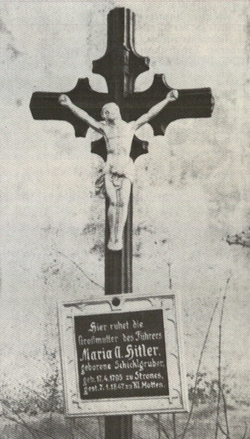
Maria Anna Schicklgruber (15 April 1795 – 7 January 1847) was the mother of Alois Hitler, (due to a clerical error the name was entered form Hiedler to Hitler) and the paternal grandmother of Adolf Hitler


                                      Maria Anna <I>Schicklgruber</I> Hitler

Relatives
Maria was born in the village of Strones in the Waldviertel region of Archduchy of Austria. She was the daughter of Theresia Pfeisinger (7 September 1769 – 11 November 1821), and farmer Johannes Schicklgruber (29 May 1764 – 12 November 1847). Maria was a Catholic; what is known about her is based on church and other public records.

Maria was one of eleven children, only six of whom survived infancy. Her early life was that of a poor peasant child in a rural forested area, in the northwest part of Lower Austria, northwest of Vienna.

In 1821, Maria's mother died when Maria was 26. She received an inheritance of 74.25 gulden, which she left invested in the Orphans' Fund until 1838. By that time it had more than doubled to 165 gulden. At that time, a breeding pig cost 4 gulden, a cow 10–12 gulden and an entire inn 500 gulden. Werner Maser wrote she was a "thrifty, reserved, and exceptionally shrewd peasant woman."

Other than saving her inheritance, which indicates she was not destitute during that period of her life, little is known about Maria's life until she was over 40.

The birth of Alois
In 1837, when she was 42 years old, considering her age this is a very late birth in her life by any standards and still unmarried, her first and only child was born. She named the boy Alois. Maser notes that she refused to reveal who the child's father was, so the priest baptized him Alois Schicklgruber and entered "illegitimate" in place of the father's name on the baptismal register. Historians have discussed three candidates for the father of Alois:

Johann Georg Hiedler, whose name was added to Alois's birth certificate later in his life and who was officially accepted as the father of Alois (i.e., as the paternal grandfather of Adolf Hitler) by the Third Reich.
Johann Nepomuk Hiedler, Georg's brother and Alois's step-uncle, who raised Alois through adolescence and later willed him a considerable portion of his life savings but who, if he was the real father of Alois, never found it expedient to admit it publicly.
And a Jew named Leopold Frankenberger, as reported by ex-Nazi Hans Frank during the Nuremberg Trials. Historians dismiss the Frankenberger hypothesis (which had only Frank's speculation to support it) as baseless as there were no Jewish families in Graz at the time she became pregnant.
At the time of his birth, she was living with a Strones village family by the name of Trummelschlager. Mr and Mrs Trummelschlager were listed as godparents to Alois.

Maria soon took up residence with her father at house number 22 in Strones. After an unknown period, the three Schicklgrubers were joined by Johann Georg Hiedler, an itinerant journeyman miller. On 10 May 1842, five years after Alois was born, Maria Anna Schicklgruber married Johann Georg Hiedler in the nearby village of Döllersheim. Maria was 47, her new husband was 50.

Whether or not Johann Georg Hiedler was actually the biological paternal grandfather of Hitler will remain unknown as he was not put as the father on Alois's birth certificate.(He never acknowledged paternally). Illegitimacy was common in lower Austria; in some areas it reached up to forty percent and as late as 1903 the figure was twenty-four percent, with the children normally legitimized at a later date. Hitler's ancestry came into question when his opponents began spreading rumors that his paternal grandfather was Jewish since one of Nazism's major principles was that to be considered a pure "Aryan" one had to have a documented ancestry certificate (Ahnenpass). Although Maria Schicklgruber worked as a charwomen in a Jewish householf and there are indications that sexual conduct took place in Jewish household with domestic female staff.

In 1931 Hitler ordered the Schutzstaffel (SS) to investigate the alleged rumors regarding his ancestry; they found no evidence of any Jewish ancestors.[5] Hitler then ordered a genealogist by the name of Rudolf Koppensteiner to publish a large illustrated genealogical tree showing his ancestry. This was published in the book Die Ahnentafel des Fuehrers ("The pedigree of the Leader") in 1937, which concluded that Hitler's family were all Austrian Germans with no Jewish ancestry and that Hitler had an unblemished "Aryan" pedigree.[6][7] As Alois himself legitimized Johann Georg Hiedler as his biological father (with three witnesses supporting and watching this), and the priest changing the father's blank space on the birth certificate in 1876 this was considered certified proof for Hitler's ancestry, thus Hitler was considered an Aryan.

Death and gravesite[edit]
Maria died during the sixth year of her marriage, at the age of 51 in Klein-Motten where she was living with her husband in the home of kin, the Sillip family. She died of "consumption resulting from pectoral (thoracic) dropsy" in 1847.[8] She was buried at the parish church in Döllersheim.

After the Anschluss of Austria in 1938, a search failed to find her grave so she was given an "honour grave" next to the church wall. This grave was tended by local Hitler Youth groups whilst Döllersheim and the surrounding areas were made proving ground areas. In 1942, this area became part of an artillery training area and the local inhabitants were moved out. Military training continued under the Soviets after 1945, and also under the Austrian Army until about 1985, by which time most of the towns and villages were in ruins. The church at Döllersheim is now preserved and undergoing reconstruction. The cemetery is being tended, but there is no grave marker there now for Maria Schicklgruber.

Relatives
In 1940 Hitler's second cousin, Aloisia Veit, was gassed at Hartheim Euthanasia Centre. Veit, a 49-year-old woman with schizophrenia, was killed as part of Action T4, the Nazi program to systematically kill people with disabilities.

This is the only known photo of the Hitler Family together. The woman 2nd to the left in the purple dress is Klara, and the man 3rd to the left in the light brown jacket is Alois. And the boy in the last row, extreme right, in the green lederhosen is Adolf.
This is the only known photo of the Hitler Family together. The woman 2nd to the left in the purple dress is Klara, and the man 3rd to the left in the light brown jacket is Alois. And the boy in the last row, extreme right, in the green lederhosen is Adolf


History  would have taken a different path if the name change had not taken place -no one would ever had yelled 'Heil Schiklbruber'!


 Hitler himself had only one testicle, his urine tract opened under his penis - or between his anus and scrotum, if so I am not certain, he had to pee like a woman. How he could receive sexual pleasures with Eva Braun is beyond me!
He also had unusually large and distorted nostrils, one reason why he would wear his toothbrush mustache - to disguise them according to his barber.

How well was Hitler's love affair with his mistress - Eva Braun - for 12 years?  Due to constant inbreeding, he had only one testicle, however, the main problem was that his urethra opened on the underside of the penis instead of at the end of it. The opening could have been between the anus and scrotum, which would mean Hitler had to pee like a woman, although this point is not clear. (sic Hks)


Hypospadias


Getty Images/Keystone


Posted by Dachau KZ at 1:57 AM No comments:
Email ThisBlogThis!Share to XShare to FacebookShare to Pinterest
Newer Posts Older Posts Home
Subscribe to: Posts (Atom)

Blog Archive

  • ▼  2018 (4)
    • ▼  January (4)
      • Dachau-KZ - SATELLITE CAMPS - Alphabetical Order S
      • THE HESS AFAIR
      • GERMANY UNDER HITLER'S INITIAL RULE
      • GERMANY BETWEEN THE WARS LEADING TO HITLERS RISE
  • ►  2017 (25)
    • ►  December (15)
    • ►  September (2)
    • ►  July (1)
    • ►  June (2)
    • ►  April (1)
    • ►  February (3)
    • ►  January (1)
  • ►  2016 (19)
    • ►  December (3)
    • ►  November (4)
    • ►  October (3)
    • ►  September (1)
    • ►  August (2)
    • ►  July (1)
    • ►  March (5)
  • ►  2015 (10)
    • ►  December (1)
    • ►  October (1)
    • ►  May (1)
    • ►  April (4)
    • ►  March (3)
  • ►  2014 (27)
    • ►  December (1)
    • ►  July (4)
    • ►  June (4)
    • ►  May (8)
    • ►  April (4)
    • ►  February (6)
  • ►  2013 (34)
    • ►  December (10)
    • ►  November (2)
    • ►  October (5)
    • ►  September (3)
    • ►  August (1)
    • ►  July (1)
    • ►  June (2)
    • ►  May (4)
    • ►  April (3)
    • ►  March (1)
    • ►  February (1)
    • ►  January (1)
  • ►  2012 (57)
    • ►  November (12)
    • ►  October (1)
    • ►  September (4)
    • ►  August (6)
    • ►  July (2)
    • ►  June (5)
    • ►  May (4)
    • ►  April (2)
    • ►  March (7)
    • ►  February (8)
    • ►  January (6)
  • ►  2011 (21)
    • ►  December (4)
    • ►  November (3)
    • ►  September (1)
    • ►  August (1)
    • ►  April (1)
    • ►  March (8)
    • ►  January (3)
  • ►  2010 (1)
    • ►  November (1)

About Me

Dachau KZ
Dachau-Ost, (now living in Auckland), Bavaria=Bayern (Manukau City), New Zealand
It is well known that Dachau is located just North of Munich, Germany. I lived in the old SS-Hospital Haus.No 52B for 10 years. I did publish my German ID but had to delete certain entries due to Identity Theft. I am now living in New Zealand since 1956 my country of adoption, still married at the age of 85 with three great grand children,have three sons and a number of relations in America, Australia, Switzerland and Germany. Otherwise of reasonable heath, although slow in my movements. My hobbies: Travelling to other countries meeting and trying to understand other cultures, supporting a school of street kids in India for the last 25 years.
View my complete profile
Simple theme. Powered by Blogger.